If you have spent more than five minutes in the SEO world, you have probably run into the classic debate: google keyword planner vs ahrefs. On one hand, you have Google’s free, first-party data powerhouse. On the other, you have Ahrefs—the premium, Swiss Army knife of SEO tools that digital marketers swear by.
Honestly, a lot of people overthink keyword research — sometimes the best insights come from just looking at the data directly. Over my eight years as an SEO specialist, I have watched people waste thousands of dollars on complex tool suites when they only needed basic search volumes, and conversely, I have seen teams fly completely blind because they refused to invest in a proper competitor analysis tool. Let's settle this debate once and for all by breaking down exactly how these tools stack up against each other.
Introduction & TL;DR
To save you some time, let's start with a high-level overview of how these two platforms compare. They are built for entirely different purposes, and understanding that distinction is the key to choosing the right one for your workflow.
Key Takeaways
• Google Keyword Planner (GKP) is a free tool designed primarily for Google Ads advertisers, meaning its search volume data is highly accurate but grouped in broad buckets unless you run active ad campaigns.
• Ahrefs is a paid, comprehensive SEO suite that offers granular organic search data, keyword difficulty estimates, backlink analysis, and competitor tracking.
• GKP is excellent for finding raw search volume and commercial intent, but it lacks critical organic SEO metrics like click-through rate (CTR) estimates and competitor SERP history.
• Ahrefs shines in competitor analysis, allowing you to plug in any URL and instantly see every keyword they rank for, along with their entire backlink profile.
• A hybrid approach—using GKP for initial volume validation and Ahrefs for competitive intelligence—is often the most metrics-driven strategy for growing organic traffic.
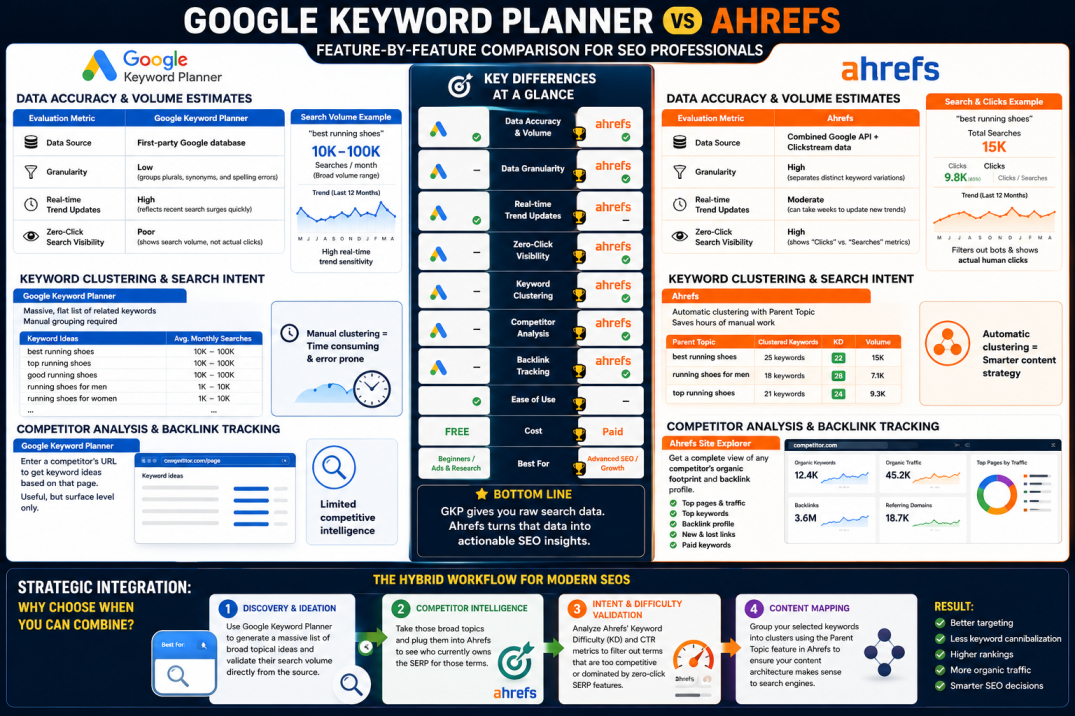
TL;DR Comparison Table
Feature | Google Keyword Planner | Ahrefs |
|---|---|---|
Primary Focus | Paid Search (PPC) | Organic Search (SEO) |
Cost | Free (requires Google Ads account) | Paid (starts at $99+/month) |
Search Volume Source | Direct from Google (grouped/estimated) | Clickstream data + Google API |
Keyword Difficulty | Competition metric is for paid ads only | Proprietary KD scale (0-100) |
Competitor Analysis | Basic (by landing page) | Advanced (full organic keyword profiles) |
Backlink Data | None | Industry-leading backlink index |
Search Intent Insights | Low (shows bid ranges) | High (analyzes SERP features) |
Table of Contents
Google Keyword Planner: The Search Engine's Direct Line
Ahrefs: The Powerhouse for Organic Search
Feature-by-Feature Comparison
Strategic Integration: Why Choose When You Can Combine?
Frequently Asked Questions (FAQ)
Sources and Methodology
Google Keyword Planner:
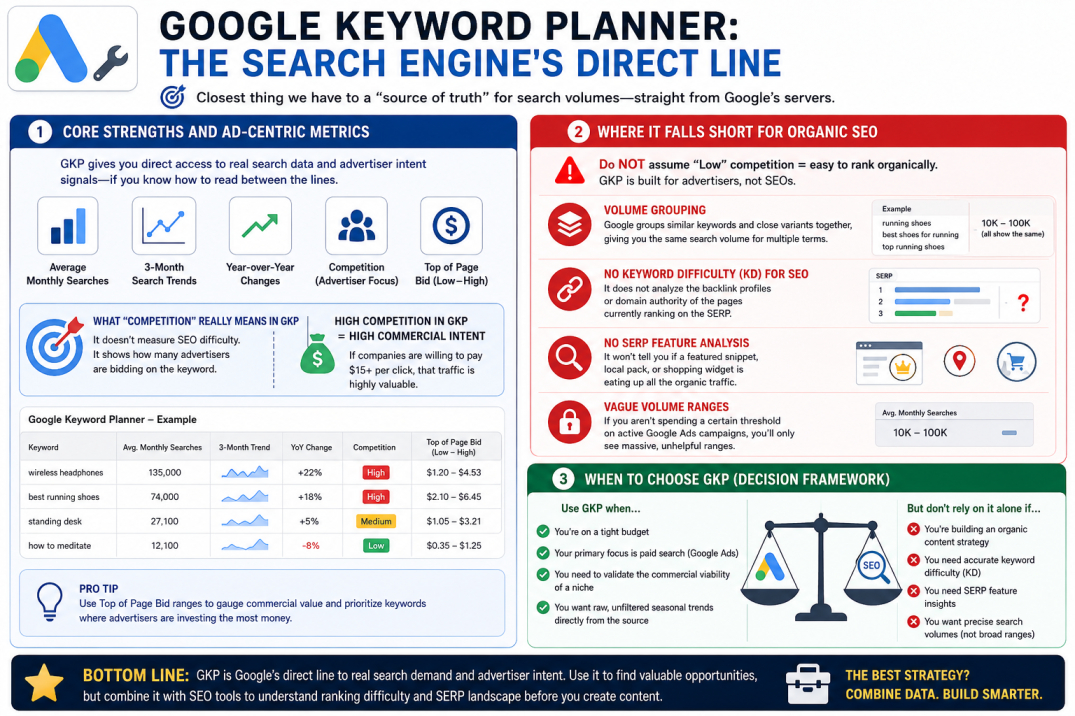
So, here's the thing about Google Keyword Planner—it is the closest thing we have to a "source of truth" for search volumes. Because the data comes straight from Google's servers, it represents actual user queries. However, because it is built to help advertisers spend money on Google Ads, the interface and metrics are heavily skewed toward paid search campaigns rather than organic search performance.
Core Strengths and Ad-Centric Metrics
Google Keyword Planner is incredibly powerful if you know how to read between the lines. It gives you direct access to average monthly searches, three-month search trends, year-over-year changes, and competition levels.
But remember, the "Competition" column in GKP does not refer to organic SEO difficulty. It indicates how many advertisers are bidding on that specific keyword. If a keyword has "High" competition in GKP, it means companies are actively fighting over it with paid ads. This is a massive signal of commercial intent. If people are willing to pay $15 per click for a term, you can bet that traffic is highly valuable. GKP also provides "Top of page bid" ranges, which show you exactly what advertisers are willing to pay to secure the top spot.
Where It Falls Short for Organic SEO
Before we look at the solutions, let's talk about what NOT to do with GKP. Do not assume that a "Low" competition score in GKP means you can easily rank your new blog post on page one of the organic results. That is a classic rookie mistake.
Because GKP is built for advertisers, it has several major limitations for organic search:
• Volume Grouping: Google frequently groups similar keywords and close variants together, giving you the same search volume for multiple distinct search terms.
• No Keyword Difficulty (KD) for SEO: It does not analyze the backlink profiles or domain authority of the pages currently ranking on the SERP.
• No SERP Feature Analysis: It won’t tell you if a featured snippet, local pack, or shopping widget is eating up all the organic traffic.
• Vague Volume Ranges: If you aren't spending a certain threshold of money on active Google Ads campaigns, Google will restrict your view to massive, unhelpful ranges like "10K–100K" monthly searches.
When to Choose GKP (Decision Framework)
You should choose Google Keyword Planner if you are operating on a tight budget or if your primary focus is launching paid search campaigns. It is also one of the best tools for conducting keyword research when you need to validate the commercial viability of a niche.
If you are looking for raw, unmanipulated seasonal trends directly from the source, GKP is your best bet. However, if you are trying to build an organic content strategy from scratch, relying solely on GKP will feel like trying to build a house with only a hammer.
Ahrefs: The Powerhouse for Organic Search
If Google Keyword Planner is a scalpel designed for advertisers, Ahrefs is a fully automated construction crew designed for SEO professionals. It is a metrics-driven platform built from the ground up to help you understand why your competitors are ranking and how you can leapfrog them in the SERP.
Deep-Dive Keyword Metrics and SERP Analysis
I find that Ahrefs is great for deep dives into backlink profiles, but for straightforward keyword planning, Google Keyword Planner is often overlooked. However, where Ahrefs absolutely crushes GKP is in its organic analysis capabilities.
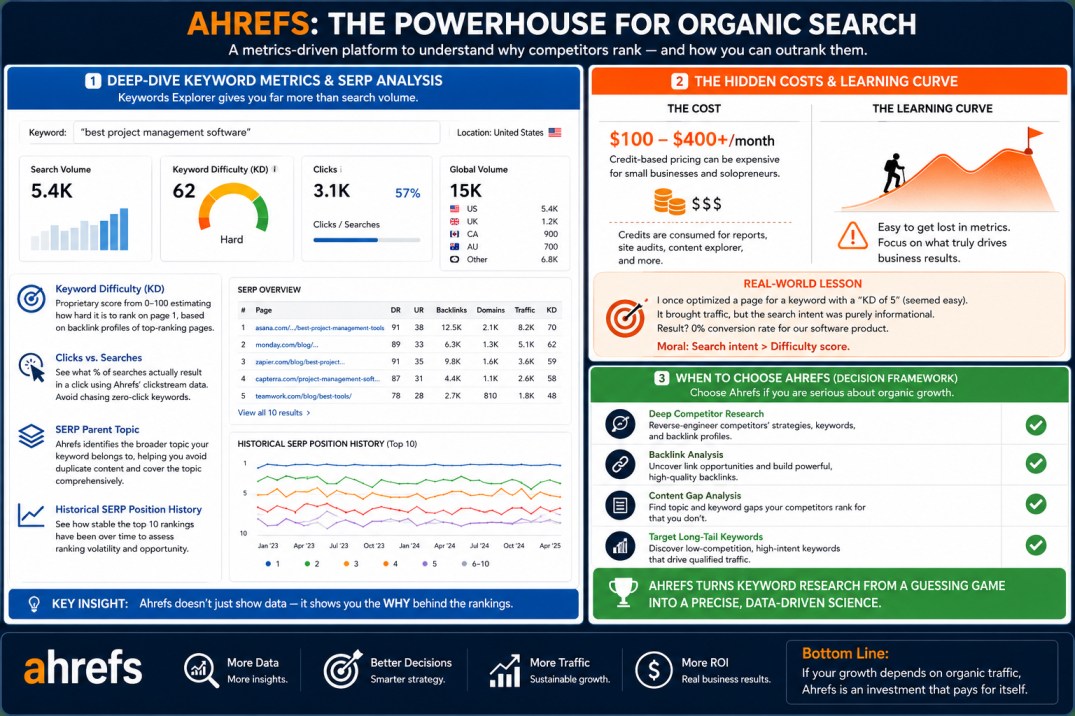
When you plug a keyword into Ahrefs’ Keywords Explorer, you don’t just get a search volume estimate. You get:
• Keyword Difficulty (KD): A proprietary score from 0 to 100 that estimates how hard it will be to rank on the first page, based primarily on the backlink profiles of the top-ranking pages.
• Clicks vs. Searches: Ahrefs uses clickstream data to show you what percentage of searches actually result in a click. This is crucial because many modern SERPs answer the user's question directly, resulting in zero-click searches.
• SERP Parent Topic: It automatically identifies if your target keyword is part of a larger, high-volume topic, helping you avoid creating duplicate content.
• Historical SERP Position History: You can see how stable the top 10 rankings have been over time, which helps you identify if Google prefers established authorities or if there is room for new players.
The Hidden Costs and Learning Curve
Let’s be honest: Ahrefs is not cheap. Over the years, they have shifted their pricing structure to a credit-based system, which has drawn some criticism from the SEO community. If you are a small business owner just starting out, spending upwards of $100 to $400 a month on an SEO tool might not make financial sense.
Furthermore, the learning curve can be steep. Many folks get hung up on fancy metrics—remember, at the end of the day, it's about creating content that resonates with your audience. I once made the blunder of spending weeks optimizing a page for a keyword with a "KD of 5" (which seemed incredibly easy), only to realize that the search intent was completely informational, and the traffic had a 0% conversion rate for our software product. I got the traffic, but I generated zero revenue. It was a humbling lesson in why search intent matters far more than a difficulty score.
When to Choose Ahrefs (Decision Framework)
You should choose Ahrefs if you are serious about organic traffic and need to conduct deep competitor research. If your growth strategy relies on reverse-engineering your competitors’ backlink profiles, finding content gaps, and targeting long-tail keywords with low organic competition, Ahrefs is worth every single penny. It transforms keyword research from a guessing game into a precise, data-driven science.
Feature-by-Feature Comparison
Let's break down how these two giants perform when pitted head-to-head in the daily tasks of an SEO specialist.
Data Accuracy and Volume Estimates
This is a highly debated topic. Google Keyword Planner uses actual search query data from Google, but it groups keywords together. Ahrefs uses a mix of Google data and massive clickstream data from third-party sources to estimate search volume.
Evaluation Metric | Google Keyword Planner | Ahrefs |
|---|---|---|
Data Source | First-party Google database | Combined Google API + Clickstream data |
Granularity | Low (groups plurals, synonyms, and spelling errors) | High (separates distinct keyword variations) |
Real-time Trend Updates | High (reflects recent search surges quickly) | Moderate (can take weeks to update new trends) |
Zero-Click Search Visibility | Poor (shows search volume, not actual clicks) | High (shows "Clicks" vs. "Searches" metrics) |
Because of these differences, you will often find that Ahrefs shows a lower search volume than GKP for the same keyword. This is because Ahrefs is attempting to filter out bot traffic and show you the actual human clicks you can expect to receive.
Keyword Clustering and Search Intent
Understanding how keywords group together is essential for modern SEO. If you write a separate blog post for "best running shoes," "top running shoes," and "good running shoes," you will end up cannibalizing your own rankings.
This is where keyword clustering and its importance comes into play. Ahrefs makes this incredibly simple by showing you the "Parent Topic" and grouping keywords that share similar search results. Google Keyword Planner, on the other hand, will simply present you with a massive, flat list of related keywords. It is up to you to manually sort, filter, and cluster them—a process that can take hours of tedious spreadsheet work.
Competitor Analysis and Backlink Tracking
In the organic search arena, you do not rank in a vacuum. You rank against your competitors.
• Google Keyword Planner: You can paste a competitor’s URL into GKP, and it will suggest keywords based on the content of that page. It is a neat feature, but it only scratches the surface.
• Ahrefs: With Ahrefs' Site Explorer, you can plug in any domain and see their entire organic footprint. You can view their top-performing pages, the exact keywords driving their traffic, and every single website linking back to them. This level of competitive intelligence is completely absent from GKP.
Strategic Integration: Why Choose When You Can Combine?
So, here's the thing: you don't actually have to choose one over the other. In fact, most elite digital marketers use both tools in tandem to build highly efficient SEO workflows.
The Hybrid Workflow for Modern SEOs
A highly effective, metrics-driven workflow looks like this:
Discovery & Ideation: Use Google Keyword Planner to generate a massive list of broad topical ideas and validate their search volume directly from the source.
Competitor Intelligence: Take those broad topics and plug them into Ahrefs to see who currently owns the SERP for those terms.
Intent & Difficulty Validation: Analyze Ahrefs' Keyword Difficulty (KD) and CTR metrics to filter out terms that are too competitive or dominated by zero-click SERP features.
Content Mapping: Group your selected keywords into clusters using the Parent Topic feature in Ahrefs to ensure your content architecture makes sense to search engines.
Transitioning to AI-Driven Automation
As search engines evolve, the manual effort required to analyze these tools is becoming a bottleneck. This is why use AI for keyword research has become the next logical step for scaling businesses.
Instead of spending hours jumping between Google Keyword Planner and Ahrefs, modern platforms are beginning to automate the extraction, clustering, and content generation phases. By automating these technical steps, you can focus on what truly matters: creating authoritative, engaging content that satisfies search intent.