Okay, let's break this down. In my eight years working as a digital marketing strategist, I have sat in countless kickoff meetings where a client drops a massive spreadsheet of search terms on my desk and says, "Here is our SEO."
I always have to take a deep breath. Many people conflate SEO with keyword research, but they are distinct processes that serve different purposes. If you treat a list of search terms as your entire strategy, you are building a house without a blueprint, plumbing, or electricity.
In 2026, search algorithms are smarter than ever. Effective SEO is more about user experience than just cramming in keywords — content quality matters. So, what is the difference between SEO and keyword research? Let's dive deep into how these two critical concepts interact, where they diverge, and how you can stop confusing the map for the actual journey.
TL;DR Summary
• Keyword Research is the specific, foundational task of discovering what terms your audience types into search engines, analyzing search volume, and assessing competition.
• SEO (Search Engine Optimization) is the comprehensive, holistic practice of optimizing your entire website—technically, structurally, and content-wise—to rank higher in SERPs.
• Keyword research is just one step within the broader SEO ecosystem.
Table of Contents
The Core Confusion: What is the Difference Between SEO and Keyword Research?
The Anatomy of Keyword Research Versus Broad SEO Execution
Real-World Scenarios: When Strategy Fails Without Execution
Building a Cohesive Optimization Workflow
Frequently Asked Questions (FAQ)
Conclusion and Final Thoughts
The Core Confusion: What is the Difference Between SEO and Keyword Research?
Here's the thing... people often use these terms interchangeably because keyword research is usually the very first step of an SEO campaign. But equating the two is like saying buying groceries is the same as cooking a five-course meal.
Defining Keyword Research (The Foundation)
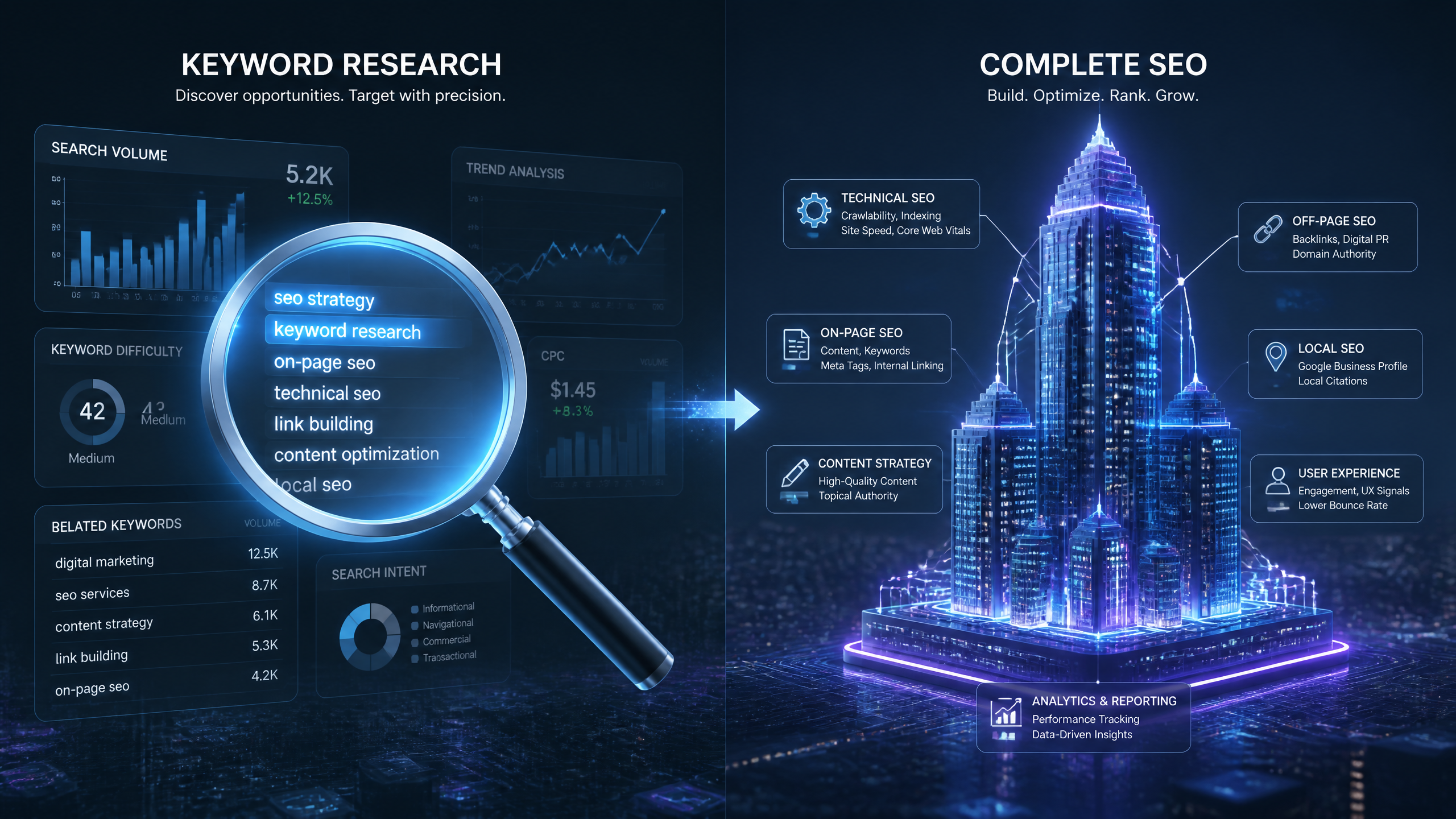
Keyword research is an investigative process. It is the act of using data to understand the exact language your target audience uses when looking for solutions. When we conduct keyword research, we are looking at specific metrics: search volume, keyword difficulty, and search intent.
We are identifying the raw materials. For instance, finding long-tail keywords that have low competition but high commercial intent is a classic research output.
Defining SEO (The Entire Skyscraper)
SEO encompasses everything you do to make your website favorable to search engines and users. It takes the insights gathered from your research and applies them across multiple disciplines. This includes on-page SEO (optimizing the actual content), technical SEO (ensuring the site loads fast and is crawlable), and off-page SEO (building authority through backlinking).
Why the Conflation Happens
The confusion largely stems from outdated practices. A decade ago, simply finding a keyword and repeating it on a page was often enough to rank. Today, that approach is a quick ticket to obscurity. To make the distinction crystal clear, let's look at a direct comparison.
Feature/Aspect | Keyword Research | Search Engine Optimization (SEO) |
|---|---|---|
Primary Goal | Identify high-value search terms and topics. | Improve overall site visibility, traffic, and conversions. |
Core Metrics | Search volume, keyword difficulty, CPC. | Organic traffic, SERP rankings, bounce rate, ROI. |
Scope | Narrow and specific (data gathering). | Broad and holistic (execution and technical health). |
Tools Used | Google Keyword Planner, Ahrefs, Moz Keyword Explorer. | Google Search Console, Nuwtonic, crawling software. |
Frequency | Periodic (quarterly or per campaign). | Continuous and ongoing. |
The Anatomy of Keyword Research Versus Broad SEO Execution
To fully grasp the difference, we need to look at the mechanics of each practice.
Metrics That Matter in Keyword Research
During the research phase, you are living in spreadsheets. You are looking at keyword density potential, content gap analysis opportunities, and competitive analysis metrics. You are asking questions like, "Does this term have enough search volume to justify writing a 2,000-word guide?"
If you want to speed up this data-gathering phase, understanding why use AI for keyword research can be incredibly beneficial. AI tools can parse massive datasets to find semantic clusters that human researchers might miss.
The Transition from Research to On-Page Optimization
Once you have your keywords, the actual SEO work begins. This is where you map those terms to specific pages. It involves writing compelling meta titles, structuring H2 and H3 tags, and ensuring the content actually answers the user's query.
"A keyword tells you what the user wants. On-page SEO is the art of delivering it perfectly."
Where Technical and Off-Page SEO Fit In
This is where the divergence between research and SEO becomes massive. You can have the best keyword list in the world, but if your site takes ten seconds to load, Google will not rank you. Understanding the nuances of on-page SEO vs technical SEO is crucial here. Technical SEO ensures search engine bots can actually read and index the brilliant, keyword-optimized content you just created.

Real-World Scenarios: When Strategy Fails Without Execution
I've seen clients focus too much on keyword stuffing instead of understanding user intent, which ultimately backfires. Let's look at a few scenarios I frequently observe in the field.
Scenario 1: The "All Keywords, No Context" Trap
Early in my career—and this is an embarrassing flub to admit—I ranked a client's page for a massive, high-volume keyword. We hit position #2 on the SERPs. The problem? The keyword was informational, but we drove that traffic to a hard-sell product page. The bounce rate was 95%, and conversions were zero. We had done the research, but we failed at the SEO execution because we ignored search intent.
Scenario 2: The Technical Roadblock
Consider a mid-sized e-commerce brand that invested heavily in finding long-tail keywords for their product categories. They wrote beautiful descriptions. However, their site architecture was a mess, and Google Search Console reported hundreds of 404 errors and broken canonical tags. Their keyword research was flawless; their technical SEO was non-existent. Traffic remained stagnant until the technical foundation was fixed.
Scenario 3: Missing the Search Intent Mark
A common pattern looks like this: A business owner finds a keyword with 10,000 monthly searches and writes a 500-word blog post. But when you actually look at the SERPs for that keyword, Google is ranking interactive tools and video tutorials. The research was accurate, but the SEO strategy failed to match the format Google deemed necessary for that specific query.
Building a Cohesive Optimization Workflow
You definitely don’t want to do this: pull a list of keywords and immediately start writing without a plan. You need a structured workflow.
Step 1: Gathering the Data (Research Phase)
Begin by identifying your core topics. Use your tools to find a mix of high-volume head terms and low-competition long-tail keywords. Group these into semantic clusters.
Step 2: Mapping Keywords to Content Architecture
Once you have your clusters, you need to decide where they live on your site. Will this keyword be a blog post? A pillar page? A product category? If you are unsure of your next moves, learning exactly what to do after keyword research is the bridge between your spreadsheet and your live website.
Step 3: Executing the Holistic SEO Strategy
Now, you execute the full SEO playbook:
Content Creation: Write high-quality, authoritative content that satisfies user intent.
Technical Auditing: Ensure the page is mobile-friendly, fast, and properly indexed via Google Search Console.
Authority Building: Begin backlinking outreach to signal to Google that your new, keyword-optimized page is trustworthy.
Frequently Asked Questions (FAQ)
Can I do SEO without keyword research?
Technically, yes, but it is like driving blindfolded. You might accidentally create great content that ranks, but without research, you have no idea if anyone is actually searching for the topics you are writing about. Research provides the directional data necessary for efficient SEO.
How often should I update my keyword strategy?
• Quarterly: Review your core keyword rankings and adjust on-page elements.
• Annually: Conduct a full content gap analysis to find new market opportunities.
• Ongoing: Monitor Google Search Console weekly for new queries your site is naturally picking up.
Are keyword metrics the same as SEO ROI?
Absolutely not. Search volume and keyword difficulty are predictive metrics. SEO ROI is measured by actual organic traffic, lead generation, and revenue. High search volume means nothing if it does not convert into business value.
Conclusion and Final Thoughts
Summary of the Distinction
To summarize what is the difference between SEO and keyword research: Keyword research is the compass; SEO is the vehicle. Research tells you where your audience is and what language they speak. SEO is the complex, multi-disciplinary engine—content, technical health, and authority—that actually gets you in front of them.
Next Steps for Your Strategy
If you have been treating your keyword list as your entire search strategy, it is time to pivot. Start looking at your site holistically. Audit your technical health, evaluate your backlinking profile, and ensure your content genuinely helps the user.