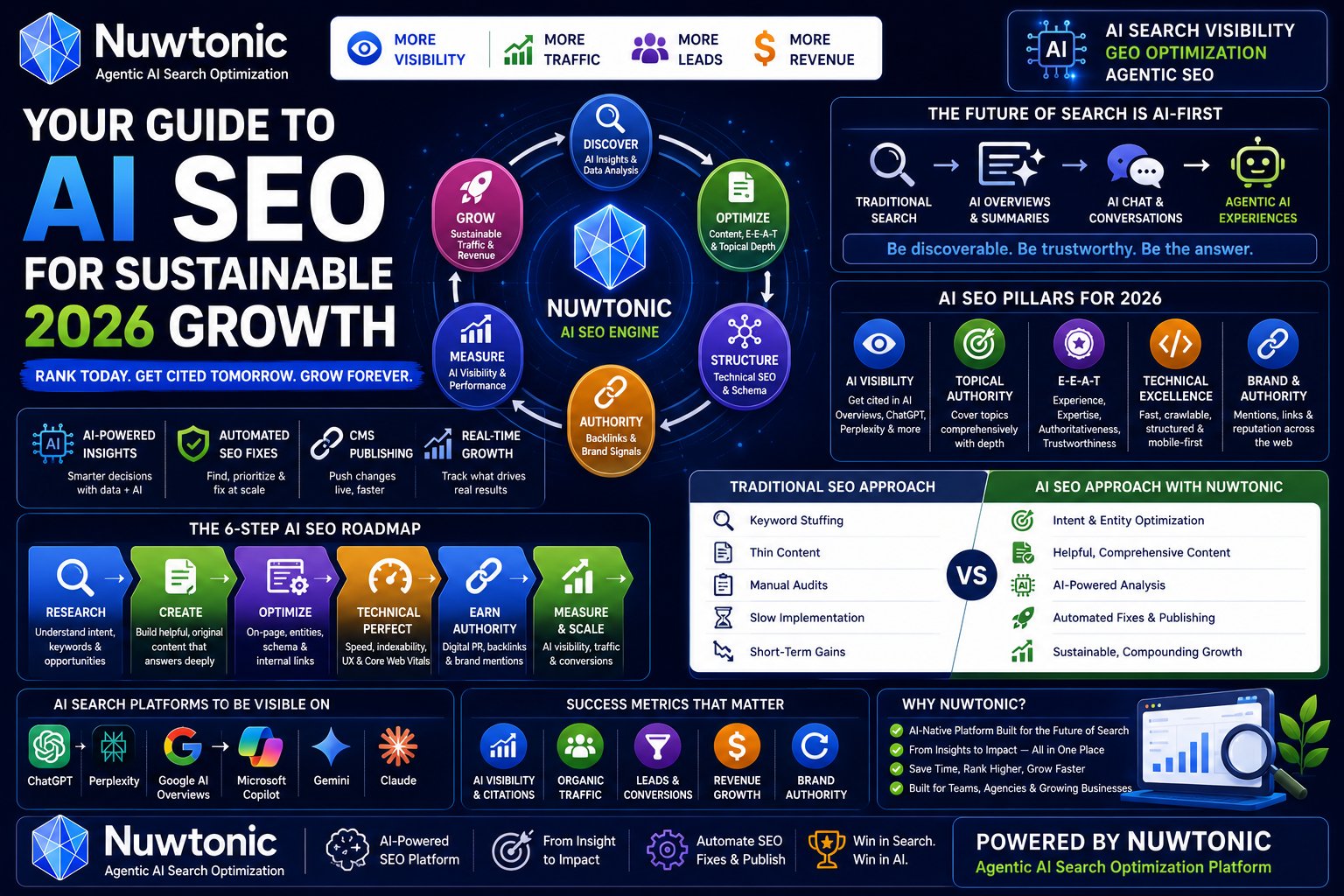
AI SEO isn't a replacement for your current strategy. It's the next evolution.
Think of it this way: traditional SEO is like organizing your book perfectly for a library's card catalog. It's all about making sure you can be found on the right shelf. AI SEO, on the other hand, is about writing the book so the librarian can directly quote it to answer someone's question on the spot.
Table of Contents
AI Search Optimization for ChatGPT, Gemini, Perplexity & AI Overviews
AI SEO Automation: Internal Linking, Schema, Metadata & On-Page Fixes
AI SEO Metrics: Rankings, AI Visibility, Citation Rate & Prompt Coverage
Future of AI SEO: Agentic SEO, Autonomous Optimization & AI Search Trends
What is AI SEO? (Definition, Evolution & How It Works)
AI SEO is the practice of optimizing your website and content so that artificial intelligence systems—like Google’s AI Overviews, ChatGPT, and Perplexity—can find, understand, and cite your information. It builds on the foundations of traditional SEO but adds a laser focus on machine readability, structured data, and provable topical authority.
The goal is no longer just to rank on a list of blue links. The new goal is to become a trusted, canonical source that AI models use to generate direct answers for users. This represents a fundamental shift in focus from mere visibility to direct citation.
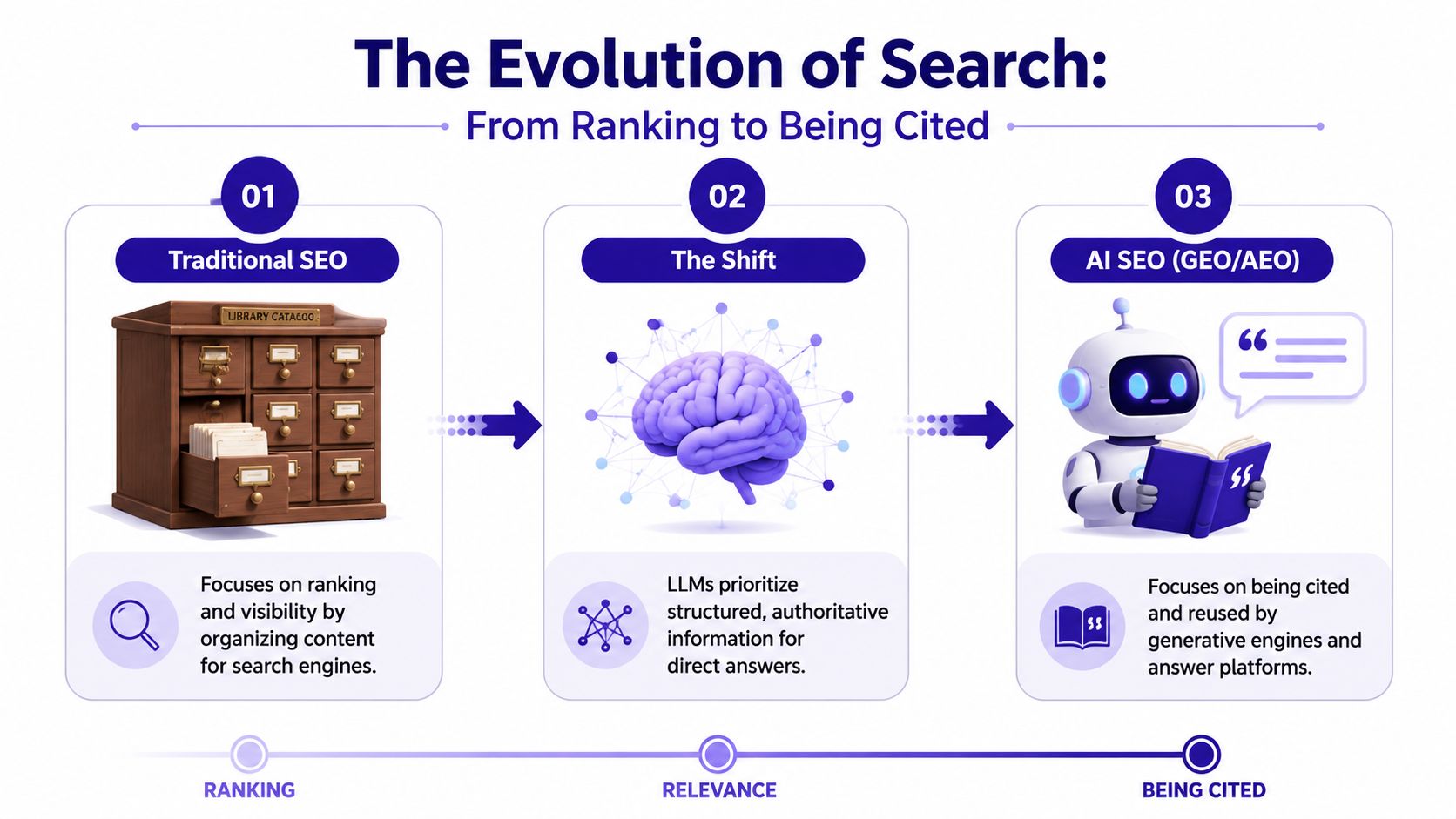
The fundamental difference is this: Traditional SEO gets you on the shelf. AI SEO gets you quoted by the librarian. One focuses on being found; the other focuses on being used.
AI SEO vs Traditional SEO vs GEO vs AEO
This evolution has given rise to several critical disciplines that every marketer needs to understand:
Traditional SEO: The foundation. Focuses on keyword optimization and backlink building to achieve high rankings in SERPs and drive clicks from a list of results.
Generative Engine Optimization (GEO): The broader practice of making your brand, products, and expertise visible and citable across all generative AI platforms. The core idea is to structure your information so that any Large Language Model (LLM) can easily consume and reuse it to answer questions.
Answer Engine Optimization (AEO): A focused subset of GEO. AEO is about optimizing specific pieces of content to provide direct, concise answers to very specific queries. This is absolutely crucial for voice search and AI assistants that deliver a single, definitive response.
AI SEO: The umbrella term encompassing GEO and AEO. Its goal is to become a cited source in AI-generated answers by using tactics like entity optimization and structured data. Success is measured by citation rate and visibility in AI answers.
The strategic implication is clear: brands that are easier for machines to trust and reuse are becoming more visible than brands that simply publish more content. New research from SE Ranking shows that websites with over 190,000 monthly visitors were twice as likely to be cited by ChatGPT. Freshness also plays a key role. AI systems need reliable, current sources to synthesize their answers, and they heavily favor authoritative sites that provide them. You can learn more about how authority and freshness impact AI citations in the full study.
AI-Powered Keyword Research & Search Intent Analysis
AI SEO reframes keyword research. It’s no longer enough to find high-volume, low-competition keywords. You must now also identify the prompts and questions users are asking AI systems and map them to your content.
This involves a shift from keyword strings to user intent clusters.
Traditional Keyword Research: Focuses on search volume, keyword difficulty, and SERP features. The goal is to match a single page to a primary keyword.
AI-Powered Intent Analysis: Focuses on understanding the underlying questions, problems, and desired outcomes behind a search. The goal is to create content that comprehensively covers a topic and can answer dozens of related AI prompts.
A practical workflow involves:
Primary Keyword Selection: Identify the core topic.
Supporting Keyword Clusters: Find related sub-topics and long-tail questions.
User Intent Segmentation: Group keywords by informational, commercial, navigational, and transactional intent.
AI Prompt Opportunity Mapping: Analyze how real users query AI assistants about your topic and identify gaps where your content could provide the definitive answer.
By mapping intent to AI prompts, you move beyond simple keyword matching and begin creating assets that are genuinely useful to both humans and machines.
AI Content Creation, Optimization & Information Gain
In the age of AI, the value of your content is measured by Information Gain: providing unique data, original insights, or a novel perspective that doesn't exist elsewhere on the web. AI-generated content has made it easy to produce fluff; your competitive advantage is creating content that is impossible to commoditize.
Optimizing for information gain involves:
Original Research: Conducting surveys, studies, or data analysis to produce unique statistics.
Expert Commentary: Including quotes and insights from recognized authorities in your field.
Proprietary Data: Sharing unique data from your business or platform (e.g., "Our data shows...").
Case Studies & Real-World Examples: Demonstrating proven experience and results.
A B2B SaaS company used Nuwtonic's AI Search Agent to analyze why competitors were consistently cited in ChatGPT and Perplexity. The agent found that winning content consistently featured original statistics and strong expert attribution. The team then expanded their core pages with citation-focused content blocks—including expert commentary and answer-ready sections—and began appearing in tracked AI prompts where they previously had zero visibility. This demonstrates that for AI models, content that provides net-new value is a powerful citation signal.
AI SEO Audits: Technical, Content, Entity & EEAT Analysis
Traditional SEO audits are great at spotting technical glitches and keyword gaps, but they often miss the deeper issues that prevent AI citation. An AI SEO audit goes further, analyzing your site for machine readability and "citation readiness."
One of the most valuable discoveries came from Nuwtonic's AI Citation & Entity Coverage Audit. The client had strong traditional rankings but was invisible in ChatGPT, Gemini, and AI Overviews. The AI audit revealed the issue wasn't rankings—it was citation eligibility.
The audit found several critical gaps that traditional tools miss:
Missing entity relationships between products, services, and brand mentions.
Weak EEAT signals across key commercial pages.
No original data, research, or unique information gain assets.
Poor answer extraction formatting for LLM consumption.
Missing supporting topical content connecting commercial pages to broader industry expertise.
After implementing the recommendations, the client began appearing in AI-generated responses for high-intent prompts, proving that AI visibility and traditional rankings are increasingly separate optimization disciplines.
AI Search Optimization for ChatGPT, Gemini, Perplexity & AI Overviews
Optimizing for AI platforms requires a shift from chasing rankings to building citable assets. Your content must be so clear, trustworthy, and well-structured that models like ChatGPT, Gemini, Perplexity, and Google's AI Overviews can instantly understand it and feel confident citing you.
This is about machine readability and proving your expertise. Some sites are already seeing over 1% of total sessions from AI platforms. And with AI-generated content showing up in over 17% of top search results, it’s clear that machines are actively reshaping what users see. You can explore the latest data yourself in Semrush's recent AI SEO statistics report.
To optimize for AI consumption:
Structure for "Answer-Readiness": Use clear headings (H2, H3), bulleted lists, and numbered lists to break down complex information into digestible chunks.
Provide Direct Answers: Start sections with a concise answer to a likely question before elaborating.
Demonstrate E-E-A-T: Clearly attribute authors, cite sources, and showcase real-world experience.
Use Schema Markup: Explicitly define your content type (e.g., Article, FAQ, HowTo) for machines.
A great first step is to go through your most important pages and ask: "Is this 'answer-ready'?" We've put together a full tactical guide on how to rank in Google AI Overviews that walks you through the process.
Entity SEO, Knowledge Graphs & AI Citation Optimization
Think of Entity SEO as building a digital resume for your brand that machines can read and verify. The goal is to establish concrete links between who you are, what you do, and the topics you're an authority on. This process directly feeds Google's Knowledge Graph, which is the foundational "brain" AI models consult to verify facts.
When an AI model is confident about your entity, it's far more likely to cite you. This is the core of Generative Engine Optimization (GEO).
Key tactics for building your entity include:
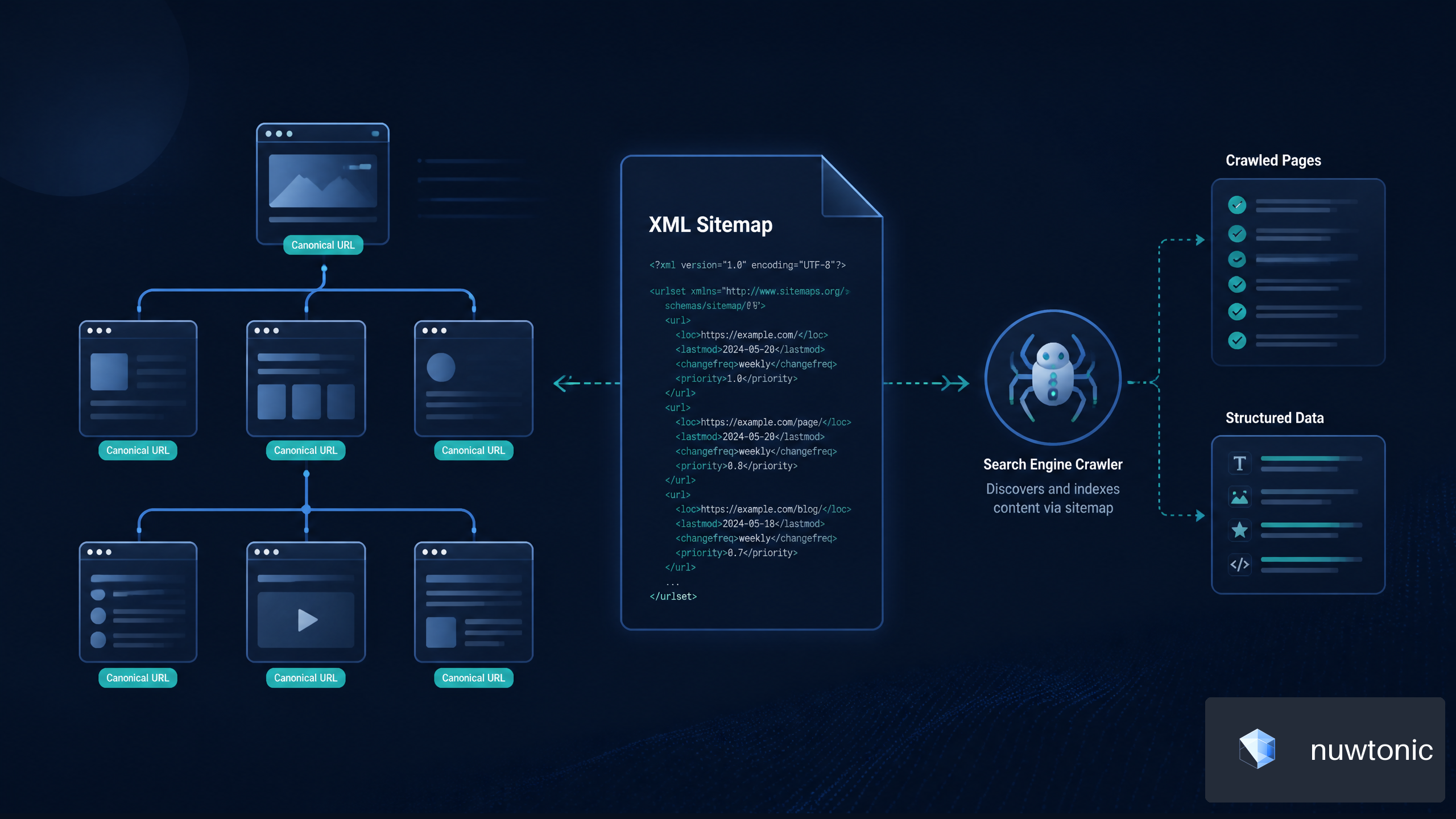
Structured Data: Use schema markup to explicitly define your organization, products, services, and authors.
Strategic Internal Linking: Connect your commercial pages to your best informational content to create a dense web of topical authority.
Consistent Mentions: Ensure your brand name, address, and phone number (NAP) are identical everywhere online.
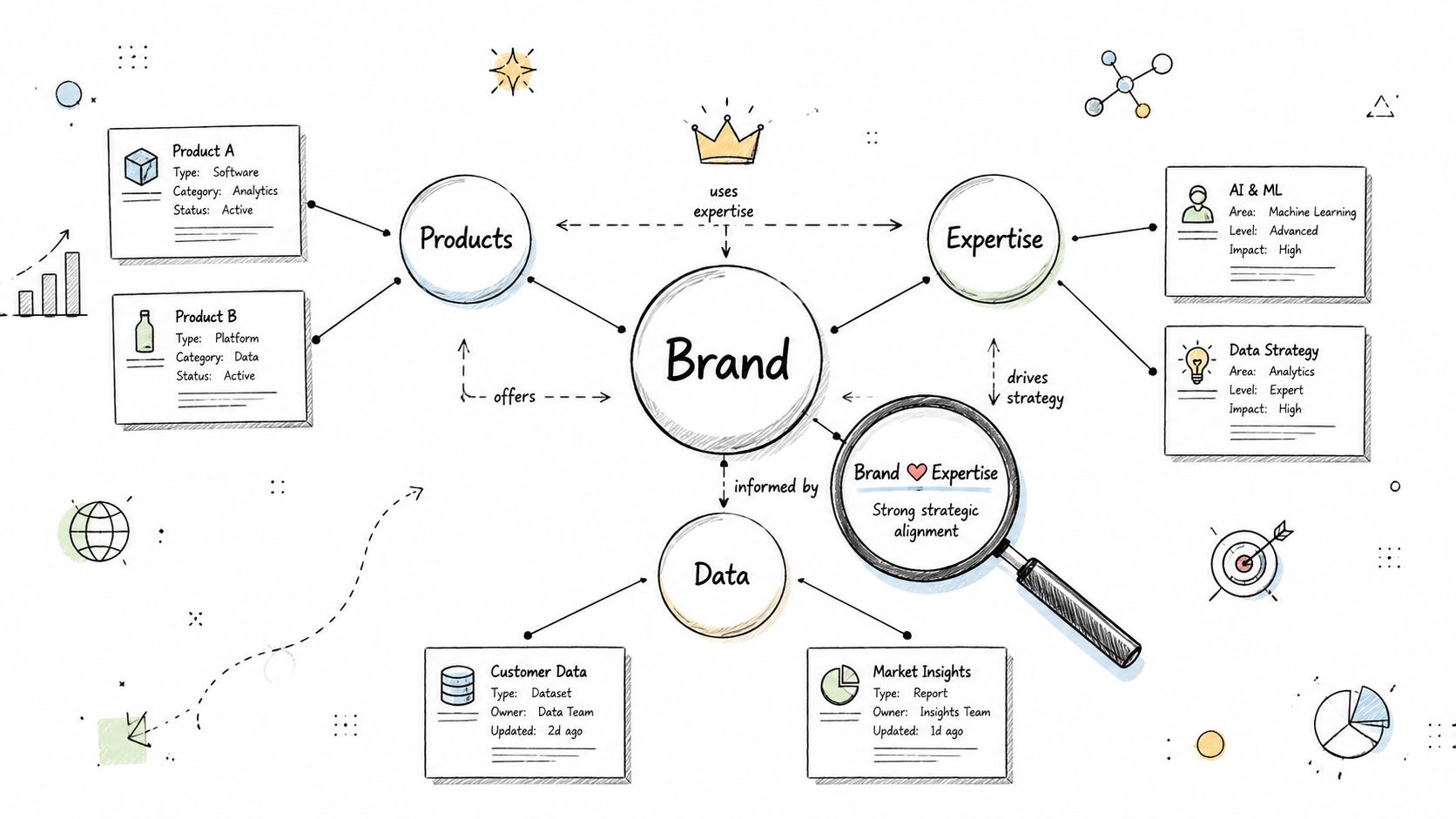
By analyzing competitor citation patterns, you can reverse-engineer a successful GEO strategy. This proves a crucial point: AI visibility often hinges on creating specific content assets that AI models value. To learn more about how to strengthen these signals, you can explore our guide on using the AI search knowledge graph.
AI SEO Automation: Internal Linking, Schema, Metadata & On-Page Fixes
The real power of AI SEO is unlocked when it moves from simply identifying problems to actively fixing them through automated workflows. This frees up your team to focus on high-impact strategy instead of tedious tasks.
For years, updating metadata, schema, and on-page elements was a slow, manual process. With platforms like Nuwtonic, this entire workflow becomes a connected, automated loop.
Before Nuwtonic, updating metadata and schema was a manual process consuming dozens of hours each month. By automating metadata generation, schema recommendations, and optimization deployment, teams were able to reduce manual optimization effort by more than 70%, while simultaneously increasing the number of pages optimized each month.
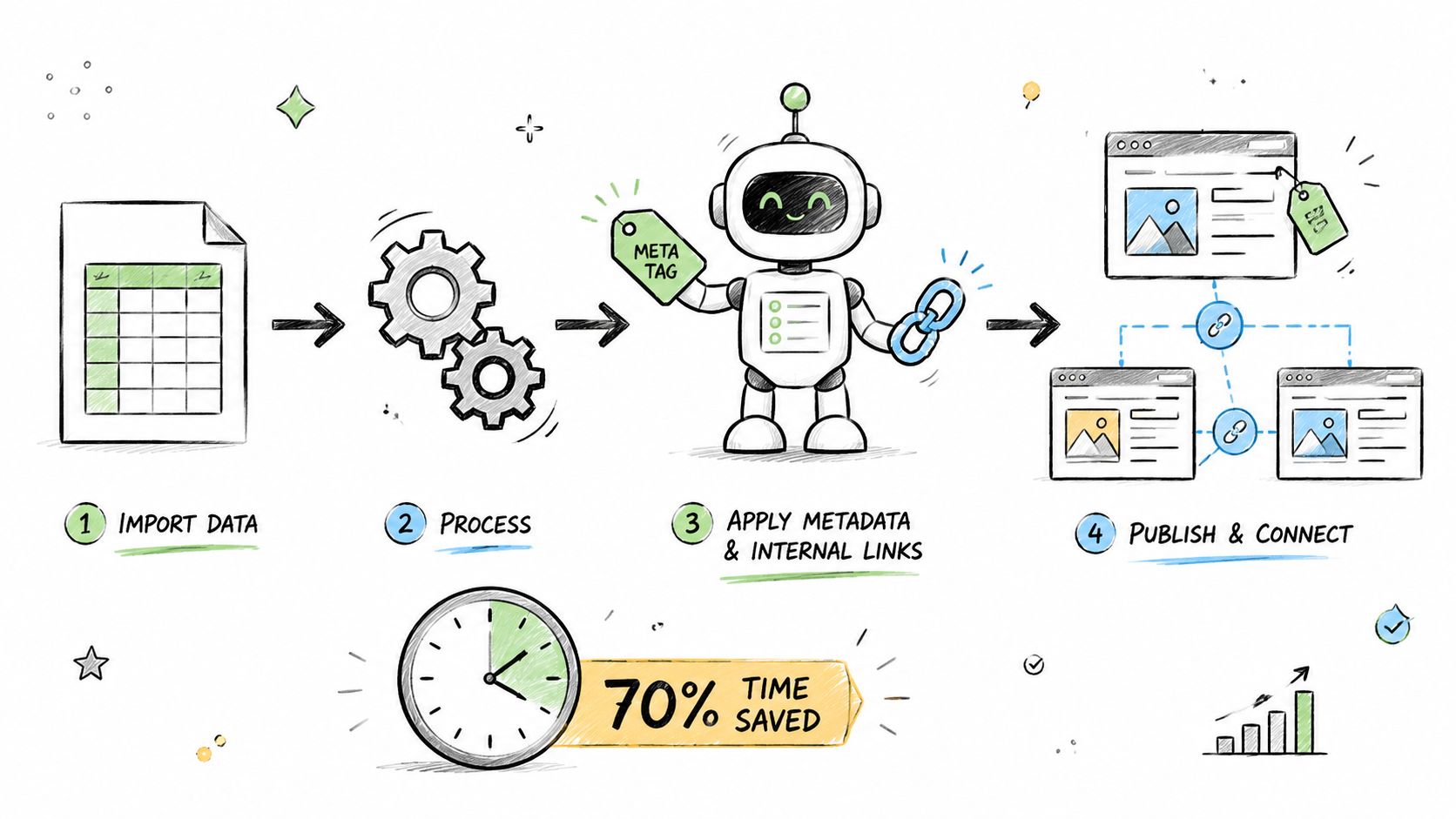
The biggest benefit is agility. Automation allows teams to continuously optimize pages based on new Search Console signals, AI visibility opportunities, and competitor movements rather than relying on periodic manual audits. This turns SEO from a reactive task into a proactive growth engine.
AI SEO Metrics: Rankings, AI Visibility, Citation Rate & Prompt Coverage
If you're still judging your SEO success by keyword rankings and organic traffic alone, you're looking in the rearview mirror. You need new KPIs that measure your brand's presence in AI-generated responses.
Here are the AI SEO metrics that matter now:
AI Visibility: Measures your brand's presence across tracked prompts on platforms like ChatGPT, Gemini, and in AI Overviews. It answers: "Are we even part of the conversation?"
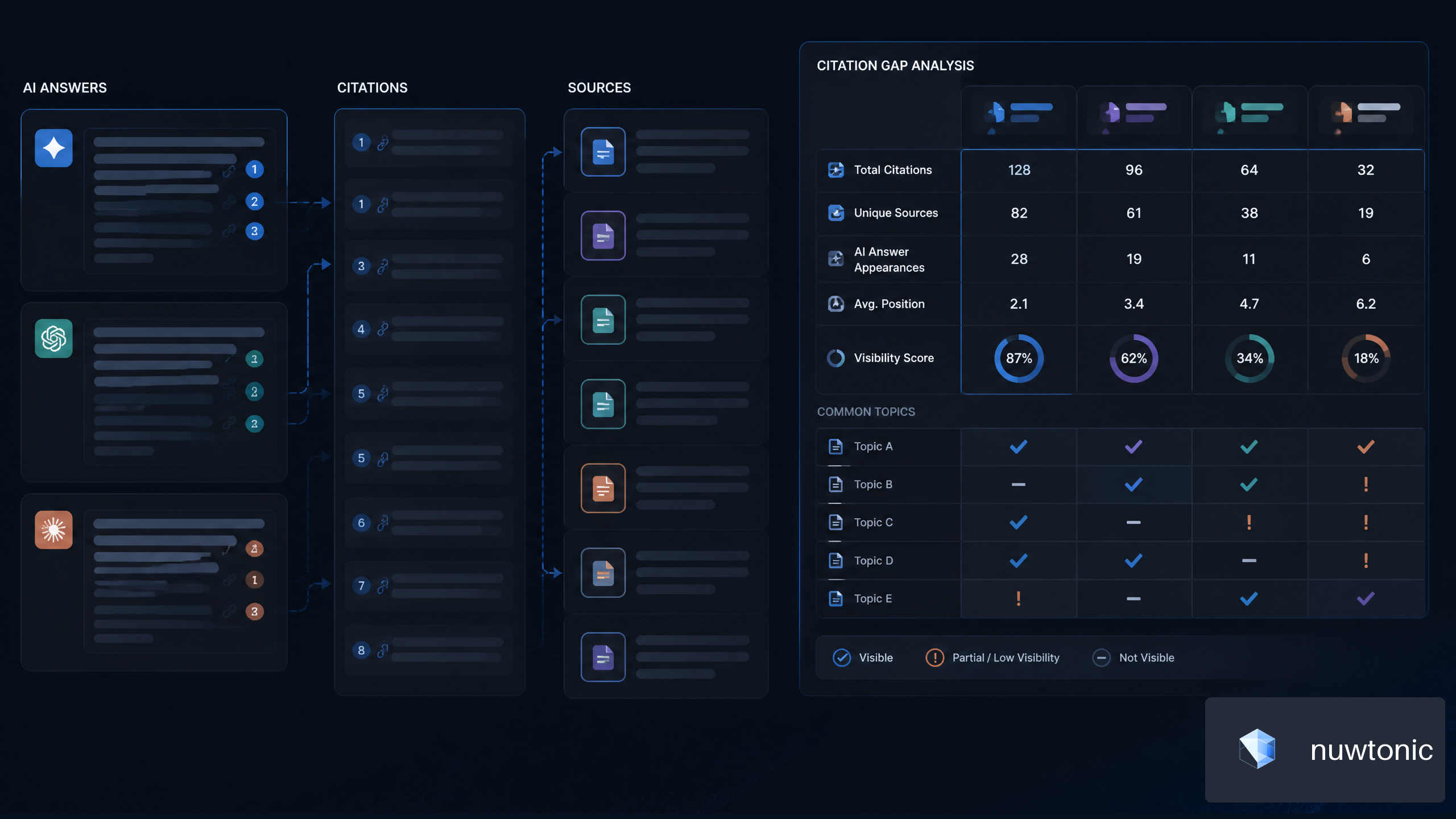
Citation Rate: Tracks how often your content is used as a direct, cited source in an AI-generated answer. A high citation rate is a powerful proxy for authority.
Prompt Coverage: Gauges the breadth of your influence by measuring the percentage of your target prompts where your brand appears, helping you spot content gaps.
The economics are compelling. Brands cited in AI Overviews earned a 0.70% organic CTR, while uncited brands saw just 0.52%—a 35% advantage. For agencies and in-house teams, this makes citation management a directly measurable performance variable. You can explore a deeper analysis of these emerging AI SEO statistics and what they mean for your strategy.
Future of AI SEO: Agentic SEO, Autonomous Optimization & AI Search Trends
The future of AI SEO is moving towards even greater autonomy and sophistication. The key trends to watch are:
Agentic SEO: This refers to the use of autonomous AI agents that can independently analyze data, devise strategies, and execute SEO tasks without human intervention. Imagine an agent that monitors SERPs, detects a drop in ranking, identifies the cause, rewrites the content, and pushes the update live on its own.
Autonomous Optimization: Building on agentic principles, this is a state of continuous, real-time optimization. Instead of periodic audits, AI systems will constantly tweak and improve pages based on live performance data, competitor movements, and shifts in the AI search landscape.
Multi-Modal and Personalized AI Search: AI search will not be limited to text. It will increasingly incorporate images, videos, and audio. Optimization will require creating and tagging multi-modal content. Furthermore, answers will become hyper-personalized to the individual user, making broad "rankings" an obsolete concept.
The role of the SEO professional will evolve from a hands-on implementer to a strategic overseer—a manager of AI agents, setting goals, defining constraints, and interpreting the results of autonomous systems. The focus will be on building the foundational brand authority and information gain assets that fuel these AI engines.
Ready to move from theory to execution? Nuwtonic is an AI-native SEO platform that unifies technical audits, content operations, and Generative Engine Optimization in a single workspace. See how our agent-driven workflows can help you get cited and drive measurable growth by exploring the platform.