AI search is changing how potential customers discover SaaS products. Instead of scrolling through ten blue links, users increasingly ask ChatGPT, Gemini, Claude, Perplexity, and Google's AI-powered search experiences for direct recommendations.
That shift means traditional SEO alone is no longer enough. Ranking on Google remains important, but being understood, cited, and recommended by AI systems is becoming an equally important growth channel.
While building Nuwtonic, one pattern repeatedly emerged: AI search doesn't simply reward keyword optimization—it rewards entity clarity, topical authority, structured knowledge, and trustworthy information. Companies that optimize only for rankings often miss the signals AI systems use when generating answers.
This guide covers the most impactful strategies SaaS companies can implement to improve their visibility across both traditional search engines and AI-powered search platforms.
1\. Build Strong Entity Recognition
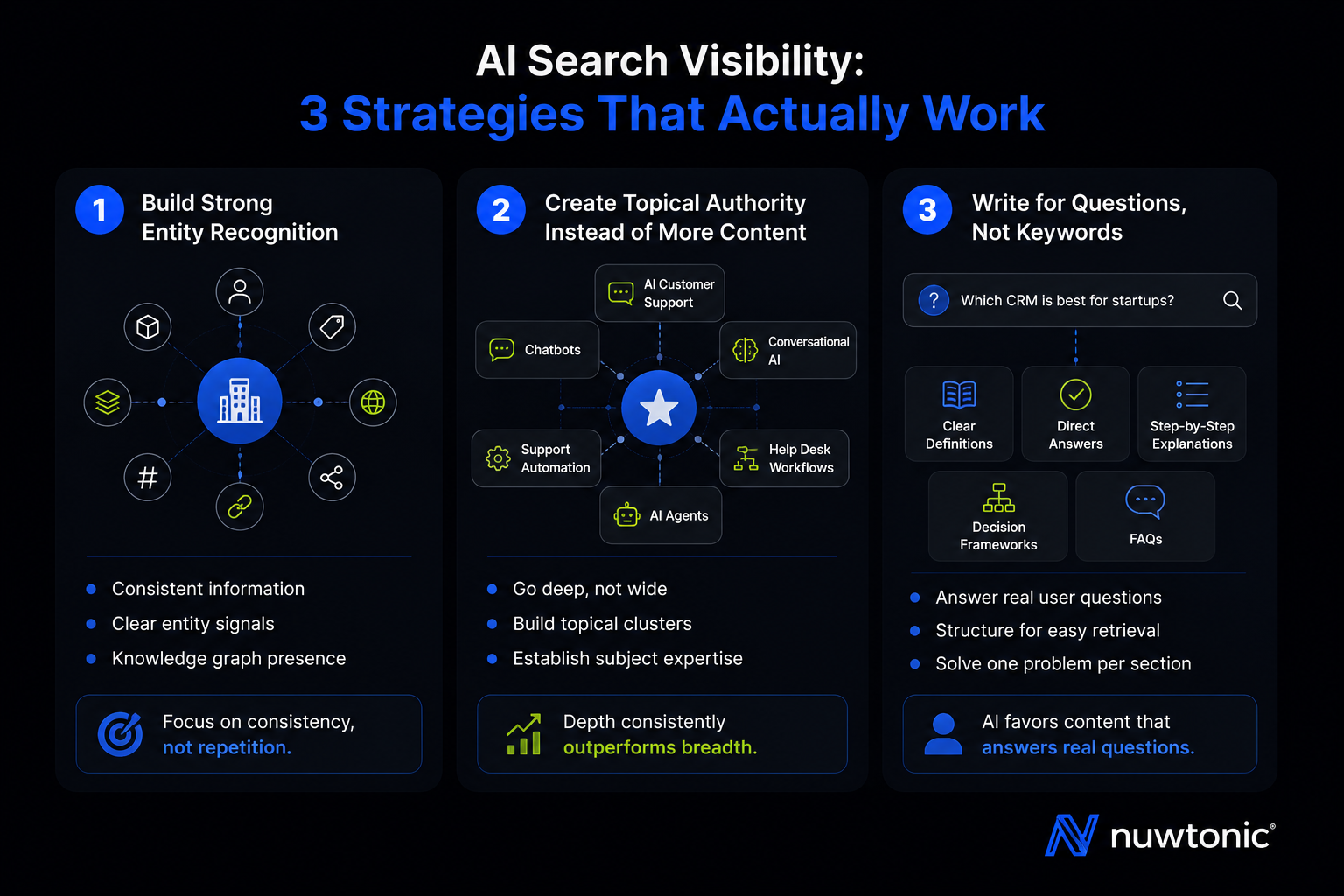
AI models don't think in keywords—they reason through entities and their relationships.
Your SaaS should be recognized as a distinct entity across the web with consistent information about:
Company name
Product name
Founders
Category
Industry
Website
Social profiles
Knowledge graph references
When AI systems clearly understand who you are, they're far more likely to include your brand in relevant answers.
Focus on consistency rather than repetition.
2\. Create Topical Authority Instead of Publishing More Content
Many SaaS companies still measure SEO success by publishing frequency.
AI search rewards something different.
It favors websites that demonstrate comprehensive expertise within a specific subject area.
Instead of writing 100 unrelated blog posts, build deep topical clusters around your core expertise.
For example, an AI customer support platform should comprehensively cover:
AI customer support
Chatbots
Conversational AI
Support automation
Help desk workflows
AI agents
Customer experience
Depth consistently outperforms breadth.
3\. Write for Questions, Not Keywords
AI platforms are fundamentally answer engines.
Most prompts resemble questions such as:
Which CRM is best for startups?
How does AI search work?
Best accounting software for SaaS businesses
Content structured around real user questions is significantly easier for AI systems to retrieve.
Include:
Clear definitions
Direct answers
Step-by-step explanations
Decision frameworks
FAQs
Each section should solve one specific problem.
4\. Optimize for Information Gain
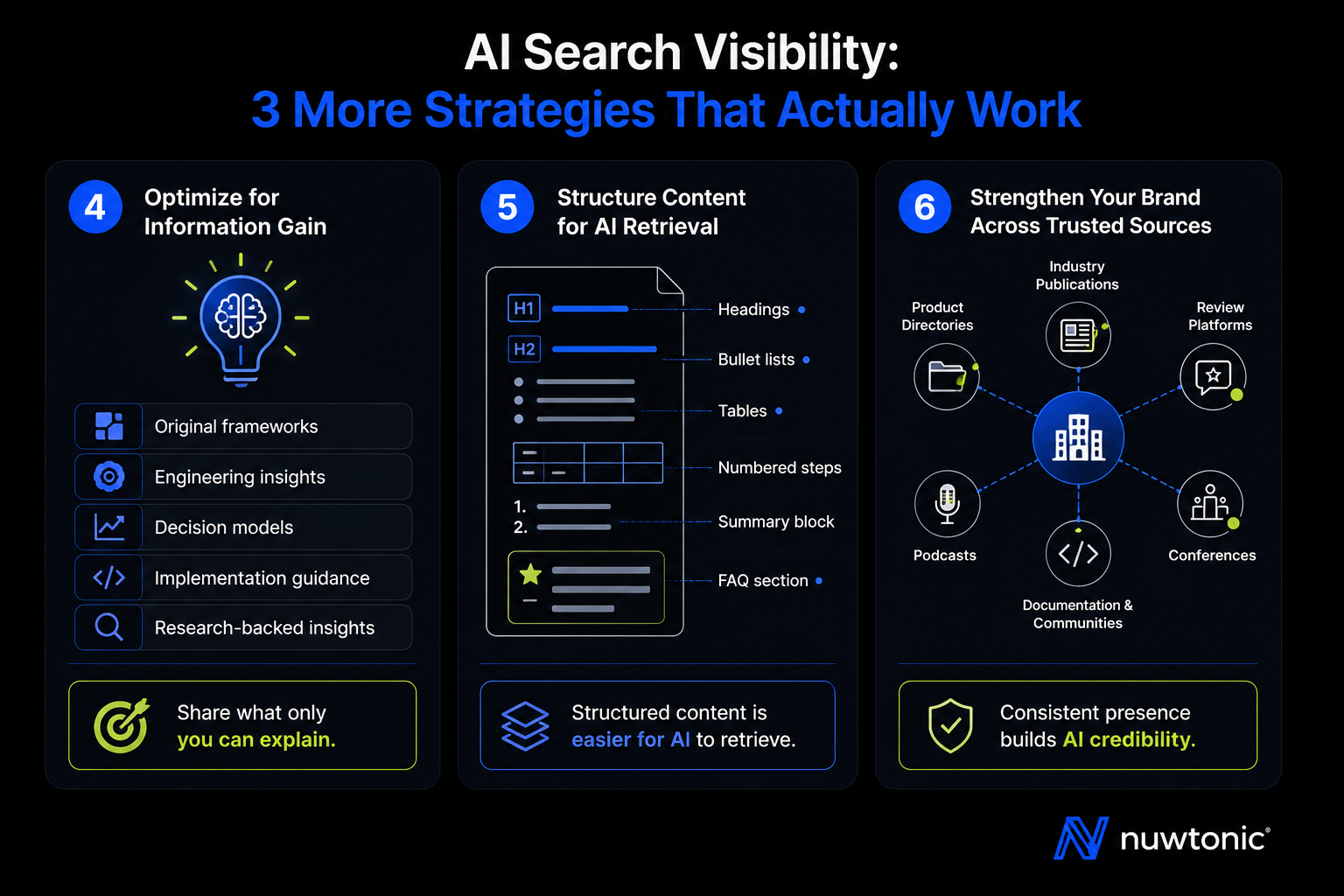
One of the biggest weaknesses across SaaS blogs is repetition.
Many articles simply summarize what's already ranking.
AI systems increasingly prioritize content that contributes new information, including:
Original frameworks
Engineering insights
Product observations
Decision models
Practical implementation guidance
Research-backed explanations
Ask yourself:
What does our team know that generic marketing blogs cannot explain?
That is usually where your strongest AI visibility opportunity exists.
5\. Structure Content for AI Retrieval
Large language models process structured information more effectively than long, unstructured narratives.
Improve retrieval by using:
Clear headings
Bullet lists
Comparison tables
Numbered processes
Definitions
Summary blocks
FAQ sections
Good structure benefits both human readers and AI systems.
6\. Strengthen Your Brand Across Trusted Sources
AI systems don't rely solely on your website.
They synthesize information from multiple trusted sources.
Strengthen your digital footprint through:
Product directories
Industry publications
Customer review platforms
Conference appearances
Podcasts
Technical documentation
Community discussions
The more consistently your company appears across reputable sources, the stronger your AI credibility becomes.
7\. Publish High-Quality Technical Documentation
Documentation is increasingly becoming an AI-friendly content format.
Unlike marketing pages, documentation typically contains:
Clear definitions
Product capabilities
Use cases
Technical accuracy
Structured information
Well-written documentation often becomes a reliable retrieval source for AI assistants.
8\. Build Semantic Topic Relationships
AI search evaluates how concepts relate to one another.
Instead of treating every page independently, connect related topics naturally.
For example:
AI Search Visibility connects with:
Entity SEO
Knowledge Graphs
Schema Markup
Retrieval-Augmented Generation (RAG)
AI Citations
Search Intent
Semantic Search
Strong semantic relationships improve contextual understanding.
9\. Earn Brand Mentions Beyond Backlinks
Traditional SEO emphasized backlinks.
AI search increasingly values trusted mentions across the web.
These include:
Expert interviews
Research citations
Industry discussions
Community recommendations
Product comparisons
Educational resources
Not every valuable mention needs to be a hyperlink.
10\. Publish Original Research
Few content types generate more authority than proprietary research.
Examples include:
Industry benchmark reports
SaaS pricing analysis
Customer behavior studies
AI adoption reports
Search trend analysis
Product usage insights
Original research creates highly citable content for both journalists and AI systems.
11\. Improve Content Freshness
AI search increasingly favors information that reflects current products, technologies, and best practices.
Regularly:
Update statistics
Refresh screenshots
Revise workflows
Add new product capabilities
Expand outdated guides
Fresh content signals ongoing expertise.
12\. Build Strong Internal Topic Clusters
Internal linking isn't just about navigation.
It helps establish topical relationships.
Connect articles that naturally reinforce one another.
For example:
AI Search Visibility
Entity SEO
Semantic Search
Technical SEO
Schema Markup
AI Citations
Well-connected content improves discoverability for both users and AI systems.
13\. Demonstrate Real Expertise
AI systems increasingly distinguish between generic advice and genuine expertise.
Include:
Practical implementation examples
Engineering observations
Lessons learned
Trade-offs
Common failure patterns
Decision frameworks
While building Nuwtonic, we found that content grounded in real experimentation consistently provides higher information value than content optimized solely around keywords.
14\. Monitor AI Search Visibility Separately from SEO
Google rankings alone no longer tell the full story.
Track visibility across:
ChatGPT
Gemini
Claude
Perplexity
Google AI Overviews
Bing Copilot
Each platform retrieves and synthesizes information differently.
Understanding those differences helps identify opportunities that traditional SEO tools may miss.
15\. Move Beyond Reporting to Continuous Optimization
One of the biggest shifts happening in search is moving from periodic audits to continuous optimization.
Traditional workflows often follow this sequence:
Collect data
Generate reports
Manually identify issues
Prioritize fixes
Implement changes
Measure results
As websites grow, this process becomes difficult to scale.
An emerging approach is Agentic SEO, where platforms continuously detect issues, diagnose root causes, prioritize improvements, recommend fixes, and help execute optimizations across both Google Search and AI Search rather than stopping at reporting. This reflects a broader shift from reactive SEO management to autonomous optimization workflows.
How to Measure AI Search Visibility
Unlike traditional SEO, AI visibility requires a broader set of signals.
Track metrics such as:
Metric | Why It Matters |
|---|---|
AI citations | Indicates whether AI systems reference your brand |
Brand mentions | Measures authority across trusted sources |
Entity recognition | Shows whether your company is consistently understood |
Topic coverage | Evaluates depth across your expertise areas |
AI recommendation frequency | Tracks how often your product appears in AI-generated answers |
Documentation visibility | Measures discoverability of technical resources |
Together, these provide a more complete picture than rankings alone.
Common Mistakes SaaS Companies Make
Many companies unintentionally limit their AI visibility by:
Focusing exclusively on keywords
Publishing repetitive content
Ignoring entity optimization
Producing shallow topical coverage
Treating AI search as identical to traditional SEO
Neglecting technical documentation
Measuring only Google rankings
Addressing these gaps can significantly improve your chances of being surfaced in AI-generated responses.
Final Takeaway
AI search visibility isn't about optimizing for a single platform. It's about making your SaaS company easier for AI systems to understand, trust, and recommend.
Organizations that invest in entity clarity, topical authority, original insights, structured content, and continuous optimization are likely to be better positioned as AI-assisted discovery becomes a larger part of how buyers evaluate software.
The companies that succeed won't necessarily publish the most content—they'll publish the most useful, trustworthy, and information-rich content.