Only 16% of brands systematically track AI search performance, according to McKinsey, and that gap explains why so many SEO dashboards still miss where discovery is happening. The old model rewarded rankings. The current one rewards being named, cited, and described correctly inside AI answers, often by sources brands don't control. If you want a practical way to tie that visibility to business impact, the discipline starts with measurement, not with content volume. A useful starting point for teams that want to connect discovery to outcomes is measuring revenue from AI search, because the hard part isn't publishing more pages, it's proving which signals matter.
Table of Contents
- Why AI Search Visibility Is Now a Measurable Discipline
- The Four Signals That Define AI Search Visibility
- Measuring AI Visibility Rate Across Multiple Engines
- The KPI Trap and What to Track Instead
- Entity-First Content and Schema Hygiene That Moves Citations
- A 30-Day Workflow Using AI Search Agents and GSC
- Execution Layer vs Report-Only Tools
- Weekly Cadence and the Three Failure Modes to Watch
Why AI Search Visibility Is Now a Measurable Discipline
McKinsey's finding that only 16% of brands systematically track AI search performance is the clearest sign that teams are still looking at the wrong screen. Traditional SEO reports show rankings, impressions, and clicks. AI-driven discovery shows up as mentions, citations, source selection, and answer framing, which often happen before a user ever reaches a results page. That shift changes the job from “rank better” to “become the source the model trusts.”
A lot of mature SEO teams are already feeling the gap. McKinsey says GEO performance at industry leaders can lag traditional SEO by 20% to 50%, which means a brand can still look healthy in classic organic reports while losing visibility inside AI answers. The same report notes that more than 65% of sources in some AI-powered results for consumer-packaged goods and financial services come from publishers, user-generated content, and affiliate sites rather than brand-owned pages. That's a blunt reminder that third-party coverage now influences visibility as much as your own site.
What the dashboard usually misses
Many teams still over-index on page-level rankings because they're easy to measure. AI search visibility is messier. You need to know whether your entity gets named, whether your URL gets cited, and whether the model describes you accurately enough to shape demand rather than confuse it.
Practical rule: if your reporting only shows organic traffic and keyword positions, it's not measuring AI search visibility. It's measuring a shrinking slice of discovery.
That's why the strategic unit isn't the page, it's the entity-plus-source ecosystem around the page. In practice, that means understanding how brand-owned content, third-party mentions, and answer engines interact. Teams that try to “optimize for AI” without a measurement layer usually end up producing more content and learning less.
The brands that move fastest treat visibility as an operating metric. They know what's being cited, what's being ignored, and where misinformation creeps in. They also know that if a model prefers external sources, the fix may live off-domain as much as on it. For a deeper treatment of the underlying mechanics, optimize content for AI search is a useful companion read because it connects source structure to inclusion behavior without pretending the answer is just more keyword targeting.
The Four Signals That Define AI Search Visibility
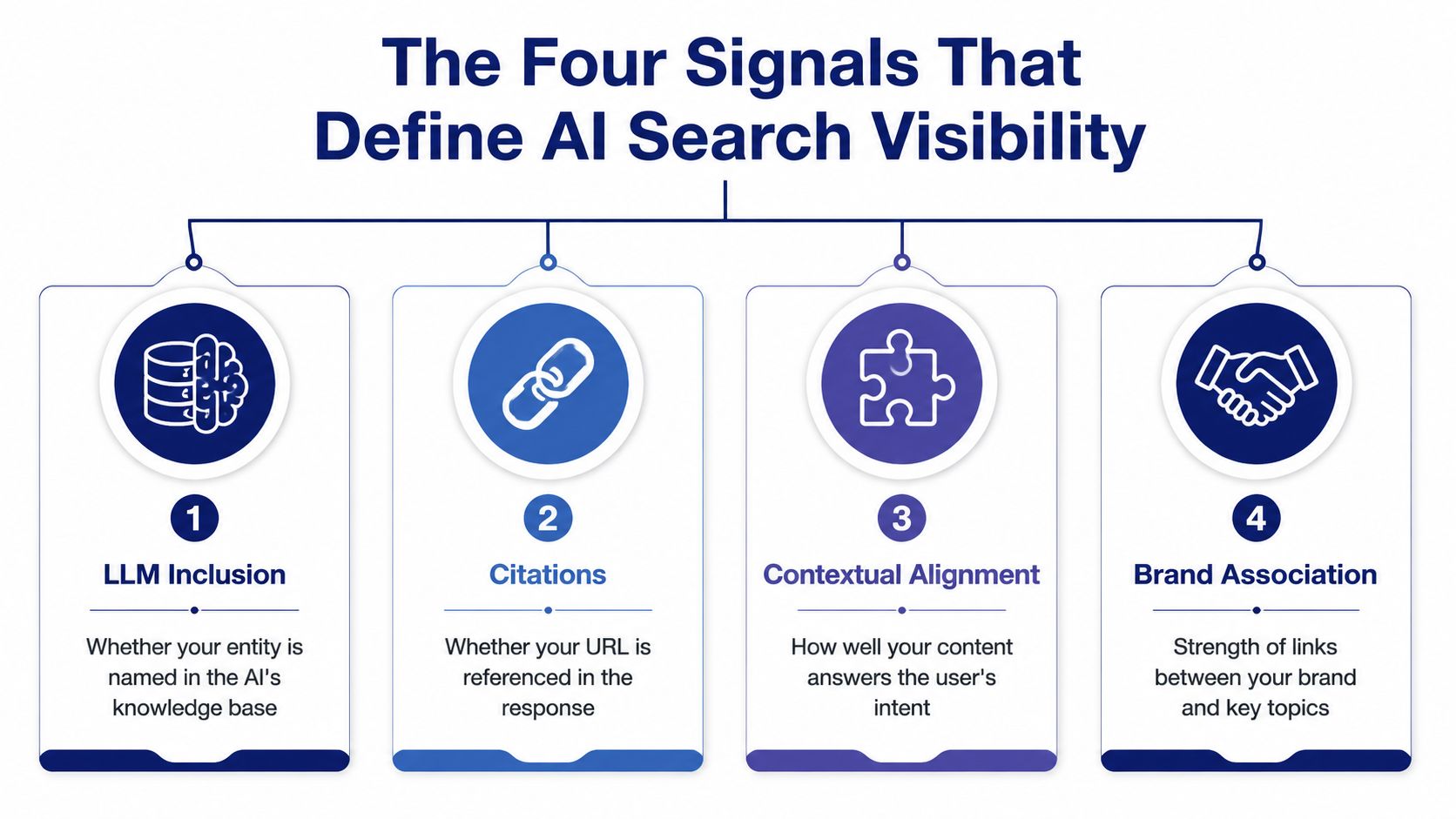
AI search visibility isn't the same as classic ranking, and it's not just a mention count either. A brand can rank well in Google and still be absent from AI answers, or it can be cited in an overview without earning the click. The useful way to define it is as the combination of inclusion, citation, query-level demand signals, and click opportunity shifts.
The four signals that matter
LLM inclusion is the simplest signal. It asks whether the model names your brand, product, or person in its answer. That's a direct visibility check across engines like ChatGPT, Perplexity, Gemini, Claude, and Google AI Overviews.
Citations are a separate signal. A model may mention your brand but cite another site, or it may cite your URL without naming the brand prominently. Those two outcomes matter differently, especially when you care about traceable traffic or page-level remediation.
GSC-derived signals sit underneath the AI layer. Search Console won't tell you that an AI Overview chose your competitor, but it will show query patterns, impression changes, and CTR shifts that often correlate with AI answer activity. In practice, it's the best place to spot which pages are being squeezed by answer-style SERPs.
CTR and trends tell you whether AI summaries are compressing the click path. One dataset reports that AI Overviews appeared in about 6.49% of queries globally in January 2025 and rose to 13.14% by March 2025, a 72% increase in just two months. Another analysis says they now trigger on roughly 48% of tracked queries, with some datasets showing as high as 55% depending on query type and device. One cited estimate also puts organic CTR down 34.5% on queries where AI Overviews appear. Those aren't abstract trend lines. They're the reason a keyword can keep volume while the page loses traffic.
The operational move is to map each signal to a source of truth. Use LLM probes for inclusion, citation checks for source quality, Search Console for query and CTR shifts, and trend comparisons for loss of click opportunity. Nuwtonic's schema markup guidance fits here because machine-readable structure supports citation parsing, not just rich snippets.
Measuring AI Visibility Rate Across Multiple Engines
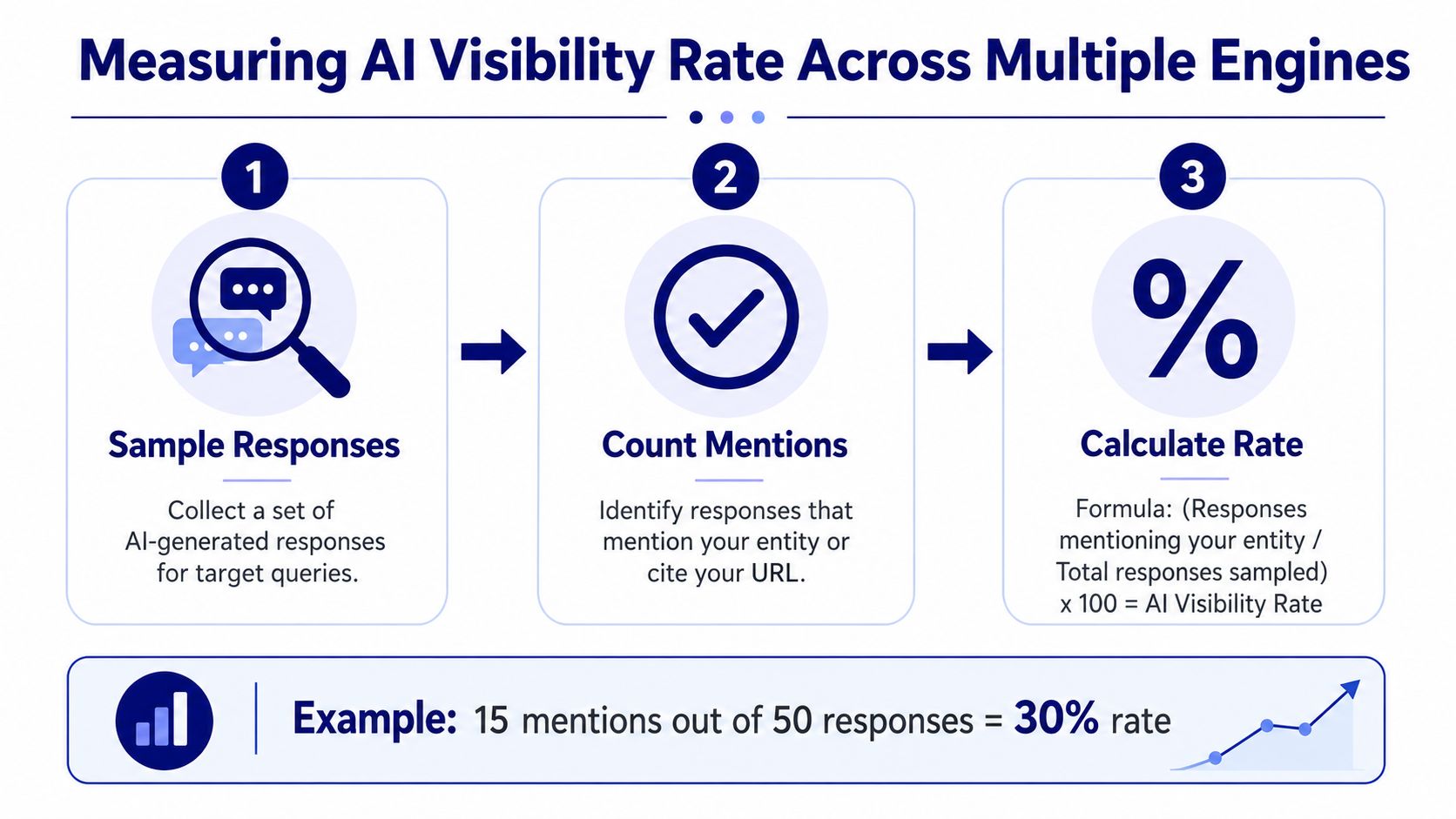
The most defensible first metric is AI Visibility Rate, calculated as responses mentioning your entity divided by total responses sampled, multiplied by 100. That sounds simple until you realize each engine behaves differently, prompts drift over time, and one platform can make you look healthier than you are. That's why a single-engine check is usually a false comfort.
Build a sample that's wide enough to matter
A practical baseline is at least 50 queries run across ChatGPT, Perplexity, Gemini, Claude, and Google AI Overviews. That's the minimum that starts to smooth out noise without turning your first pass into a quarterly research project. Single-platform tracking can miss 60% to 70% of visibility signals, because each engine pulls from different retrieval sources and weights citations differently.
The query set should reflect real intent, not vanity keywords. Use buyer questions, comparison prompts, category definitions, and problem-solving queries. A small prompt bank is enough to start, but it has to be representative.
- Choose high-intent prompts: prioritize questions buyers would ask before shortlisting vendors.
- Run the same prompt set repeatedly: this helps separate a one-off answer from a stable pattern.
- Rotate prompt phrasing: small wording changes expose how fragile the result set is.
- Normalize timing: check responses at similar times of day when possible.
- Pin model versions when the platform allows it: version drift can make week-over-week comparisons meaningless.
Don't confuse one run with a trend
AI search is probabilistic. The same prompt can produce different citations on different runs, which means your measurement system needs repetition, not just snapshots. If a competitor shows up once and you show up once, that's not parity. It's sampling noise until you see a repeated pattern.
A brand I trust in this space isn't the one that appears once in a clean demo. It's the one that appears consistently when the prompt set is rerun across engines and time windows.
The point of this metric isn't vanity. It's to give you a repeatable benchmark you can tie to remediation. If your AI Visibility Rate rises after a content update, schema change, or third-party mention campaign, you've got a signal worth scaling. If it doesn't move, the problem is probably not visibility in the abstract. It's source selection, entity clarity, or query mismatch.
The KPI Trap and What to Track Instead
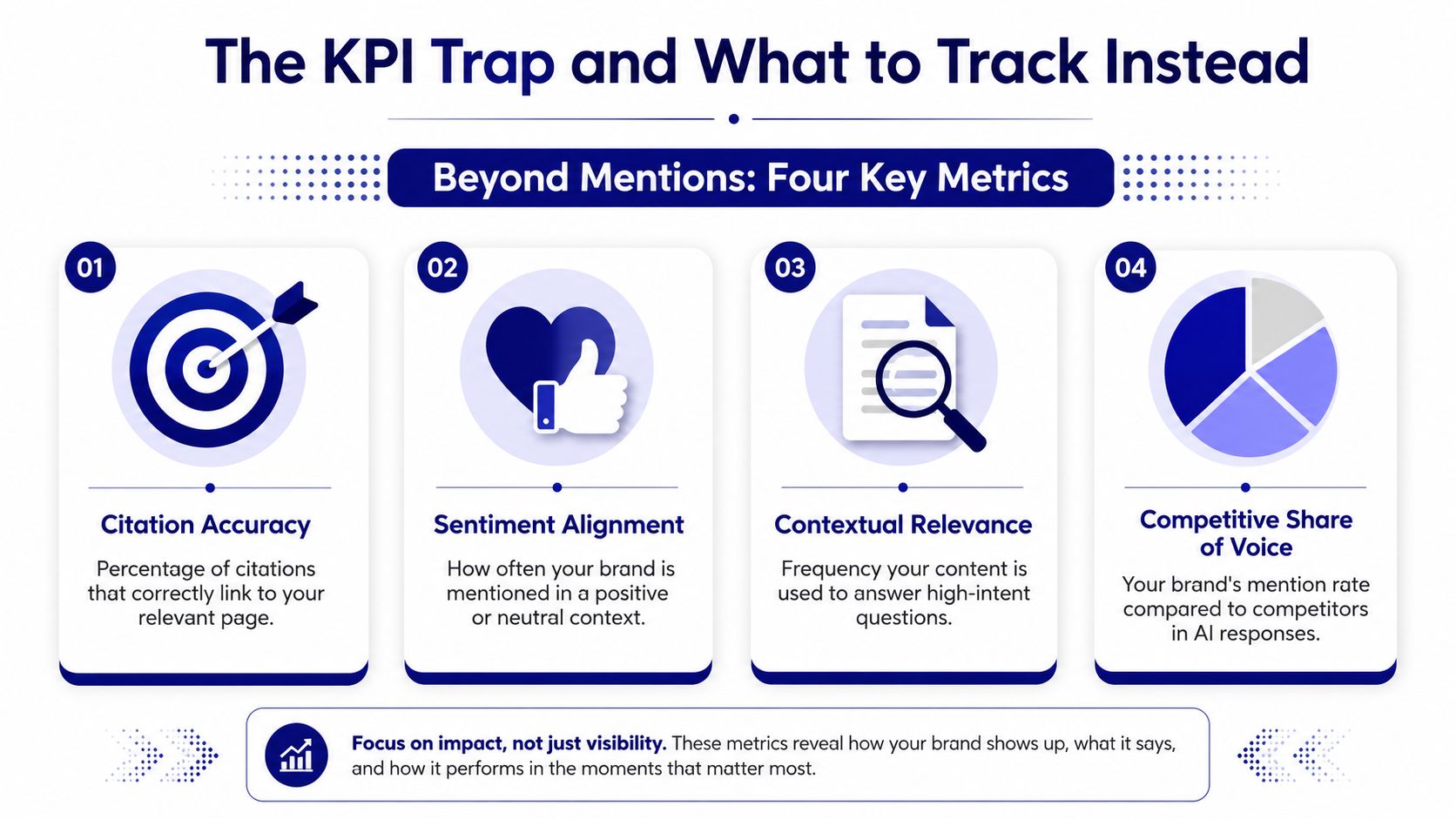
High mention counts feel reassuring, but they can hide a problem. A brand can be mentioned often and still lose demand if the model frames it badly, cites the wrong page, or associates it with the wrong category. The KPI trap is treating “was mentioned” as the same thing as “was represented well enough to matter.”
The metrics that expose real visibility
Visibility frequency tells you how often you appear across the sampled query set. That's the base layer, but it doesn't say whether the model cited you, ignored your URL, or described you accurately.
Citation rate is more useful because it shows how often the answer engine references your page. That's the metric that connects visibility to retrievable source material.
Ghost citation rate matters when the model discusses your category but leaves your brand out. If competitors keep appearing in category answers while you're invisible, you don't have a content problem alone. You have an entity recognition problem.
Accuracy is the one many forget. If the model cites you but gets the feature set, audience, or positioning wrong, you may be winning exposure while losing intent.
The fact that 85% of AI mentions come from third-party sites changes the entire playbook. Off-domain coverage often does more for inclusion than a self-congratulatory blog post on your own site. Searchable also notes that pages updated within 60 days are 1.9x more likely to appear in AI answers, which makes freshness a measurable lever, not a vague best practice. That doesn't mean you should churn pages for the sake of it. It means stale content is one of the easiest ways to fall out of the model's source set.
The quality lens teams should adopt
The better KPI is citation-to-traffic quality. Ask whether the cited page is eligible to drive clicks, demo requests, or product consideration. A citation to a buried support page is not equivalent to a citation to a commercial page with a clear next step.
Useful test: if a cited page wouldn't matter in a sales conversation or content journey, the citation is probably weak even if the mention count looks healthy.
That's the trap with dashboard inflation. More numbers can make teams feel busy without improving the business. The cleaner dashboard tracks frequency, citation quality, ghost citations, and accuracy together. That combination shows whether you're becoming more visible, more trusted, and more commercially useful.
Entity-First Content and Schema Hygiene That Moves Citations
AI systems reward pages that make identity clear. A page needs to say who you are, what you do, and why the content belongs to your entity, not just the keyword set. Entity-first content is less about adding more copy and more about removing ambiguity.
Anchor the page to a real entity
Start with the entity, then build the page around it. Use Organization and Person schema where they fit, add sameAs links for canonical profiles, and keep the brand name consistent across the page, author box, and structured data. For companies with a product or service page, the entity should be visible in the opening copy, not buried after the fold.
The knowledge-graph angle matters because AI systems read relationships, not just strings. If you want a practical framework for how entities connect, ontologies in graph databases is a useful reference. The point is the same in AI search, the model is looking for a clean identity frame before it trusts the page enough to cite it.
Keep the schema clean and the page specific
Schema hygiene is where a lot of teams get sloppy. Do not layer markup that conflicts with the visible page. Do not mark up generic copy as if it were expert content. Use FAQPage blocks that mirror real buyer questions, and keep the answers specific enough that an AI system can extract them without guessing.
A practical pattern for a commercial page is straightforward:
- Organization schema: defines the company and its canonical properties.
- FAQPage schema: captures buyer objections, comparisons, and implementation questions.
- sameAs fields: point to consistent brand profiles and authoritative references.
- Date signals: show when the page was last updated so freshness is visible.
Technical precision matters because AI search engines prefer content they can parse confidently. A page can be well written and still lose citations if the entity is muddy or the schema is inconsistent. Nuwtonic's schema markup guide is relevant here because schema should support machine readability, not just chase rich-result eligibility.
The harder fix comes when visibility exists but representation is wrong. More content usually does not solve that. The model already knows the brand, but it is interpreting it through the wrong category frame. Source-level correction, entity disambiguation, and third-party coverage do the essential work.
A 30-Day Workflow Using AI Search Agents and GSC
A useful rollout doesn't start with publishing. It starts with baselines, because you can't improve what you haven't sampled. The cleanest 30-day pattern I've seen is to use prompt tracking, Search Console, and a structured audit to turn AI visibility into a closed loop.
Week 1 baseline the prompts
Build a prompt bank from real buyer questions, then run it across ChatGPT, Gemini, Perplexity, Claude, Google, and Grok. Track which prompts mention your entity, which cite your URL, and which competitors appear instead. That first pass gives you a reference point, not a verdict.
This is also where an execution tool earns its place. Nuwtonic, for example, combines AI Search Agent tracking, a GEO audit, and a GSC dashboard in one workspace, which is useful if you want the measurement and the fix workflow in the same place. The value isn't the brand name, it's the fact that prompt results and remedial actions sit in one thread.
Week 2 audit by URL and issue type
Run the GEO audit, cluster the findings by URL, and separate structural issues from content issues. A page can fail because it lacks schema, because the answer is buried, or because the topic is too vague for the engine to trust. Don't treat those as the same problem.
Week 3 patch the high-leverage pages
Push entity-first updates, fix FAQ blocks, and correct schema where the page is underspecified. If the page is already ranking in Search Console but weak in AI answers, it's often the best candidate for surgical improvement. The goal is to change inclusion behavior, not just word count.
Week 4 rerun and compare
Re-measure the same prompt set and compare the movement in inclusion, citation quality, and query coverage. Then use the Search Console delta to decide what gets refined next. If a page still underperforms, the next step is usually source reinforcement or entity cleanup, not more rewriting.
Execution Layer vs Report-Only Tools
Most GEO tools are dashboard tools. They tell you where the gap is, then hand you a report and leave the rest to another team. That model breaks down fast when the same people who identify the issue can't deploy the fix.
| Capability | Report-Only Tools | Execution-Layer Platforms |
|---|---|---|
| Issue detection | Flags problems | Flags and prioritizes issues |
| Fix delivery | Manual handoff | Reviewable fixes inside the workflow |
| Schema updates | Usually external | Can be pushed with approval |
| Content remediation | Separate process | Linked to the prompt or citation gap |
| Outcome tracking | Often disconnected | Tied to the original issue thread |
The difference is operational, not philosophical. If a tool surfaces 200 alerts and none of them can be actioned in the same workspace, the team ends up with backlog instead of progress. That's why permissioning, previews, and review-before-deploy controls matter. They turn automation into something a content lead or SEO manager can trust.
For teams looking at the market, how to dominate SERPs with AI is a useful adjacent perspective because it makes the point that AI-assisted research has to connect to execution, not stop at analysis. The same logic applies here. If the platform can't link a prompt, a citation gap, a fix, and a follow-up measurement, you're paying for reporting twice.
What to look for before you buy
- A single workspace: fewer handoffs usually means faster remediation.
- Approved-change controls: no one wants automatic edits without review.
- URL-level visibility: mentions are useful, but page-level diagnosis is what drives fixes.
- GSC integration: Search Console data should inform prioritization, not sit in another tab.
- Content and technical coverage: schema, metadata, and page structure all need to be in scope.
That's why consolidation usually wins. Four point solutions with overlapping data create more debate than movement. One execution layer gives you a cleaner loop from diagnosis to remediation to remeasurement. Nuwtonic's generative engine optimization tools fit that model because they combine tracking, audits, and approved fixes instead of stopping at a report.
Weekly Cadence and the Three Failure Modes to Watch
The best programs don't run on heroic sprints. They run on a weekly cadence that makes drift visible before it becomes a bigger problem. A simple rhythm is enough if it's consistent and tied to action.
A cadence that keeps visibility honest
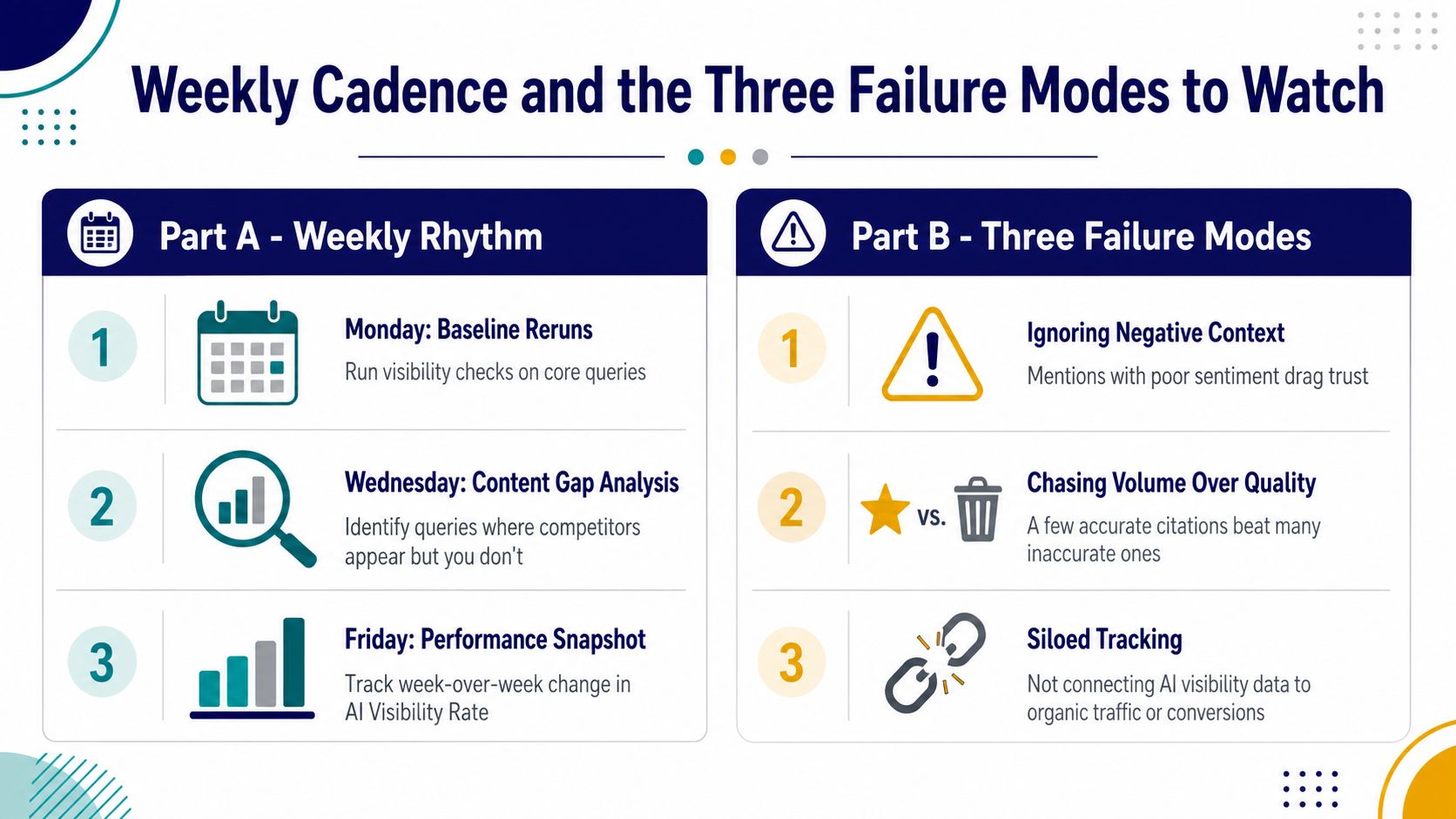
Monday baseline reruns should refresh the core prompt bank so you can see whether inclusion is stable or slipping. If the answer set changes, you want to know quickly.
Wednesday gap analysis should compare your outputs against competitor appearances. That's where missing citation opportunities and source weaknesses show up cleanly.
Friday performance review should pull the Search Console deltas, the AI Visibility Rate trend, and any prompt-bank changes into one review. If the week produced no movement, the issue is usually either source quality or weak remediation priority.
The three failure modes that quietly break programs
Model drift happens when the engine changes what it cites without warning. The signal is a drop in citation frequency for prompts that used to be stable. The move is to rerun the same prompts across multiple engines and look for source substitution, not just mention loss.
Source decay shows up when a third-party page updates, loses your mention, or stops carrying the source context that used to support inclusion. The signal is a fall in third-party citation share. The move is to refresh off-site coverage and rebuild the references that the model already trusted.
Entity ambiguity appears when the model confuses your brand with a homonym or a loosely related entity. The signal is inconsistent naming, wrong descriptions, or mismatched category framing. The move is to tighten sameAs, author markup, and explanatory copy until the entity is disambiguated.
Mentions with poor context aren't a win. They're often the first sign that your visibility is drifting in the wrong direction.
The common thread is simple. AI search visibility goes to teams that measure relentlessly, fix surgically, and treat third-party coverage as a first-class channel. Publishing more content without that loop just adds more noise. If you want a platform that brings measurement, remediation, and reporting into one place, visit Nuwtonic and see how its AI search visibility workflow connects prompt tracking, GSC prioritization, and reviewable fixes in a single system.