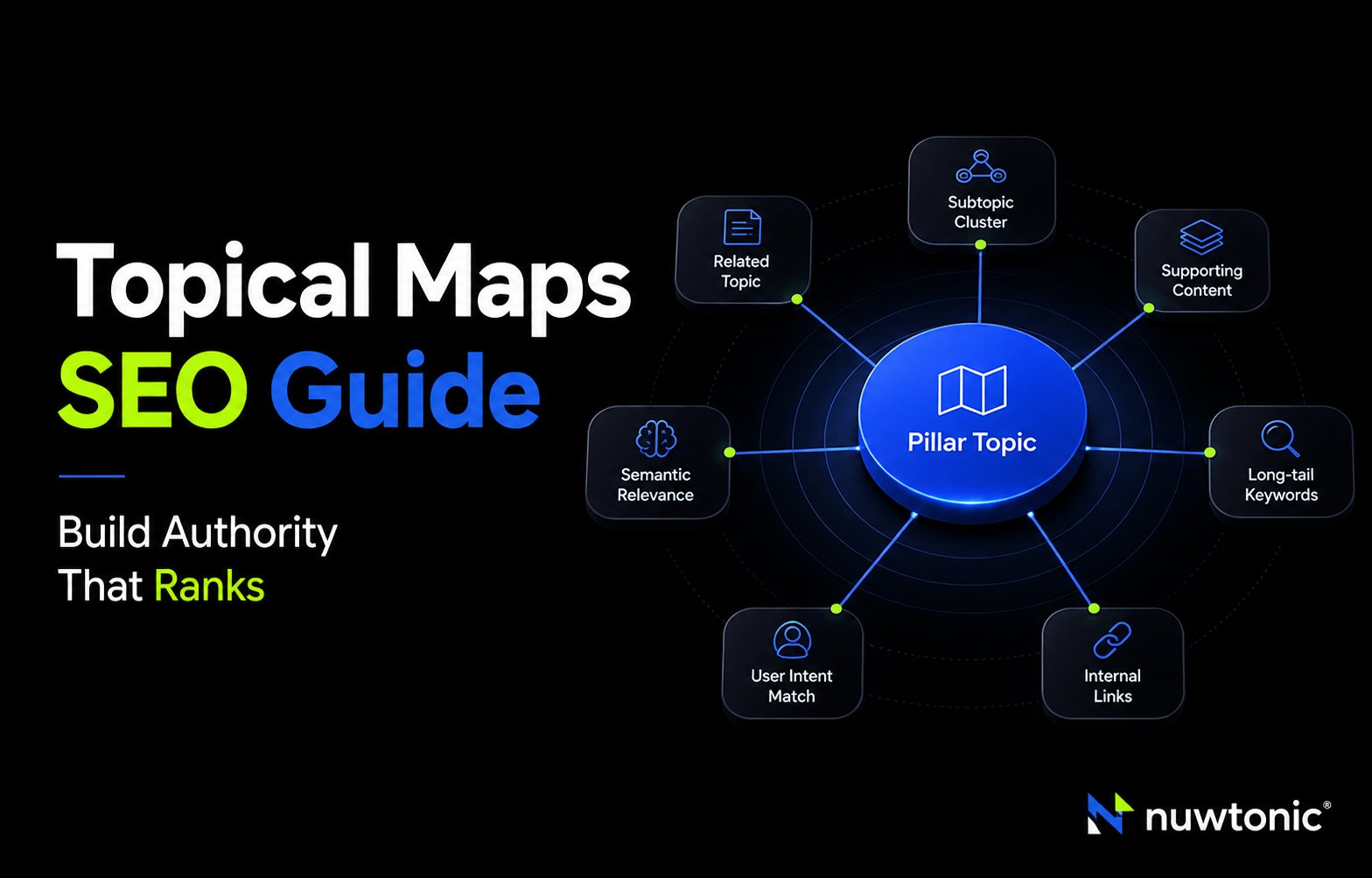
You've published the “complete guide,” answered several long-tail questions, and added a few comparison posts. Each article is useful on its own, yet the site still behaves like a shelf of unrelated books. Rankings arrive sporadically, internal links are added after publication, and newer pages compete with older ones instead of strengthening them.
That pattern is common in topical maps SEO. Keyword-by-keyword publishing creates URLs, but it doesn't necessarily create a recognizable subject architecture. A topical map gives your team an operating system for deciding which entities to cover, which intent each page should serve, how pages should connect, and which gaps deserve investment next.
The shift matters because search has moved beyond simple phrase matching. Hummingbird in 2013 moved Google toward query intent, RankBrain in 2015 improved interpretation of ambiguous queries, and Google's 2023 launch of AI-generated answers made topic-level authority more important for visibility, as outlined in this timeline of topical authority and modern search. The practical response is to build connected coverage rather than isolated wins.
You'll start with the basic map, then turn it into an entity-first architecture, connect it with deliberate internal links, and prioritize updates using Google Search Console signals. The final step is designing pages that can support both conventional rankings and AI citations. If your team also needs to turn real expertise into useful content, these subject matter expertise tips for businesses provide a useful companion framework.
Table of Contents
- Introduction Why Random Content Fails to Build Authority
- What Topical Maps Really Are and How Search Engines Read Them
- Why Topical Authority Matters for Rankings and AI Visibility
- Building an Entity First Topical Map From Core Topic to Clusters
- Turning Your Map Into a Measurement Driven Growth System
- Real World Examples Internal Linking Patterns and Common Pitfalls
- Evolving Your Map for AI Search and Sustaining Authority Over Time
Introduction Why Random Content Fails to Build Authority
Random content usually fails for a structural reason, not because every article is poorly written. A company might publish a guide to payroll software, another article about employee onboarding, and a third post about compliance. Those subjects may belong to one commercial universe, but if the site doesn't define their relationships, each URL has to establish relevance largely on its own.
A topical map changes the publishing question from “Which keyword should we target next?” to “Which part of the subject graph is missing, weak, or disconnected?” That shift helps writers cover the customer's questions in a logical sequence. It also gives editors a way to prevent two pages from pursuing the same intent under slightly different wording.
Practical rule: A page should have a clear job in the topic system before anyone assigns it a title.
The expected outcome isn't a guaranteed ranking position. A well-built map makes it easier for search engines to interpret the site, for users to find the next relevant answer, and for teams to compound coverage over time. Graphite's research across 12 websites found that stronger topical authority significantly reduces time to visibility for new articles, because pages inside established clusters can earn impressions and clicks faster than disconnected pages (Graphite's topical authority white paper).
The rest of this guide treats the map as a working system. You'll define the core entity, separate pillars from supporting pages, classify intent, assign links, and use performance evidence to decide whether to publish, refresh, merge, or redirect. You'll also see why AI visibility requires more than adding a few related keywords. It requires pages with enough depth, clear relationships, and identifiable source value to support citation.
What Topical Maps Really Are and How Search Engines Read Them
A keyword list is a set of addresses. A topical map is a city plan showing which addresses belong to the same neighborhood, how people travel between them, and what each location is for.
That distinction makes a topical map more useful than a spreadsheet of phrases. It documents a core topic, its entities, subtopics, search intents, planned URLs, content assets, and internal-link targets. A content calendar answers when a page should be published. A map answers why that page exists and how it contributes to the wider subject.
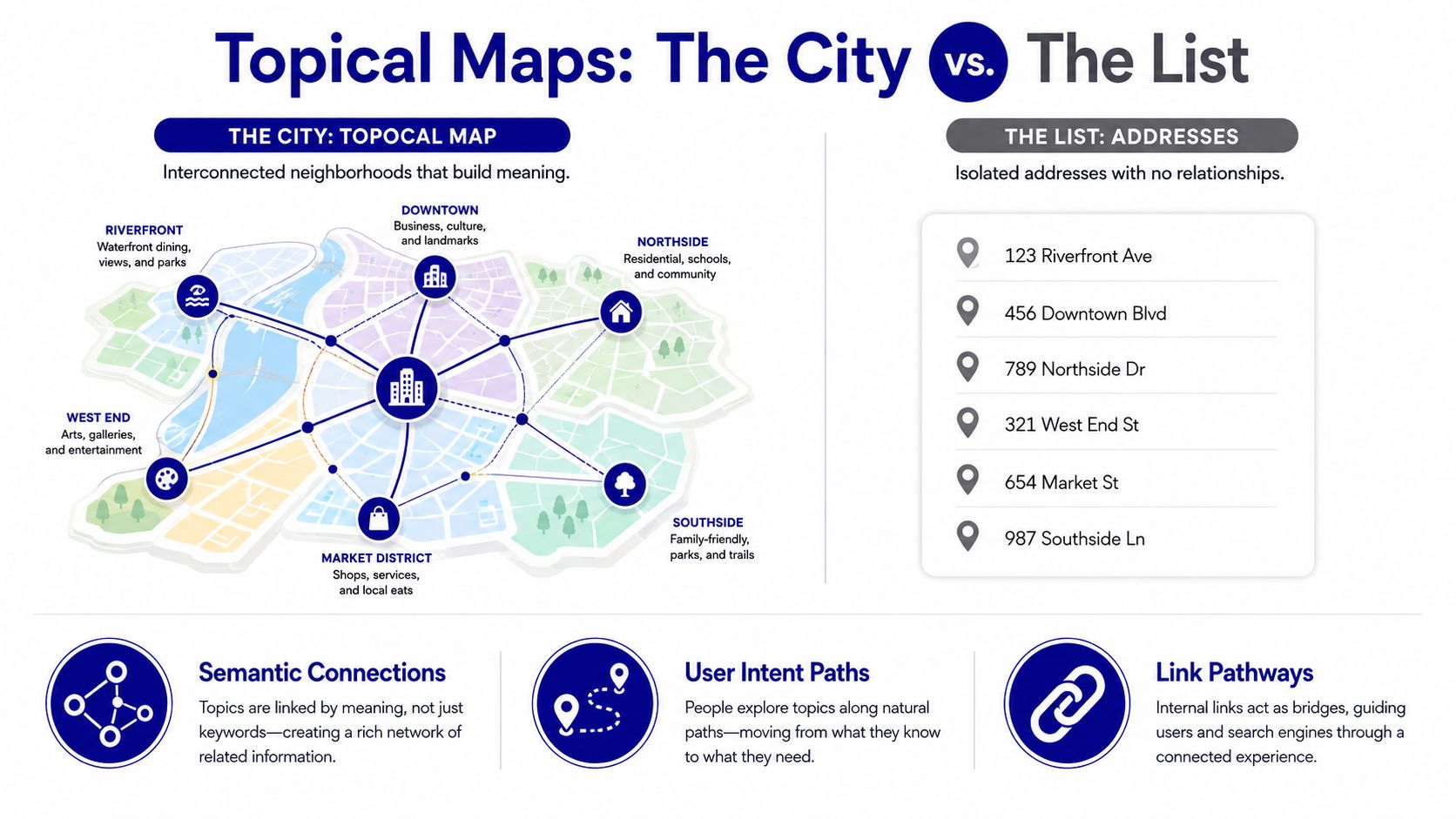
From a pile of articles to a connected subject
Consider a site about home coffee brewing. A keyword list might contain “French press,” “coffee grind size,” “pour-over ratio,” and “cold brew.” A topical map groups those pages under a broader brewing entity, then records relationships such as method, equipment, preparation, troubleshooting, and comparison.
The pillar page provides orientation. Cluster pages answer narrower questions. Supporting pages handle specific procedures or problems. The links between them create a path for both readers and crawlers, rather than leaving every article as a separate endpoint.
This resembles a library, not a pile of books. A library classifies books, places related works near one another, and provides navigation between subjects. Search engines can use that structure to interpret whether a site covers a subject broadly and thoroughly, rather than merely repeating a phrase across unrelated pages.
Why intent belongs inside the map
Two queries can share words while asking for different outcomes. “Email automation” may seek a definition, a setup tutorial, or software comparison. Those intents shouldn't automatically become three pages, because live search results may show that one page can satisfy several closely related formulations.
Build each proposed cluster from SERP observations. Group queries when the result types, page formats, and user needs overlap. Separate them when the dominant intent or required answer changes. This reduces cannibalization and gives every URL a distinct purpose.
Why Topical Authority Matters for Rankings and AI Visibility
A site can publish a polished article and still remain difficult to understand as a whole. Search engines infer topical authority from connected signals, including entity coverage, internal-link density, and publishing consistency. Coverage shows which parts of a subject the site addresses. Links show how those parts relate. Continued publishing and maintenance show that the subject is supported over time, rather than represented by a single page or temporary content batch (semantic SEO guidance on topical authority signals).
One strong article may satisfy one search intent. A coherent cluster gives related pages shared context, allowing each URL to answer a distinct question while supporting the others. The value comes from selecting relevant entities, matching pages to real user needs, and making relationships clear through the site structure.
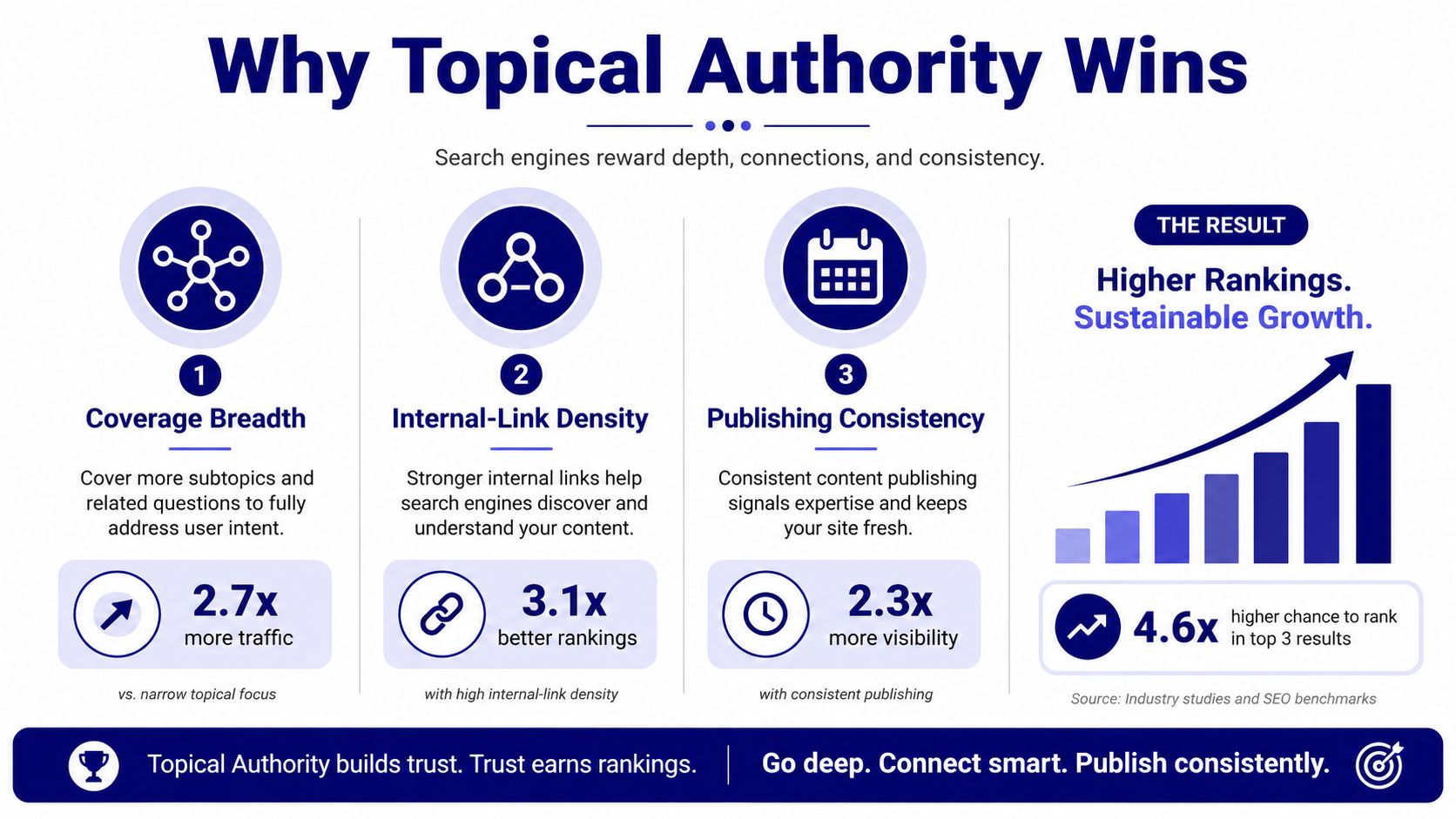
Coverage creates context
Breadth covers the main dimensions of a subject. Depth addresses the practical questions, edge cases, comparisons, definitions, and decisions within those dimensions. Together, they help a site earn visibility for related queries instead of depending on one broad term, a pattern discussed in guidance on topical authority and content clusters.
Internal links turn coverage into a usable system. A pillar can define the subject and point to a detailed procedure. That procedure can connect to troubleshooting, comparison, or implementation guidance, while linking back to the broader explanation. Readers receive a clear research path, and crawlers gain more evidence about each URL's role.
The map should also guide prioritization. A static pillar-and-cluster hierarchy describes what the site intends to cover. Google Search Console can show which entities and intents already attract impressions, where pages gain clicks, and which related questions remain weakly supported. Those signals help teams decide whether to strengthen an existing cluster, create a missing page, or revise links before expanding into another branch.
Authority can shorten the path to visibility
Graphite's study across 12 websites found that higher topical authority was associated with less time for new articles to gain initial impressions and clicks (Graphite research on time to visibility). The practical lesson is limited but useful: a new page that fills a genuine gap may benefit from the context established by related, credible pages. It is not a guarantee of rankings, and performance still depends on intent, quality, competition, and technical accessibility.
Teams can apply this by measuring each cluster as a group. Track impressions, clicks, query coverage, internal-link paths, and pages that receive impressions without clicks. A low-performing page may need a clearer answer or stronger links. A cluster with impressions but little query breadth may need missing entities or supporting content.
AI systems need citation-ready structure
Traditional rankings and AI answers overlap, but they evaluate content through different retrieval and presentation processes. AI systems need passages that define entities, explain relationships, support claims, and can be attributed to a source. Connected pages create more opportunities to establish that context without forcing one article to answer every question.
Guidance on topical maps and AI visibility reports stronger citation potential for interconnected topic coverage than for isolated articles, including the cited analysis of 5 to 7 interconnected pages, 3.2 times more AI citations, and ChatGPT citing 15% of pages it retrieves (2026 topical maps and AI citation guidance). Use those figures as directional evidence from that analysis, not as a universal forecast. The durable strategy is to build answer-focused pages, connect them around shared entities, and use performance data to improve the map as search behavior changes.
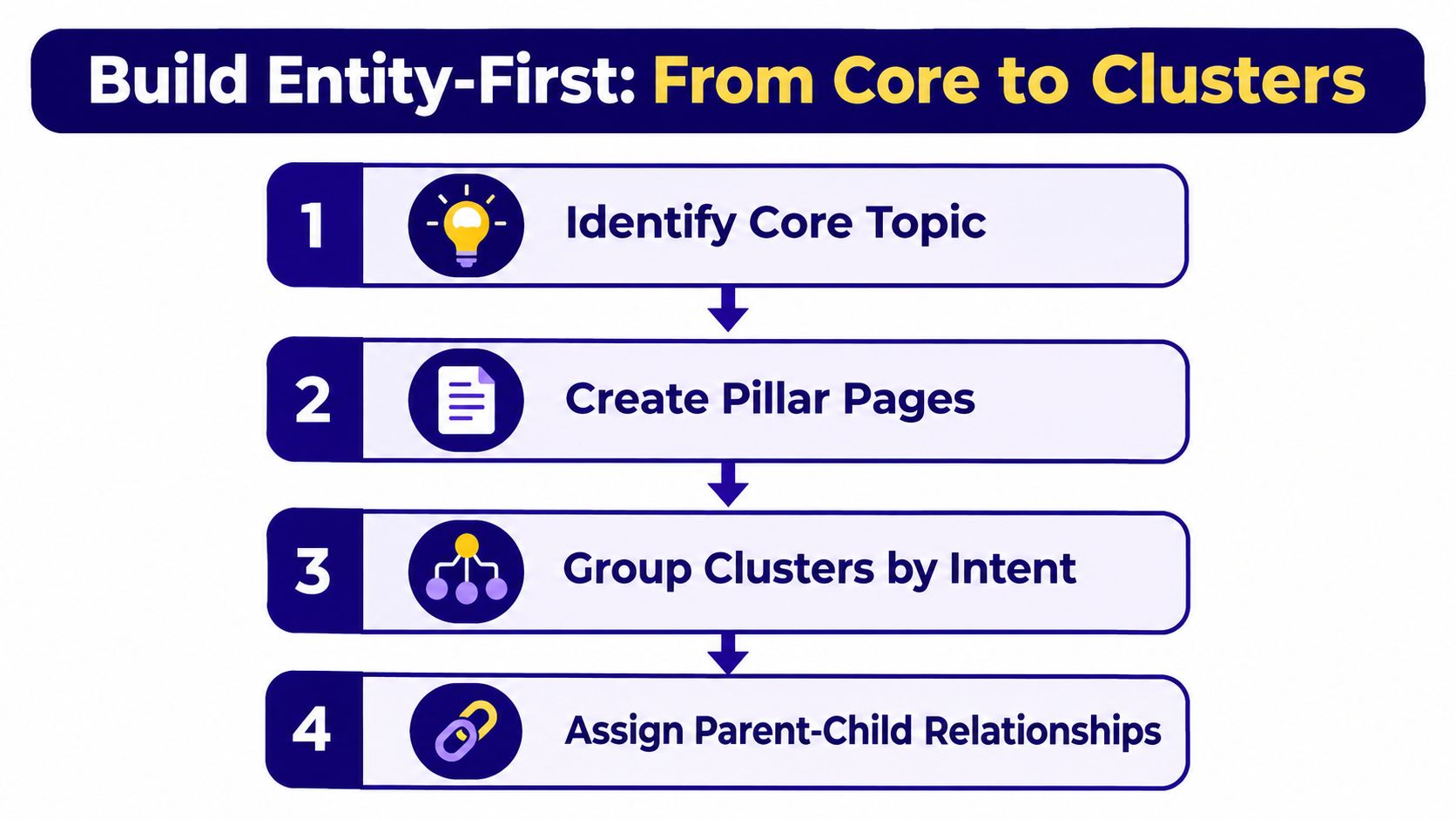
Building an Entity First Topical Map From Core Topic to Clusters
Start with the entity your business wants to be known for, not with a long export of keywords. For a payroll software company, the core may be payroll management, while connected entities include tax withholding, employee classification, payslips, compliance, integrations, and payroll reporting.
Step one defines the subject boundary
Write a one-sentence scope statement. “Payroll” is broad enough to sprawl across employment law, accounting, benefits, and HR operations. “Payroll processing for small businesses” creates a more workable boundary.
Then collect questions from Search Console, existing site content, competitor SERPs, sales conversations, support tickets, and relevant community discussions. Extract the nouns and concepts, not only the phrases. “How do I calculate overtime?” contains an action, a labor concept, a calculation task, and a likely informational intent.
Step two separates pillars and clusters
A pillar page covers the broad subject and introduces its major branches. Cluster pages explore those branches in detail. Supporting pages address narrower tasks, comparisons, definitions, or troubleshooting questions.
Use a map with fields such as:
- Entity: The subject, object, process, or concept the page explains.
- Intent: Informational, comparison, transactional, navigational, or another SERP-supported purpose.
- Parent: The pillar or higher-level cluster this page supports.
- Sibling pages: Closely related pages that may need contextual links.
- Primary URL: The page that owns the intent.
- Assets: Templates, diagrams, calculators, videos, or original explanations.
- Link targets: Pages the draft must reference and pages that should reference it.
A practical topical map content architecture treats parent, child, and sibling relationships as part of the design, not as an afterthought.
Step three assigns each query to the right page
Review live SERPs before combining keywords. If the same pages appear for several formulations, they may belong to one content cluster. If the result types differ, separate the intents and assign distinct URLs.
Use descriptive anchors that name the destination's subject naturally. A pillar might link to “how to calculate overtime,” while a compliance page links to “employee classification requirements.” Don't force the exact keyword into every anchor. The reader should understand what they'll get after clicking.
For machine readability, extract important entities from page copy and media, map them to stable identifiers such as Wikidata QIDs, and add JSON-LD through the CMS or template layer. Reinforce the same entities with consistent internal links, then audit entity coverage after publication and major updates, following this entity schema structuring workflow.
A webinar, research report, or recorded workshop can become a pillar plus supporting pages when the source material contains several distinct intents. A practical guide to maximizing webinar content assets can help your team preserve the relationships between the original asset and its derivative content. For a broader view of entity relationships, review knowledge graph optimization.
Turning Your Map Into a Measurement Driven Growth System
A static hierarchy tells you what could exist. Search Console helps you decide what deserves attention first.
Create a row for every mapped page and gap. Add its current URL or proposed URL, parent entity, intent, impressions, clicks, CTR, average position, trend direction, cannibalization status, conversion relevance, and production effort. You don't need a complicated formula at the start. You need consistent fields and an agreed decision rule.
Use performance signals to choose the next action
A page with rising impressions but weakening CTR may need a title, snippet, or intent review. A page with declining impressions and stable relevance may need content updates, stronger internal links, or a SERP format check. A topic with repeated queries landing on several URLs may need consolidation or clearer ownership.
Score each candidate qualitatively across four dimensions:
- Demand evidence: Are relevant queries already generating impressions?
- Performance movement: Is CTR declining, visibility slipping, or a page gaining momentum?
- Topic importance: Does the node support a commercially meaningful entity or customer journey?
- Resolution clarity: Can one update, new page, merge, or link change address the problem?
This creates a backlog based on observed conditions instead of editorial instinct. Keep the original query set, the chosen intent, the proposed action, and the expected destination in the map so the decision remains auditable.
Connect the map to an operating workflow
Review the backlog on a fixed cadence. For each priority, choose one action: publish a missing page, refresh an aging page, strengthen links, merge overlapping URLs, or investigate a technical blocker. After deployment, annotate the map with the change and monitor whether impressions, CTR, query ownership, and rank movement change.
Nuwtonic's SiteWise topical maps and GSC Performance Dashboard combine GSC patterns with topical planning, while its broader workspace supports competitor gap mapping, click-decay detection, cannibalization tracking, and review-before-deploy changes. That makes it one option for teams that want measurement and execution connected rather than maintained in separate spreadsheets.
A useful map also records uncertainty. Mark a topic as “needs SERP validation” when the query grouping is unclear, and “needs entity review” when the page mentions important concepts without stable schema or internal-link support. This prevents false precision and keeps the system responsive to evidence.
Real World Examples Internal Linking Patterns and Common Pitfalls
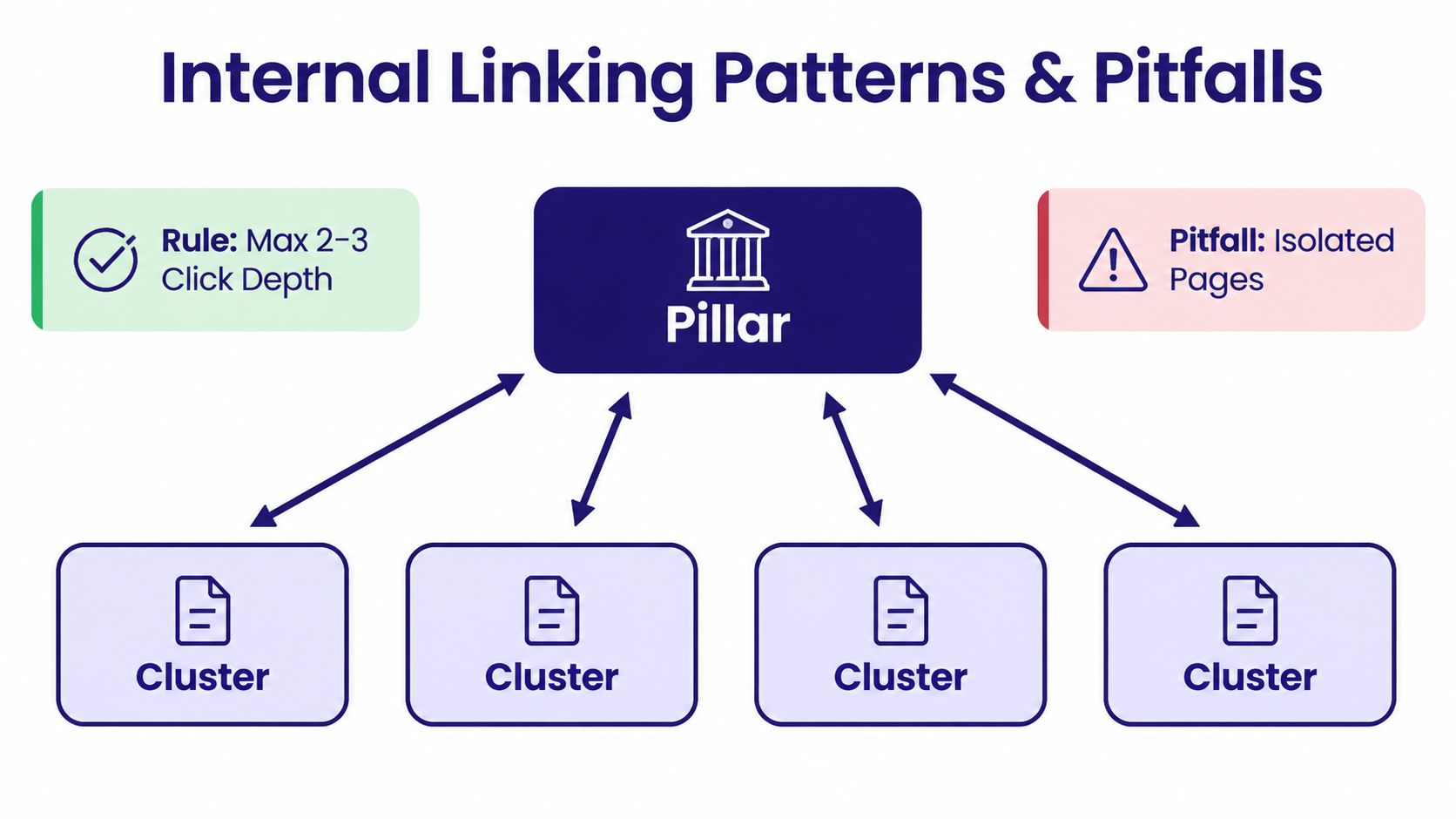
Suppose a B2B site owns a pillar called “Payroll Processing.” Under it sit clusters for payroll setup, payroll taxes, employee classification, reporting, and integrations. The pillar links to every major cluster, each cluster links back to the pillar, and sibling pages connect when the reader's next question is obvious.
That is a nested hub-and-spoke model. The spokes aren't decorative links. They establish the intended route through the subject and help prevent a detailed page from becoming an orphan.
The practical linking rules
Keep meaningful pages within two to three clicks of the pillar page, and give each cluster page two to three contextual in-body links back to its pillar, as recommended in this topical map internal-linking framework. The links should appear where they help the reader, not in a forced block of keyword-rich navigation.
Maintain a link log with these columns:
| Source URL | Target URL | Anchor text | Reason |
|---|---|---|---|
| Payroll processing pillar | Payroll tax guide | payroll tax calculations | Extends the tax section |
| Payroll tax guide | Payroll processing pillar | payroll processing overview | Returns to the parent context |
| Payroll setup guide | Employee classification guide | employee classification | Clarifies a setup dependency |
This log gives editors a concrete review checklist. It also makes future updates easier because the team can see which relationships already exist.
What breaks the architecture
An orphan page may contain excellent information but contribute little to the cluster if no relevant page points to it. A crawl export compared with the map can expose URLs that exist in the CMS but have no meaningful inbound path. Cannibalization creates a different failure: two pages answer the same intent, split signals, and leave users unsure which page is authoritative.
Build content clusters from live SERP analysis, not just similar wording. If “payroll software comparison” and “payroll processing guide” produce different page types, they need different roles. If two existing URLs serve the same result type and audience need, consolidate them or assign one as the clear canonical destination.
For a deeper technical review of orphan pages, anchor patterns, and link distribution, use this internal linking audit workflow.
Evolving Your Map for AI Search and Sustaining Authority Over Time
A topical map becomes stale when the team treats publication as the finish line. New entities appear, user questions change, competitors introduce better explanations, and AI answer systems alter which passages they retrieve and cite.
Maintain the map at three levels. First, expand entity coverage when a page introduces an important concept that the site doesn't explain elsewhere. Second, reinforce relationships with contextual links and consistent terminology. Third, review structured data so important entities map to stable identifiers such as Wikidata QIDs rather than remaining ambiguous text.
Pages also need citation-ready depth. Define the subject plainly, answer the specific question early, support important claims with credible references, and make the source's expertise visible. Use original processes, examples, diagrams, and clear update notes where they add verification value. Guidance on optimizing content for AI search can help teams adapt page structure for answer systems without abandoning conventional SEO.
Use this maintenance checklist after every meaningful launch or update:
- Check ownership: Every query cluster has one primary URL.
- Check relationships: New pages link to their parent and relevant siblings.
- Check entities: Important concepts appear in copy, links, and structured data.
- Check performance: GSC impressions, CTR, queries, and movement inform the next action.
- Check AI visibility: Track whether important pages are retrieved or cited for relevant prompts.
- Check decay: Refresh pages when relevance or click-through performance weakens.
This is how authority compounds. You publish with structure, measure the response, improve the weakest connection, and keep the map aligned with both search behavior and the subject itself.
Nuwtonic helps teams build GSC-informed topical maps, identify content gaps and cannibalization, monitor AI citations, and route approved SEO fixes through reviewable workflows. Visit Nuwtonic to connect topical planning with measurable execution across your site.