You can do everything “right” on the page and still disappear from the answers people read. The homepage is indexed. Core pages rank. The schema validates. Yet when someone asks a category question in ChatGPT, Perplexity, or Gemini, the brand name never shows up because the system can't confidently resolve the entity behind the site.
That gap is usually not a content problem. It's a knowledge graph optimization problem, which means the machine can't trust the entity, can't reconcile duplicate signals, or can't trace where the facts came from. In Google's wider semantic ecosystem, that matters at massive scale, because the Knowledge Graph has been widely cited at 18 billion statements about 570 million entities, with 1,500 entity types and 35,000 relation types. The original survey makes the point clearly, search at that scale isn't just keyword matching, it's entity confidence.
The brands that win AI citations tend to do one thing well, they make the entity legible across multiple layers. The ones that lose usually stop at markup validation and never connect identifiers, metadata, source authority, and provenance. That's why a four-layer execution model is more useful than a vocabulary tutorial.
Table of Contents
- Why Your Brand Disappears From AI Answers
- The Four Layers of Knowledge Graph Optimization
- Setting Up Canonical Entity Identifiers That Stick
- Deploying Schema.org and Open Graph the Right Way
- Five Quality Dimensions You Can Measure Today
- The Cyclical Repair Workflow That Actually Works
- Query Architecture for Fast AI Retrieval
- Measuring Outcomes in AI Answers and Knowledge Panels
Why Your Brand Disappears From AI Answers
A SaaS marketing team can have a solid page-one presence and still be invisible in AI answers. That happens when the site talks about the company in one place, the product in another, and the founder on a third URL, but the machine sees three partly overlapping entities instead of one coherent brand. Search engines can still rank the pages. Large language models often won't cite the brand if they can't resolve the entity with enough confidence.
What the machine is actually missing
Many teams assume the answer lives in better copy, more backlinks, or a stronger title tag. Those help, but they don't solve entity ambiguity. If the site doesn't present a consistent canonical identity, AI systems can't reliably associate the brand name, product line, and authority signals with the same real-world thing.
That's why knowledge graph optimization is different from ordinary on-page SEO. It's about making the entity readable across systems that combine structured data, external references, and source provenance. If you've already mapped this problem in a broader AI search workflow, the AI search knowledge graph guide is the right companion reading.
Practical rule: if the same brand can be described three different ways across templates, the graph will usually reflect that confusion.
Why rankings don't guarantee citations
Ranking pages and being named in AI answers are separate outcomes. A page can satisfy search intent without giving the model enough entity-level confidence to name the business. That's especially common in category-defining queries, where the model chooses entities it can tie to structured metadata, trusted external sources, or clear provenance rather than the best-ranked document alone.
The quality literature backs up this operational reality. Knowledge graphs are judged through dimensions like accuracy, consistency, completeness, timeliness, and redundancy, not a single “good” or “bad” score as summarized in the 2022 survey. If any one of those dimensions is weak, the entity can vanish from downstream answers even when the page experience looks fine.
The fast diagnosis is simple. If AI systems describe the category but skip the brand, the graph likely lacks canonical identity, external validation, or provenance links. If they mention the brand inconsistently, the graph probably contains duplicates or conflicting facts. If they cite the wrong page, the metadata may be clean but disconnected from the right entity.
The Four Layers of Knowledge Graph Optimization
The most useful way to organize this work is as four layers, not one schema checklist. Each layer solves a different failure mode, and each layer depends on the one below it. If one is weak, the rest start leaking trust.
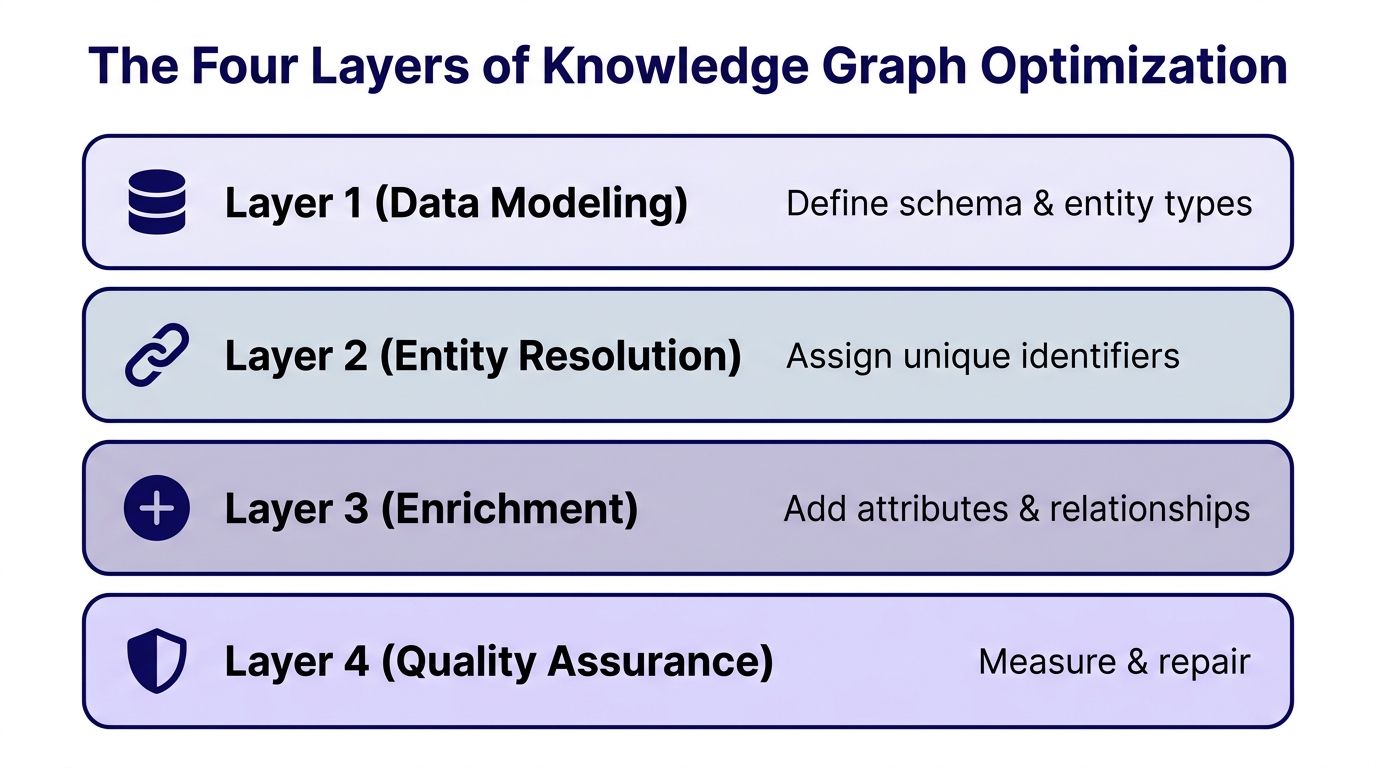
Layer 1 Canonical identifiers
This is the anchor. Every entity needs one stable identifier, ideally a URI or equivalent canonical ID that never changes when URLs, templates, or campaigns change. For a B2B SaaS brand, that usually means one identity for the company, one for the product family, one for the founder, and one for the primary contact or author if those people are part of the entity story.
Layer 2 Structured metadata
Once the identity is stable, expose it in machine-readable form. That means schema.org and Open Graph on the right templates, but also the same identifier pattern across About, Product, Team, and Knowledge Base pages. Metadata isn't useful when it exists only on a single page. It becomes useful when it repeats the same identity across the site.
Layer 3 Trusted external sources
A graph gets stronger when its identifiers can be reconciled against authoritative external records. Wikidata, industry registries, and other stable references help machines confirm that the entity isn't just a self-declared label. The practical goal isn't “get more links.” It's to make the entity easier to reconcile.
Layer 4 Provenance linking
Provenance answers the question, “Where did this fact come from?” A graph that links claims back to source pages, citations, or publication context is more trustworthy than one that lists facts without attribution. Entity resolution turns into citation readiness because the machine can follow the path from claim to source instead of guessing.
A clean example helps. A SaaS company's About page should identify the organization once, the product page should nest the product under that organization, and the founder bio should connect back to the same corporate identity. If those pages all point to the same canonical ID, the system can reason over one entity instead of stitching together fragments.
Setting Up Canonical Entity Identifiers That Stick
Most entity work fails here because teams treat identifiers as a technical detail. They let CMS defaults, template slugs, and ad hoc author profiles become the identity layer. That creates duplicate entities, broken joins, and inconsistent citations the moment the site scales.
Choose one identifier strategy and document it
Start by deciding what the canonical ID is for each major entity type. Some teams use a slug-based URI, some use a custom internal ID, and some map to Wikidata QIDs when the entity already exists there. The key is consistency. The machine should see one identifier per entity, not a new variation every time a page template changes.
The centralized AI knowledge hub is a useful example of how a single workspace can collect entity definitions, connected references, and content context without forcing every team to reinvent the same record structure.
One stable identifier is worth more than ten loosely related mentions.
Audit the current duplicates before you publish more markup
Before adding new JSON-LD, crawl the site for duplicate Person, Organization, and Product entities. Look for pages that describe the same entity with different names, slightly different company descriptions, or multiple author profiles for one real person. If those duplicates stay live, schema only amplifies the conflict.
A practical check is to compare About, Contact, Product, and Author pages side by side. If the company name, legal name, logo, headquarters reference, or author bio varies without a deliberate reason, the entity is already fragmented. Fix that before adding more structured data.
Use sameAs where the external identity is real
The sameAs property is valuable only when it points to authoritative profiles or records. Don't spray it across random listings. Use it where the external source helps reconcile the entity, then keep that mapping stable across all templates.
A clean JSON-LD pattern looks like this in principle, not as decorative markup but as a governance rule: one @id per entity, repeated consistently, and sameAs only for verified equivalents. The exact implementation depends on the template, but the policy doesn't. One entity, one identifier, one source of truth.
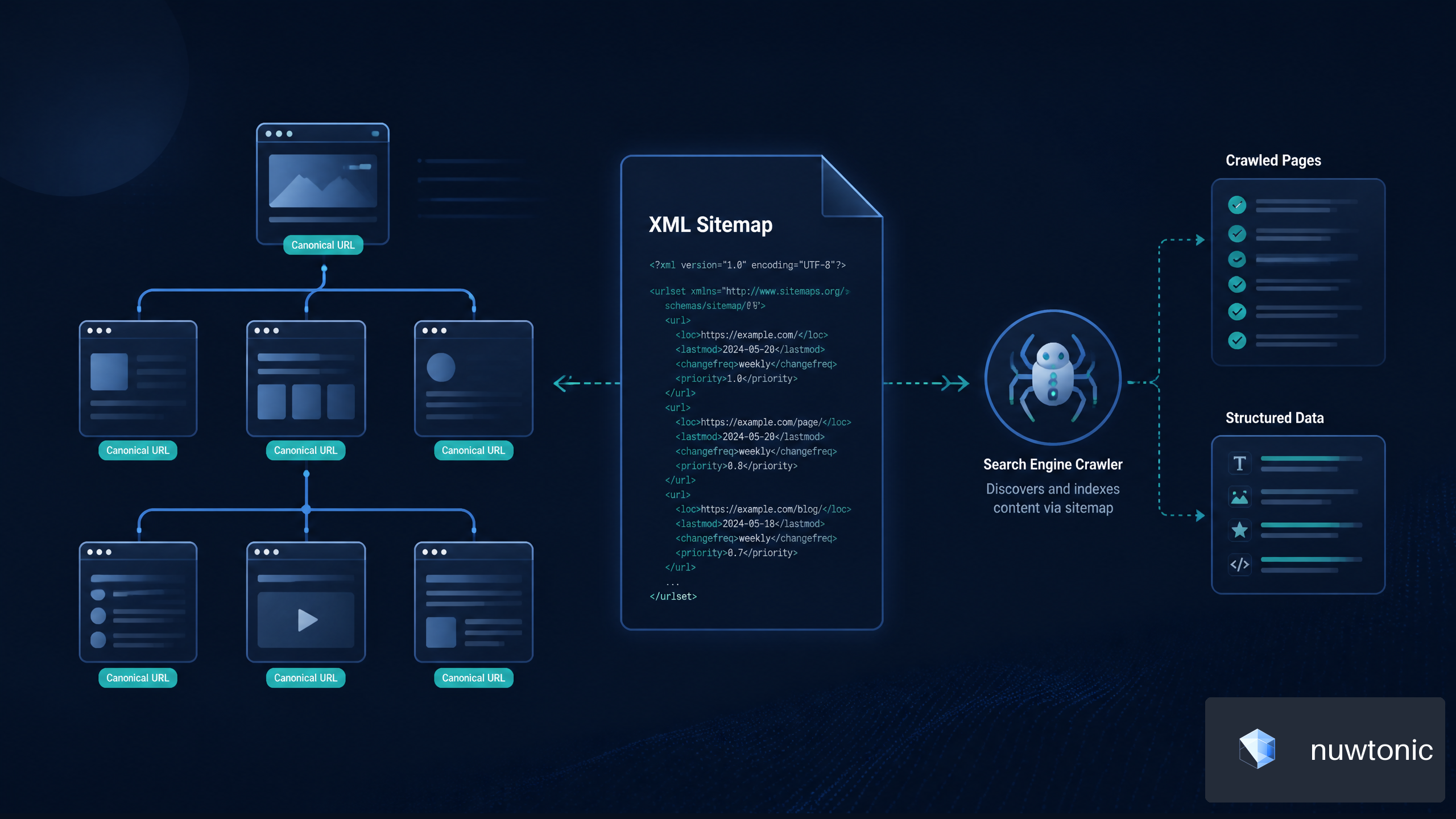
For a quick validation pass, a canonical URL checker helps catch the URL-level version of the same problem before it bleeds into the graph.
Deploying Schema.org and Open Graph the Right Way
A lot of structured data is syntactically valid and strategically useless. The markup exists, the validator passes, and nothing changes because the page never connects the right entity to the right properties. That usually means the site is using schema as decoration instead of entity infrastructure.
Match the schema type to the entity intent
Use Organization when the page represents the company. Use Person when the page represents a real human with a public role. Use Product when the primary entity is the offer itself. Don't force one type everywhere just because it's easier to template.
Nested schema usually works better than isolated page-level blobs. A product can belong to an organization. A founder can be part of the organization. An article can be written by a person who represents the same brand. That structure helps machines understand how the entities connect instead of seeing disconnected pages.
Use JSON-LD as the default, not as the only layer
For entity-first SEO, JSON-LD is usually the cleanest deployment pattern because it separates semantics from layout. Microdata and RDFa can still work, but they tend to be harder to maintain in modern CMS stacks. What matters more than the syntax choice is that the same identity, relationship, and source references appear across templates without drift.
Open Graph matters too. Social and AI crawlers often rely on it as a quick entity clue, especially for title, description, image, and canonical URL alignment. If your OG tags describe one thing and your JSON-LD describes another, the graph gets noisy fast.
Focus on the properties that help resolution
Google's own guidance has long pointed to properties like founder, award, knowsAbout, and sameAs as useful signals in entity understanding. Don't stuff them everywhere. Use them where they reflect the actual entity and where the supporting page content can defend the claim.
If you need a practical comparison of deployment patterns for local or entity-rich pages, the schema guidance from AI Tools for Local SEO is a strong reference point.
The rule of thumb is straightforward. If a property can't be defended by visible content or a trusted external source, leave it out. Schema should clarify the page, not invent authority for it. For a broader implementation pattern, the schema markup guide is the closest internal match.
Five Quality Dimensions You Can Measure Today
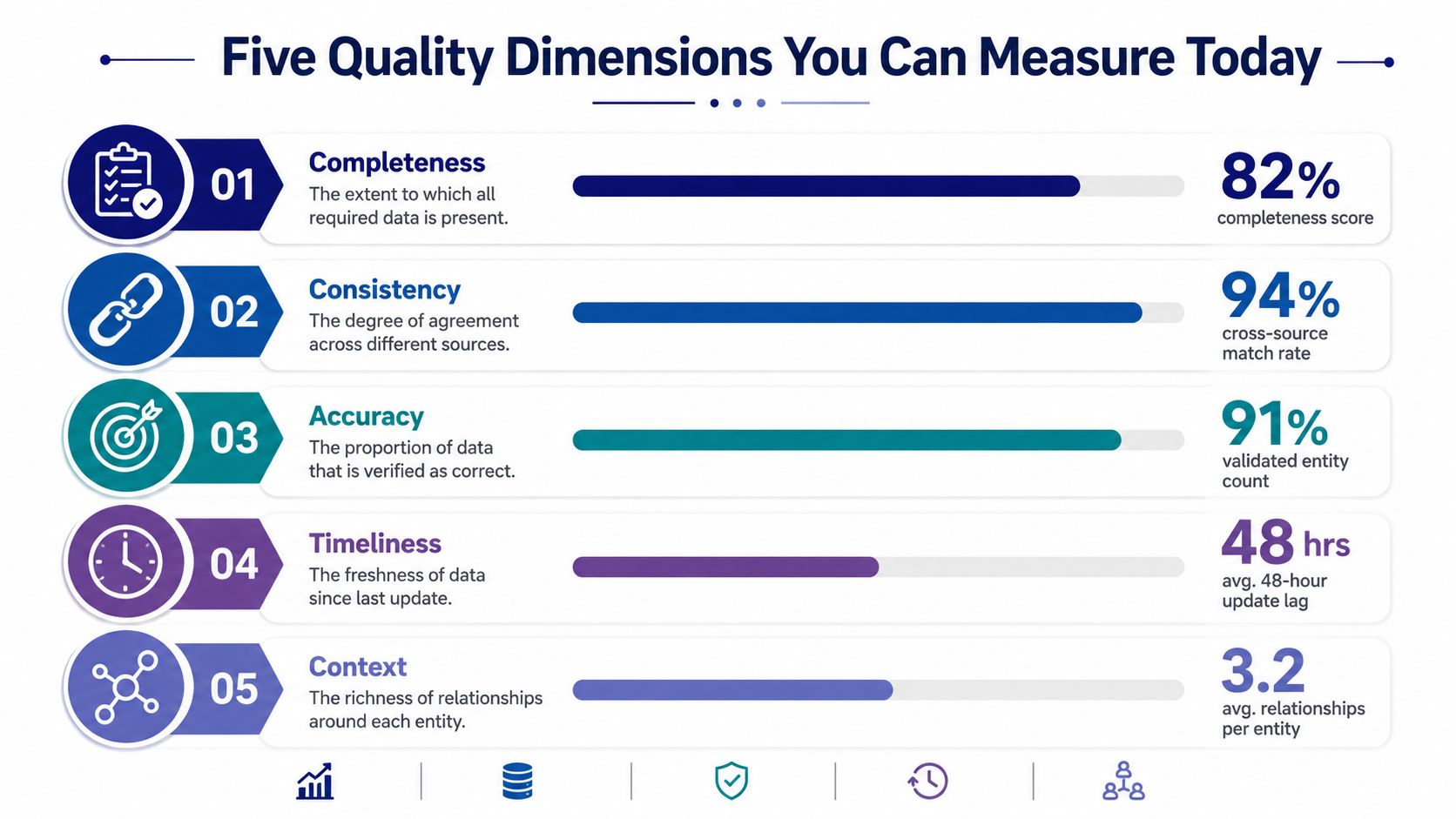
Knowledge graph quality breaks down in predictable ways. A graph can be complete but stale, accurate but duplicated, or consistent on one template and wrong on another. The quality-management literature is explicit about this, which is why a single score rarely tells the truth.
Turn the abstract dimensions into audit checks
Accuracy is the percentage of triples in the knowledge graph that are correct, so the audit question is simple, which claims can be verified against trusted sources or visible page evidence? Consistency asks whether the same entity facts conflict across pages, feeds, and structured data blocks.
Completeness measures whether expected attributes exist. A company entity without legal name, logo, or primary contact is incomplete even if the page looks polished. Timeliness is about freshness, especially for founders, roles, awards, pricing, and service areas that change over time.
Redundancy is the duplicate problem. If one person has three profiles and two bios, the graph can't tell which one to trust. That usually creates citation drift in downstream answers.
Measure the graph the same way you measure content defects
A useful audit process starts with a spreadsheet or graph report and one row per entity. Add columns for source of truth, conflicting facts, missing attributes, and last verified date. Then score each entity by whether the facts are correct, current, and uniquely represented.
Practical rule: if an attribute matters to the business, it needs a named owner, a verification source, and a refresh cadence.
When graphs get large, exact inspection gets expensive. A 2024 paper on graph statistics notes that approximate estimation is often used because exact computation across large graphs can be costly for structural estimation at scale. That's a useful reminder that you don't need to inspect everything before you fix the obvious defects.
For teams that want a practical scoring model, the data quality scorecard guide offers a helpful way to map the dimensions into a working audit sheet. The point is not perfection. It's finding the entities and relations that are hurting trust the most.
The Cyclical Repair Workflow That Actually Works
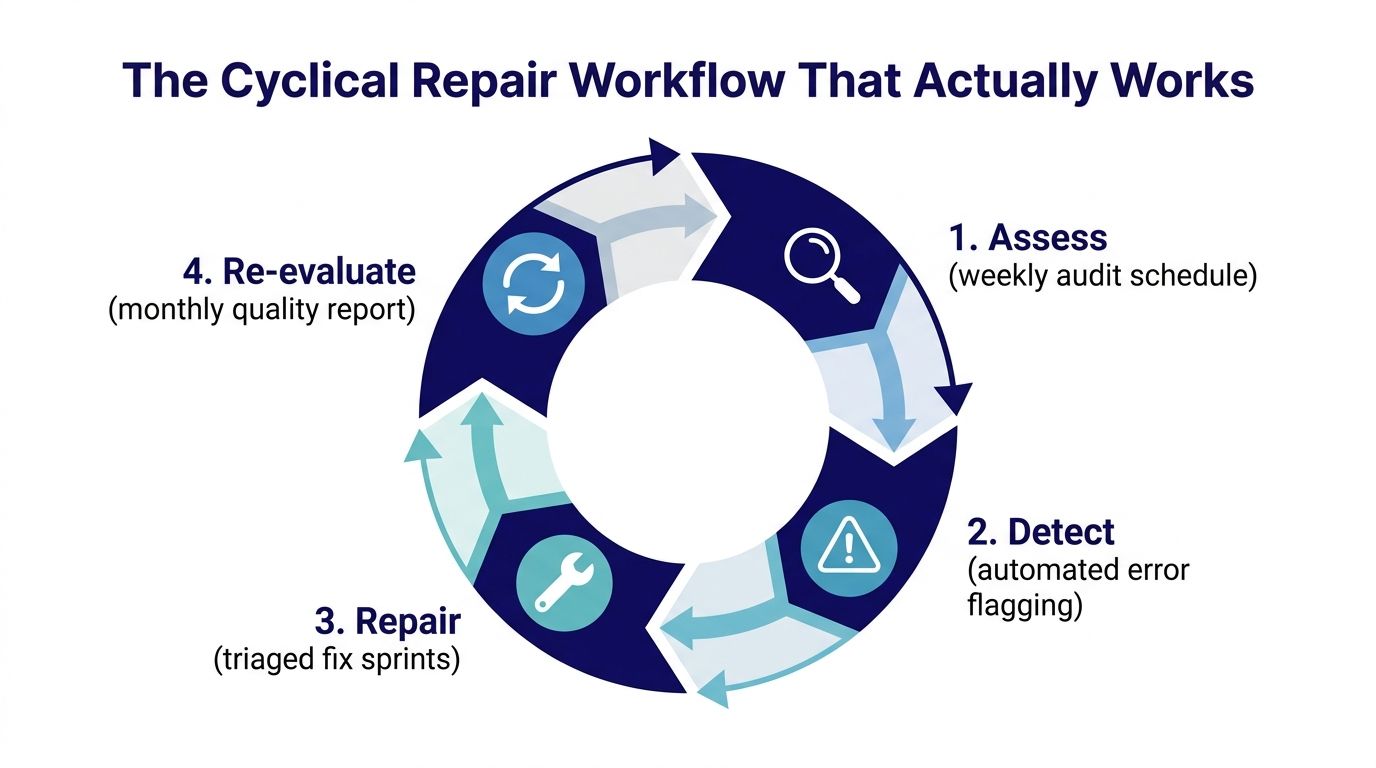
Quality management only works when it repeats. One pass through the graph will catch obvious duplication, but it won't hold up after product launches, rebrands, author changes, or content migrations. The effective workflow is always cyclical, assess, detect, repair, re-evaluate.
Assess first, then look for damage
Start with a weekly audit of the highest-value entities. That usually means the company, core products, executive profiles, and top linked content hubs. Review schema validity, canonical IDs, page content alignment, and external references together, not in separate silos.
Detect before you repair anything
When the graph is too large to inspect manually, use estimated graph statistics to identify likely problem areas first. Look for duplicate entity patterns, missing identifiers, uneven relation density, and stale dates. Those structural clues tell you where the repair work will matter most.
Repair by impact, not by neatness
A duplicate Person entity that fragments brand signals across three URLs should be fixed before a low-value typo in a niche article. If two pages represent the same real person, merge the entity, choose the canonical profile, and redirect or rel-canonical the alternates when that's appropriate for the site architecture. If the pages serve different intents, keep them separate and rewrite the descriptions so the distinction is obvious.
The repair job should always be followed by re-evaluation. That means rerunning the same checks, confirming the duplicate is gone, and checking whether the canonical entity now appears consistently across the affected pages. If the facts still conflict, don't publish more markup. Fix the source content first.
The graph doesn't get cleaner because you touched it once. It gets cleaner because you keep closing the loop.
A monthly report should summarize what changed, which defects recurred, and which templates are generating the most noise. That turns graph maintenance into an operating rhythm instead of a one-time cleanup sprint.
Query Architecture for Fast AI Retrieval
When the graph is used for AI retrieval, speed becomes part of quality. A slow graph may still be correct, but it won't serve product experiences or retrieval workflows reliably if every answer takes too much work to compute. That's why query architecture belongs in optimization, not as a separate ops concern.
Design around real query patterns
Index the properties people filter and sort on. If users search by category, region, author, or product status, those fields need to be easy to traverse. If you don't monitor query patterns over time, you'll keep optimizing the wrong parts of the graph and miss the fields that drive retrieval.
Limiting traversal depth matters too. Deep walks can make a graph feel precise, but they can also drag execution time down and increase compute cost. Shorter, more intentional traversals usually make retrieval more predictable for AI systems that need grounded answers quickly.
Pick the right structure for the access pattern
Adjacency lists work well when you need direct relationships. Inverted indices are useful when the same property is searched from many angles. Graph partitioning helps when the graph is large enough that locality starts affecting performance. The right choice depends on how the system is queried, not on what looks elegant in the model.
For AI retrieval, exact statistics aren't always the first thing you need. Approximate graph statistics can help you decide where to partition, which properties need indexing, and which subgraphs are likely to become hotspots. The goal is to prioritize the most expensive paths before they become production bottlenecks.
The practical trade-off is clear. More traversal freedom can improve expressiveness, but it can also create latency spikes. Faster retrieval usually comes from stricter modeling, clearer indexing, and fewer unnecessary hops. That's the engineering cost of making the graph useful in real-time workflows.
Measuring Outcomes in AI Answers and Knowledge Panels
The only reason to do this work is to change what users and machines can see. If the entity becomes clearer, the business should show up more consistently in AI answers, knowledge panels, and structured citations. Those outcomes are what justify the operational effort.
Track the metrics that map to entity confidence
| Metric | What It Measures | Tracking Cadence |
|---|---|---|
| Brand mention share in AI responses | Whether the brand is named in prompt-based answers | Weekly |
| Structured-data citation frequency | How often the entity appears in SERP features that use markup | Weekly |
| Canonical-identifier presence in external knowledge sources | Whether the same entity can be reconciled outside the site | Monthly |
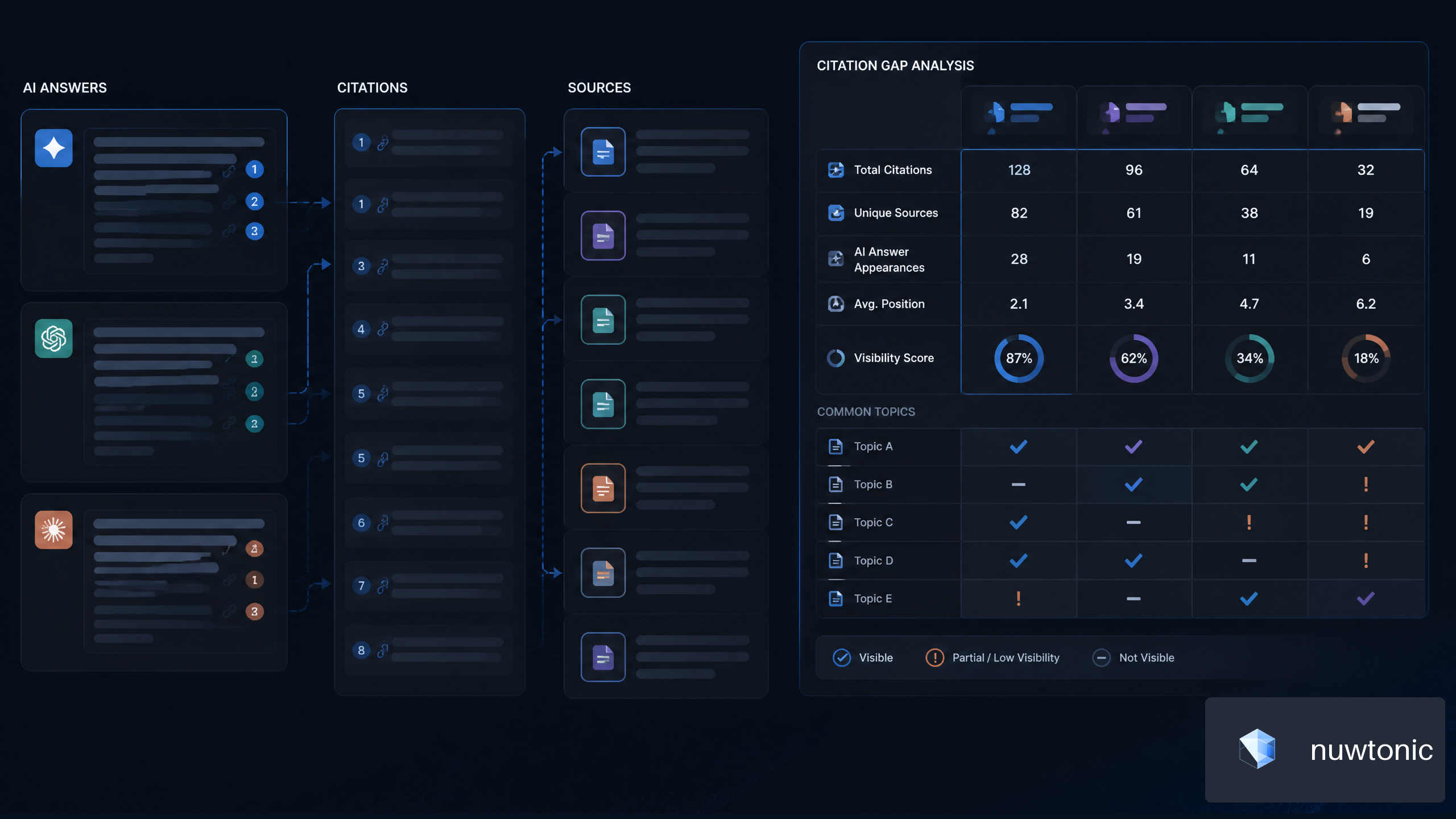
Prompt tracking should focus on the questions customers ask. Brand comparisons, category definitions, and “best X for Y” queries are the most revealing because they expose whether the graph is strong enough to support mention-level inclusion. SERP tracking should look for changes in how the entity appears, not just whether the page ranks.
Use the signal to choose the next fix
If AI answers still skip the brand, go back to canonical identity and external validation. If the brand appears but the description is wrong, the schema and page content are likely out of sync. If structured citations improve but external sources lag, provenance and reconciliation are still too weak.
A weekly review cadence is usually enough to spot movement without overreacting to noise. Monthly is better for entity governance, duplicate cleanup, and cross-template repair. The point is to tie each signal to one clear action so the next optimization cycle is easier to prioritize.
When this gets operationalized well, it stops being a technical hygiene project. It becomes a visibility system for how machines describe the brand.
If you want a team that can connect entity structure, schema fixes, and AI visibility measurement in one workflow, Nuwtonic is built for that kind of execution. It ties prompt tracking, structured audits, and reviewable fixes back to the pages that shape your entity presence. Visit Nuwtonic and use it to turn knowledge graph work into a repeatable visibility program.