Your traffic graph can look healthy while pipeline stays stubbornly flat. That usually happens when the content team is still optimizing for the last era of search, more blog posts, more rankings, more sessions, while buyers are reading summaries inside AI answers and moving through longer, messier sales committees before they ever click through. In a SaaS business, that creates a painful gap, because the dashboard looks busy, but revenue doesn't feel it.
The 2026 playbook has to answer two questions at once. First, are your pages being cited or surfaced by AI systems. Second, is your content helping a buying committee move from curiosity to consensus. If it doesn't do both, it's probably activity masquerading as strategy.
Table of Contents
- The Pipeline Problem Most SaaS Content Programs Miss
- Map Personas and Funnel Stages Before You Write a Word
- Build an Editorial Calendar from Clusters and Entities
- Optimize Every Page for Both Google and AI Answer Engines
- Run Production and Approvals Through a Review-Before-Deploy Workflow
- Measure Pipeline Quality, Not Just Sessions and MQLs
- Your 90-Day Rollout and the Nuwtonic Stack Behind It
The Pipeline Problem Most SaaS Content Programs Miss
A SaaS team can ship ten posts a month, watch organic clicks rise, and still lose the quarter in revenue review. That's the trap. The content looks active, the team looks productive, and the board deck looks full, but the pages aren't moving deals because they were planned around traffic, not around buyer intent or AI visibility.
The shift is visible in the market. Blogging is now close to universal in SaaS, with 98% of companies using a blog and 90% using blog posts in their marketing strategy, while 57% of top B2B tech companies outsource SaaS content marketing, which signals a mature operational function rather than an experimental side channel. SaaS companies are also reported to spend $342,000 to $1,090,000 annually on content marketing, and 65% spend more than $3,000 per month. Those numbers, from the Mailmodo SaaS content marketing statistics roundup, show that content is no longer a cheap support play, it's a real growth system.
Practical rule: If the content plan can't explain how a page helps a buying committee or earns a citation in an answer engine, it isn't ready for budget.
The teams that keep winning don't start with “what can we publish.” They start with “what must exist for a buyer to feel safe enough to move.” That usually means a conversion-oriented page first, then the supporting educational layer around it. One practical playbook says most SaaS teams see organic traffic gains in 3–4 months, revenue impact in 6–9 months, and break even around 7 months over a three-year horizon, but that only matters if measurement follows attributable revenue and not vanity metrics, as outlined in the SaaS content marketing workflow guide. Only 31% of content teams track revenue attribution rather than traffic, which explains why so many programs get cut just when they start to work.
The core operating question in 2026 is whether content is visible in search and cited in AI answers, while also helping sales committees make progress. That's the lens for the rest of this playbook.
Map Personas and Funnel Stages Before You Write a Word
Start by shrinking the ICP into a few named people the team can write for. If the audience is mid-market SaaS, don't stop at “marketing leaders.” Split the field into the RevOps leader who owns process, the demand gen manager who owns volume, and the CRO or VP Sales who wants pipeline quality. Each one reads for a different reason, and each one needs a different next step.
Build one-page persona briefs
A usable persona brief fits on one page. It should name the role, the business trigger, the biggest fear, the buying objection, and the proof that would change their mind. Then attach a funnel stage to that persona, not in theory, but in the content calendar. A RevOps leader usually meets a pricing comparison or implementation guide before a fluffy educational post, because they're closer to technical validation than broad awareness.
For a mid-market SaaS selling into RevOps, the first ten articles should usually favor bottom-of-funnel assets. That's the highest-probability path to revenue because the buyer is already comparing options, checking fit, or trying to reduce internal risk. A useful external reference on positioning the wider content system is WaveGen's B2B content strategy for 2026, especially if your team needs a way to connect persona intent with publication priorities.
Write for the objection, not just the job title.
Use competitor questions to sharpen the brief
Before the editorial team commits topics, pull the questions competitors already answer. The SERP Rank Tracking and Competitor Intelligence modules in Nuwtonic are built for that kind of scan, because they show which pages are already owning the queries your personas care about and where gaps still exist. The point isn't to copy the market, it's to avoid wasting slots on questions the category has already exhausted.
A strong persona brief then feeds directly into the editorial brief template. That brief should carry the persona, funnel stage, primary objection, preferred proof type, and the exact action you want next, such as trial, demo, or sales conversation. If a topic can't be traced back to one of those fields, it usually belongs in a later phase, not the first wave.
Build an Editorial Calendar from Clusters and Entities
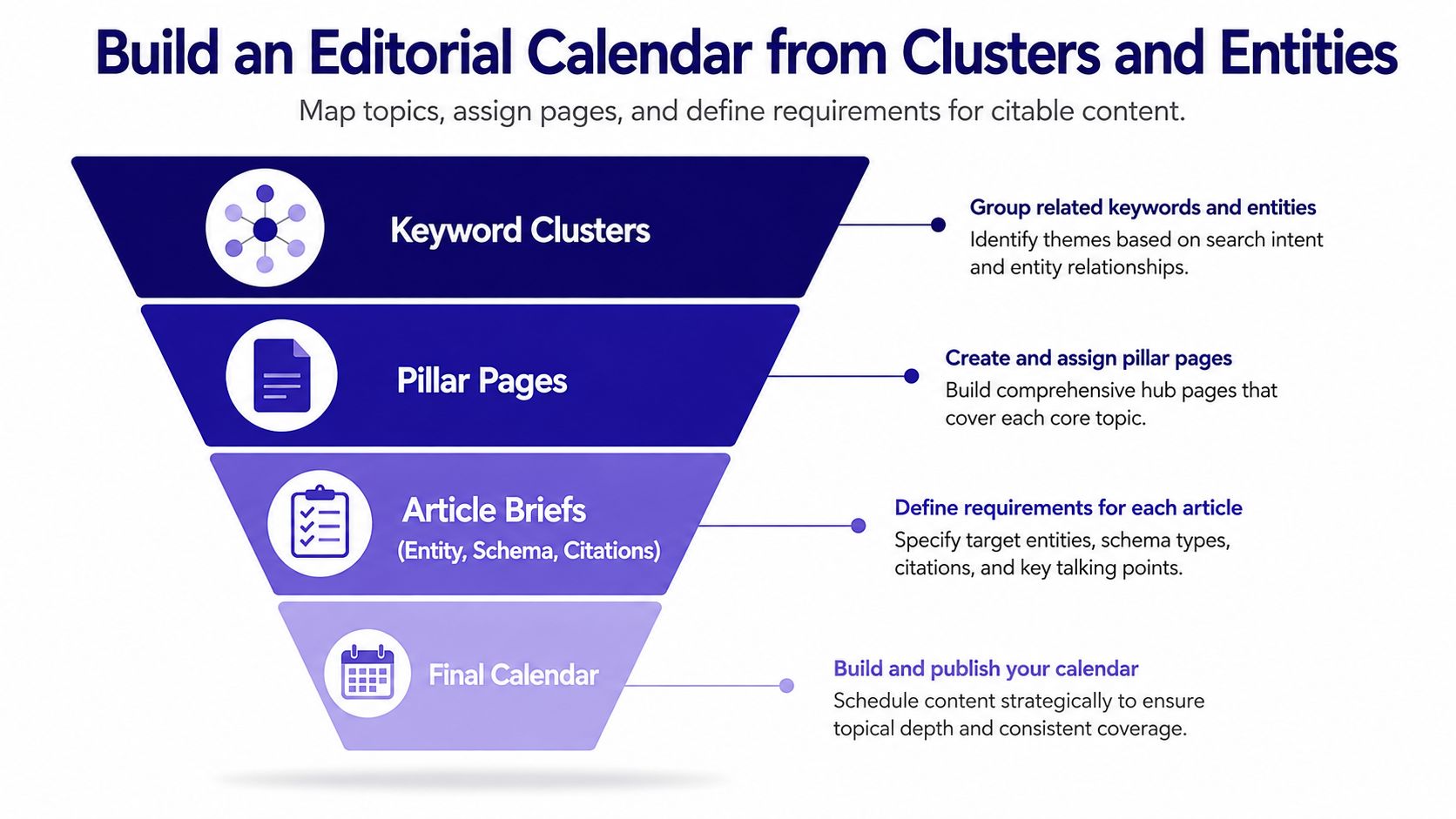
An editorial calendar that works for SaaS isn't a list of posts. It's a production map that connects one pillar page, the supporting cluster, and the proof assets that make the cluster credible. The teams that guess at topics end up with thin overlap and weak internal linking. The teams that cluster intentionally get a cleaner authority structure and fewer dead-end pages.
Start with a cluster, not a keyword
Take “customer health scoring” as the example. The pillar page should define the concept, explain who uses it, and anchor the business case. Supporting posts can cover scoring models, common inputs, and implementation questions. Then add a comparison piece that weighs manual scoring against platform-based approaches, plus a case study that shows the metric in practice. That mix gives search engines a cleaner entity map and gives sales something more concrete than an abstract explainer.
The Topical Map guide is useful here because the calendar should mirror how topical authority builds, not how a spreadsheet looks after a brainstorming session. In practice, the calendar should show cluster name, pillar URL, supporting URLs, target persona, funnel stage, and the entity requirements for each asset.
Use authority signals, not guesswork
Nuwtonic's SiteWise topical maps and Topical Authority Builder are designed to use GSC patterns to suggest cluster opportunities the site is more likely to win. That matters because the right calendar isn't just broad coverage, it's coverage the domain can credibly own. A broad calendar with no topical depth creates more pages, not more authority.
If you need an outside reference for structuring the broader content system, revid.ai's audience growth content plan is a useful companion read. It's especially helpful if your team is aligning content with audience growth rather than just topic volume.
Use this simple build order:
- Name the pillar topic and define the commercial angle.
- List supporting questions that belong under that pillar.
- Assign each article an entity set, such as product category terms, integrations, use cases, and proof points.
- Specify citations and schema needs so each piece is citable, not just readable.
- Place everything on one calendar with publication order and internal link targets.
The calendar becomes production-ready when every row answers two questions, what topical job it does, and what entity it strengthens.
Optimize Every Page for Both Google and AI Answer Engines
Classic on-page SEO still matters, but in 2026 it's not enough to optimize for keywords and metadata alone. Pages need to be clear enough for Google to understand, structured enough for AI systems to cite, and explicit enough that a sales committee can follow the reasoning without hunting for context. That means the page has to pass a lot more than a title-tag check.
Treat entity clarity as a publishing requirement
A good SaaS page names the product category, the use case, the buyer, and the proof. It doesn't hide the subject inside clever copy. If the page is about customer health scoring, say so early and define the term in a way an AI system can parse cleanly. If the page is a comparison, make the comparison obvious, and avoid burying the conclusion in the final paragraph.
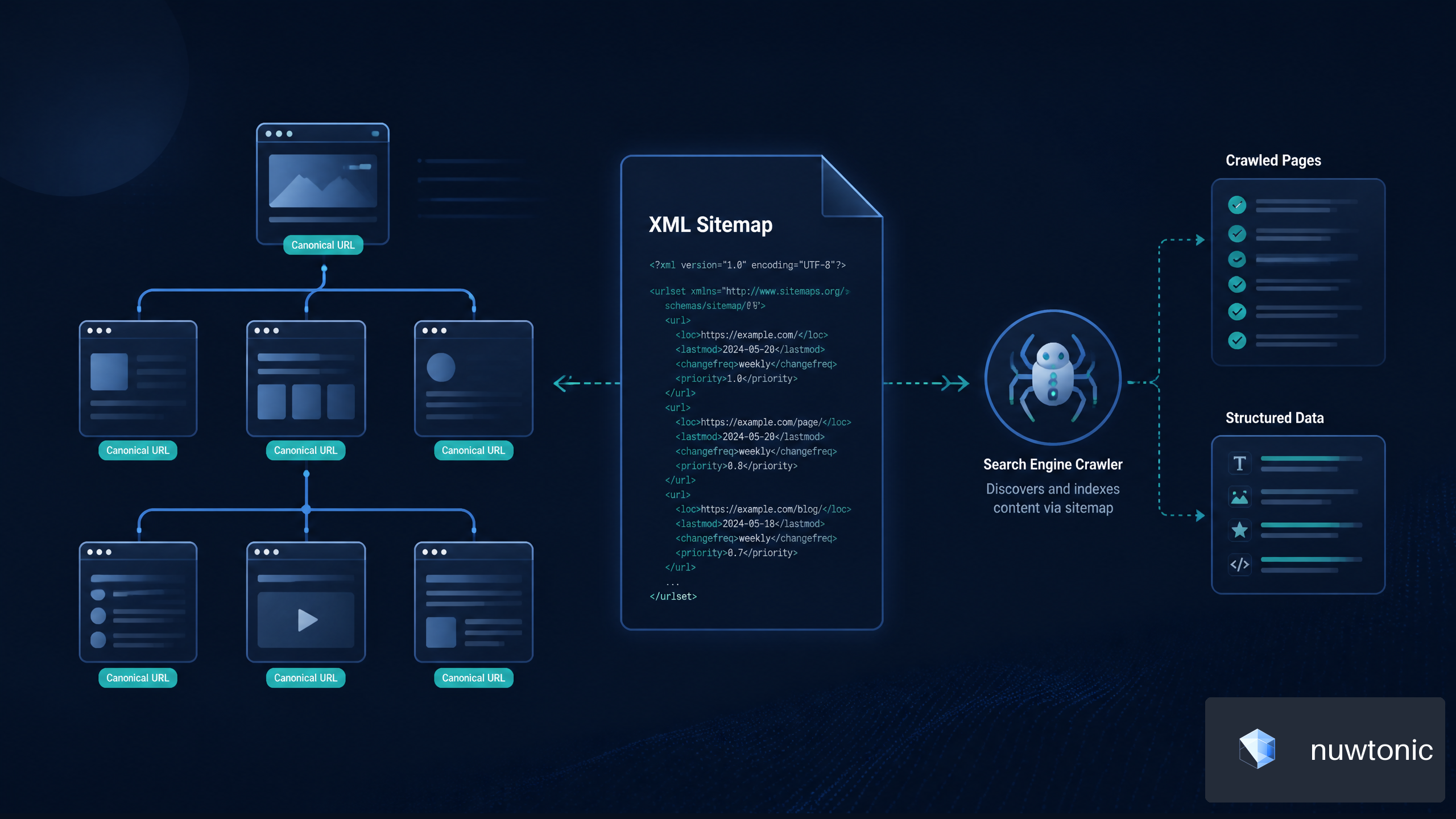
That's the logic behind Nuwtonic's GEO Audit, which checks for AI visibility across more than a hundred structural signals, and the On-Page SEO Audit, which pushes CMS-ready fixes for metadata, schema, alt text, and related elements. The workflow isn't just “find problems,” it's “fix the page in a way that survives publication.” The guide on ranking in AI Overviews is a good external reference if you want another framework for source eligibility and answer-first formatting.
The best AI-visible page is usually the one that reads like a complete answer, not a keyword exercise.
Track visibility where buyers actually ask questions
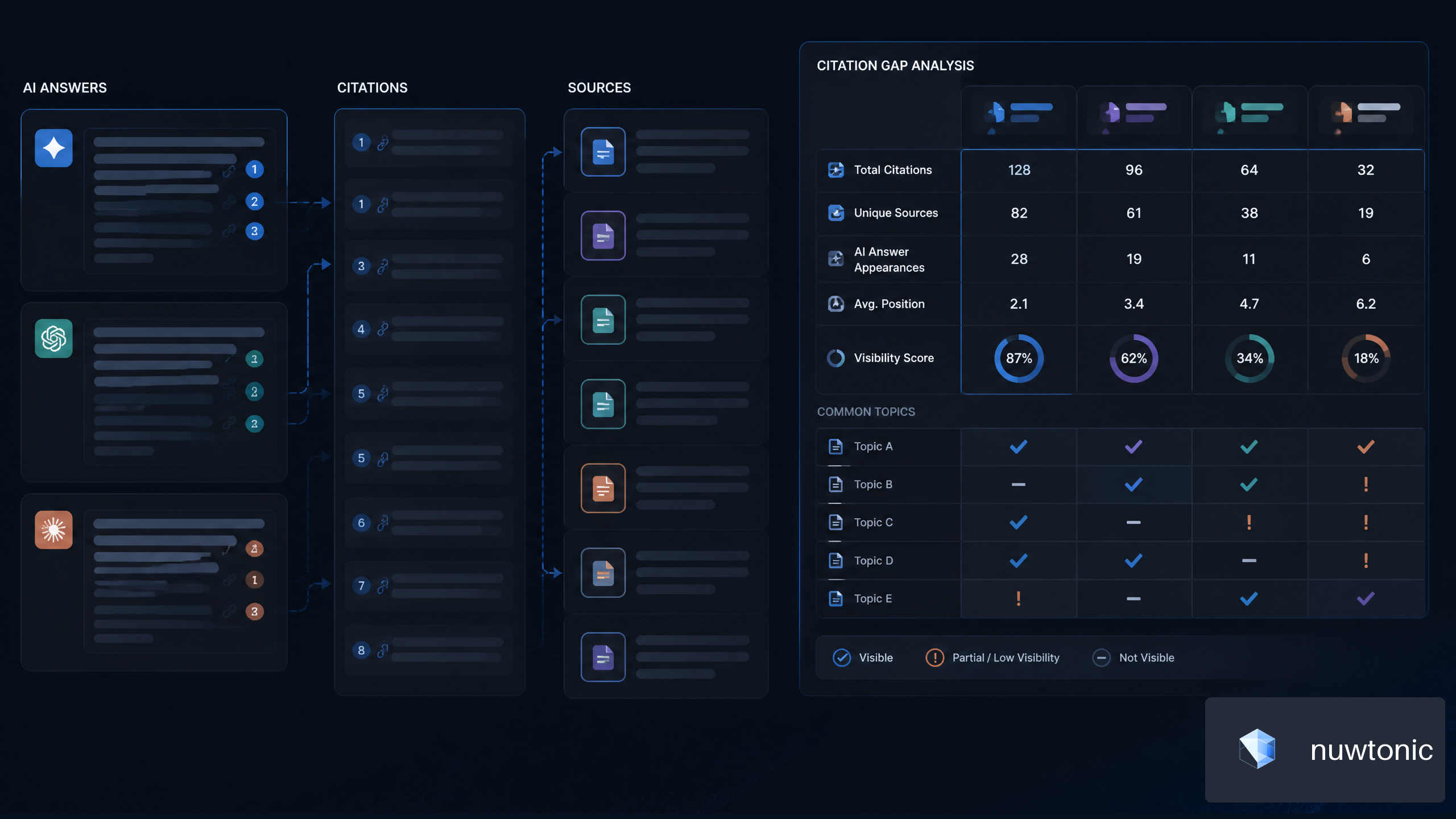
The AI Search Agent in Nuwtonic measures brand visibility across ChatGPT, Gemini, Perplexity, Claude, Google AI Overviews, and Grok, then turns prompt-level visibility into URL-level remediation work. That matters because teams can't fix what they can't see. If the prompt answer mentions competitors and skips your page, the fix usually lives in structure, clarity, or sourceability, not in writing another generic post.
A practical before-and-after lens helps:
- Metadata before: title and description exist, but they don't clarify intent. After, they state the use case and buyer angle.
- Schema before: basic markup is missing or partial. After, structured data reinforces the page type and entity relationships.
- Internal links before: articles float alone. After, they point to the pillar, the comparison page, and the proof asset.
- Alt text before: decorative descriptions. After, the image alt text reinforces the page's main entity.
The internal link that belongs with this stage is optimize content for AI search, because the work only pays off when the page is both readable and retrievable by answer engines. Keep that focus, and on-page work stops being cosmetic.
Run Production and Approvals Through a Review-Before-Deploy Workflow
Most SaaS content teams don't fail because they can't write. They fail because draft review, SEO review, legal review, and brand review all happen in different tools, with different people, and no real change control. That creates silent edits, version confusion, and content that gets published after the original brief is no longer current.
Move the work through a Kanban, not a pile of docs
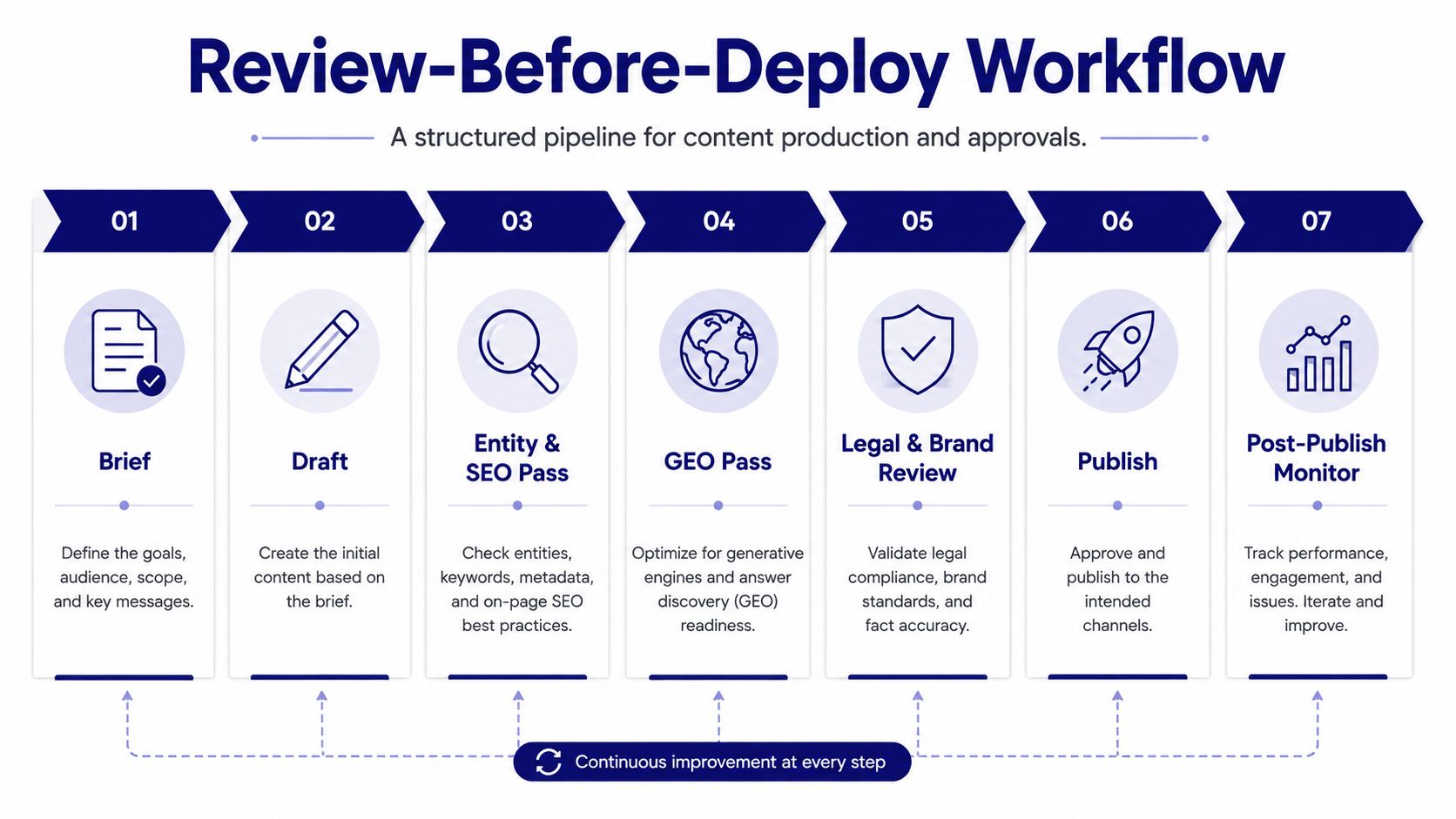
The cleanest workflow is simple. Brief. Draft. Entity and SEO pass. GEO pass. Legal and brand review. Publish. Post-publish monitor. Each stage has one owner, one checklist, and one exit condition. If a stage doesn't have a clear exit condition, it turns into a parking lot.
Content Autopilot fits this kind of flow because it supports scheduling, bulk publishing, and a Smart AI Edit pass while keeping humans in control. The useful part isn't the automation alone. It's that the review-before-deploy model keeps previews visible, avoids automatic changes by default, and preserves permissioned roles so nobody pushes a risky update without sign-off. That's the right posture for SaaS, where a wrong claim or a broken comparison page can create sales friction fast.
Ship a pillar in days, not in endless revision loops
A 1,200-word pillar can move through this board in five business days if the team is disciplined. Day one, the brief and outline get approved. Day two, the draft lands. Day three, the entity and SEO pass cleans the structure. Day four, legal and brand review checks the final wording. Day five, publish and monitor.
Keep the approval chain short enough that the content still matches the market question you set out to answer.
The internal reference that fits this workflow is generative AI for content creation, because the point of AI assistance is speed with governance, not speed without control. Once the board is working, the team can scale output without losing edit discipline.
The mistake to avoid is letting distribution happen before approval. That usually produces scattered updates, broken URLs, and lower trust from sales. A review-before-deploy process slows the wrong kind of motion and speeds the right kind.
Measure Pipeline Quality, Not Just Sessions and MQLs
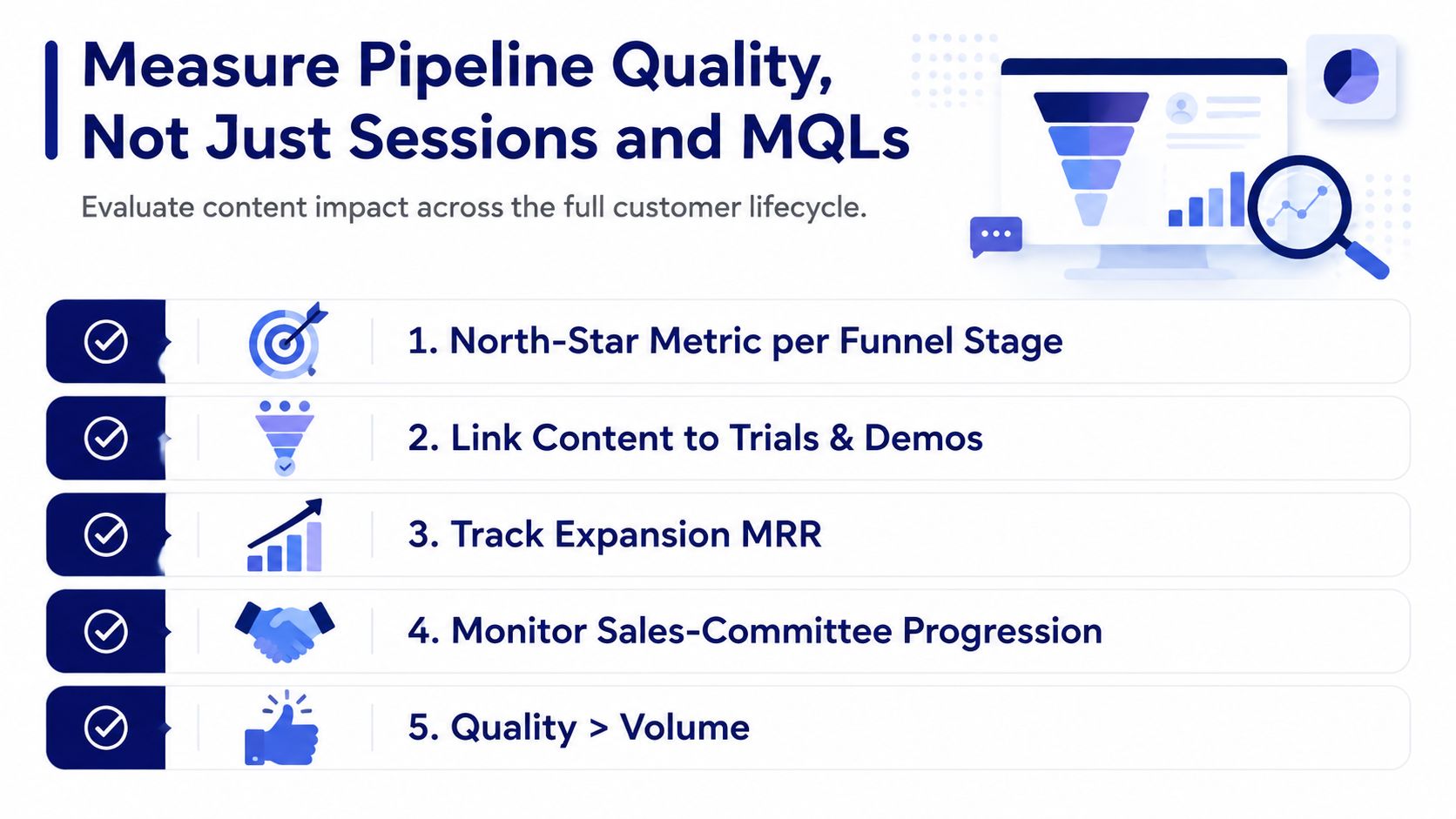
Traffic is a visibility metric, not a business outcome. If a SaaS content program can't show movement into trials, demos, expansion MRR, or buying-committee progression, it's reporting on attention rather than contribution. That's why the measurement layer has to be built around commercial movement, not just audience activity.
Set one north-star metric per stage
Discovery can be measured through impressions and organic clicks, but conversion needs a more durable metric, such as paid subscriptions, MRR, or ARR. That stage-by-stage discipline is useful because it prevents the common mistake of optimizing every page for the same outcome. A comparison page, a case study, and an educational article should not all be judged the same way.
The GSC Performance Dashboard in Nuwtonic helps here because it turns query trends, CTR drops, and performance changes into prioritized actions instead of generic reporting. If a page is losing clicks on a high-intent query, the fix should be specific, not buried in a monthly deck. That's also where the Mobile Opportunity Gap analysis matters in practice, because desktop visibility doesn't always translate into the same result on mobile, and those gaps need different fixes.
Wire attribution into the CRM
Content attribution breaks when teams rely on traffic alone. It works better when first-party tracking is connected to the CRM so the team can see which articles appeared before a demo, which comparison pages helped a deal move forward, and which assets correlate with expansion conversations. One industry benchmark notes that only 31% of teams track revenue attribution rather than traffic, which is why so many reports overstate success.
A practical measurement stack should include:
- Trials and demos for conversion-oriented assets.
- Expansion MRR for post-sale content that helps adoption and upsell.
- Sales-committee progression for content that helps multiple stakeholders reach consensus.
- Qualified pipeline contribution so the team sees whether the right opportunities are influenced.
- Quality over volume as the reporting standard, because high traffic without fit doesn't pay the bill.
Use a single north-star metric per funnel stage, then connect each page to the stage it's meant to move. That's the easiest way to keep the team honest and keep budget tied to real business motion.
Your 90-Day Rollout and the Nuwtonic Stack Behind It
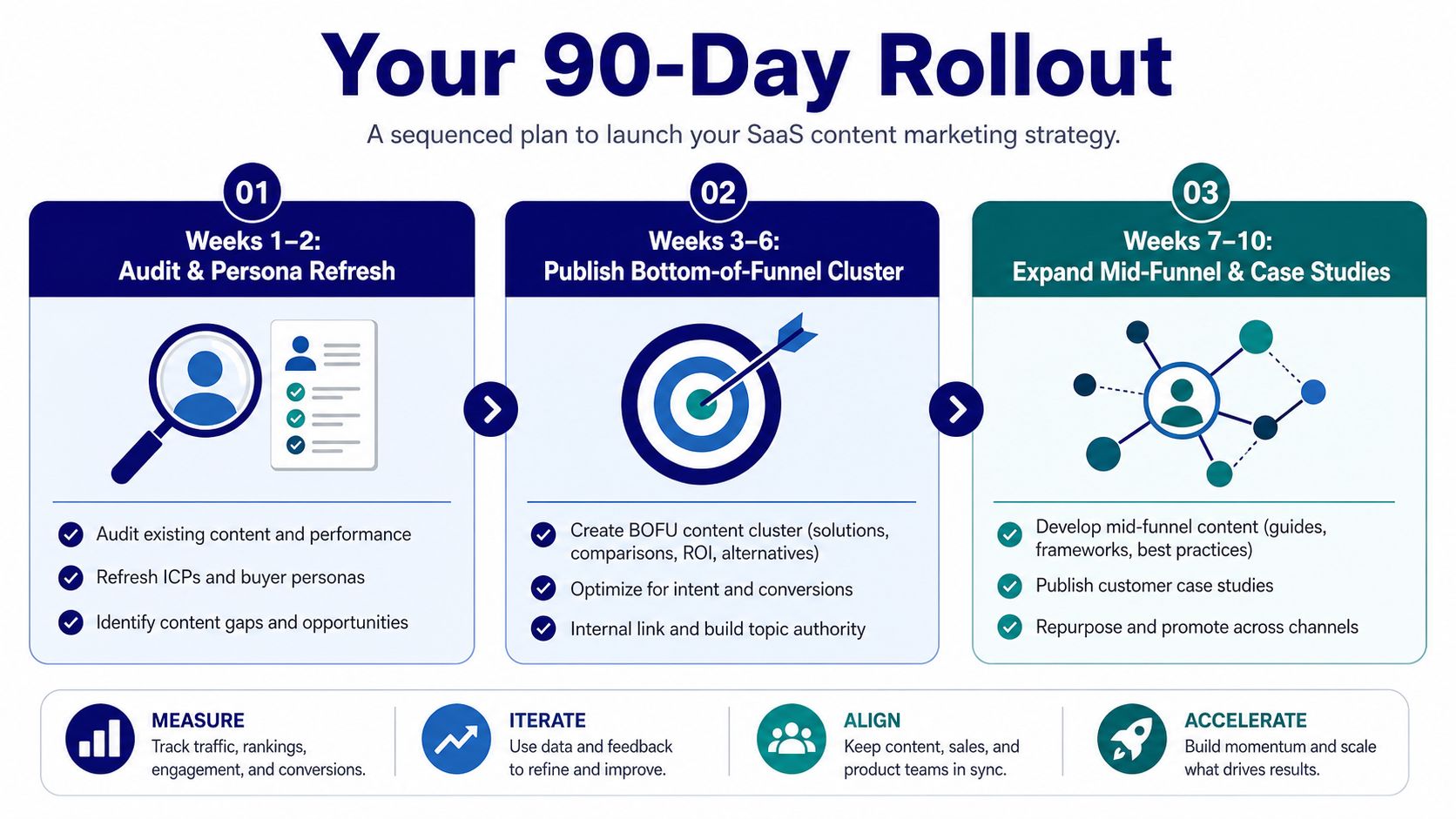
The cleanest rollout starts with the parts most likely to affect revenue, then adds the visibility and optimization layer after the foundation exists. Weeks 1–2 are for audit and persona refresh. Weeks 3–6 are for the bottom-of-funnel cluster. Weeks 7–10 expand into mid-funnel content and case studies. Weeks 11–13 layer in GEO and AI-search tracking.
Match each phase to the right module
The first two weeks lean on Competitor Intelligence, SERP rank tracking, and Cannibalization Tracker to identify what already exists, what's overlapping, and where the site is losing share. The next four weeks use the Topical Authority Builder and SiteWise topical maps to define the cluster and publish the conversion assets first. Mid-funnel expansion can then move through Content Autopilot and the editorial workflow, while the GEO layer uses GEO Audit, On-Page Auto-Fix, and AI Search Agent to validate answer-engine visibility.
If the team needs one place to run the work, Nuwtonic ties those modules together with review-before-deploy controls, API and webhooks for agency rollouts, and permissioned publishing. It's not a replacement for strategy, but it does give the team a single execution layer for the strategy they've already committed to.
Stop doing these three things this quarter
- Stop publishing around keyword volume alone. If the topic doesn't map to a buyer question or a sales objection, it's probably a distraction.
- Stop reporting only traffic and MQLs. If pipeline quality isn't visible, the content team will keep defending the wrong metric.
- Stop letting pages drift after publish. Review, monitor, and refresh matters as much as the first draft.
The teams that win in 2026 will treat saas content marketing as a discoverability system, not a blog factory. They'll build for AI citations, buying-committee progression, and measurable pipeline movement in the same operating model.
If you're ready to turn content into a pipeline system instead of a traffic engine, visit Nuwtonic and see how the GEO Audit, AI Search Agent, Content Autopilot, and topical mapping tools fit into one reviewable workflow. It's built for teams that want content to show up in AI answers, move through approvals cleanly, and connect back to revenue.