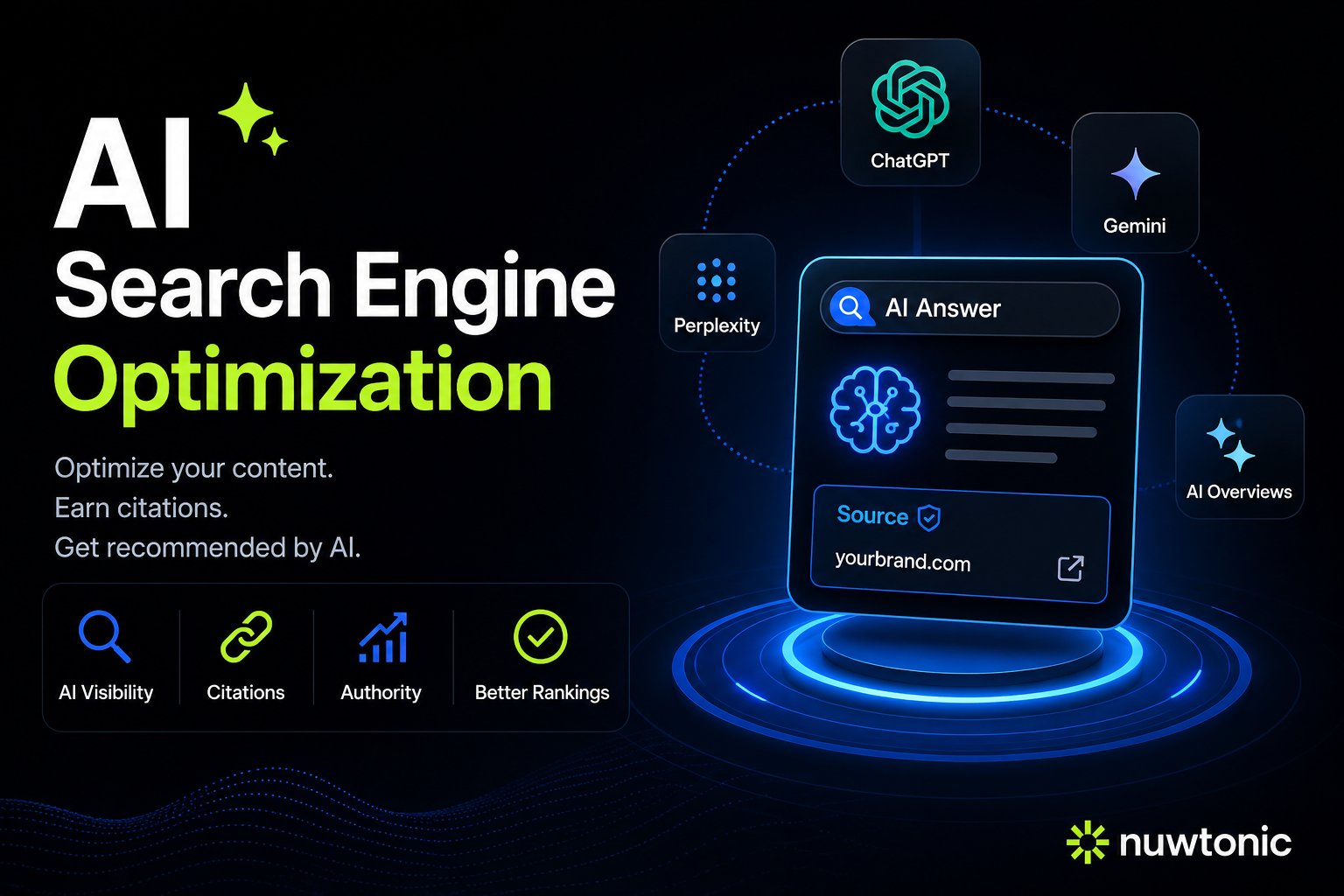
AI search engine optimization changed the search game because the click is no longer the main event. In a July 2025 Pew Research Center analysis of 68,879 searches, users clicked a traditional organic result only 8% of the time when a Google AI Overview was present, compared with 15% without one, a 47% relative CTR drop. Independent reporting also puts zero-click behavior at roughly 60% of searches, which means visibility now depends on being cited, summarized, and selected inside the answer itself rather than only earning a blue-link visit.
That shift makes ranking reports incomplete on their own. A page can still show up in the ecosystem and still lose the downstream interaction that used to justify the work. The teams that adapt fastest are the ones that treat AI search as a measurement and execution problem, then connect prompts, citations, and content changes to inclusion outcomes in a repeatable workflow.
Table of Contents
- Why AI Search Engine Optimization Is the New Default
- AI SEO vs Traditional SEO Where the Rules Actually Change
- Measuring AI Visibility at the URL and Citation Level
- Entity-First Content and Schema That AI Engines Can Read
- The Weekly Prompt Tracking and Remediation Workflow
- Original Research and Statistics as Citation Magnets
- A Recovery Playbook Using Nuwtonic From Drop Detection to Shipped Fixes
Why AI Search Engine Optimization Is the New Default
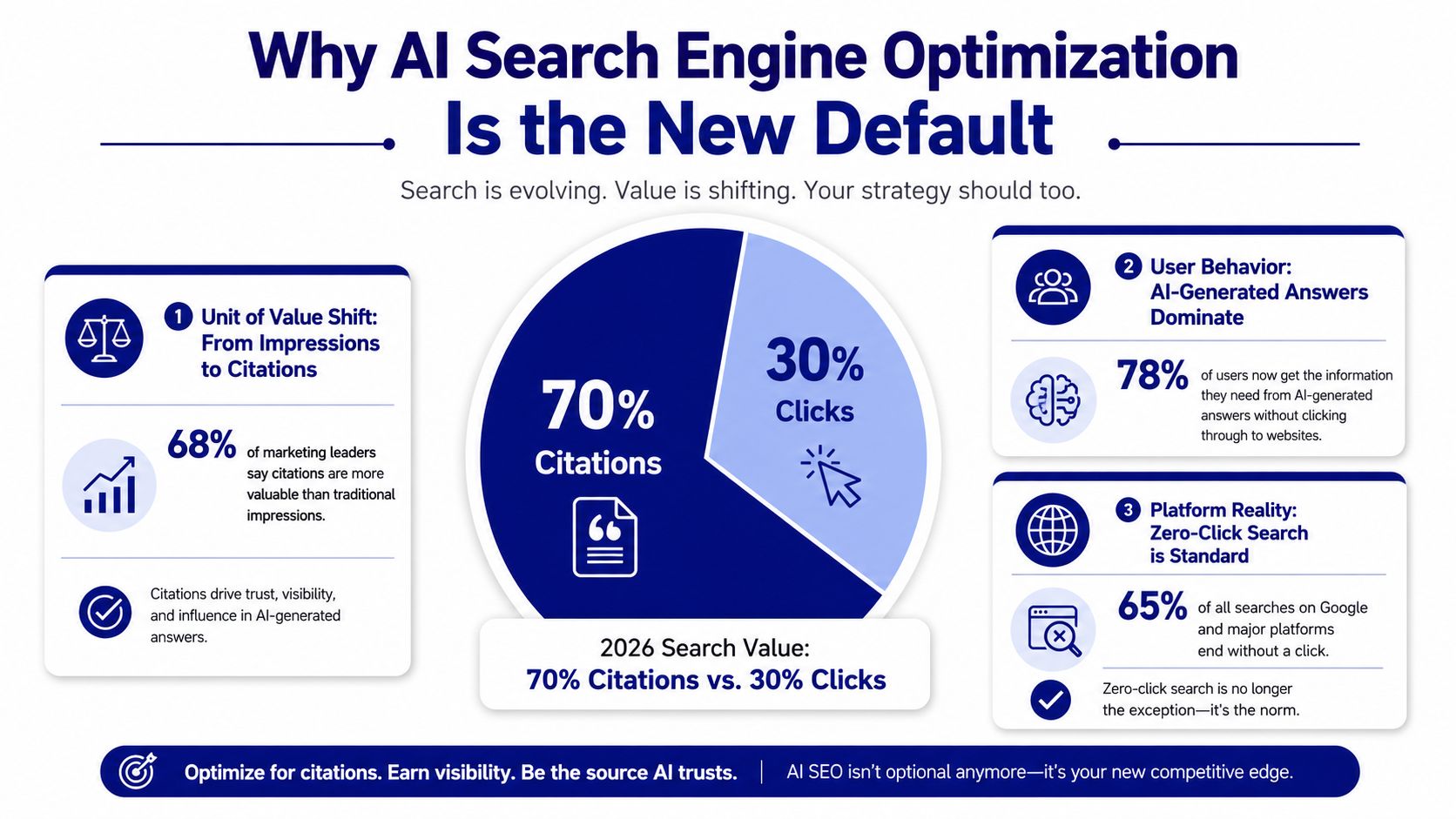
Google's AI Overviews are no longer a fringe feature. Reporting cited in 2026 puts them at about 2 billion monthly users globally, and BrightEdge data cited in the same reporting shows AI Overviews reaching about 48% of tracked queries, up 58% year over year from roughly 30% a year earlier. That matters because informational queries, the kind that drive top-of-funnel discovery, are exactly where the zero-click behavior shows up most often.
The practical result is simple. Traditional SEO dashboards overvalue impressions and understate whether a page influenced the answer. When the answer itself becomes the destination, the unit of value shifts from rank position to answer inclusion, citation presence, and brand recall. That is why teams can keep “performing” in a legacy report while still losing the business outcome they care about.
Practical rule: if your report only shows rankings and clicks, it is already incomplete for AI-led search.
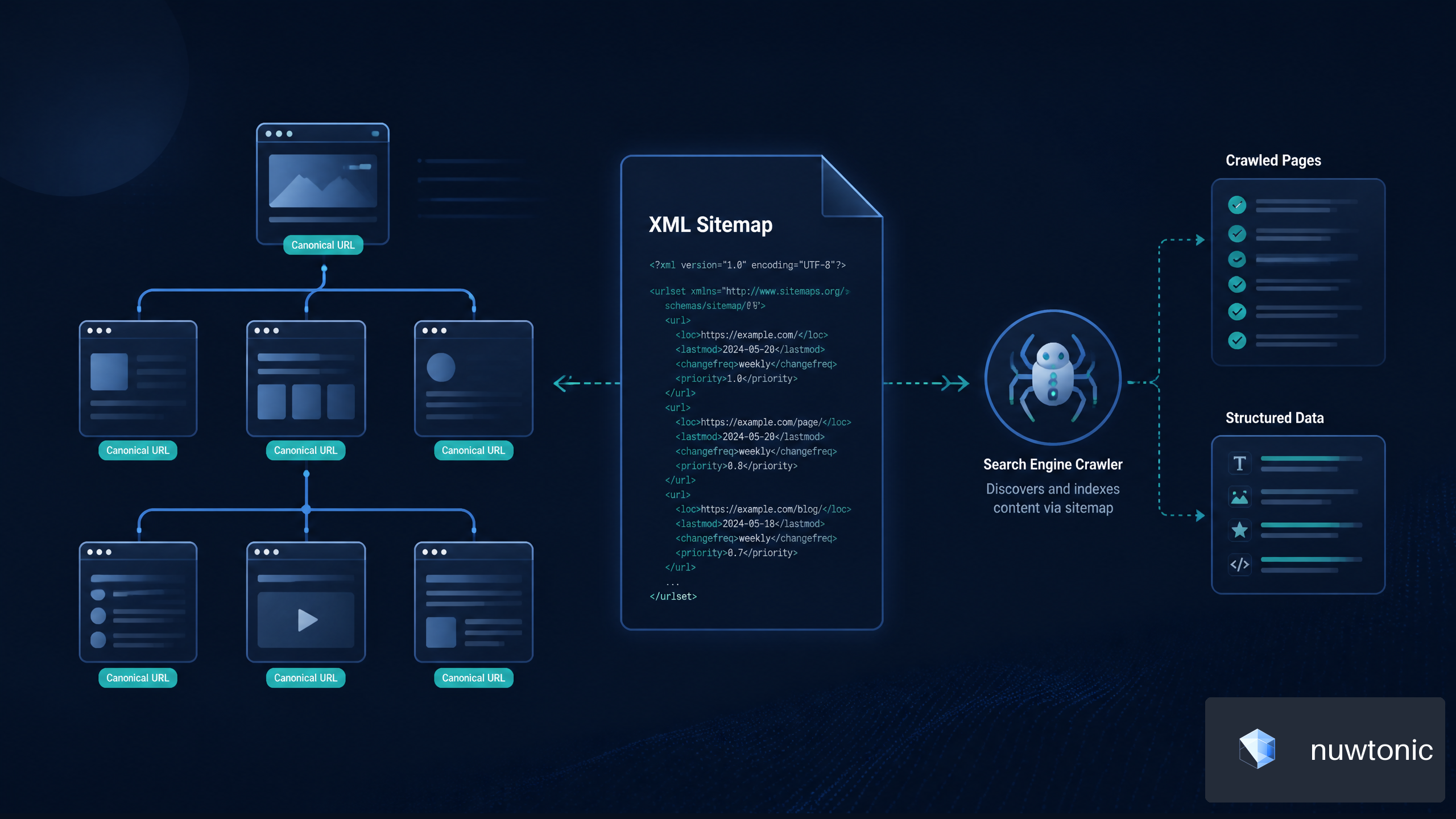
A lot of internal debates still get stuck on whether AI search is “real SEO.” That framing misses the operational issue. Google's own guidance for generative optimization still centers on fundamentals like crawlability, canonical hygiene, and page experience for the users who do click through, which means the work is not exotic. It's just broader than classic rank-chasing.
If you're still counting success only by landing page sessions, you're measuring too late. The winning teams are watching where the answer was assembled, which source got cited, and whether the brand was memorable enough to get picked when the click was no longer guaranteed.
AI SEO vs Traditional SEO Where the Rules Actually Change
Classic SEO and AI inclusion-driven optimization share a base layer, but they do not reward the same behaviors equally. Ranking systems still care about crawlability, metadata, internal links, and authority signals. AI systems also care about whether the page can be parsed into clean, answer-ready pieces that are easy to cite in a synthesis.
What carries over and what changes
Traditional SEO still starts with discoverability. Google's AI optimization guidance says the basics matter, including clean indexing, duplicate-content control, and a good page experience. Those fundamentals don't disappear just because a query may be answered by a model instead of a blue-link list.
What changes is the shape of the content that gets rewarded. Ahrefs data cited in 2026 reporting found that 99.9% of keywords triggering AI Overviews are informational, with only 5.5% commercial, 1.2% transactional, and 0.1% navigational. That tells you where the early battle was fought, informational pages that needed concise definitions, short steps, and entity relationships that AI systems could lift cleanly.
A useful comparison is this:
| Classic SEO signal | AI inclusion signal |
|---|---|
| Page rank target | Citation or mention inside the answer |
| Click-through rate | Answer presence and source visibility |
| Keyword mapping | Prompt and intent mapping |
| Long-form coverage | Modular, answerable sections |
| Link equity emphasis | Citation-worthiness plus extractability |
The habits that break most often are the ones that depend on “more content” being the answer. More words without sharper structure rarely help. A better example is a product or service page with clear entity definitions, scoped sections, and concise claims that are easy for the model to reuse without confusion.
For teams cleaning up output before publication, a practical editing pass can help the page sound less mechanical and more selection-ready. If you need a reference point for that style of cleanup, improve AI drafts for search is a useful read because it focuses on readability without pretending structure alone is enough.
The goal is no longer to win a search result, but to be the source a model trusts when it composes the answer.
The other habit to retire is treating every query like a commercial page should rank for it. AI Overviews are still heavily informational in the current data, so forcing sales language into educational content usually hurts inclusion rather than helping it. For a more detailed framework on the broader GEO model, the internal primer on generative engine optimization is the right companion piece.
Measuring AI Visibility at the URL and Citation Level
McKinsey's warning is directionally right, even if the market still talks about AI search like a formatting exercise. You need a robust diagnostic that shows where GEO value is at risk, which pages are being used in answers, and whether owned or third-party content is carrying the citation. Without that, optimization becomes guesswork.
The measurement stack that actually answers the right questions
Start with the prompt, not the page. Track the exact questions that matter to your category, then map each prompt to one or more URLs that should be eligible for citation. That is the only reliable way to tell whether a page is missing from answers because of structure, authority, freshness, or topic mismatch.
| AI Visibility Measurement Layer | Question Answered | Source |
|---|---|---|
| Prompt set | What are users asking in AI tools? | Internal prompt library |
| Citation tracking | Which sources are being cited? | AI answer logs |
| URL ownership | Which page should win inclusion? | Content inventory |
| Gap analysis | Where is the page absent or weak? | Prompt-to-page map |
| Value at risk | Which themes are losing inclusion? | Executive reporting |
The important distinction is that a mention is not the same as a citation, and a citation is not the same as the right URL. URL-level visibility matters because the wrong page can satisfy the model while starving the page that should carry the business outcome. That is why the current reporting gap is so expensive.
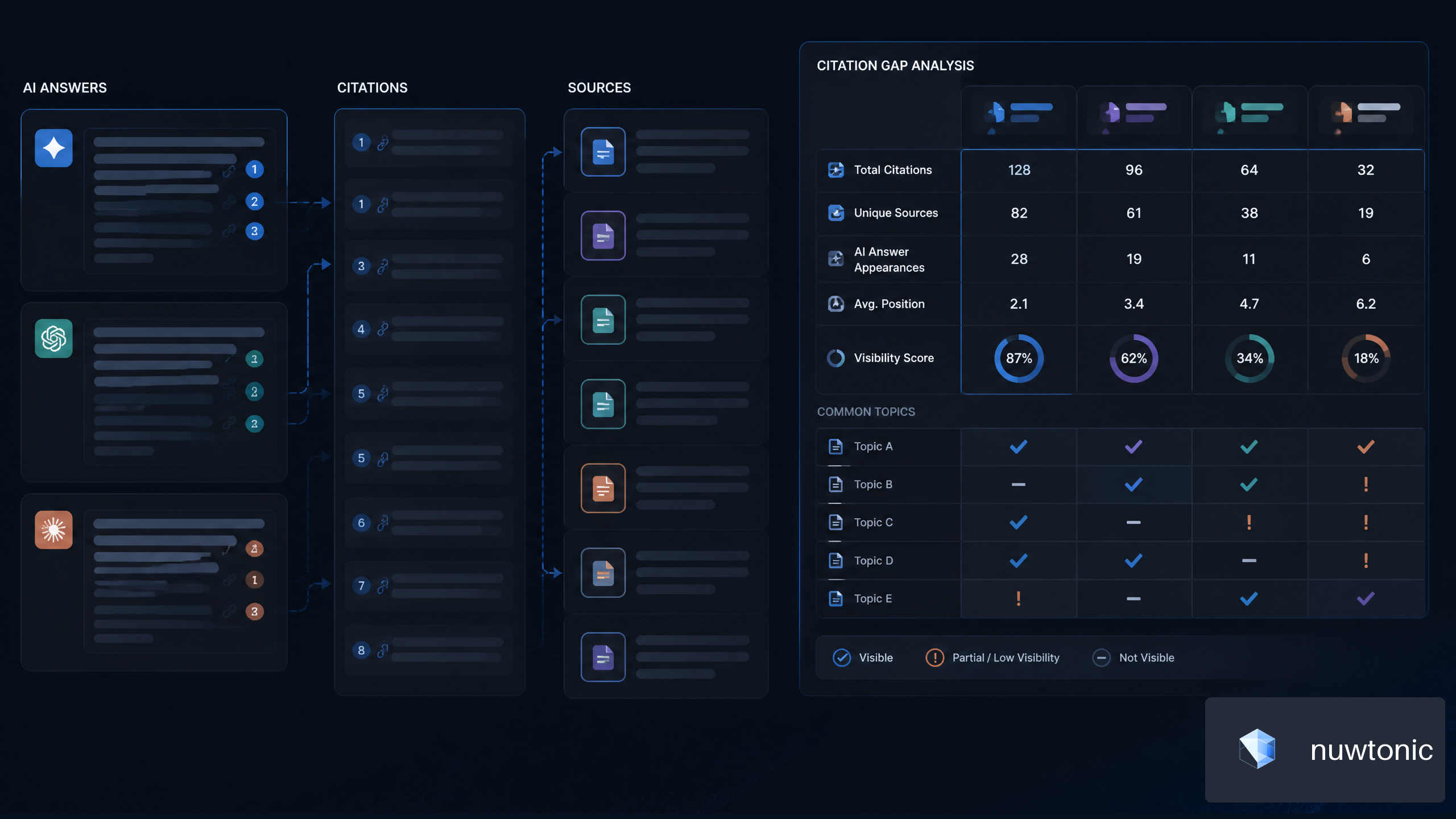
I've seen teams chase broad brand mentions while the issue sat in a single article, a stale FAQ block, or a missing entity description on a money page. The fix only becomes obvious when the report shows which prompt, which answer, which source, and which page in the same row. The internal breakdown on how to analyze citation gaps in AI is a good reference for that mapping logic.
If your dashboard can't point to the exact page that lost inclusion, it can't support remediation.
That is also where third-party content matters. AI answers are assembled from multiple sources, so your owned pages may be fine while external references define the answer's frame. Measuring both sides is the only way to see whether you need content edits, stronger source material, or a different entity pattern altogether.
Entity-First Content and Schema That AI Engines Can Read
AI systems are much better at reading content when the page tells them what the entity is before it starts telling them everything around it. That means the page should define the main subject, the related attributes, and the relationships among them in plain language before schema even enters the picture. If the copy is fuzzy, the markup only amplifies the fuzziness.
Build the page around entities, not themes
An entity-first page says exactly what the thing is, who it's for, what it includes, and how it relates to other objects on the page. For a SaaS product, that usually means a clear product name, a short description, a feature list, pricing or plan context if relevant, and an Organization block that ties the brand to the offering. For a how-to page, it means a direct task, a step sequence, and a result that can be summarized without reinterpretation.
The highest-value patterns are usually the simplest ones:
- FAQ schema: Use when the page answers distinct user questions that can stand alone.
- HowTo schema: Use when the content follows a real sequence, not a loose advisory essay.
- Organization schema: Use to define the brand, official site, and identity signals.
- Product schema: Use when the page describes a concrete product with attributes that matter.
Alt text and metadata still matter because they reinforce the page's subject in a compact form. A weak alt attribute that says “image1” or a metadata field that hides the topic forces the model to infer too much. That's a bad trade when AI systems prefer pages that can be parsed quickly and confidently. Google's own guidance also warns that duplicate URLs and wasteful crawling can hurt efficiency, so canonical discipline matters even in AI-driven discovery.
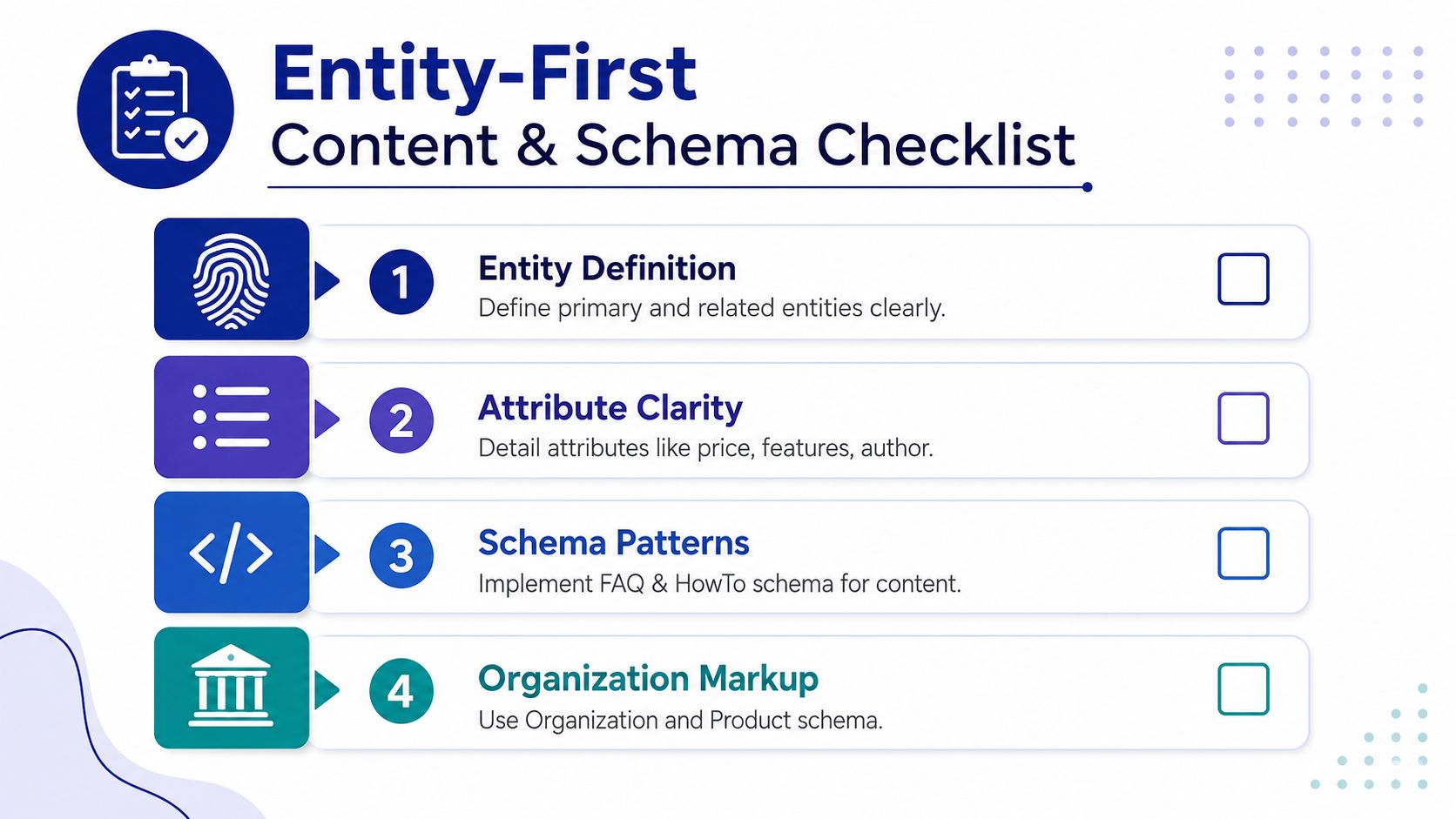
Schema rule: mark up what the page already says clearly. Don't use structured data to hide weak copy behind technical decoration.
If technical debt is making this hard, fix SaaS indexing issues is worth a look because it focuses on the kind of crawl, index, and structure problems that keep good pages from being readable in the first place. For a more detailed content-and-model perspective, the internal guide on SEO for LLMs complements this approach well.
The Weekly Prompt Tracking and Remediation Workflow
The most reliable operating cadence I've seen is boring on purpose. Pick a fixed prompt set, test it every week, log the citations, and turn misses into concrete content tasks. That discipline matters more than chasing every new platform claim or every shiny tool that promises “AI visibility” without showing the underlying evidence.
A weekly loop that teams can actually sustain
Use a compact prompt set that reflects your category, then test those prompts across ChatGPT, Gemini, Perplexity, Claude, Google, and Grok. A 2026 AI-search optimization study recommends 10 to 15 prompts, weekly testing, and citation logging in a spreadsheet, plus allowing crawler access for bots such as GPTBot, ClaudeBot, PerplexityBot, and OAI-SearchBot. That's a practical floor, not a theoretical ideal.
Run the same review each week:
- Select prompts. Choose the exact phrases that map to your core topics and money pages.
- Log citations. Record whether your page appeared, which URL was cited, and where it sat in the answer.
- Analyze gaps. Flag prompts with no inclusion, weak inclusion, or the wrong URL.
- Remediate. Update copy, add schema, improve entity clarity, or strengthen the source page.
For press releases and announcement-style content, the workflow is similar. If the draft doesn't clearly state the entity, the event, and the supporting facts, AI systems tend to flatten it. proven press release AI strategies is useful because it keeps the structure tight instead of dressing up fluff as distribution strategy.
The important part is not the spreadsheet itself. It's the handoff from row to action. A weak row should become a content patch, a schema update, a title rewrite, or a new support article, then go back into the next week's prompt cycle so the team can see whether the change moved inclusion.
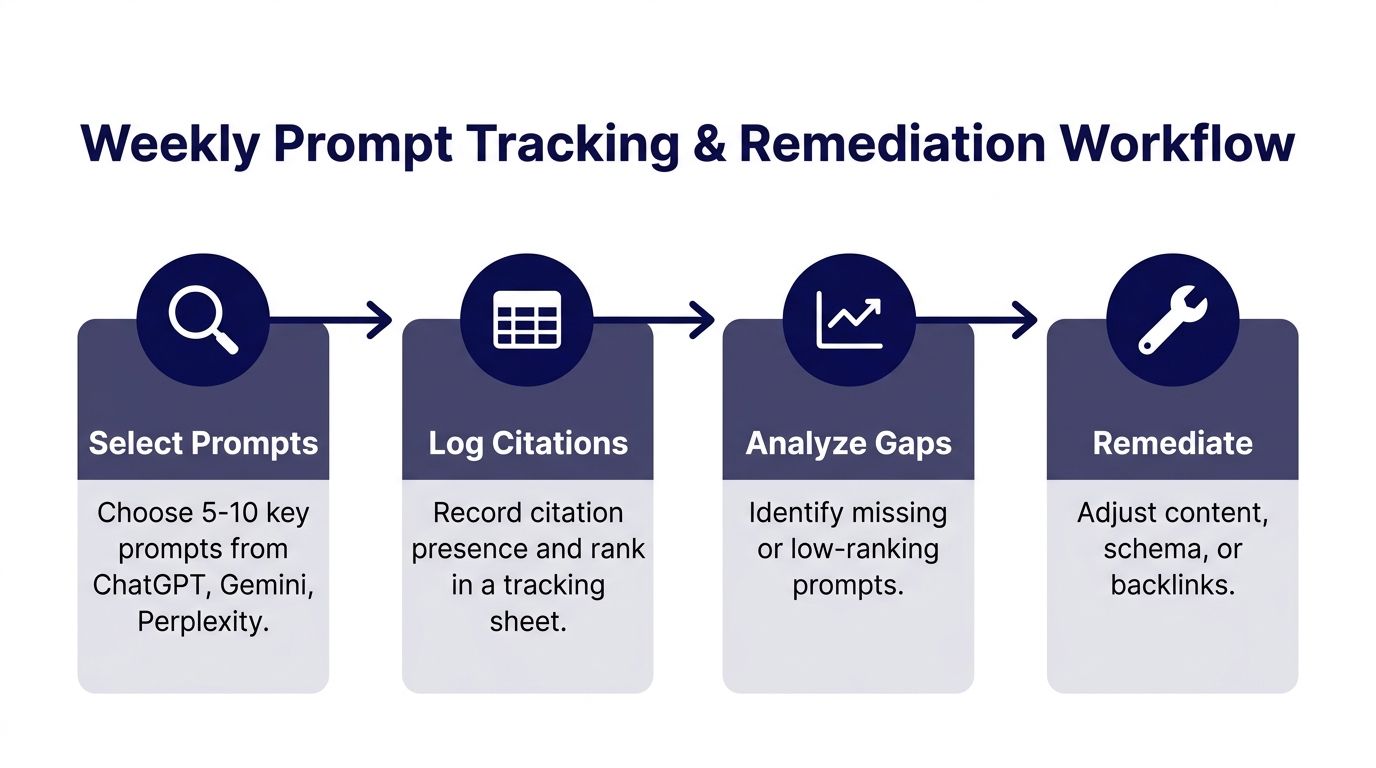
The fastest gains usually come from fixing the page that should have been cited already, not from rewriting every page on the site.
Original Research and Statistics as Citation Magnets
The most overrated GEO advice is the idea that every page just needs better headings and shorter paragraphs. That helps readability, but it doesn't automatically create a reason for the model to cite you. Original research, benchmark reports, and pages that carry real statistics are stronger citation assets because they give the answer something concrete to point to.
Why data beats generic polish
Independent AI SEO coverage says original research is one of the strongest citation drivers in generative search, and one 2026 analysis estimates a +41% visibility lift when statistics are added to content. That doesn't mean every page needs a six-month study. It means that even lightweight proprietary data can shift a page from generic explanation to source material.
The cheapest version of this is often already inside the business. Customer counts, usage patterns, aggregated support themes, anonymized issue categories, or internal trend summaries can all become citation-worthy if they're framed carefully and published clearly. The trick is to turn those raw observations into a page with a defensible method, a plain description of the sample, and a tight takeaway.
A useful pattern is this:
- Benchmark page: summarize one observable trend and explain how the sample was gathered.
- Survey summary: publish a concise question, method, and result narrative.
- Stats block: place a few validated numbers near the top of an educational page so models can extract them easily.
- Source appendix: keep supporting detail on-page so the claim is reproducible.
That kind of material tends to get pulled into answers because it reduces ambiguity. It also creates a better reason for third-party sites to reference you later, which compounds the citation effect. If the team can only afford one extra asset per quarter, this is the one I'd prioritize before another generic blog cluster.
A Recovery Playbook Using Nuwtonic From Drop Detection to Shipped Fixes
The cleanest recovery flow starts with a drop, not a theory. A site owner sees a decline in GSC, the team opens the workspace, and the first pass surfaces ranked issues, competitor gaps, and AI visibility gaps together. That matters because the same page can have a technical issue, a citation problem, and a content mismatch at the same time.
From audit signal to approved fix
The working sequence is straightforward. The GSC Performance Dashboard spots the decline, the GEO Audit runs through 120+ checks, and the AI Search Agent scores prompt visibility across ChatGPT, Gemini, Perplexity, Claude, Google, and Grok. From there, the team sees whether the issue is a missing citation, weak entity coverage, thin schema, or an outdated page that no longer matches the prompt set.
The next step is execution, not more analysis. The Entity-first content generation and Smart AI Edit tools can draft a patch, while review-before-deploy controls keep changes permissioned instead of automatic. If the problem is structural, the On-Page SEO Audit & Auto-Fix module can push metadata, schema, alt text, and content elements through the CMS workflow after approval.
That loop is what most point solutions still miss. They can alert, score, or suggest, but they stop before the change gets shipped. Nuwtonic's value is that it treats AI visibility as an execution lane, not just a reporting layer, so the audit result can become a content edit, and the content edit can become a measurable prompt test in the next cycle.
For teams with multiple sites, the practical benefit is fewer handoffs. A single workspace can connect the issue, the suggested fix, the approver, and the post-change visibility check without splitting the work across disconnected tools. That doesn't make the strategy easier, but it does make the follow-through much less fragile.
If you want to run AI search like an operating system instead of a set of disconnected tactics, start by connecting your prompt tracking, citation mapping, and page-level fixes in one workflow. Visit Nuwtonic to see how the platform ties technical audits, GEO checks, and reviewable content updates into the same execution layer.