TL;DR Summary
For home service providers, local search visibility is the ultimate driver of phone calls and booked jobs. This guide outlines a standards-first approach to seo for home services, focusing on Google Business Profile optimization, user-first service page design, compliant review acquisition, and precise technical health. By aligning your digital presence with local search intent, you can transform search engine traffic into reliable local revenue.
Key Takeaways
• Local Pack Dominance is Critical: Appearing in Google's local map results is the primary driver of high-intent phone calls and emergency service bookings.
• Optimize for Service Areas: If you do not have a physical storefront, configure your Google Business Profile as a Service-Area Business (SAB) to maintain compliance and relevance.
• Prioritize On-Page Content Over Backlinks: High-quality, user-focused service pages and structured data often have a more direct impact on local search rankings than aggressive link building.
• Never Incentivize Reviews: Google permits asking for reviews, but offering discounts or gifts in exchange for ratings violates their guidelines and risks profile suspension.
• Track Conversions, Not Just Rankings: Measure phone calls, form fills, and booked jobs using Google Search Console and call tracking systems to calculate true SEO return on investment (ROI).

Table of Contents
The Realities of Modern SEO for Home Services
Strategic Keyword Research and Service Page Architecture
Mastering the Google Business Profile for Service-Area Businesses
Review Acquisition and Reputation Management
On-Page Optimization, Schema Markup, and Technical Health
Tracking, Attribution, and Measuring Success
Frequently Asked Questions (FAQ)
Sources and References
The Realities of Modern SEO for Home Services
Why Local Visibility is Your Lifeline
You know, many home service providers underestimate the importance of local SEO — it can be the difference between landing jobs or being invisible online. When a homeowner's basement floods at 2:00 AM, they aren't browsing social media or reading editorial blogs. They are searching Google for immediate help. If your business isn't highly visible in those critical moments, you simply don't exist to that customer.
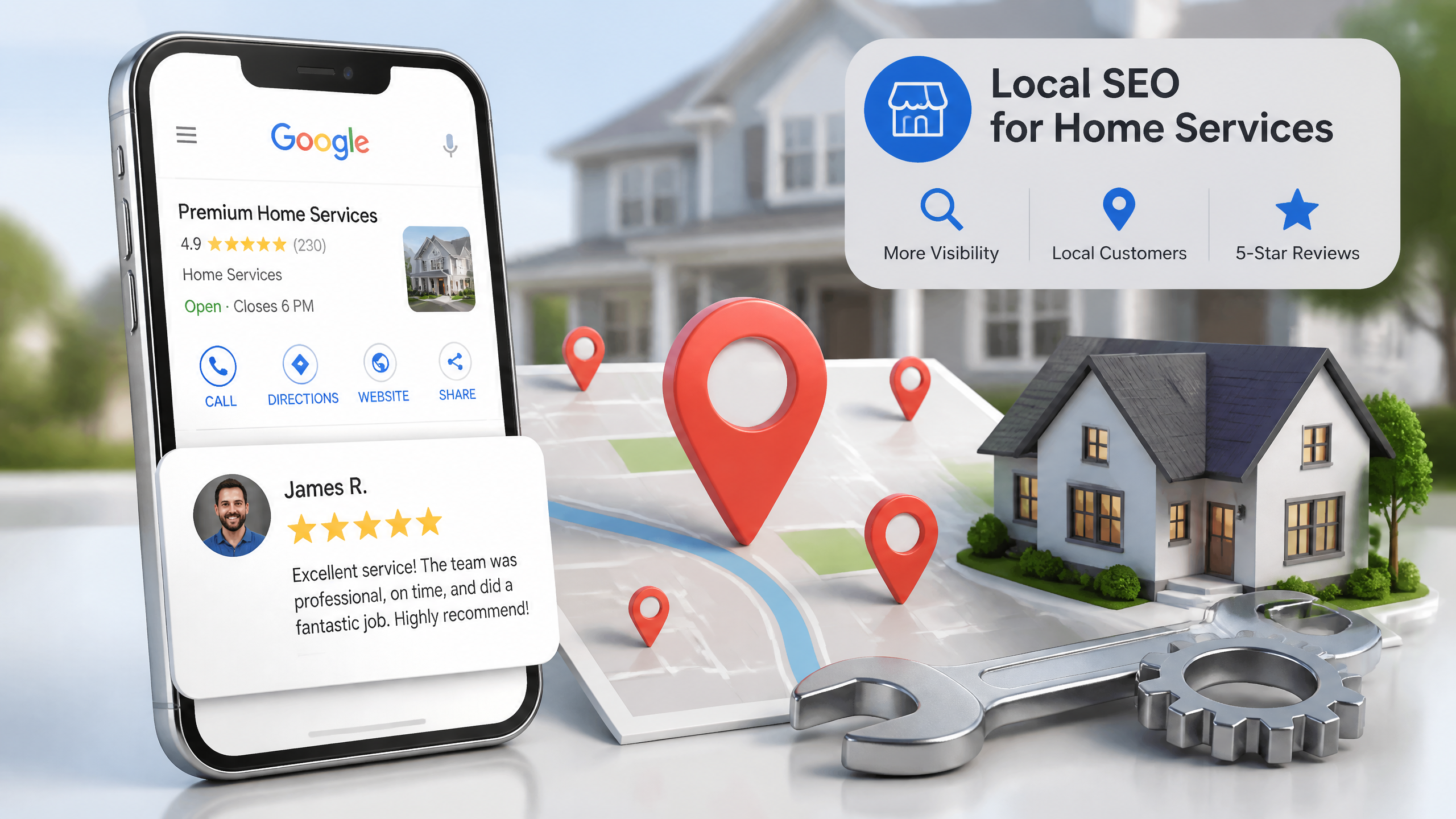
In my experience over the last eight years working with local businesses, visibility in the local pack is the absolute lifeblood of home service lead generation. The local pack refers to the map-based set of local results that Google displays at the top of the search engine results pages (SERPs) for local queries. To secure a spot here, having an optimized profile—formerly known as GMB (Google My Business)—is non-negotiable.
The Dual Nature: Local Pack vs. Organic Search
Local search is highly dynamic. According to Google, local search rankings can change based on the user’s location and query wording, which means local search results are highly context-dependent. This means a homeowner searching for "plumber near me" from their living room will see different results than someone searching for the same phrase three miles away at their office.
To capture the maximum share of local search traffic, you must execute a dual strategy that targets both the local map results and traditional organic search listings. While the map pack captures immediate, high-intent clicks, organic search listings allow you to rank for broader, research-focused queries and establish long-term authority. This dual approach requires a careful balance of citation building to establish local prominence and on-page optimizations to rank for specific regional services.
Rankings vs. Booked Jobs: The Conversion Gap
Honestly, I see too many digital marketers obsessing over keyword rankings while their clients' phones remain silent. It's not just about rankings... it's about conversions. Ranking number one for a high-volume keyword doesn't mean a thing if your website fails to build immediate trust and make it easy for a homeowner to take action.
According to Google, businesses should provide clear contact information and ways to take action, which directly supports call-driven lead generation for home service SEO. If a user lands on your site and has to hunt for your phone number, or if your mobile site makes it difficult to submit a quote request, they will hit the back button. In local search, a high bounce rate is often a symptom of poor user experience and missing trust signals.
Strategic Keyword Research and Service Page Architecture
Mapping Search Intent for Homeowners
Most SEO tools overcomplicate keyword research — sometimes a simple Google search reveals more about customer intent than any paid tool. When you type your primary service into Google and look at the "People Also Ask" section and autocomplete suggestions, you are looking at real questions from actual customers in your market.
For home services, keywords generally fall into three distinct categories of intent:
• Emergency Intent: High-urgency queries like "AC repair out of hours" or "burst pipe plumber." These users need immediate service and typically convert directly into phone calls.
• Transactional Intent: Queries indicating a readiness to hire, such as "best water heater installers near me" or "licensed electrician cost."
• Informational Intent: Early-stage research queries like "why is my AC blowing warm air" or "how to reset a GFCI outlet." While these users aren't ready to book today, answering their questions builds brand familiarity for when they do need a professional.
Structuring High-Converting Service Pages
Every core service you offer needs its own dedicated page. If you group plumbing, HVAC, and electrical services onto a single, cluttered page, search engines will struggle to understand your primary focus, and users will find the content confusing.
According to Google Search Central, pages should be created primarily for users, which means home service SEO content should answer homeowner questions, not just target keywords. When designing these pages, focus heavily on understanding on-page SEO principles. Ensure your page structure includes clear headings, detailed explanations of your process, transparent pricing estimates, and visible license and insurance details to establish immediate credibility.
Location Pages: When and How to Build Them
If your business serves multiple suburbs or surrounding cities, you may need to develop dedicated location pages. However, here's what NOT to do: do not spin up dozens of identical, thin pages where you only swap out the city name. Google easily identifies this as low-quality, duplicate content, and it can actively harm your site's overall search performance.
When executing keyword research for multiple locations, make sure you only build location pages for areas where you have a physical presence or a highly active, dedicated service-area team. According to Google Search Central, internal links and clear site structure help search engines discover and understand pages, which is why your location pages should be logically integrated into your main site navigation.
Location Strategy Element | Single Location Focus | Multi-Location Focus |
|---|---|---|
Target Audience | Residents within a 10-15 mile radius | Multiple distinct municipalities or suburbs |
GMB / GBP Setup | Single optimized business profile | Multiple profiles (if physical offices exist) |
On-Page Strategy | Embed local map, highlight local community involvements | Distinct local content, unique local reviews, regional imagery |
Internal Linking | Direct links from homepage to core services | Regional landing pages linking to localized service offerings |
Mastering the Google Business Profile for Service-Area Businesses

Storefront vs. Service-Area Business (SAB) Setup
Many home service companies operate out of a residential address or a central dispatch office that isn't open to the public. If this describes your business, you must set up your profile correctly. According to Google, home service businesses that serve customers at their locations can use a service-area business setup instead of showing a physical storefront address.
When setting up a Service-Area Business, you will hide your physical address from the public and instead define your service boundaries. According to Google, service-area businesses should define the areas they serve, because that helps customers and search engines understand coverage. Additionally, according to Google, businesses should use a real-world business name consistently, because profile quality and trust signals matter in local results. Do not stuff keywords into your business name (e.g., "Pro Plumbing - Best Cheap Plumber Dallas") if that is not your legal, registered name, as this is a frequent trigger for immediate profile suspension.
Selecting Categories and Optimizing Profile Elements
Your primary business category is one of the most important local ranking factors. According to Google, adding accurate business categories helps search systems understand the type of service a home service company provides. If you are primarily an HVAC contractor, set that as your primary category, and use secondary categories for additional services like "AC Repair" or "Heating Contractor."
To make your profile as competitive as possible, fill out every available field. According to Google, adding photos and business details can improve profile completeness, which is especially valuable for visual trust in home services like roofing, remodeling, and landscaping. Upload high-resolution photos of your branded trucks, clean-cut technicians in uniform, and completed projects to build immediate trust with potential clients.
Keeping Hours and Details Accurate
Nothing damages consumer trust faster than a business listing that claims to be open 24/7, only for the caller to be sent to a full voicemail box. According to Google, a business can improve local visibility by keeping opening hours, phone numbers, and service details accurate across its profile and website. If your hours change during holidays or seasonal rushes, update them promptly to prevent negative reviews from frustrated callers.
Review Acquisition and Reputation Management
The Direct Impact of Reviews on Local Pack Rankings
According to Google, customer reviews can influence local search visibility and consumer trust, which makes review management central to home service SEO. When Google evaluates businesses for the local pack, it looks closely at your total review count, the average star rating, and how frequently you receive new reviews. A business with a steady stream of fresh, positive feedback will consistently outperform a competitor with stale reviews from two years ago.
How to Ask for Reviews Without Violating Guidelines
I always tell my clients that the best time to ask for a review is right when the job is completed and the customer is smiling. According to Google, asking for reviews is allowed, but review solicitation must not be incentivized in ways that manipulate ratings or mislead consumers. This means you cannot offer discounts, free maintenance visits, or gift cards in exchange for a review.
Review Tactic | Compliant (Google-Approved) | Non-Compliant (Violation Risk) |
|---|---|---|
Requesting Reviews | Sending an automated email or SMS link after a service call | Offering a $10 discount on the next service for a 5-star review |
Staff Incentives | Rewarding technicians for getting mentioned by name in reviews | Paying technicians based on the volume of 5-star ratings received |
Review Filtering | Asking all customers to share their honest experiences | Screening unhappy customers before sending review links (gating) |
Managing and Responding to Customer Feedback
Make it a habit to respond to every single review your business receives—both positive and negative. Responding to reviews shows search engines that you are an active, engaged business, and it demonstrates to prospective customers that you care about client satisfaction. When responding to negative feedback, keep your cool, avoid getting defensive, and offer a clear path to resolve the issue offline. Often, a professional response to a bad review is more persuasive to a future customer than a dozen perfect 5-star ratings.
On-Page Optimization, Schema Markup, and Technical Health
Essential On-Page Elements for Local Trust
I’ve seen too many companies focus solely on backlinks when optimizing for local search; on-page elements are often just as crucial. According to Google, local results are influenced by relevance, distance, and prominence, so service pages and business profiles need both topical and geographic alignment. To establish strong topical relevance, ensure your title tags, meta descriptions, and header tags (H2s and H3s) naturally incorporate your core services and target geographic locations.
Avoid keyword stuffing at all costs. According to Google, spammy or misleading local content can violate local ranking and profile policies, so fake locations and keyword stuffing are risky tactics that can result in your site being filtered out of search results entirely.
Implementing Schema Markup for Local Relevance
To help search engines understand the precise details of your business, you should implement local business schema markup. According to Google Search Central, structured data can help search engines understand page content, which is useful for service pages, FAQs, and business details on home service sites.
By adding structured data, you can explicitly tell Google your business name, operating hours, phone number, service areas, and even the specific types of home services you offer. This technical implementation increases the likelihood of your site earning rich snippets in search results, which can significantly improve your click-through rates.
Technical Health: Speed, Mobile, and Link Integrity
Homeowners in urgent situations almost always search from their mobile devices. If your website takes too long to load on a 4G connection, they will leave and click on a competitor's site. According to Google Search Central, pages that load slowly or provide poor mobile experiences can underperform, which is important because many home service searches happen on phones.
Additionally, regularly audit your website for broken links and crawl errors. If you want to understand why maintaining clean site architecture is so critical, look at the impact of broken links on SEO. A healthy, fast-loading, mobile-optimized website provides a superior user experience and signals to search engines that your business is professional and reliable.
Tracking, Attribution, and Measuring Success
Setting Up Call Tracking and Form Attribution
According to Google, search performance should be monitored with Search Console and analytics tools, because ranking alone does not show whether home service SEO is generating leads. To understand your true return on investment, you must implement robust conversion tracking. This involves setting up Google Analytics 4 (GA4) to track form submissions and utilizing a reliable call tracking platform to attribute phone calls to specific search terms.
With call tracking, you can dynamic-swap phone numbers based on how a user arrived at your site. This allows you to differentiate between a call generated by a local map listing, an organic blog post, or a paid search advertisement, giving you clear visibility into which marketing channels are driving actual revenue.
Key Performance Indicators (KPIs) for Home Services
When evaluating the performance of your SEO campaigns, focus on metrics that directly correlate with business growth. While keyword rankings are a useful diagnostic tool, they should not be your primary measure of success.
SEO Metric | Business Impact | Tracking Tool |
|---|---|---|
Organic Phone Calls | Direct, high-intent leads ready for booking | Call Tracking Software / GA4 |
Form Submissions | Non-urgent inquiries, quote requests, and bookings | Google Analytics 4 |
Local Pack Impressions | Brand visibility and exposure in your local market | Google Business Profile Insights |
Organic Search Clicks | Overall traffic volume to your service and location pages | Google Search Console |
Continuous Optimization and Handling Seasonal Demand
Home services are highly seasonal. An HVAC contractor will see a massive surge in air conditioning queries in June, followed by furnace repair searches in November. Conversely, landscapers and painters must navigate slower winter months. Understanding these shifts allows you to adjust your content and optimization strategies ahead of peak seasons.
During shoulder seasons, focus your efforts on building informational content that addresses preventative maintenance, such as "how to prep your pipes for freezing winter temperatures." This keeps your team busy with scheduled maintenance calls and builds organic authority that carries over into high-demand emergency seasons.
Frequently Asked Questions (FAQ)
Frequently Asked Questions
Q: How do I rank my plumbing or HVAC company in my city?
To rank effectively in your local market, you need to optimize your Google Business Profile, build consistent local citations, and create dedicated, high-quality service pages for each of your offerings. Focus on acquiring authentic customer reviews and ensuring your name, address, and phone number are consistent across the web.
Q: Should I create separate pages for each service and location?
Yes. Each core service (e.g., drain cleaning, water heater repair) should have its own dedicated page. If you serve multiple distinct cities and have a physical presence or dedicated teams in those areas, you should also create unique, localized landing pages for those specific markets.
Q: How do I do SEO if I do not have a storefront?
If you do not serve customers at a physical storefront, you can set up your Google Business Profile as a Service-Area Business (SAB). This allows you to hide your physical address from the public while defining your specific service boundaries, ensuring you remain compliant with Google's local guidelines.
Q: Are local citations still important for home service SEO?
Yes, local citations remain a foundational element of local search. Consistent mentions of your business name, address, and phone number (NAP) on authoritative directories help search engines verify your business's existence, location, and legitimacy, which supports your overall prominence in search results.
Q: How long does SEO take for a local home service business?
While some local optimizations can yield improvements in visibility within a few weeks, a comprehensive SEO strategy typically takes three to six months to begin driving a consistent, measurable increase in organic leads and phone calls. The exact timeline depends heavily on your local market's competition and your site's starting authority.
Sources and References
Google Local Search Ranking Guidelines: https://support.google.com/business/answer/7091
Google Search Central Structured Data Documentation: https://developers.google.com/search/docs/appearance/structured-data
Digital Platform Impact Analysis: ACCC Commissioned Report on Digital Platforms