Introduction
If you're evaluating an ai search visibility tool for agencies, the real question is not just which dashboard looks nicest. It’s which platform helps your agency monitor multiple clients, explain citation gaps, and turn those signals into billable work.
I’ve worked with agencies long enough to see the same pattern repeat: they’re great at traditional SEO, solid on SERP tracking, decent at site audit workflows, and then AI search shows up and suddenly the old reporting stack starts looking... a little antique. Let’s not go back to the days of keyword stuffing, shall we?
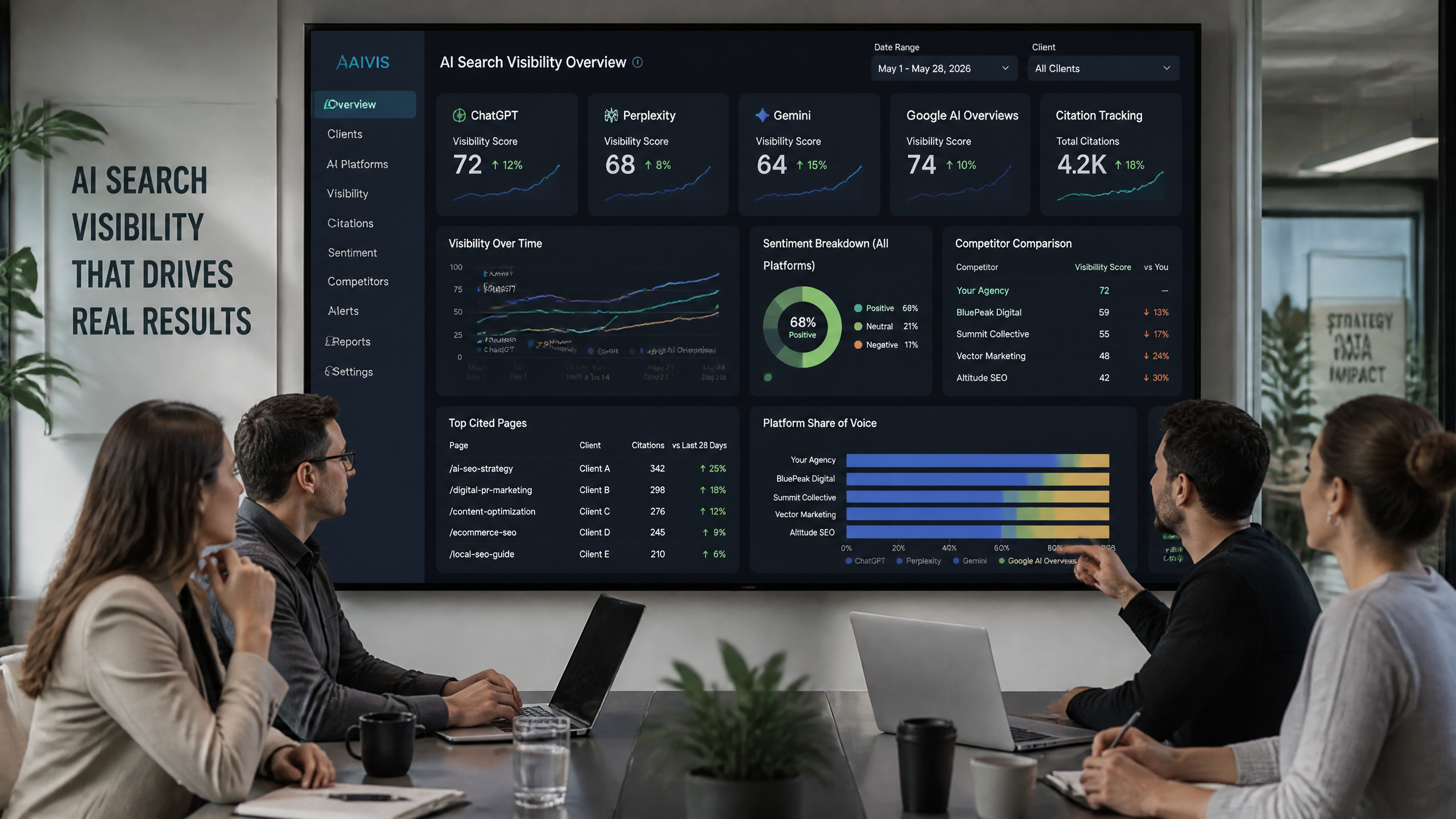
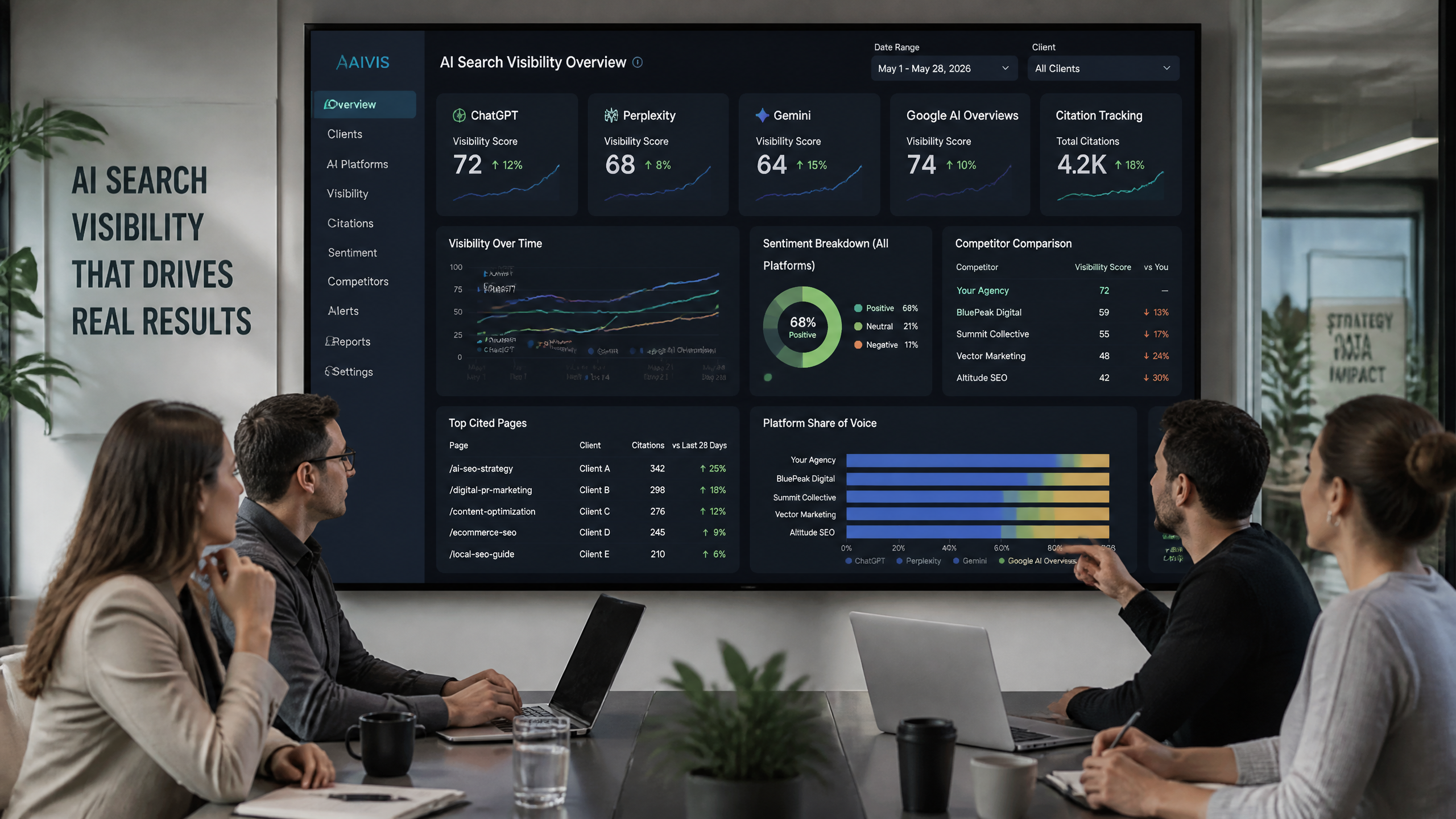
Now, here’s the thing—AI search visibility is not a cosmetic add-on to SEO. It’s a separate measurement layer. Instead of watching rankings on a results page, you’re tracking whether ChatGPT, Perplexity, Gemini, Google AI Overviews, Claude, and Copilot mention, cite, or recommend your clients at all. WP Engine defines AI visibility tracking as monitoring how often and in what context a brand appears in LLM-generated responses, which is a clean starting point for agencies trying to operationalize GEO and AEO (WP Engine’s AI visibility tracking overview).
The problem is that most tools stop at monitoring. They tell you visibility dropped. Helpful, sure. But agencies need more than a blinking warning light. You need to know why it dropped, which competitor gained ground, whether citations were linked or unlinked, whether sentiment turned negative, and what content or entity gaps to fix next.
That’s the lens I’m using in this guide.
TL;DR Summary
Quick answer
For most agency teams in 2026, the best ai search visibility tool for agencies is the one that combines:
• Multi-client infrastructure
• Cross-engine tracking
• Citation analysis
• Competitor gap detection
• A workflow for actually fixing visibility loss
My short list
Tool | Best For | Engine Coverage | Agency Strength | Monitor or Monitor + Fix |
|---|---|---|---|---|
Nuwtonic | Agencies that want diagnosis and action | 6 major engines | Strong for closing citation gaps | Monitor + Fix |
OtterlyAI | Agencies needing multi-client monitoring at lower complexity | 6 major engines | Purpose-built for agencies | Monitor |
Profound | Enterprise and data-heavy agency teams | 10 major engines | Strong, but usually heavier and pricier | Monitor + Partial Fix |
Frase | Teams linking visibility data to content workflows | 5 major engines tracked daily | Better for workflow closure than pure monitoring | Monitor + Fix |
SE Ranking | Agencies already inside a broader SEO suite | AI answer monitoring + linked/unlinked refs | Good bundled option | Monitor |
AIclicks | Affordable prompt-scale tracking | ChatGPT, Perplexity, Gemini, Google AI Overviews | Good for hundreds of prompts | Monitor |
My bottom-line take
• If your agency sells GEO/AEO as a managed service, choose a platform built for multi-client operations first.
• If your team already has content strategists and writers who can act fast, a monitor-only tool can work.
• If your team keeps asking why are competitors cited and we’re not?, you need monitor + fix, not another report.
Table of Contents
What’s in this guide
What an ai search visibility tool for agencies actually does
How GEO and AEO differ in practice
The features agencies should prioritize
Best tools for agencies in 2026
How to choose based on agency model
A practical workflow for closing the citation gap
FAQ
Sources and references
Key Takeaways
The big points most buyers miss
• Agencies need infrastructure, not just analytics. A single-brand tool can look impressive in a demo and then fall apart once you’re managing 20 client workspaces.
• Prompt tracking methodology matters. Most articles skip this, which is bizarre because prompt quality determines whether your visibility data is useful or just expensive noise.
• Linked citations are not the same as mentions. SE Ranking explicitly checks both linked and unlinked references, which is critical if clients expect referral traffic or attribution.
• There is no universal benchmark for “good” AI visibility yet. That’s still messy in 2026, and any vendor implying otherwise is overselling.
• The best tools don’t just throw data at you; they help you make sense of it—clarity is key. I’ve seen too many agencies drown in dashboards and still miss the action items.
• Recovery timelines vary. If you lose visibility, recovery can happen in weeks or take a few months depending on engine refresh behavior, content authority, and competitor momentum. There is no clean industry standard yet.
What an AI Search Visibility Tool for Agencies Actually Does
It tracks prompts, not just keywords
Traditional SEO tools watch rankings, CTR, backlink profile movement, and organic reach on classic search surfaces. AI visibility tools work differently.
They run a set of prompts across LLM-powered engines and check:
• Whether your client is mentioned
• Whether the mention includes a citation
• Whether that citation is linked or unlinked
• What sentiment or framing surrounds the mention
• Which competitors appear instead
• How visibility changes over time
Nightwatch.io frames the category well: AI search monitoring is about how LLMs describe your brand and whether they cite your content, which is distinct from traditional keyword-centric SEO (Nightwatch.io’s AI search monitoring breakdown).
It solves a multi-engine blind spot
Most agencies still have decent Google reporting and weak AI answer reporting. That gap matters because buyers don’t research in one place anymore.
According to OtterlyAI, its platform was purpose-built for agencies and tracks 6 major AI engines in one dashboard, including ChatGPT, Perplexity, and Google AI Overviews. On the enterprise side, a 2026 comparison published by TryProfound positions Profound as covering 10 major AI answer engines (TryProfound’s agency tool comparison).
For agencies, this means the tool is not just replacing rank tracking. It’s replacing the manual chaos of checking six to ten platforms one by one.
It exposes what your SEO stack misses
Just a heads-up: a strong SERP position does not guarantee AI citation visibility.
That’s one of the most important strategic shifts here. Traditional SEO still matters—a lot—but AI systems often cite based on source patterns, entity clarity, contextual relevance, authority signals, and prompt-answer fit in ways that don’t map neatly to top-10 rankings.
I’ve seen too many agencies invest heavily in traditional SEO tactics while neglecting AI tools that could streamline their processes. Then they get blindsided when a competitor with weaker classic rankings becomes the name that keeps getting quoted.
GEO vs AEO: Same Family, Slightly Different Use Cases
GEO and AEO overlap more than vendors admit
The clean definitions look like this:
Term | Meaning | Practical Agency Use |
|---|---|---|
GEO | Generative Engine Optimization | Broader optimization for AI-generated answers across multiple LLM platforms |
AEO | Answer Engine Optimization | Optimization focused on answer engines and direct-response interfaces |
AI Search Visibility | Measurement layer for how often and how well a brand appears in AI outputs | Reporting and operational layer supporting both GEO and AEO |
In practice, the market uses GEO and AEO almost interchangeably. WP Engine and Nightwatch both discuss these ideas in overlapping ways, and that’s not surprising—vendors are still settling the language.
The distinction matters when selling services
Where I think agencies should care is not vocabulary purity. It’s packaging.
• If you sell reputation and PR-led visibility, AEO language may land better.
• If you sell content, SEO, entity optimization, and AI citation growth, GEO usually gives you more room.
• If you’re pitching both, use AI search visibility as the measurable reporting layer and let GEO/AEO describe the optimization work.
That framing avoids a common client confusion problem: they understand reports more easily when the measurement term is separate from the service term.
Benchmarks are still immature
This is one of the biggest knowledge gaps in the category.
There is no standardized benchmark for:
• A “good” visibility score across platforms
• A successful citation rate by engine
• A standard sentiment weighting model
• A universal prompt set by industry
For example, a B2B SaaS agency tracking 80 bottom-funnel prompts for one client may consider 12% citation presence a useful baseline if the category is competitive and model citations are sparse. Another agency in a niche vertical with less competition might treat that same number as weak.
So, yes, vendors show visibility scores. No, the market has not agreed on what “excellent” looks like across all engines. Fair warning: if a sales demo presents one magic benchmark, ask how they derived it.
The Features Agencies Should Prioritize First
Multi-client management is non-negotiable
This sounds obvious, but I keep seeing agencies trial tools designed for in-house teams and then wonder why operations become painful.
An agency-grade platform should support:
• Separate client workspaces
• Bulk prompt sets
• Role-based access
• Reporting by brand
• Competitor segmentation by client
• Fast switching between accounts
OtterlyAI’s positioning matters here because it explicitly states it was built for agencies managing multiple brands in one dashboard. That’s very different from slapping client folders onto a single-brand workflow.
Citation analysis must distinguish linked vs unlinked
This is one of those features that sounds minor until you’re explaining outcomes to clients.
SE Ranking’s AI Search Toolkit monitors AI-generated answers tied to prompts and checks for both linked and unlinked references to brands. That distinction is useful because an unlinked mention may help visibility or perception, while a linked citation has a stronger case for attribution and downstream traffic value.
Citation Type | What It Means | Why Agencies Should Care |
|---|---|---|
Mention only | Brand name appears with no source link | Useful for awareness, weaker for measurable referral impact |
Unlinked reference | A page or source is implied but not clickable | Better than nothing, but hard to monetize in reporting |
Linked citation | AI answer points to a clickable client URL | Best case for attribution, trust, and conversion opportunity |
Competitor gap analysis is where the real strategy begins
AIclicks describes its value in terms of showing how often a brand is mentioned in engines like ChatGPT, Perplexity, Gemini, and Google AI Overviews while also surfacing where competitors outrank that brand. That second part is the money-maker.
Because once you know the competitor gap, you can investigate:
Which pages keep getting cited
Which entities or supporting concepts those pages include
Whether your client lacks topical depth, freshness, or trust signals
Whether the AI prefers competitor framing in comparisons
That’s much more actionable than another “visibility down 8%” alert.
Workflow integration beats dashboard sprawl
Frase argues that the best AI visibility tools for teams connect daily citation tracking across ChatGPT, Perplexity, Claude, Gemini, and Google AI directly into research and drafting workflows. I agree with that principle.
Many agencies overlook the power of AI in search visibility—it’s not just a buzzword, it can genuinely enhance performance. But only if the signal feeds into execution.
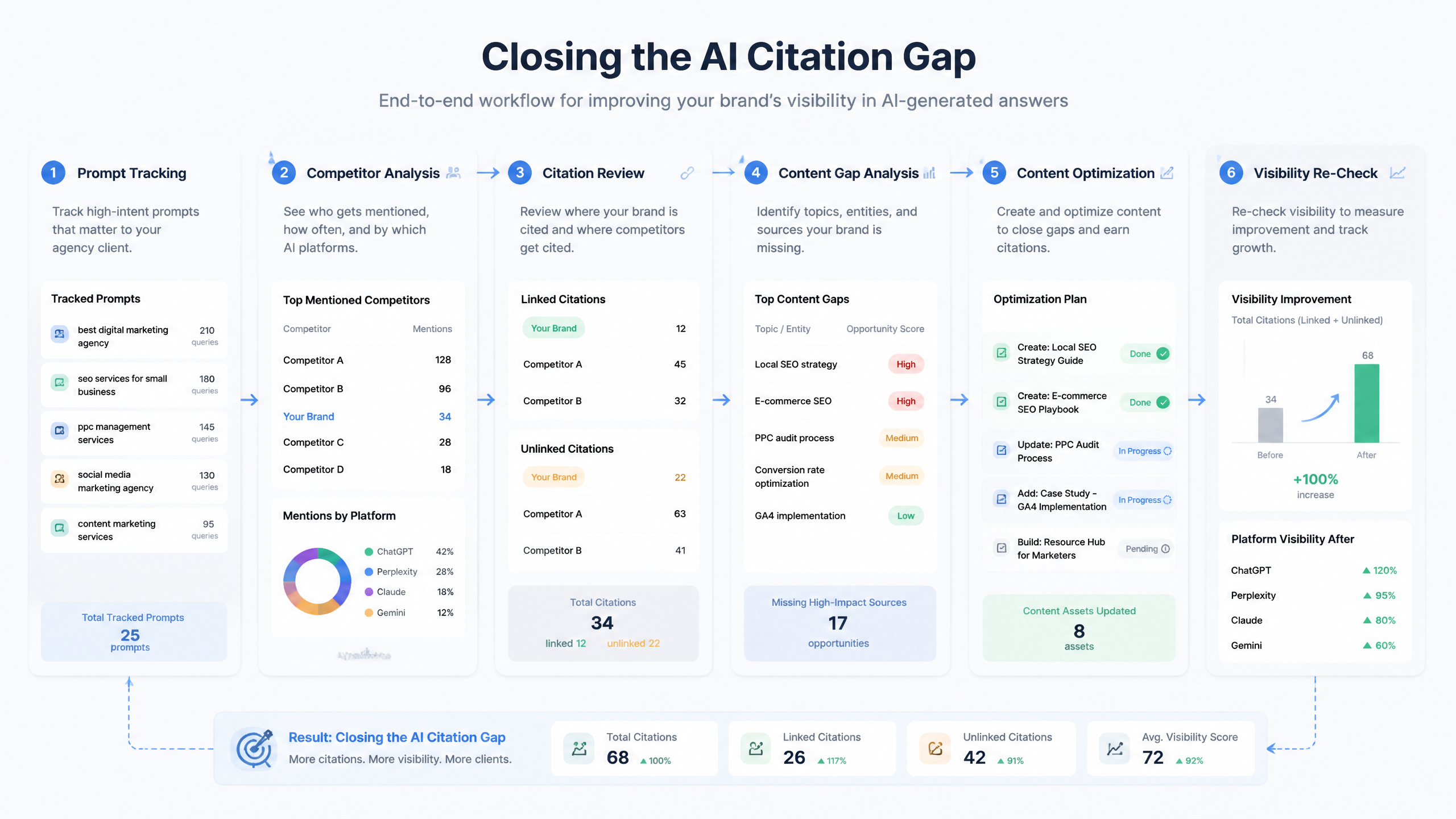
A good agency workflow should move like this:
Detect a citation gap
Compare competitor presence
Run content gap analysis
Draft or revise content
Publish updates
Re-check visibility within a defined interval
If the tool handles steps 1 and 2 only, your team still needs operational discipline to bridge the gap.
Best AI Search Visibility Tools for Agencies in 2026
Comparison table: top tools by agency fit
Tool | Best For | Major Strength | Main Limitation | Best Agency Fit |
|---|---|---|---|---|
Nuwtonic | Agencies that need diagnosis and fixes | Connects visibility monitoring to technical/content SEO action | Requires a team ready to act on recommendations | SEO and content-led agencies |
OtterlyAI | Multi-client agency monitoring | Agency-first setup, 6-engine tracking | Lighter on optimization depth | Lean agencies launching GEO services |
Profound | Enterprise-grade AI visibility | 10-engine coverage, robust reporting, advanced intelligence | Can be expensive and operationally heavy | Large agencies with enterprise clients |
AIclicks | High prompt volume affordability | Efficient for tracking hundreds of prompts | Less depth than heavier platforms | Mid-size agencies with many SMB clients |
Frase | Closed-loop content workflow | Daily tracking tied to research and drafting | Not as agency-infrastructure-first as OtterlyAI | Content-heavy agencies |
SE Ranking | Bundled suite users | Linked/unlinked references and broader SEO context | Less purpose-built for GEO-only agencies | Agencies already standardized on SE Ranking |
Nuwtonic: best when you need monitoring plus fixes
If I’m looking at this through an agency operator lens, Nuwtonic stands out when the question is what do we do after we spot the problem?
Nuwtonic’s brand positioning is clear: it combines technical SEO automation, content generation, and data-driven SEO analysis in one workflow. For agencies, that matters because AI visibility issues often don’t live in a vacuum. The root cause may involve:
• Weak topical depth
• Missing entities
• Poor content structure
• weak technical SEO foundations
• unclear source trust signals
• delayed publishing cycles
So instead of juggling a monitoring tool, a separate site audit platform, another drafting tool, and a spreadsheet graveyard, Nuwtonic is strongest when your team wants AI-powered insights tied to execution.
Choose Nuwtonic if:
• You want to close visibility gaps, not just report them
• Your team already manages technical SEO and content optimization together
• You need one platform to reduce tool sprawl
• You care about approval workflows instead of blind automation
Avoid it if:
• You only need low-cost mention alerts
• You’re not ready to act on recommendations internally
OtterlyAI and Profound: the two clearest agency-first references
OtterlyAI and Profound are the two most consistently cited agency-oriented names in the source set.
OtterlyAI says it was built specifically for agencies managing multiple brands and tracks six major AI engines from one dashboard. WP Engine also flags Otterly.ai as especially suitable for PR teams, brand teams, and agencies because of its brand sentiment analysis capabilities.
Profound, meanwhile, is repeatedly positioned in 2026 comparisons as a leading platform with broad engine coverage. TryProfound’s comparison identifies it as tracking 10 major answer engines, and Frase’s 2026 roundup also includes Profound, Peec AI, and Otterly.ai among the leading tools for measuring brand citations.
Tool | Multi-Client Orientation | Sentiment Analysis | Engine Breadth | Ideal Agency Scenario |
|---|---|---|---|---|
OtterlyAI | Strong | Yes | 6 engines | Fast launch of GEO service lines |
Profound | Strong | Yes/advanced intelligence | Up to 10 engines | Enterprise or data-heavy retainers |
Nuwtonic | Strong in execution workflows | Strategic, tied to optimization | 6 engines | Agencies wanting monitor + fix workflows |
AIclicks, Frase, and SE Ranking: practical options for different agency models
AIclicks is interesting because it frames itself around both brand mention visibility and competitor gaps, and TryProfound notes it as a cost-effective choice for agencies tracking hundreds of prompts daily. That matters if your margin model relies on serving many smaller accounts efficiently.
Frase is the better option when your agency’s value is tightly tied to content ops. Frase states it tracks daily brand citations across ChatGPT, Perplexity, Claude, Gemini, and Google AI, then connects that signal back into research and drafting.
SE Ranking is the practical “we already have the suite” option. Its AI toolkit is useful if your team wants AI visibility without adopting a completely separate stack, especially because it checks linked and unlinked references.
How to Choose Based on Your Agency Model
Choose by delivery model, not hype
A lot of tool selection goes wrong because agencies buy based on feature lists instead of service economics.
Use this framework instead:
Agency Model | What You Need Most | Best Tool Type | Best Fit |
|---|---|---|---|
SMB SEO agency | Low-cost scaling across many clients | Affordable monitoring with multi-prompt tracking | AIclicks, OtterlyAI |
Content-led growth agency | Research-to-drafting loop | Monitor + content workflow | Frase, Nuwtonic |
Enterprise SEO agency | Reporting depth, broad engine coverage, sentiment | Premium intelligence layer | Profound |
PR / brand reputation agency | Sentiment and mention framing | Monitoring + sentiment analysis | OtterlyAI |
Full-service digital agency | SEO, technical fixes, content execution in one stack | Monitor + fix | Nuwtonic |
Model your prompt volume before buying
This is another area where buyers get sloppy.
Prompt limits can quietly destroy agency economics. The research set explicitly notes that many articles fail to explain prompt volume constraints, even though agencies may need hundreds of prompts per client.
Before signing anything, map:
Number of clients
Prompts per client
Engines per prompt set
Update frequency
Reporting users or seats
For instance, an agency with 25 clients tracking 60 prompts each across 6 engines is already dealing with a substantial monitoring footprint. If a tool’s lower tier caps prompt capacity aggressively, your “affordable” option stops being affordable very quickly.
Decide whether you need monitor-only or monitor-plus-fix
This is the decision axis I think most agencies should use.
Decision Factor | Monitor-Only Tool | Monitor + Fix Tool |
|---|---|---|
You have strategists who can diagnose gaps manually | Strong fit | Also works |
You need lower monthly software costs | Better fit | Usually pricier |
You sell advisory reporting only | Strong fit | Sometimes overkill |
You sell implementation and optimization retainers | Limited fit | Best fit |
You want to reduce content production delays | Weak fit | Strong fit |
If your team can turn raw AI-powered insights into action fast, monitor-only can be enough. If not, paying for diagnosis often saves margin.
A Practical Workflow to Close the Citation Gap
Start with prompt selection, because bad prompts ruin everything
One of the biggest gaps in this category is the lack of a standardized prompt selection methodology.
Here’s the framework I use with agencies:
Core category prompts
• “Best [category] tools”
• “[category] software for [use case]”Comparison prompts
• “[client] vs [competitor]”
• “Alternatives to [competitor]”Problem-aware prompts
• “How to solve [pain point]”
• “What is the best tool for [specific issue]”Decision-stage prompts
• “Is [client] worth it”
• “Who should use [client]”Reputation prompts
• “What do people think about [brand]”
• “Is [brand] reliable”
Prompt Bucket | Goal | Typical Volume per Client |
|---|---|---|
Category | Presence in broad commercial discovery | 10 to 25 |
Comparisons | Capture bottom-funnel demand | 15 to 40 |
Problem-aware | Earn educational citations | 15 to 30 |
Decision-stage | Influence conversion conversations | 10 to 20 |
Reputation | Monitor framing and sentiment | 5 to 15 |
Your mileage may vary, but this gets most agencies to a usable set fast.
Then score what the tools actually show you
Once prompts are live, assess results using a simple internal framework:
Metric | What to Track | Why It Matters |
|---|---|---|
Mention rate | How often the client appears | Basic visibility baseline |
Linked citation rate | How often a clickable source is included | Stronger commercial value |
Unlinked reference rate | How often the brand is mentioned without link | Awareness without direct attribution |
Competitor share | Which brands dominate the answer set | Prioritizes competitive response |
Sentiment/framing | Positive, neutral, or negative mention context | Protects brand positioning |
Prompt volatility | How much visibility shifts week to week | Helps explain unstable performance |
There is no universal weighting standard, so agencies should define their own. For example, a PR-focused client may weigh positive sentiment more heavily than linked citations. A lead-gen SaaS client may do the opposite.
Build a recovery loop, not a reporting loop
One situation I keep seeing is this: an agency spots a visibility drop, exports a chart, sends the client a polished deck, and nobody actually fixes the source issue for three weeks. By then the competitor has widened the gap.
A better loop looks like this:
Detect drop in mention or citation rate
Identify which competitors replaced the client
Review cited competitor pages
Run content gap analysis and entity comparison
Improve or publish pages
Re-measure after 2 to 6 weeks
I’m deliberately giving a range there because the research is thin on exact recovery timeframes. Some gains show up quickly. Others lag because AI engines refresh or source content at different intervals, and those mechanics aren’t always transparent.
What Real Agency Use Looks Like
Scenario 1: launching a GEO retainer without burning margin
A pattern reflected in OtterlyAI’s agency positioning is the need to launch GEO services without hiring an entire analyst bench first. Agencies use one dashboard to manage multiple brands across ChatGPT, Perplexity, and Google AI, then package the output into recurring deliverables.
The implication is simple: if your team is still checking engines manually, your service margin is already under pressure before the retainer even matures.
Scenario 2: tracking hundreds of prompts for many smaller clients
AIclicks is described as a cost-effective option for agencies tracking hundreds of prompts daily, and that aligns with what I’ve seen from smaller agencies serving broad local or SMB portfolios. They don’t always need enterprise-grade bells and whistles. They need fast monitoring, reasonable pricing, and enough competitor context to decide where to invest effort.
A quick anecdote: I worked with a team that was overcomplicating this with giant custom spreadsheets and manual screenshots. Classic agency move—heroic effort, terrible scalability. Once they standardized prompt sets and engine tracking, reporting time dropped and the content team finally had clarity instead of chaos.
Scenario 3: pairing classic SEO tools with AI visibility tools
The only solid community example in the source set comes from a Reddit discussion where a startup paired SEMRush for traditional SEO with Otterly.AI for visibility on GPT and Google AI Overviews. In the same discussion, SE Ranking’s AEO tracker was highlighted as especially useful for assessing standing in Gemini responses and competitor movement, while another tool was preferred because it could reveal brand perception without needing “countless prompts.”
That’s a useful lesson for agencies: the combo model is still common.
Workflow Pattern | Why Teams Use It | Trade-Off |
|---|---|---|
Traditional SEO suite + AI visibility tool | Keeps SERP, site audit, backlink profile, and AI reporting separate but complete | More tool sprawl |
Bundled SEO suite with AI module | Fewer vendors, easier reporting alignment | Less specialized AI depth |
Single platform with monitor + fix | Better execution speed and fewer handoffs | Requires adoption across teams |
FAQ
What is the best ai search visibility tool for agencies in 2026?
It depends on your service model.
• Nuwtonic is strongest if you want to diagnose and fix citation gaps, not just monitor them.
• OtterlyAI is one of the clearest agency-first monitoring tools for multi-client management.
• Profound is the better fit for enterprise or data-heavy agency teams needing broad engine coverage.
• Frase is compelling if your agency lives inside research, drafting, and content production workflows.
How many AI answer engines can agencies track with one tool?
Based on the source set:
• OtterlyAI says it tracks 6 major AI engines.
• Profound is described in a 2026 comparison as covering 10 major AI answer engines.
• Coverage varies, so always verify current engine lists before buying.
Can these tools track linked and unlinked citations?
Yes, some can.
• SE Ranking’s AI Search Toolkit explicitly monitors both linked and unlinked references.
• Not every platform makes that distinction clearly in public docs, which is exactly why agencies should ask before signing.
Do AI visibility tools support multi-client agency workflows?
Some do, some really don’t.
• OtterlyAI is explicitly positioned as purpose-built for agencies managing multiple client brands.
• Enterprise-oriented tools like Profound also support more complex team structures.
• Lighter team-focused tools may support multiple projects, but not full agency infrastructure elegantly.
How do I tell whether AI sentiment is positive or negative?
Tools with sentiment analysis score the context around brand mentions.
• WP Engine identifies Otterly.ai as a strong option for agencies and PR teams specifically because of brand sentiment analysis.
• Just remember: there is no market-wide standard for sentiment weighting yet. One tool’s “neutral” may be another tool’s mild negative.
What is the difference between GEO and AEO tracking tools?
In practice, not much.
• GEO usually frames optimization for generative engines more broadly.
• AEO usually frames optimization around answer engines.
• Most agency buyers should focus less on the acronym and more on engine coverage, prompt methodology, citation analysis, and workflow usefulness.
Can these tools generate content to improve visibility?
Some can support that workflow.
• Frase explicitly connects daily visibility tracking to research and drafting.
• Nuwtonic is designed around SEO automation and content generation, which is useful when agencies want to move from insight to execution.
• Other tools are monitor-first and leave content creation to your existing stack.
How often do AI visibility tools update data?
It varies.
• Frase says it tracks daily across key engines.
• Other platforms emphasize timely updates, but “real-time” is often used loosely in marketing.
• Fair warning: engine refresh cadence is partly opaque, so tool update frequency and actual answer volatility are not always the same thing.
Are these tools affordable for agencies with many small clients?
Some are more agency-margin-friendly than others.
Budget Level | Likely Best Fit | Why |
|---|---|---|
Low budget | OtterlyAI, AIclicks, SE Ranking | Lower entry cost or bundled value |
Mid budget | Frase, Nuwtonic | Better workflow depth |
High budget | Profound | Broad engine tracking and enterprise capability |
How do I track competitor visibility effectively?
Use a consistent prompt set and compare:
Brand mention rate
Linked citation rate
Unlinked reference rate
Prompt-level winner by engine
Sentiment/framing
AIclicks is one of the tools in the source set that explicitly emphasizes where competitors outrank the brand, which makes it useful for this job.
Conclusion
The best ai search visibility tool for agencies in 2026 is not necessarily the one with the longest feature page. It’s the one that matches your delivery model, client volume, and execution maturity.
If your agency just needs baseline monitoring across major answer engines, tools like OtterlyAI, AIclicks, and SE Ranking can get you moving without a huge operational lift.
If your team needs deeper reporting and broader engine coverage for enterprise retainers, Profound is the obvious heavyweight.
If your real bottleneck is turning visibility data into SEO, content, and technical fixes, Nuwtonic is the stronger strategic fit because it aligns monitoring with execution instead of leaving your team stuck between dashboards.
Now, here’s the thing—monitoring is easy to sell. Fixing the citation gap profitably is harder. That’s also where agencies create the most value.
So before you buy, ask three questions:
Can this tool handle my client count and prompt volume?
Can it show me why competitors are winning?
Can my team act on the output without adding more workflow mess?
If the answer to the third question is no, keep looking.
Sources and References
Verified references used in this guide
Note: Pricing, prompt limits, engine coverage, and packaging in this category change often. I strongly recommend verifying current plan details directly with each vendor before budgeting or pitching a client package.