TL;DR Summary
Want to fill your chairs without burning cash on expensive PPC ads? This guide breaks down the exact dental SEO framework we use to scale practices. You will learn how to align your website with local search intent, optimize your Google Business Profile, design high-converting procedure pages, and track actual patient bookings rather than just vanity metrics.
Table of Contents
The Reality of Dental SEO
The "Don't Do This" Hall of Shame
Architecting a High-Converting Dental Website
Winning the Google Maps Local Pack
Tracking, Attribution, and Measuring SEO ROI
Frequently Asked Questions
Sources and References
Key Takeaways
• Local Search is King: Most dental searches are highly localized and intent-driven. If you are not in the local Map Pack, you are invisible.
• Procedure Pages Drive Revenue: Do not group all your services onto one generic page. High-value procedures like implants and Invisalign need dedicated, optimized landing pages.
• Conversion Matters More Than Traffic: A beautiful website is useless if it does not convert visitors into phone calls and scheduled appointments.
• Technical Health is Non-Negotiable: Fast loading speeds, mobile usability, and clean site architecture keep both users and search engines happy.

The Reality of Dental SEO
The Local Search Intent Engine
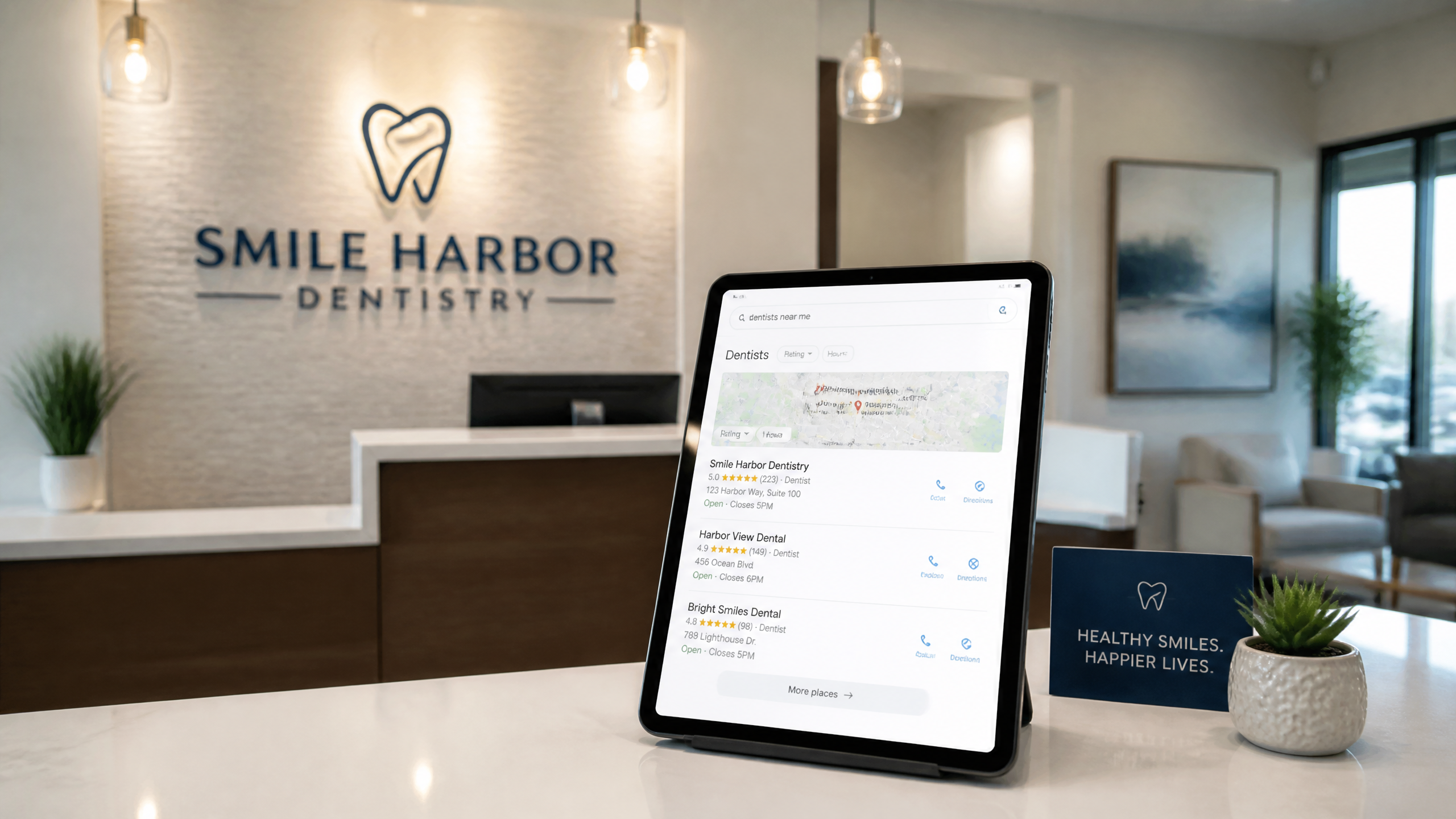
When someone searches for a "dentist near me" or "emergency tooth extraction," they are not casually browsing—they are looking to book an appointment immediately. This is the core of local search intent. Unlike informational searches where users want to read articles, dental search queries are transactional.
You know what’s funny? Most dental practices underestimate the power of local SEO—it's often the easiest way to attract new patients in your area. If your practice does not show up in those crucial moments of high intent, you are handing high-value patients directly to your competitors down the street. Local SEO ensures your practice is visible precisely when and where patients are looking to book.
Why Organic Search Beats PPC for Long-Term Growth
Pay-Per-Click (PPC) advertising is like a faucet: when you turn it on, the leads flow, but the moment you stop paying, the leads dry up entirely. Organic SEO, on the other hand, is an investment that builds compounding equity over time.
I once had a client who spent $5,000 a month on PPC ads but had a website that loaded so slowly patients would click away before the phone number even rendered. We cut their ad spend in half, invested in local SEO, and doubled their monthly patient intake.
Feature | Local SEO | Pay-Per-Click (PPC) |
|---|---|---|
Long-Term Cost | Compounding value; lower cost per acquisition over time | High, ongoing cost per click that rises with competition |
Credibility | High; organic listings and map packs build trust | Moderate; users often skip ads to find organic results |
Sustainability | Traffic continues even if budget is paused | Traffic stops immediately when budget ends |
Targeting | Broad local intent and specific procedural terms | Direct keyword targeting but highly competitive |
Bridging the Gap Between GBP and Your Website
Your Google Business Profile (GBP)—formerly known as Google My Business—and your website do not operate in silos. They are two halves of the same organic search engine. Google constantly cross-references the information on your website with your GBP to verify your practice's legitimacy and relevance.
If your website mentions that you offer "dental implants," but your GBP does not have that service selected, or vice versa, you are sending mixed signals to search engines. A well-optimized website acts as the contextual anchor that powers your GBP's rankings in the highly coveted local map pack.
The "Don't Do This" Hall of Shame (Common Dental SEO Mistakes)
Keyword Stuffing and Thin Service Pages
Before we look at how to build a winning SEO campaign, let's look at what not to do. Many practices make the mistake of creating a single "Services" page that lists twenty different procedures in bullet points. This is a massive missed opportunity. Search engines cannot rank a single page for "teeth whitening," "root canals," and "pediatric dentistry" all at once.
Here’s a tip: don’t try to rank for "best dentist in [city]" by writing that exact phrase fifty times on your homepage. That’s keyword stuffing, and Google’s algorithms are way too smart for that. When you pack your pages with repetitive, unnatural phrasing, you do not just anger Google—you alienate prospective patients who find your content completely unreadable.
Ignoring NAP Consistency and Local Citation Messes
Another silent killer of dental rankings is inconsistent NAP data (Name, Address, Phone number). If your practice is listed as "Elite Dental Care" on your website, "Elite Dental Group" on your GBP, and "Elite Dentistry" on Yelp, search engines will struggle to verify your identity.
This lack of NAP consistency damages your local authority. Google needs to be 100% confident in your business's physical location and contact details before it risks showing your practice to local searchers. A messy trail of outdated listings from previous office moves or phone number changes will actively drag your rankings down.
Slow Page Speeds and Heavy Stock Imagery
Dentists love high-resolution, beautiful photography of smiling families and state-of-the-art operatories. However, uploading giant, unoptimized images directly to your website is a recipe for technical disaster.
A slow-loading website frustrates users and search engines alike. If a patient in pain has to wait more than three seconds for your mobile site to load, they will bounce back to the search results and click on the next dentist. Technical optimization is just as critical as your content strategy.
Architecting a High-Converting Dental Website
Crafting High-Value Procedure Pages
To rank for high-value services, each procedure needs its own dedicated page. If a patient is considering dental implants—a multi-thousand-dollar investment—they want to read a comprehensive, compassionate page that explains the process, benefits, cost expectations, and recovery.
Each dedicated procedure page should include:
A Clear, Patient-First Explanation: Avoid overly complex clinical jargon; explain the procedure in warm, accessible terms.
Before and After Gallery: Real visual proof of your work (with proper patient consent) builds immense trust.
FAQ Section: Answer the exact questions patients ask during consultations.
Strong Call to Action (CTA): Make it incredibly easy to request an appointment or call the office.
The Difference Between SEO and Keyword Research for Dental Services
A lot of SEO guides make things sound overly complicated; in reality, it's about delivering quality content and proper keyword targeting. However, understanding the difference between SEO and keyword research is crucial before you write a single word of copy. Keyword research helps you identify what your patients are searching for, while SEO is the broader strategy of how you position your entire site to satisfy those queries and search engines.
This is where what is on-page SEO comes into play—aligning your titles, headers, and content structure with search intent. For instance, keyword research might show that "Invisalign cost [city]" has high search volume. Your on-page SEO strategy ensures that you create a dedicated page addressing pricing, payment plans, and insurance options to directly satisfy that intent.
Implementing Local Schema Markup and Technical Signals
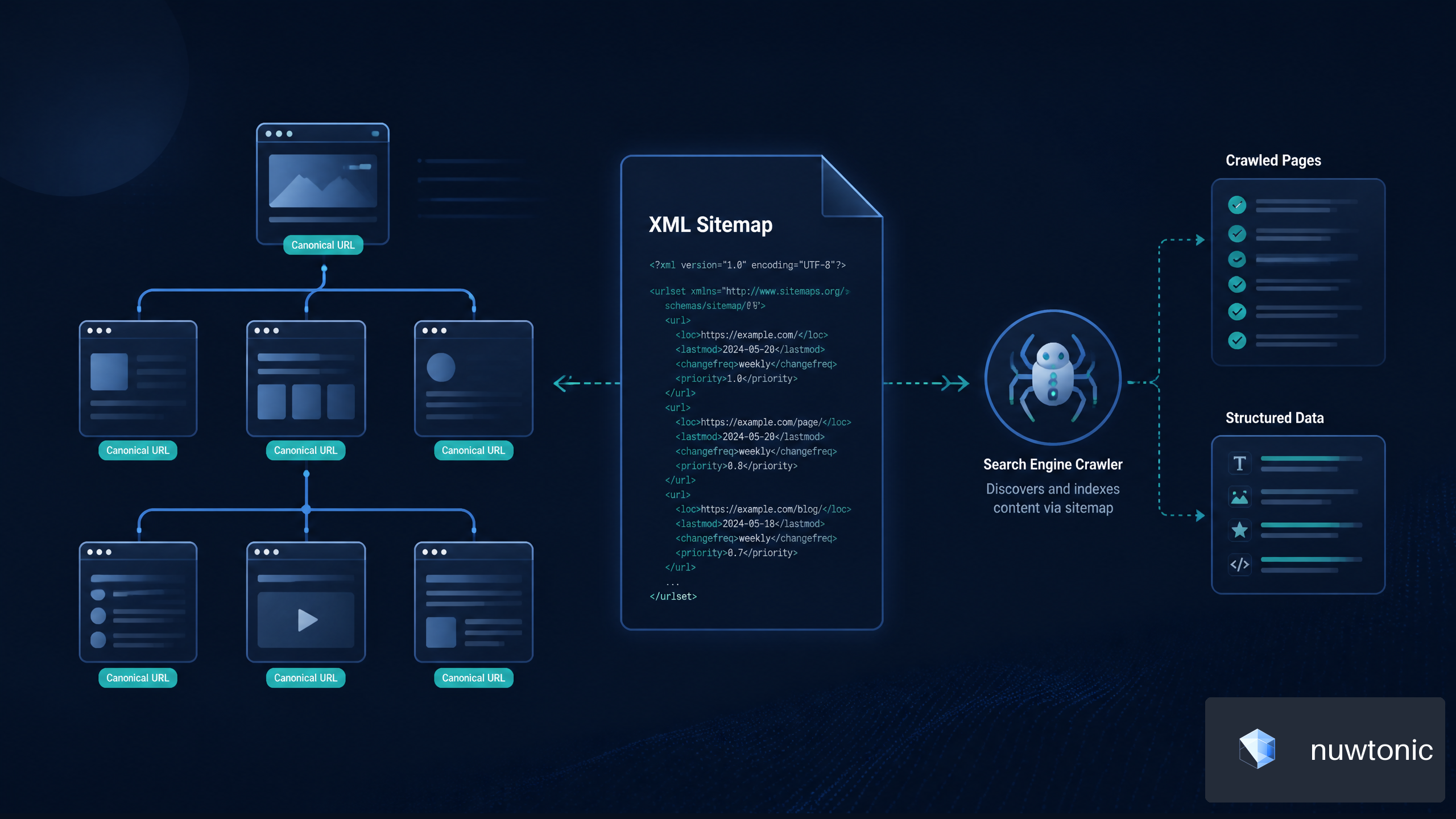
To help search engines understand your practice's specific details, you must implement local schema markup. This is structured data code added to your website that explicitly tells Google your practice name, address, phone number, business hours, and accepted payment methods.
Additionally, you must keep an eye on technical health, because understanding why broken links hurt SEO is a lesson you don't want to learn the hard way when Google drops your rankings. Regularly audit your site to ensure all internal links work perfectly, images load quickly, and your mobile navigation is seamless.
Winning the Google Maps Local Pack
Optimizing Your Google My Business Profile
I've noticed that many dentists struggle with their Google My Business profiles; a well-optimized listing can drastically improve visibility. To stand out in the competitive local pack, your profile must be completely filled out and regularly maintained.
• Select the Right Primary Category: Your primary category should be "Dentist" or "Dental Clinic," while secondary categories can include "Cosmetic Dentist," "Pediatric Dentist," or "Orthodontist."
• Upload High-Quality, Real Photos: Avoid generic stock photos. Upload real pictures of your office interior, exterior, friendly staff, and clinical team.
• Post Regular Updates: Use Google Updates to share holiday hours, special promotions, community involvement, or new technology additions.

Ethical Review Management and HIPAA Compliance
Reviews are the lifeblood of local SEO and trust building. However, healthcare professionals must navigate strict ethical and legal boundaries when managing reviews.
When responding to reviews—especially critical ones—you must maintain absolute HIPAA compliance. Never confirm that the reviewer is a patient, and never disclose any clinical information.
Here is an example of how to handle reviews ethically and safely:
"Thank you for sharing your feedback. We take all patient experiences seriously. Due to privacy laws, we cannot discuss specific patient care online, but we invite you to contact our office manager directly at [Phone Number] so we can address your concerns immediately."
Multi-Location SEO: Scaling Without Duplicate Content
If you operate a dental group with multiple locations, your SEO strategy requires a slightly different approach. You must avoid creating identical pages for each location, as search engines will view this as duplicate content and suppress your rankings.
Strategy Element | Single-Location Practice | Multi-Location Dental Group |
|---|---|---|
GBP Strategy | One highly optimized Google Business Profile | Separate GBP listings for each physical location |
Website Architecture | Focus on homepage and main service pages | Dedicated location landing pages (e.g., |
Content Approach | General local community content | Location-specific team bios, reviews, and community involvement |
Schema Markup | Single LocalBusiness schema on homepage | Distinct LocalBusiness schema on each location page |
Tracking, Attribution, and Measuring SEO ROI
Setting Up Call Tracking and Conversion Rate Optimization
Driving traffic to your website is only half the battle; you need to convert those visitors into booked appointments. This is where conversion rate optimization (CRO) and proper call tracking come into play.
Because many dental patients still prefer to call the office to book, standard web analytics will not show the full picture. Implementing dynamic call tracking allows you to attribute specific phone calls directly to the organic search keywords or landing pages that brought the patient to your site in the first place.
Distinguishing Leads from Actual Bookings
Here is a common pitfall: confusing a "form submission" or "phone call" with a newly scheduled patient. Not every phone call results in a booking; some are existing patients rescheduling, while others are spam or billing questions.
To measure true SEO ROI, your marketing agency or internal team must integrate your call-tracking software with your dental practice management software (such as Dentrix, Eaglesoft, or Open Dental). This allows you to track a lead all the way from their initial Google search to their first hygiene appointment, giving you an accurate cost-per-acquisition (CPA) metric.
Expected Timelines and Realistic Benchmarks
I always tell my clients that SEO is a marathon, not a sprint. If an agency promises to rank you #1 on Google in thirty days, run the other way. In highly competitive metropolitan markets, it typically takes 4 to 6 months of consistent optimization to see significant movement in organic rankings and patient lead volume.
Your mileage may vary based on your domain's historical authority, local competitor strength, and budget. However, once established, organic rankings provide a highly sustainable, low-cost flow of new patients that outlasts any temporary ad campaign.
Frequently Asked Questions
Do dentists need a blog for SEO?
While a blog is not strictly mandatory, it is highly beneficial for building topical authority and answering patient-education questions. Writing detailed articles about postoperative care, Invisalign vs. braces, or dental implant longevity signals to Google that you are an expert in your field.
How long does dental SEO take to show results?
Generally, you can expect to see noticeable improvements in local rankings and call volume within 4 to 6 months. Highly competitive dental markets may take up to 9 to 12 months of sustained, high-quality optimization to secure top-tier organic positions.
What schema markup should a dental website use?
Your website should implement "Dentist" or "LocalBusiness" schema markup. This structured data should include your official business name, physical address, phone number, logo, geo-coordinates, operating hours, and links to your social media profiles.
How should a multi-location dental group handle SEO?
Each physical office must have its own verified Google Business Profile. On your website, you should build unique, dedicated location pages for each office, complete with unique local copy, staff photos, specific reviews, and distinct schema markup.
Wrapping Up: Your Next Steps to Dental SEO Success
Growing your dental practice through organic search does not require a magic formula—it requires consistency, technical precision, and a relentless focus on patient needs. By aligning your website content with local intent, optimizing your Google Business Profile, and tracking actual conversion metrics, you can build a patient-acquisition engine that works for you 24/7.
Take a look at your website today. Are your services grouped onto a single thin page? Is your phone number easy to find on mobile? Start by fixing those simple technical gaps, and watch your practice chairs fill up.
Sources and References
• National Institutes of Health (NIH) - Research on healthcare communication and digital patient engagement: PMC7079055
• U.S. Department of Justice (DOJ) - Patient privacy guidelines and disclosures: Privacy Act Disclosures