You're probably already doing the annoying version of this workflow.
A query comes in from a client or editor. You open Perplexity to check what's changed, what competitors are publishing, and whether an AI answer is citing the sources you expect. Then you switch to Claude to turn that research into an outline, a brief, a rewrite, or a usable long-form draft. Then you go back because one claim needs verification. Then back again because the draft lost nuance. Then you realize the context that mattered in tab one never made it into tab two.
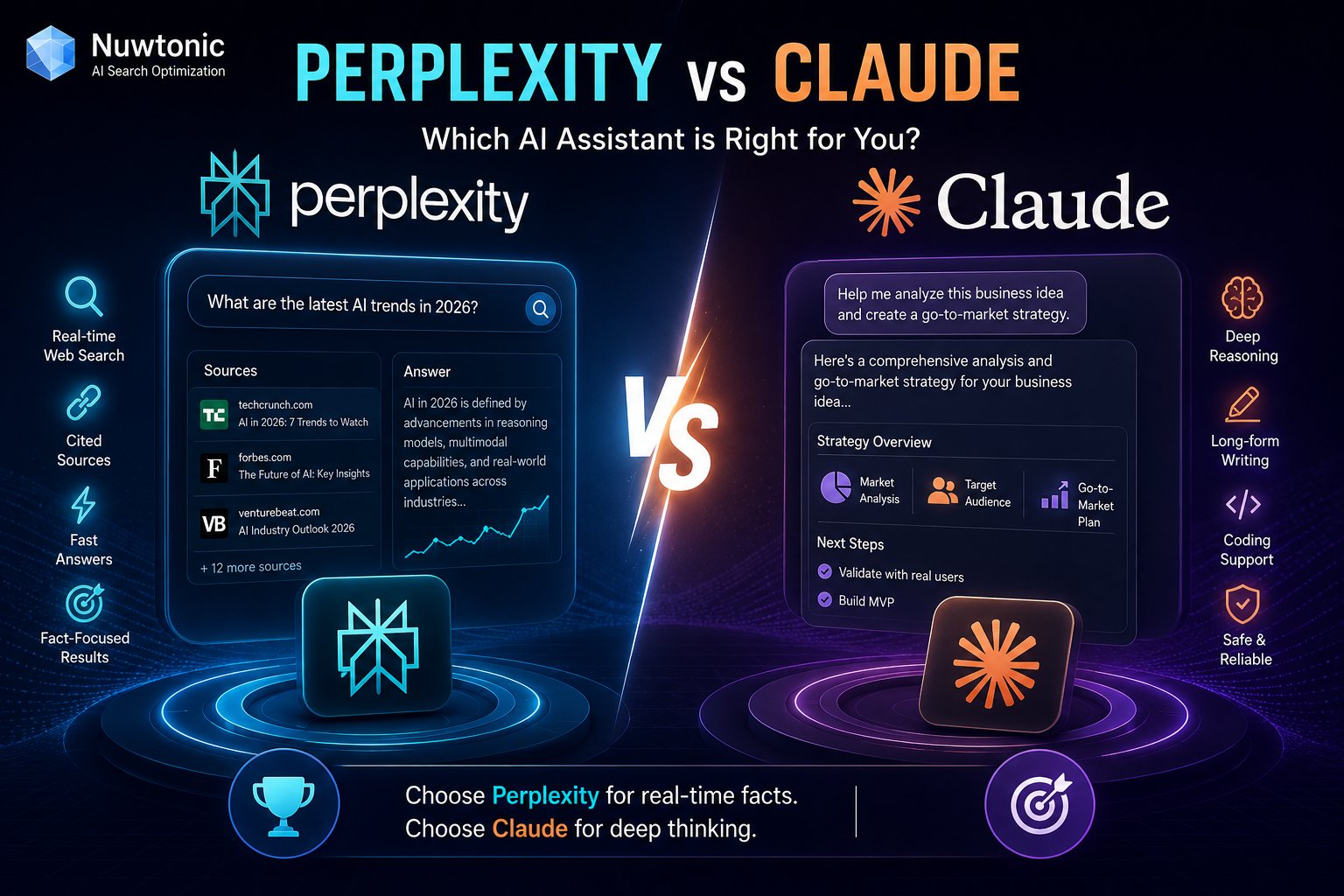
That's the Perplexity vs Claude problem for SEO teams. It isn't deciding which one is “better.” It's deciding how to use each one without wasting time, dropping source context, or creating a verification mess halfway through production.
Table of Contents
- Why This Perplexity vs Claude Comparison Is Different
- The Core Battleground Research Engine vs Reasoning Engine
- When to Use Perplexity Research, Accuracy, and GEO Audits
- When to Use Claude Creative Drafting and Contextual Analysis
- The Workflow Gap Where Both Standalone Tools Fail SEO Teams
- Building a Hybrid AI Workflow for Modern SEO and GEO
Why This Perplexity vs Claude Comparison Is Different
Search “Perplexity vs Claude,” and you will find plenty of comparisons that score features side by side. That format is useful for a buyer deciding which subscription to test first. It is less useful for an SEO lead trying to get reliable research into a draft without losing citations, context, or speed.
An actual workflow is messier.
A strategist starts in a live search environment, checks whether a claim still holds, reviews which sources are getting cited, compares competitor pages, and turns that material into a brief another system can use. Then drafting starts. In many teams, Perplexity handles discovery and verification, while Claude handles synthesis and writing. The hard part is not choosing between them. The hard part is preserving research quality during the handoff.
That handoff is where weaker comparisons miss the operational problem. Teams pull source-backed findings out of Perplexity, paste them into Claude, trim context to fit the task, and rewrite instructions so the second tool understands what matters. By that point, the draft can lose source visibility, qualifier language, or the original reason a source was included at all.
Practical rule: If you can't explain why a source mattered when moving from research to drafting, the draft usually becomes weaker than the original notes.
This comparison is built for that professional use case. It focuses on where each tool fits inside a working SEO and GEO process, not just which one looks better in a standalone demo. If you are also evaluating the broader stack of generative engine optimization tools, that distinction matters because tool performance in isolation rarely matches tool performance inside a team workflow.
The comparison that matters in actual SEO ops
A practitioner view asks different questions:
- Which tool should handle live verification
- Which tool should process long internal context
- Where source integrity gets lost during transfer
- How research, drafting, and GEO checks stay connected across steps
Those are the questions that affect output quality, review time, and whether a team can repeat the process without rebuilding it from scratch on every project.
The Core Battleground Research Engine vs Reasoning Engine
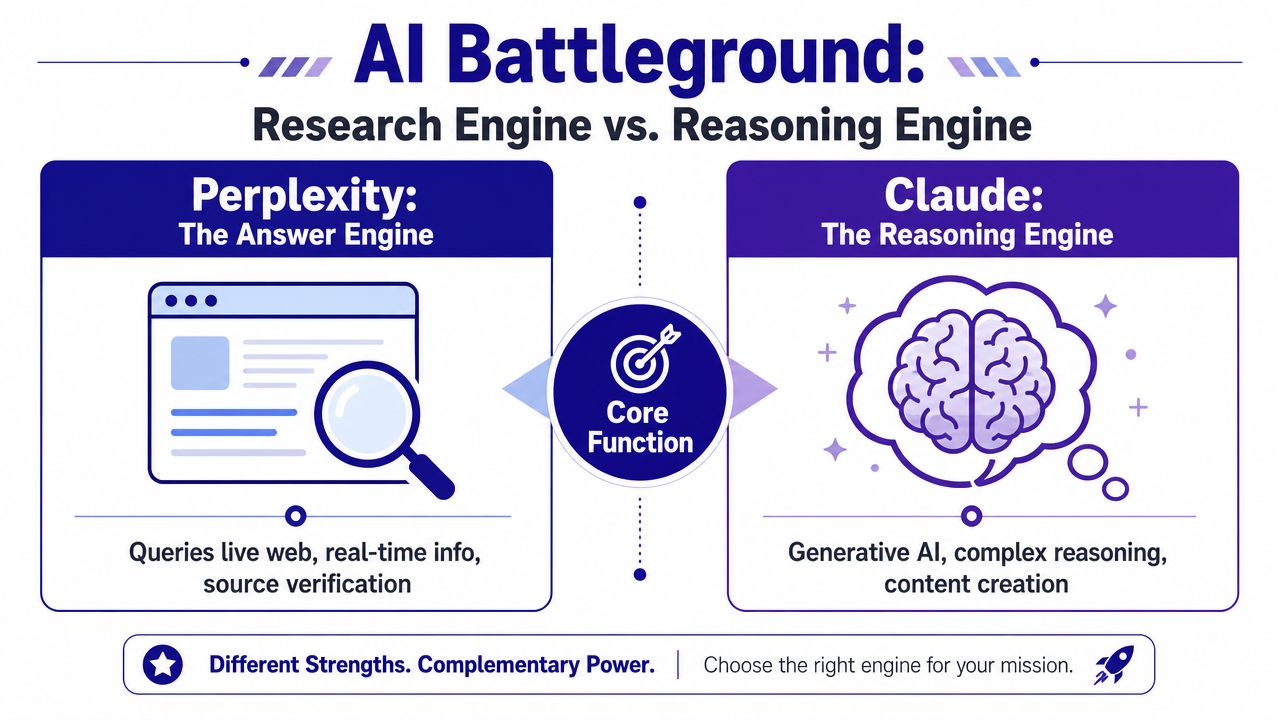
A typical SEO handoff makes the difference obvious. An analyst pulls current sources, SERP snapshots, and competitor changes into one tab. A strategist then needs to turn that raw material into a brief, narrative, or recommendation that can survive review. Perplexity and Claude help with different halves of that job.
Perplexity handles retrieval first
Perplexity is strongest at gathering current information with visible source paths. That makes it useful for work where recency and citation checking matter more than style, such as validating a fresh statistic, checking whether a competitor changed messaging, or seeing which sources appear around a GEO query.
For SEO teams, that matters because a large share of production work starts before writing. It starts with verification. If the input layer is weak, the draft is weak, even if the prose is polished.
That is why Perplexity fits naturally inside a broader stack of generative engine optimization tools for research, validation, and visibility tracking.
Perplexity also has real user adoption, which matters if you care about how mainstream answer engines are shaping research behavior. It has been described as having a monthly user base in the 15 to 20 million range, as noted earlier in this article.
Claude handles reasoning over trusted inputs
Claude is better once the material is already in front of it. Its value is less about finding live information and more about processing long context, following nuanced instructions, and turning messy inputs into something usable.
That is the practical split many comparisons flatten. SEO teams do not only need answers. They need a system for moving from evidence to decisions, then from decisions to assets.
Claude is strong at tasks like these:
| Task type | Better fit |
|---|---|
| Check current facts against live sources | Perplexity |
| Compare multiple long documents at once | Claude |
| Create a concise answer with citations | Perplexity |
| Rewrite a complex brief into a stronger narrative | Claude |
| Hold nuanced instructions across a long exchange | Claude |
The trade-off is straightforward. Claude can produce cleaner synthesis, but it depends heavily on the quality of what you feed it. If the source pack is thin, outdated, or stripped of context during handoff, Claude will still produce a confident draft. It just may be confidently built on the wrong foundation.
The real operational divide is upstream versus downstream work
Perplexity is usually the better choice for upstream tasks. Source gathering, verification, SERP observation, and current-state checks belong there.
Claude is usually the better choice for downstream tasks. Brief expansion, structural rewriting, audience adaptation, objection handling, and multi-document synthesis belong there.
Problems start when teams force one tool to cover both stages.
Using Claude as the first stop for live research increases the chance of stale or weakly supported claims. Using Perplexity as the main drafting environment often leads to copy that is serviceable but compressed, repetitive, or too close to summary mode. Using either tool alone also creates a workflow problem that feature comparisons rarely address. Source rationale, qualifiers, and decision context often get lost between retrieval and writing.
That is the actual battleground. It is not just research versus reasoning as product labels. It is whether your workflow preserves trust from the moment a source is found to the moment a draft is approved.
When to Use Perplexity Research, Accuracy, and GEO Audits
Perplexity earns its place when the cost of stale information is high. In SEO, that's often the default condition.
Use it when freshness and citation visibility matter
The easiest way to misuse Perplexity is to treat it like a writing assistant first. It's better used as a verification layer.
Three common SEO scenarios make that obvious:
Competitor change detection
You want to know if a rival just launched a new feature page, got funding, changed positioning, or started appearing in AI answers for a money query.Source-backed stat gathering
You need a current, citable claim for a draft and want direct source links you can inspect before anything goes into the page.GEO inclusion checks
You ask commercial and informational prompts relevant to your category and review whether your brand appears, how it appears, and which sources the answer seems to prefer.
For Perplexity-specific query design, this guide on optimizing for Perplexity AI search is useful because it matches how source-backed answers are surfaced and validated.
A practical Perplexity workflow for SEO teams
Use this process when you need research that can survive editorial review.
- Start with one query, not a topic bucket: Ask a direct operational question such as “Which project management platforms are cited most often for mid-market teams?” or “What changed in this category in recent months?” Broad prompts waste time.
- Inspect the source list before the wording: Don't read the answer first and trust it after. Open the linked sources, check dates, and identify whether Perplexity is citing primary material, vendor pages, publisher coverage, or low-trust summaries.
- Pull evidence into a structured note: Save each usable finding with three fields only. Claim, source URL, why it matters. This makes the later Claude handoff far cleaner.
- Run a second query from the opposite angle: If the first prompt asks for “best tools,” the second should ask for “most cited alternatives,” “criticisms,” or “missing contenders.” That exposes source bias faster.
- Use it for brand presence checks: Ask the same category prompt in multiple phrasings and record whether your client is included, excluded, or cited indirectly through another publisher.
What Perplexity does poorly
Perplexity can summarize, but that doesn't mean it should own downstream editorial thinking.
It's less effective when the task requires sustained instruction handling, voice calibration, or long multi-document synthesis. It's also easy to get seduced by citation density and forget that not all cited sources deserve equal trust. A linked answer still needs judgment.
Field note: Perplexity reduces research friction. It doesn't remove editorial responsibility.
If the task starts with “find out what's happening and show me where that came from,” use Perplexity first.
When to Use Claude Creative Drafting and Contextual Analysis
Claude earns its place after the source gathering is done and the evidence has been cleaned up. In a real SEO workflow, that usually means Perplexity or another research layer has already surfaced the raw material, and someone on the team has decided what is worth carrying forward.
That handoff matters more than feature lists suggest.
Claude performs best when the job is to interpret, reorganize, and draft from a defined body of material. Give it competitor pages, product documentation, voice notes, sales call themes, and query exports, and it can hold those inputs together across a long working session. Ask it to retrieve fresh facts on its own, and quality gets less predictable.
Claude is strongest when the corpus is already curated
Claude is useful for contextual work that falls between research and writing. That includes turning messy inputs into a usable point of view, spotting contradictions across documents, and maintaining instruction fidelity over multiple turns.
In practice, I use Claude when the team already has the ingredients but does not yet have a clear output.
Typical inputs include:
- competitor article exports
- PDF whitepapers
- internal product docs
- existing landing pages
- GSC query exports
- editorial guidelines
- brand voice notes
The trade-off is straightforward. Claude can reason across a large stack of material, but it will usually treat what you provide as the working truth unless you tell it what to question. If the corpus is weak, biased, outdated, or stuffed with internal assumptions, the draft quality reflects that.
High-value Claude tasks in a professional workflow
Claude is a better fit than Perplexity when the work depends on synthesis rather than retrieval.
Multi-document synthesis
Feed Claude several competing articles, internal briefs, product notes, and customer language samples. Then ask for a single outline that separates shared talking points from real differentiation. This is one of its strongest use cases because it can preserve distinctions that often get flattened in lighter summarization workflows.
Structural rewriting
SEO teams often inherit pages that are accurate but unusable. Product marketing writes for internal stakeholders. Sales writes for objections. Legal writes for risk reduction. Claude is good at rewriting those materials for a specific search audience while preserving the claims that need to stay intact.
Query clustering with rationale
Claude can review long query sets and group terms into intent buckets, page types, and content modules. The valuable part is not the cluster label. It is the reasoning. A strategist can inspect why a term belongs on a commercial page versus an educational page, which makes review faster and easier to defend.
Brief retention across long sessions
Long briefs break weaker tools. Claude usually handles layered instructions better if you specify priorities clearly: target audience, prohibited claims, source hierarchy, tone guardrails, conversion goal, and format. That makes it useful for drafting pages that need consistency across several rounds of revision.
Where Claude creates friction
Claude slows teams down when they skip structure.
A vague prompt often produces polished sprawl. The writing sounds competent, but it can drift away from search intent, overwrite simple ideas, or bury the core decision inside extra explanation. In production, that means more editing passes and more Slack threads about what changed.
It also lacks a native research posture. Claude can analyze documents you upload. It is less dependable as the first stop for current citations, breaking category shifts, or source discovery. SEO teams that treat it like a search engine usually end up doing the research twice.
The practical limitation most tool comparisons miss is transfer cost. Claude does not know which Perplexity findings were verified, which sources were discarded, or which claims are politically sensitive inside the client account unless you package that context explicitly. Without that packaging, the model starts every assignment partially blind.
How to get better output from Claude
Claude responds well to constraints that mirror an editorial brief. The strongest prompts usually include:
- the exact material it may use
- the material it should ignore
- the output format
- the intended audience
- the decision criteria for inclusion
- any claims that require conservative wording
That is how Claude becomes useful in SEO operations. It is not the research engine. It is the interpretation and drafting layer that turns validated inputs into outlines, briefs, rewrites, and synthesis a team can publish.
The Workflow Gap Where Both Standalone Tools Fail SEO Teams
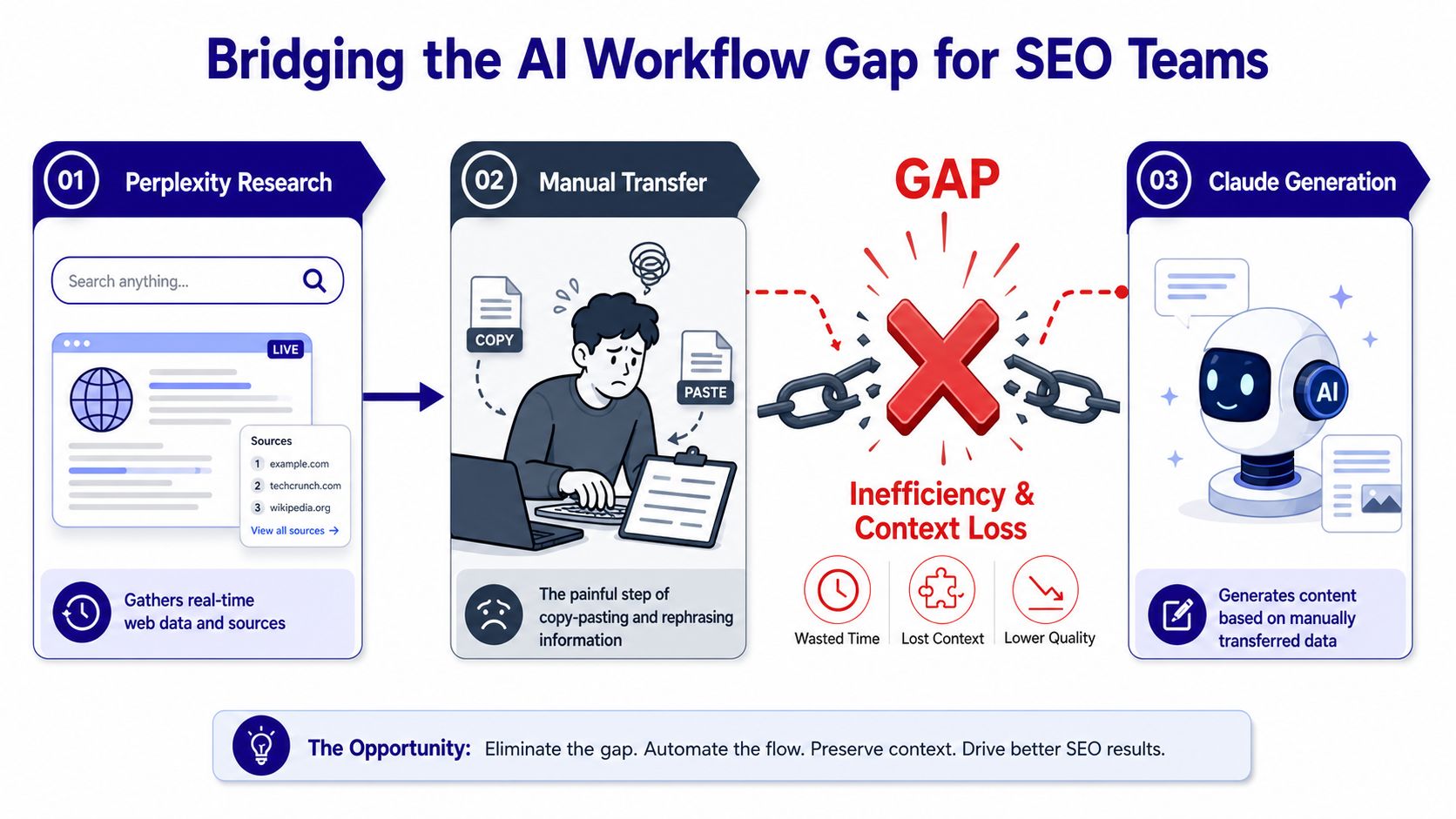
The friction in using Perplexity and Claude together comes from the broken process of moving work between them.
Most comparisons skip the operational problem
A strategist finishes source discovery in Perplexity, copies notes into a doc, opens Claude, pastes the useful parts, then rewrites the prompt three times because the first draft missed the actual constraint. That is the failure point. It is not model quality. It is process design.
Feature comparisons rarely deal with that handoff. They treat retrieval and reasoning as separate buying decisions, even though SEO teams use them inside one production chain. In real work, the gap shows up between the source check and the first draft, then again during review when someone has to trace a claim back to the original evidence.
That gap matters more in GEO workflows, where source provenance affects not just content quality but also how teams assess visibility in AI-generated answers. Teams working on content optimization for AI search already feel this. The hard part is not getting an answer from either tool. The hard part is preserving context from research through drafting and review.
How context loss shows up in real work
The failure pattern is usually mundane, which is why teams underestimate it.
| Workflow stage | What happens | What gets lost |
|---|---|---|
| Perplexity research | Team gathers current sources and answer patterns | Source priority, discarded sources, and why a source was trusted |
| Manual transfer | Notes are copied into Claude | Caveats, exclusions, exact wording, and client-specific sensitivities |
| Claude drafting | Draft is built from partial context | Citation trail, verification status, and retrieval logic |
| Editorial review | Human checks the output | Time spent reconstructing the research path instead of improving the piece |
One missing note can change the draft. If Perplexity surfaced five sources and only one was strong enough to support a claim, Claude will not know that unless the handoff states it clearly.
That is why manual transfer creates more than delay. It changes the evidence quality inside the draft.
What breaks first at agency scale
The problem gets sharper once multiple people touch the same asset.
Agency teams deal with client approvals, changing briefs, repeated prompt chains, and writers who inherit work halfway through production. In that setup, Perplexity and Claude can both perform well individually and still create messy output together. Research lives in one tab. Decisions live in another. The reasons behind those decisions often disappear.
The first thing that breaks is consistency. Two strategists can research the same topic in Perplexity, hand it to two different writers using Claude, and produce drafts with different standards of proof, different source discipline, and different interpretations of what the client approved.
Standalone tools do not solve that operating model. They solve parts of it. SEO teams still need a structured way to carry verified findings, rejected claims, editorial constraints, and attribution rules from retrieval to analysis to draft review. Without that layer, Perplexity and Claude remain useful but incomplete parts of the same workflow.
Building a Hybrid AI Workflow for Modern SEO and GEO
A good hybrid workflow doesn't ask one model to do everything. It creates a disciplined handoff between retrieval and reasoning, then connects that handoff to measurement.
The manual bridge that still works
If you're using Perplexity and Claude together today, the best manual process is surprisingly simple.
- Export findings as evidence blocks: For each Perplexity finding, keep the original claim, linked source, publication context, and a one-line note on editorial importance.
- Create a transfer brief before opening Claude: Don't dump raw notes. Write a compact handoff that states objective, audience, exclusions, must-use evidence, and unanswered questions.
- Separate verified facts from drafting instructions: Claude performs better when it can distinguish source-backed inputs from stylistic or structural requests.
- Ask for reasoning against the evidence set: Good prompt pattern: synthesize only from supplied material, flag any unsupported claim, and identify where the evidence is thin.
- Review the output against the evidence blocks: This is the fastest way to catch drift.
That process is still manual, but it's workable. It reduces lost context and makes the Claude draft easier to audit.
What a usable system needs beyond prompts
Prompt discipline helps, but it doesn't solve the bigger GEO measurement problem. As Clickrank's GEO analysis argues, the challenge now is turning citations into a measurable performance layer because AI answers account for 25% of clicks.
A more complete workflow needs capabilities most standalone chat tools don't provide well:
- Brand visibility tracking across AI surfaces
- URL-level citation monitoring
- A connection between search performance data and content actions
- An execution layer for fixes, updates, and structured improvements
- Reviewable workflows instead of one-off chats
That's the difference between using AI tools and operating an AI-native SEO system. For teams that need research, drafting, optimization, and AI search measurement in one place, a unified workflow matters more than model loyalty. One practical example is this guide on how to optimize content for AI search, which aligns content improvement with the realities of AI answer inclusion instead of stopping at generic content advice.
Teams that are serious about SEO and GEO don't need another isolated chatbot. They need one workspace that connects research, visibility tracking, content updates, technical fixes, and reviewable execution. Nuwtonic does that by combining AI search visibility measurement, GEO audits, on-page optimization, content workflows, and GSC-driven prioritization in a single platform built for real production work.