Keyword clustering stopped being a niche SEO trick the moment teams had to manage large keyword pools at scale. The practice was formalized in 2015 and, from that point on, the question changed from “what keywords do we have?” to “what intent does Google group together?” For practitioners, that shift matters because clustering is no longer about tidy spreadsheets, it's about page mapping, cannibalization control, and topical authority built from real SERPs, not guesswork. If you want a practical starting point, even a simple system for topic grouping methods for comments shows the same principle, organize messy input into usable themes.
Table of Contents
- 1. Nuwtonic
- 1. Nuwtonic
- 2. Keyword Insights
- 3. KeyClusters
- 4. WriterZen
- 5. Serpstat
- 7. SE Ranking Keyword Grouper
- 7. SE Ranking Keyword Grouper
- Top 7 Keyword Clustering Tools Compared
- From Clusters to Content Your Action Plan
1. Nuwtonic
Nuwtonic is built for teams that need keyword clustering to lead directly into content work. It connects with Google Search Console, surfaces ranked issues and citation gaps, and turns those signals into fixes that can be reviewed and staged for CMS deployment. For SEO teams that have watched clustering die in a spreadsheet, that matters. The platform keeps the workflow tied to publishing, not just exports. Visit Nuwtonic, and you can see how it positions keyword clustering, topical mapping, and AI visibility as one system. It also sits well alongside broader AI tools for marketing teams that support execution after the research phase.
Why it stands out in practice
The strongest part of Nuwtonic's model is the way it connects clustering, GSC signals, and fixes. The platform includes 120+ automated visibility checks, entity-first content generation, competitor gap analysis, and multi-model prompt tracking across ChatGPT, Gemini, Perplexity, Claude, Grok, and Google AI. That mix matters when a cluster strategy has to answer more than “which page should this keyword live on?” It also has to answer “what is broken, what is missing, and what can we publish next without creating more cannibalization?”
Nuwtonic is useful for teams that want a working system, not just grouped keywords. It gives analysts a way to move from SERP grouping or semantic grouping into briefs, fixes, internal links, and rank monitoring without rebuilding the process in another tool. That is the practical difference. Some platforms help you sort terms, while Nuwtonic helps you act on the cluster after the sort is done.
Practical rule: If clustering does not feed briefs, fixes, internal links, and rank monitoring, it is still research, not an operating workflow.
1. Nuwtonic
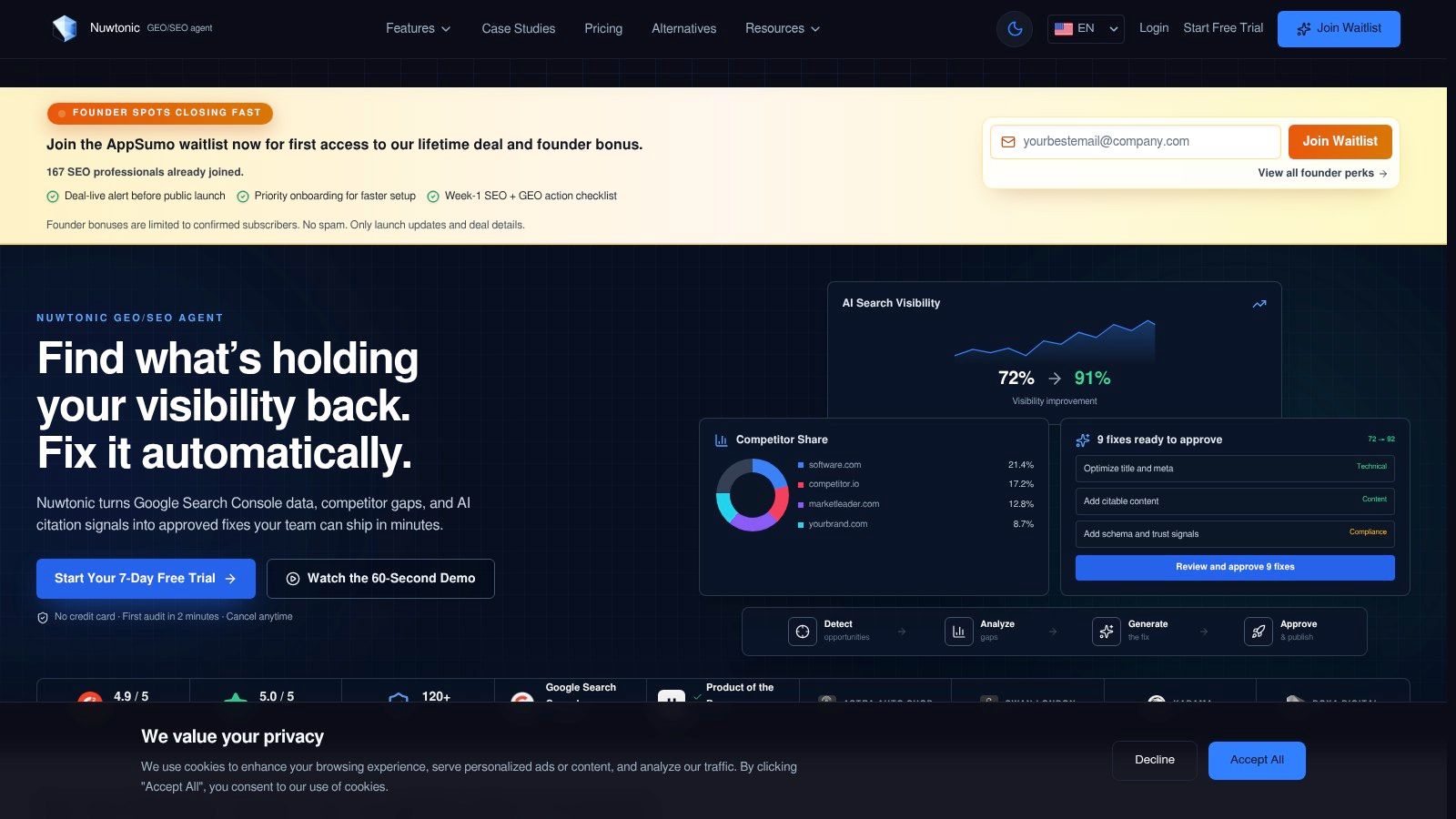
Nuwtonic is the most execution-oriented keyword clustering tool in this list because it does not stop at grouping terms. It connects to Google Search Console, surfaces ranked issues and citation gaps, and turns those signals into reviewable fixes that can be staged for CMS deployment. That matters if your clustering workflow has ever died in a spreadsheet, because the platform pushes the work toward actual content operations instead of leaving you with a static export. Visit the product at Nuwtonic, and you'll see the broader stack built around keyword clustering, topical mapping, and AI visibility.
Why it stands out in practice
The strongest part of Nuwtonic's model is that it links clustering, GSC signals, and fixes. The platform includes 120+ automated visibility checks, entity-first content generation, competitor gap analysis, and multi-model prompt tracking across ChatGPT, Gemini, Perplexity, Claude, Grok, and Google AI. That combination is useful when your cluster strategy needs to answer more than “what page should this keyword live on?” It also needs to answer “what is broken, what is missing, and what can we safely publish next?”
Practical rule: If clustering does not feed briefs, fixes, internal links, and rank monitoring, it is still research, not strategy.
Nuwtonic's workflow is especially strong for agencies and in-house teams that need approval controls. It can generate technical, schema, metadata, alt text, and content fixes, then stage them for review before anything goes live. The GEO Audit, Auto-Fix, Content Autopilot, and SiteWise topical maps all point in the same direction, which is to make clusters actionable inside the same workspace where performance is measured.
That approach also fits teams comparing SERP-based and semantic grouping methods. If you want a practical overview of how those clustering approaches differ, the guide on what keyword clustering is and how to cluster keywords is the right starting point. For teams working on broader content interpretation and intent mapping, the related SEO and GEO insights resource can help frame how labels and topical structure affect planning.
Where it fits and where it doesn't
The trade-off is governance. Credit-based usage is flexible, but heavy users need to understand how their content, audit, and optimization volume will consume credits. The other consideration is implementation discipline, because CMS pushes and auto-fix workflows still need human review before launch. For teams that want a pure clustering-only utility, Nuwtonic is more than they need.
For teams that want a cluster tool tied to site recovery, content generation, and AI search visibility, it is a strong fit. The platform's pricing starts at Bronze $99/month with 1,200 monthly flexible AI credits, while Silver is $199/month with 2,400 credits, and custom agency plans scale higher. Nuwtonic also offers a 7-day free trial with no credit card, which makes it easier to test whether the workflow fits your editorial process.
2. Keyword Insights
Keyword Insights is built for teams that want SERP-based clustering with enough control to trust the output. Its core logic groups keywords by the ranking URLs they share, which is more useful than simple word similarity when you're trying to decide whether one page can serve multiple intents. The platform also adds intent labels, visual prioritization, and content brief generation, so the move from research to production stays inside one workflow. See the platform at Keyword Insights.
The practical value of SERP overlap
This tool makes sense when your keyword list is large and messy. Its strength is not just grouping terms, it's helping you read the shape of the cluster so you can spot whether a topic belongs on one page or should split into multiple pages. That is especially useful for mixed-intent SERPs, where superficial similarity can hide a different search goal.
Keyword Insights is also a good fit when editorial teams need a way to prioritize what gets written first. The visual cluster structure makes it easier to see which groups are worth targeting, and the built-in brief generation reduces handoffs between SEO, strategy, and content. If your team has ever lost momentum after research because no one converted the spreadsheet into a writing plan, this solves a real operational problem.
Where the tool earns trust
The methodology matters. Keyword Insights says it groups keywords where the ranking URLs are the same or similar, which means the cluster is tied to how search engines behave, not just how terms look in a database. That makes it more defensible for page planning, because you're working from observed SERPs rather than guessing at semantics. For teams building topical maps, that's a meaningful difference.
The trade-off is the credit model. It works well for variable workloads, but teams still need to watch consumption if they cluster often or at scale. It may also need to sit beside a broader SEO stack if you want deep technical, backlink, or site audit coverage. For agencies and in-house teams focused on content architecture first, though, it's one of the clearest specialist options.
3. KeyClusters
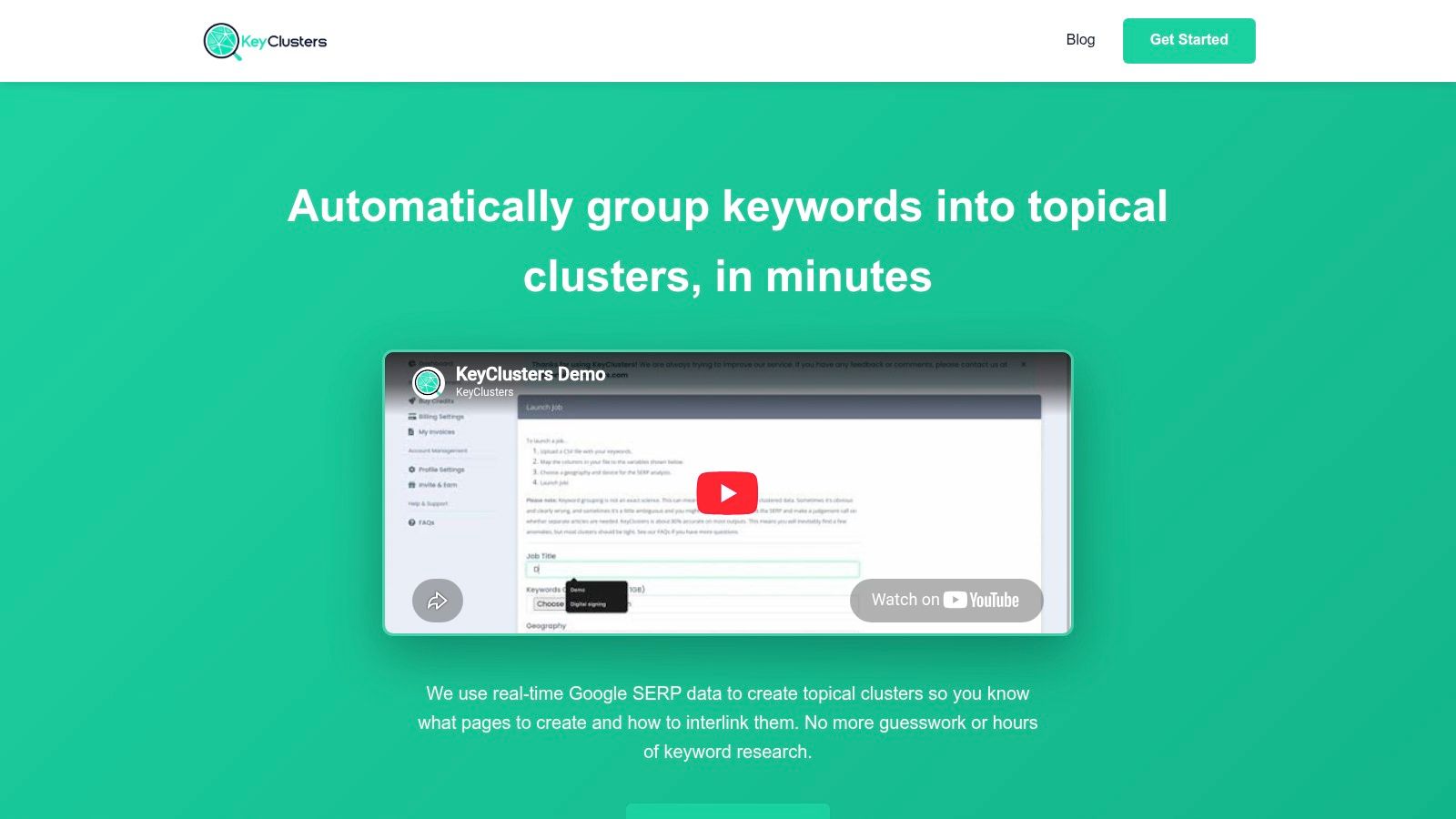
KeyClusters is the cleanest choice if you want a narrowly defined SERP-overlap clustering workflow. It's built around a simple rule, keywords are grouped when three or more of the same URLs appear across the top results. That keeps the methodology easy to audit and makes the output easier to defend in content planning meetings. The tool is available at KeyClusters.
Why this straightforward model works
KeyClusters is useful when you need to de-dupe topics fast. If two queries keep returning the same top pages, the tool treats them as the same intent cluster, which helps you avoid publishing competing pages for one search need. That makes it especially valuable for agencies mapping one-URL versus multi-URL strategies across large keyword lists.
The workflow is very practical. You upload a CSV, let the tool process the list, and export the clustered output for documentation or review. Because the method is transparent, SEO leads can explain why a keyword belongs on a given page without resorting to vague “semantic similarity” language. In client environments, that clarity reduces debate.
The limitation to keep in mind
The narrow scope is also the main constraint. KeyClusters is clustering-first, so it doesn't try to become your research suite, audit tool, or content brief platform. That's not a flaw, it's just a reminder that you'll need other systems for page optimization, tracking, and execution.
When a team wants a precise clustering pass before architecture work, a small, auditable tool is often better than an all-in-one suite.
The other consideration is dependency on live Google results. That's a feature for accuracy, but large batches can take time because the tool is checking real SERPs. If you value speed plus clarity over a broader feature set, KeyClusters is one of the easiest tools to trust. For teams that want a clustering engine they can plug into a larger workflow, that makes it useful.
4. WriterZen
WriterZen is a strong fit for small teams that want keyword discovery, clustering, briefs, and drafting in one place. It does not try to be the most technical clustering engine on the market. Instead, it focuses on giving content teams a smooth path from topic research to page creation without bouncing between too many tools. The platform lives at WriterZen.
Best for teams that need momentum
The appeal here is workflow coherence. You can move from keyword discovery into topic grouping, then into outline or brief creation, and finally into AI-assisted drafting. That is useful when the team is small and every extra handoff slows production.
WriterZen's clustering features sit inside its broader content system, which means the tool makes more sense when content operations are the main goal. If you're building blog programs, resource hubs, or editorial calendars, the platform's structure helps you turn clusters into actual publishing tasks. The built-in tutorials also matter more than people admit, because teams often need help understanding how to judge cluster boundaries before they start writing.
Where it falls short
The main trade-off is that credit-based usage needs monitoring on big datasets. WriterZen is comfortable for routine content work, but larger or more complex cluster audits can push teams back toward spreadsheets for QA. That's not unusual in an all-in-one tool, but it matters if you're planning to process very large keyword sets.
WriterZen works best when the priority is speed and consistency, not absolute analytical depth. If your team wants a single platform for research and drafting, it earns its place. If your workflow depends on very granular clustering controls or enterprise-scale batch processing, a specialist tool may be a better primary engine.
5. Serpstat
Serpstat's Keyword Clustering module fits teams that want clustering inside a broader SEO platform. The clustering logic is based on SERP overlap, and the module also maps keywords to pages, which makes it useful for architecture planning as well as topic grouping. The platform is available at Serpstat.
Why it's a good mid-stack option
The biggest advantage is continuity. If your team already uses Serpstat for rank tracking, research, or audits, clustering inside the same environment keeps the workflow simpler. Credits are pooled across tools, so the platform feels operationally integrated rather than bolted on as a single feature.
That matters in practice because clustering rarely stands alone. Teams need to check page ideas against ranking data, content gaps, and existing site coverage. Serpstat's exports and documentation make that easier, especially when the work is spread across analysts, writers, and editors.
What to watch before you commit
The credit-sharing model is the main constraint. Heavy text analysis or other platform activity can eat into the same quota used for clustering, so teams need to plan their workloads carefully. The breadth of the interface can also feel heavy if clustering is the only thing you want from the platform.
Still, Serpstat is a sensible choice if you want a mature suite with a practical clustering module attached. It's less specialized than a single-purpose tool, but it becomes more attractive when you need clustering to live next to page-level SEO tasks. For mid-market teams that want one environment for multiple workflows, that balance is hard to ignore.
7. SE Ranking Keyword Grouper
SE Ranking's Keyword Grouper fits teams that need clustering with geography-aware controls. It groups keywords by comparing Google TOP-10 results, and the workflow lets users choose a region, an optional interface language, a grouping method, and a grouping accuracy level before importing keywords. For teams that also want a cleaner research process, how to do keyword research is a useful reference before you start clustering.
Why it works well for regional work
This tool is useful when a site serves multiple markets. Region and language settings matter because cluster boundaries can change by geography and by SERP behavior, so the same keyword set may not group the same way in every market. That makes SE Ranking a practical option for agencies, SMBs, and in-house teams managing localized content plans.
The grouping logic is direct. It clusters terms based on shared URLs in the top results, which gives you a practical way to judge whether one page can cover multiple queries. The UI also lets you return to recent jobs, so the workflow stays manageable when you are iterating across several projects and checking where a cluster should turn into a page, a section, or a support article.
What the suite adds, and what it doesn't
SE Ranking works best as part of its broader SEO stack, which includes rank tracking, audits, and backlinks. That makes it more than a clustering utility, but it also means the tool can feel larger than necessary if clustering is your only objective. For teams that want a balanced mid-market platform, that trade-off is easy to understand.
The practical value is in how the cluster output fits into execution. You can take grouped terms, compare them with existing pages, and decide where a new asset is needed versus where a current page already covers the intent. That is the same kind of decision-making that drives keyword clustering and turns raw keyword lists into an editorial plan tied to topical authority.
Use the cluster output to review existing coverage, then map each group to the page that already matches the intent or to the new page that fills the gap.
7. SE Ranking Keyword Grouper
SE Ranking's Keyword Grouper is a solid choice for teams that need clustering plus geography-aware controls. The tool organizes keywords by comparing Google TOP-10 results, and the workflow lets users select a region, an optional interface language, a grouping method, and a grouping accuracy level before importing keywords. The platform is available at SE Ranking.
Why it works well for regional work
This tool is useful when the same site operates across markets. Region and language controls matter because clustering can shift depending on geography and the SERP environment. That makes SE Ranking a sensible choice for agencies, SMBs, and in-house teams managing localized content plans.
The grouping logic is also straightforward. It clusters terms based on shared URLs in the top results, which gives you a practical way to decide whether one page can serve multiple queries. Because the UI also lets you revisit recent jobs, the workflow feels manageable when you're iterating across several projects.
What the suite adds, and what it doesn't
SE Ranking works best as part of its broader SEO stack, which includes rank tracking, audits, and backlinks. That makes it more than a clustering utility, but it also means the tool may be more than you need if clustering is your only objective. For teams that want a balanced mid-market platform, though, that's part of the appeal.
Use the cluster output to answer one question first, should this be a new page or an improvement to an existing one?
The platform is strongest when the clustering output feeds architecture decisions and cannibalization control. If you want a practical, search-result-based grouper inside a broader SEO suite, SE Ranking is a credible option. For a workflow-focused team, it's a dependable middle ground between specialist tools and heavyweight platforms.
Top 7 Keyword Clustering Tools Compared
| Product | Implementation complexity | Resource requirements | Expected outcomes | Ideal use cases | Key advantages |
|---|---|---|---|---|---|
| Nuwtonic | Moderate–High, GSC connection, CMS integrations and governance | Moderate, credit-driven AI usage, domains/seats, CMS access; plans from $99/mo | Prioritized GSC-trained fixes, faster traffic recovery, higher AI citation rates, reduced triage time | Agencies, in-house SEO/content teams, e‑commerce, solo marketers needing end-to-end fix deployment | Auto-generates reviewable fixes and CMS-ready patches; GSC-trained impact scoring; multi-LLM prompt tracking |
| Keyword Insights | Low–Medium, SRP-based setup and visualization tuning | Low–Moderate, subscription or PAYG credits | Clear SERP-clustered keyword groups and content briefs for planning | Agencies and in‑house teams focused on clustering and content planning | Fine clustering controls, intent tagging, visual prioritization, built-in brief generation |
| KeyClusters | Low, upload CSV and run SERP-overlap clustering | Low, simple PAYG/credit model | Auditable clusters for de‑duping, cannibalization detection, URL-mapping guidance | Large keyword lists, agencies needing predictable, repeatable clustering | Transparent SERP-overlap methodology, pay-as-you-go pricing, predictable results |
| WriterZen | Low, integrated research-to-draft workflow with minimal setup | Low–Moderate, credit limits for clustering and AI drafting | Faster research→brief→draft execution; cohesive content workflow | Small content teams wanting end-to-end keyword research, briefs and drafting | Unified workflow, integrated AI drafting, learning resources to shorten ramp-up |
| Serpstat | Medium, clustering inside broader SEO platform | Moderate, pooled credits across tools (clustering, text analytics, etc.) | Keyword clusters mapped to pages with exports; integrates with audits and tracking | Teams wanting clustering within a full SEO toolkit (agencies, practitioners) | Reliable SERP-overlap clustering, good documentation, works with Serpstat suite |
| Semrush, Keyword Strategy Builder | Medium, part of Semrush ecosystem, setup depends on workflow integrations | High, Semrush subscription; feature access varies by plan | Automated clusters mapped to topics/pillars and prioritized content plans | Teams standardizing on Semrush for research→planning→execution at scale | Seamless integration with Semrush tools; automates topic/pillar mapping |
| SE Ranking, Keyword Grouper | Low–Medium, in-platform clustering with precision controls | Moderate, included in SE Ranking plans; tier limits may apply | Organized keyword groups to inform site architecture and avoid cannibalization | SMBs and agencies wanting affordable clustering within a mid-market SEO suite | Practical SERP-overlap logic, manage/revisit recent jobs, balanced price/features |
From Clusters to Content Your Action Plan
A keyword clustering tool only matters if it changes what gets published. The win comes from turning grouped terms into page-level decisions, then connecting those pages into a pillar-and-spoke structure that reflects how Google serves intent. That means you don't just cluster for the sake of cleanup, you cluster to decide what deserves a new page, what should be folded into an existing page, and what should be consolidated to stop cannibalization.
Start with your existing content, not your wish list. Audit the pages you already have against your clusters, then sort each group into one of three buckets, new page, optimize existing page, or consolidate. That workflow is where topical authority starts to become visible, because you're aligning your site with the SERP patterns you've already confirmed instead of writing into the dark.
The next step is to connect clusters to your editorial system. Writers need briefs, editors need page targets, and SEO leads need a way to monitor whether the published page is winning the cluster. The strongest keyword clustering tools in this list make that easier by linking clusters to content briefs, topical maps, internal linking, or rank tracking. That's also where Nuwtonic is especially useful, because it connects GSC performance, keyword clustering, topical authority building, and reviewable fixes in one workspace.
One more practical point. Mixed-intent and entity-rich queries can break weak clustering logic, so don't trust default output blindly. Test the cluster against your site coverage, SERP overlap, and editorial purpose, then refine the mapping before anything ships. When the tool's output and your content architecture agree, you've got a publishable plan.
If you want a workflow that goes beyond grouping keywords and helps you act on the data, start with Nuwtonic. It gives you the clustering layer, the GSC signal layer, and the execution layer in one place, so your team can move from research to published fixes without losing the thread. Visit Nuwtonic to see how its keyword clustering, topical mapping, and AI SEO workflows can fit into your content operation.