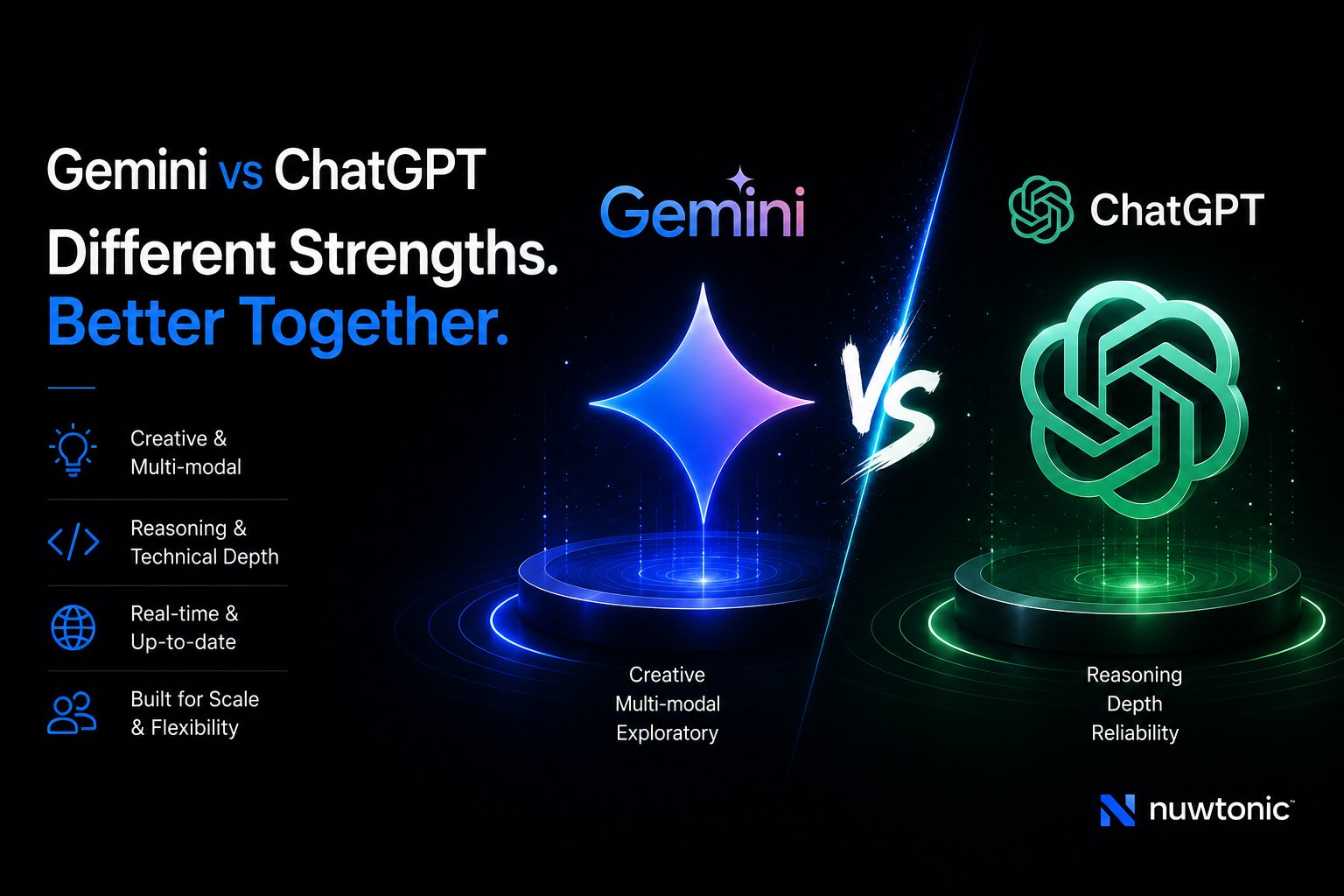
Most advice on Gemini vs ChatGPT is too shallow to help a working SEO team. It usually collapses the comparison into creativity, speed, or which chatbot feels nicer to use. That misses the professional question.
If you're responsible for research quality, content production, technical audits, and whether your brand gets cited inside AI answers, the useful comparison starts somewhere else. It starts with context limits, search grounding, citation behavior, and how each model behaves when a task moves from a one-shot prompt to a multi-step workflow.
That changes the decision. A content marketer drafting headlines has a different winner than an SEO lead auditing a large site, tracing citation gaps, or analyzing a competitor's content library. The tools overlap, but they don't fail in the same places, and that matters more than any generic "best AI" verdict.
Table of Contents
- Beyond the Hype The Real Gemini vs ChatGPT Debate
- The Core Architectural Divide Context Window and Data Ingestion
- Performance Benchmarks Reasoning Accuracy and Code
- The Agentic Advantage Web Research and Multimodal SEO
- The GEO Deciding Factor Source Citations and Attribution
- Conclusion Your Strategic Decision Framework
- Frequently Asked Questions
Beyond the Hype The Real Gemini vs ChatGPT Debate
The biggest mistake in most Gemini vs ChatGPT comparisons is treating them like consumer chat apps. Professional teams don't just need fluent answers. They need answers they can trace, defend, and turn into action.
That is where the gap gets more serious. A 2026 analysis of attribution reliability in Gemini and ChatGPT workflows notes that Gemini delivers up-to-the-minute information with source citations, while ChatGPT's browsing can feel less integrated. The same analysis also points out that mainstream comparisons rarely test which model more reliably avoids false or orphaned links across large sets of factual queries. For SEO agencies, compliance teams, and in-house researchers, that's the practical fault line.
A strategist evaluating AI tools for production work should care about four things first:
- Can it hold enough context: Large audits, content inventories, and multi-page briefs break smaller working windows.
- Can it research the live web well: Static reasoning isn't enough when SERPs, products, and citations change daily.
- Does it surface sources cleanly: If a model rarely links out, your brand has fewer chances to appear as the cited authority.
- Can the output be checked: Good prose without clear attribution creates rework, not value.
Practical rule: If the output will influence a page update, client recommendation, or published claim, attribution quality matters more than creative polish.
This is also why broad market-share style roundups can be useful as a secondary lens, not a primary one. The QuickSEO analysis of AI platforms is worth reviewing if you want ecosystem context, but professional selection still comes down to workflow fit.
For SEO and GEO, the core debate isn't "which AI is smarter?" It's which AI is more dependable for the exact job in front of you.
The Core Architectural Divide Context Window and Data Ingestion
The architectural difference that shows up fastest in real work is the context window. In plain terms, this is how much material the model can hold in active working memory during a task.
For GEO work, that isn't an abstract spec. It changes whether you can review a whole content library at once, compare long technical exports in one prompt, or trace an entity across dozens of pages without splitting the task into fragments.
Why context size changes SEO work
For Generative Engine Optimization, Gemini 3.1 Pro has a 1 million-token input context window while ChatGPT's GPT-5.4 limit is 272K tokens, which gives Gemini a structural advantage for ingesting full competitor content libraries or complete technical audit reports in a single pass for citation generation, according to this GEO-focused comparison of Gemini and ChatGPT.
That matters because chunking large inputs is where teams subtly lose signal. A crawler export, an editorial archive, a cluster map, and a schema inventory rarely live cleanly in one small prompt. Once you split them, the model may miss repeated entities, contradictory titles, orphan topics, or citation-worthy source pages that only make sense in aggregate.
| Feature | Gemini 3.1 Pro | ChatGPT (GPT-5.x) | Why It Matters for SEO/GEO |
|---|---|---|---|
| Context window | 1 million tokens | 272K tokens | Larger context reduces prompt splitting during audits and content library analysis |
| Large-scale ingestion | Handles full libraries in one pass more comfortably | More likely to require chunking | Fewer handoffs means less entity loss and less reconciliation work |
| Best-fit SEO use | Technical audits, competitor library synthesis, citation generation | Tighter scoped tasks and shorter review loops | Tool choice should match task size, not brand preference |
A simple example makes this clearer. If you're mapping topical authority across a large site, Gemini is better suited to take the site export, category pages, article set, and competitor benchmark corpus together. It can synthesize patterns across the whole set rather than through stitched summaries.
Teams building their own retrieval layers should also think about context as a systems problem, not just a model feature. The Geode AI context solutions piece is useful here because it frames how context handling affects downstream reliability, especially when multiple sources have to stay connected.
Where ChatGPT still fits
ChatGPT isn't disqualified by a smaller window. It performs better when you tighten the job.
Use it when the task is discrete and instruction-heavy:
- Prompt-constrained rewriting: Tight messaging edits, tone control, and short-form restructuring.
- Focused troubleshooting: One landing page, one snippet, one schema block, one bug.
- Sequential iteration: Back-and-forth refinement where the constraint set matters more than total corpus size.
Smaller context isn't always worse. For some editorial tasks, a narrower working set produces cleaner output because the model has less irrelevant material to juggle.
If your workflow is "analyze everything at once," Gemini is the better architectural fit. If your workflow is "refine this exact artifact carefully," ChatGPT often feels more controlled.
Performance Benchmarks Reasoning Accuracy and Code
Benchmarks aren't the full story, but they do help separate preference from repeatable performance. For professional SEO work, the useful question is not who wins overall. It's where each model creates less cleanup.
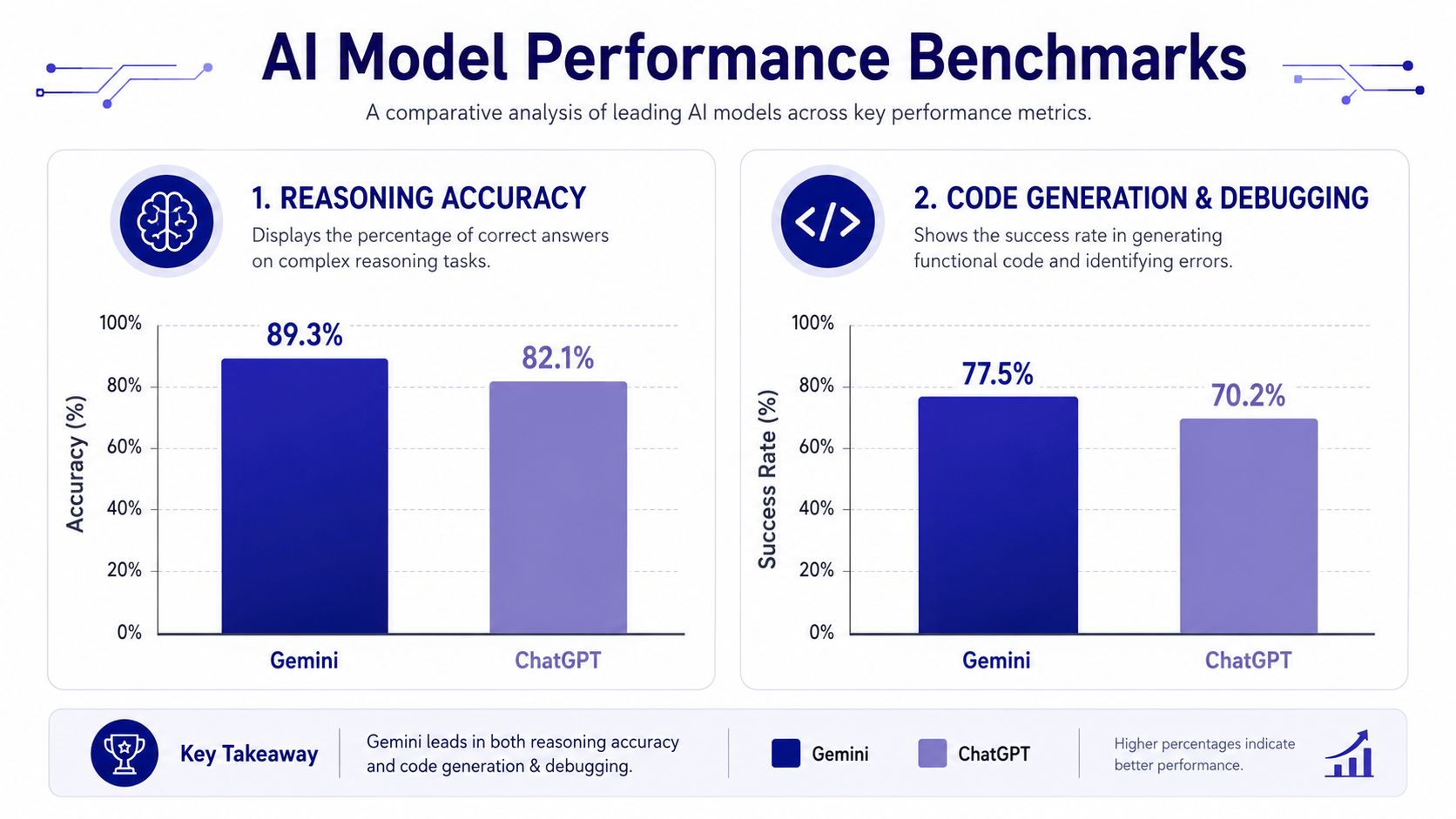
Gemini 3.1 Pro leads in scientific reasoning with 94.3% on GPQA Diamond versus ChatGPT's 92.8%, and in abstract reasoning with 77.1% on ARC-AGI-2 versus ChatGPT's 73.3%. GPT-5.5, however, scores higher on pure coding benchmarks with 82.7% on Terminal-Bench 2.0, according to Vellum's benchmark comparison of Gemini and ChatGPT.
What the benchmark split means in practice
For SEO, higher reasoning performance shows up in tasks like interpreting messy source material, reconciling mixed evidence, and producing cleaner analytical summaries from technical inputs. That's different from asking a chatbot to write a decent intro paragraph.
Gemini's edge is more relevant when the job involves ambiguity:
- SERP interpretation: Sorting what changed versus what only looks different.
- Entity relationships: Connecting products, categories, use cases, and supporting sources.
- Research synthesis: Converting scattered findings into a defensible recommendation.
ChatGPT's coding strength matters in a narrower but still valuable lane. If you're generating scripts for data cleanup, regex transformations, content QA helpers, or structured output validators, the coding benchmark lead is meaningful.
How to assign the right model to the right task
A practical split looks like this:
Use Gemini for analytical reading
Feed it research notes, page sets, and technical documentation when the problem requires broad synthesis.
Use ChatGPT for implementation scripting
Ask it for Python helpers, transformation logic, QA checks, and function-level code where precision in generation matters.
Don't force one tool into every workflow
The team that tries to make one model do research, coding, drafting, QA, and attribution equally well usually creates more review overhead.
If you're comparing research-first engines more broadly, this Perplexity vs Gemini analysis is a useful adjacent read because it sharpens the distinction between answer generation and source-grounded discovery.
Good benchmark reading means matching the benchmark to the work. Coding scores don't pick your research model. Reasoning scores don't pick your scripting model.
The Agentic Advantage Web Research and Multimodal SEO
The most important modern SEO workflows are no longer single-prompt tasks. They are chains. The model has to search, compare, revisit, filter, and pull the answer together from live material. That is where agentic performance starts to matter.
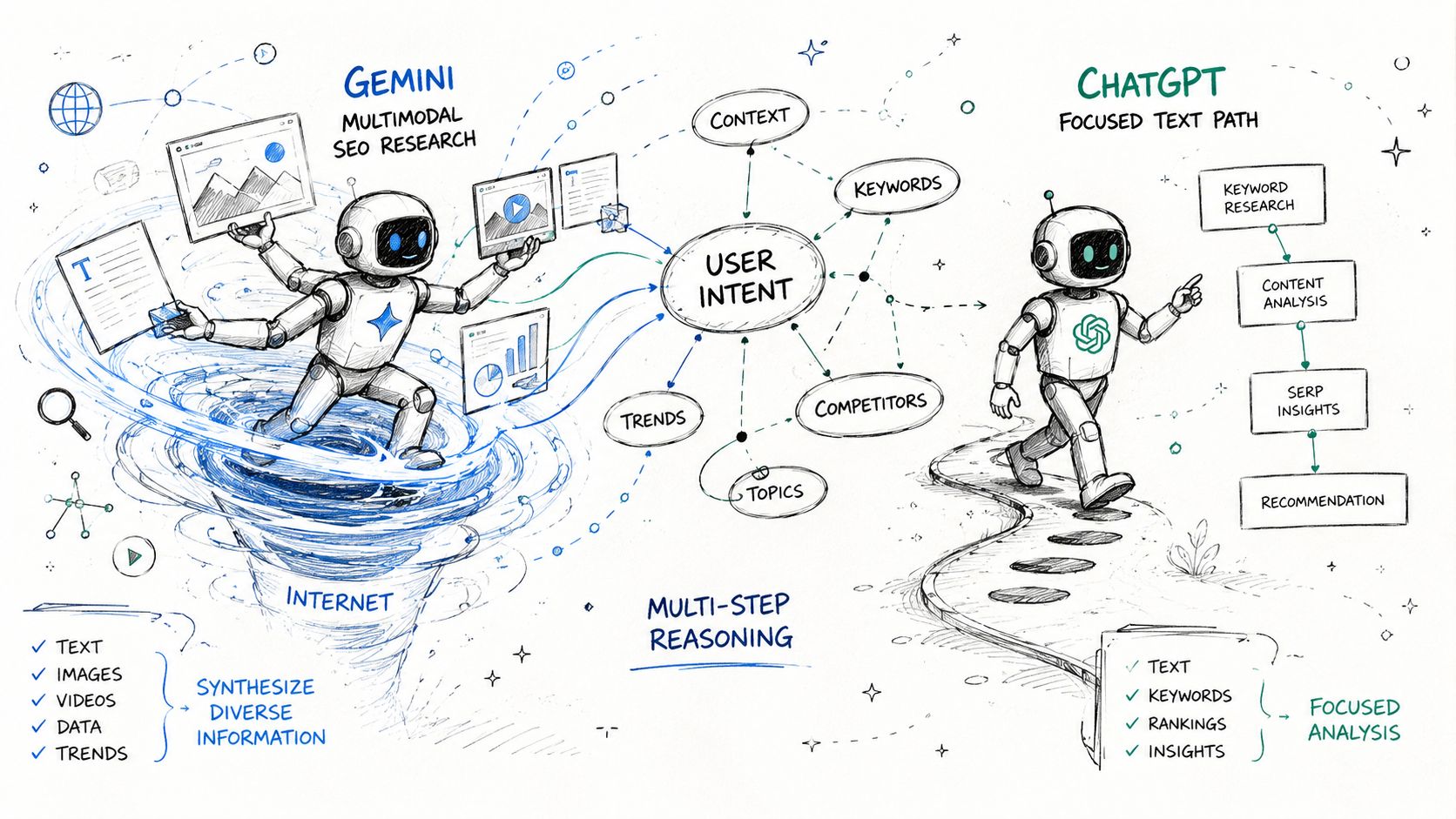
Gemini 3.1 Pro scores 85.9% on the BrowseComp benchmark for multi-step web research, compared with ChatGPT's 65.8%, and it also supports native video and audio processing up to 1 hour of video, according to AIVY's review of Gemini's agentic search and multimodal capabilities.
What agentic search changes for SEO teams
Agentic search matters when the model has to do more than answer from memory. Think of workflows like these:
- Competitor gap research: Identify who owns a topic, what sources are cited, and which angles are repeatedly missing.
- Live SERP verification: Check whether a result set changed and whether your earlier assumptions still hold.
- Source validation: Compare current documents, policies, product pages, and press material before summarizing.
In these jobs, Gemini has a structural advantage because web access is woven into the experience more naturally. That usually produces better continuity between query, retrieval, and synthesis.
A practical operating rule is simple. Use Gemini when freshness matters. Use ChatGPT when the task is more self-contained and doesn't depend heavily on the live web.
A practical multimodal workflow
The SEO potential of Gemini's multimodal support is greater than generally perceived. SEO teams increasingly work with webinars, demos, podcasts, founder interviews, and customer education videos. Those assets contain entities, objections, terminology, and supporting claims that never make it onto the site.
A usable workflow looks like this:
- Start with the media file: Upload the webinar or recorded demo and ask for key entities, repeated questions, product terminology, and timestamped topic changes.
- Extract page opportunities: Turn those findings into article briefs, FAQ candidates, comparison sections, and schema-supporting facts.
- Patch existing content: Update weak landing pages with terminology and evidence users hear in the video.
Here is a useful product walkthrough to pair with that kind of evaluation:
ChatGPT can still help after the research phase. It remains useful for turning extracted notes into cleaner narrative drafts. But if the first step is understanding rich media natively, Gemini is better equipped for the job.
The GEO Deciding Factor Source Citations and Attribution
For GEO, the decisive question isn't whether a model can generate a persuasive answer. It's whether it names sources in a way that gives your brand a chance to appear inside that answer.
That changes optimization priorities. If a system rarely cites external pages, you can have strong content and still see weak visibility in AI-generated responses.
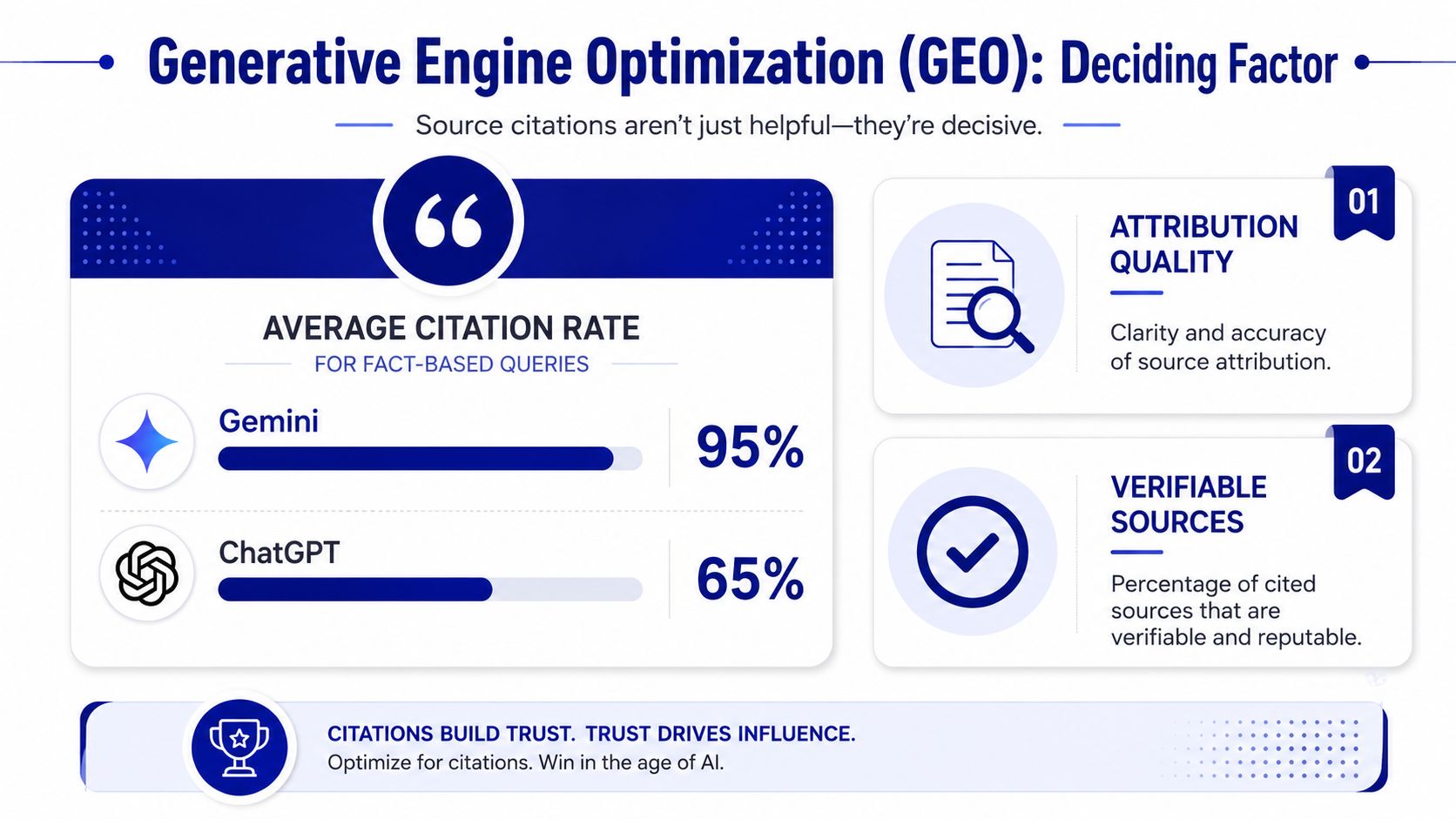
Gemini cites external sources in approximately 6.38% of responses, while ChatGPT cites a source in about 0.59% of responses. That means Gemini is over 10 times more likely to provide a clickable URL link to a brand's page in its answer, according to AI Citation Monitor's comparison of citation frequency in Gemini and ChatGPT.
Why citation behavior matters more than style
This is the most actionable difference in the entire Gemini vs ChatGPT debate for GEO teams.
If your goal is AI answer visibility, citation frequency is the metric that connects model behavior to business outcome. A model that cites more often creates more opportunities for:
- Brand inclusion: Your URL can appear directly inside the answer path.
- Attribution measurement: Teams can monitor which page types earn mentions and which do not.
- Structural optimization: Schema, entity clarity, and page-level fact formatting have somewhere to pay off.
Citation behavior is where SEO becomes GEO. Ranking matters, but being selected as the cited source is a different contest.
This is also why content needs stronger source design. Clean factual sections, explicit entities, scannable supporting claims, and page structures that are easy for machines to parse matter more than ornamental prose. If your team is tightening editorial sourcing standards, a practical guide to APA for students can help junior writers think more rigorously about traceable attribution, even though AI citation behavior follows different mechanics.
How to work from attribution backward
A workable GEO process starts with the pages most likely to be cited, not the pages your editorial calendar happens to prioritize.
Audit pages by asking:
- Does this page answer a narrow factual need clearly?
- Is the main entity unambiguous?
- Are supporting claims easy to isolate and verify?
- Would a model have a reason to cite this page instead of summarizing from memory?
Teams that want a more systematic process should study this method for analyzing citation gaps in AI. The useful mindset is to treat citations as a page-structure problem as much as a content-quality problem.
For pure GEO visibility, Gemini is the more important environment to optimize for because it is more willing to expose external sources.
Conclusion Your Strategic Decision Framework
The wrong way to decide between these tools is to pick a universal winner. The right way is to assign each one to the work it handles best.
Choose Gemini when the task is research-heavy, source-sensitive, or too large for a smaller working window. It fits long-context analysis, technical audit synthesis, competitor library review, live-web research, and workflows that depend on citations or media understanding.
Choose ChatGPT when the task is narrower and instruction fidelity matters more than retrieval breadth. It remains strong for rewrite passes, scoped drafting, scripting support, structured transformations, and focused back-and-forth iteration.
A practical decision framework looks like this:
Use Gemini for discovery
Research, source gathering, long-document synthesis, citation-oriented tasks, and multimodal input.
Use ChatGPT for refinement
Rewriting, implementation support, code generation, prompt-controlled edits, and shorter task loops.
Use both when the workflow has two phases
One model finds and grounds the material. The other shapes it into the final artifact.
There is also an ecosystem angle. ChatGPT still benefits from a wider add-on culture and a broad custom GPT environment, while Gemini is tightly aligned with Google-centric workflows and grounded research behavior. Which matters more depends on whether you need extensibility or better live-search integration inside day-to-day operations.
If your team is building a durable AI search process, don't stop at model choice. You also need a repeatable way to adapt content for AI retrieval and citation systems. This guide on how to optimize content for AI search is a useful next step because model selection only solves part of the problem.
Frequently Asked Questions
Is Gemini better than ChatGPT for SEO?
For professional SEO and GEO workflows, Gemini usually performs better at the top of the funnel. It is more useful for source discovery, long-document review, SERP-aware research, and tasks where cited evidence matters. ChatGPT is often stronger later in the workflow, especially for controlled rewriting, structured formatting, and implementation-focused drafting.
Is ChatGPT better for content writing?
For many editorial tasks, yes.
ChatGPT tends to follow tight instructions more cleanly during rewrites, voice matching, schema drafting, and short-form asset production. Gemini is usually the better option when writing depends on fresh research, document-heavy inputs, or verifying claims against live sources before publishing.
What about pricing and platform access?
Platform fit matters more than list price for many organizations. Google has folded Gemini more directly into Workspace, which can make adoption easier for organizations already operating inside Docs, Sheets, and Drive. ChatGPT still has the broader extension and customization culture. OpenAI reported that users had created over 3 million custom GPTs in its ecosystem, as covered by Reuters reporting on OpenAI's GPT Store and custom GPT adoption.
That split affects procurement and workflow design. Teams that need Google-native collaboration often find Gemini easier to roll out. Teams that depend on specialized assistants, niche automations, or custom task environments often prefer ChatGPT.
Which one is better for factual accuracy on current topics?
Gemini has an edge on current-topic QA if your process depends on search-grounded answers and source retrieval. OpenAI's SimpleQA benchmark documentation reported 34.9% for GPT-4o, while Google reported 72.1% for Gemini 2.0 Flash in its Gemini 2.0 benchmark materials. Those numbers come from different vendor materials, so I would not treat them as a clean apples-to-apples buying signal. I would treat them as directional evidence that grounded retrieval is one of Gemini's stronger modes.
For agency work, that matters on volatile topics such as algorithm updates, product changes, pricing pages, and competitive research.
Which tool should an agency use first?
Start with the model that matches the failure point in your current process.
If account teams waste hours collecting sources, checking claims, and reviewing large inputs, start with Gemini. If the main difficulty involves polishing drafts, producing deliverables faster, or converting messy notes into clean outputs, start with ChatGPT. Agencies with mature workflows usually keep both in the stack because research and refinement are different jobs.
If you're trying to turn AI search visibility into an operating system instead of a collection of manual checks, Nuwtonic is built for that. It brings technical audits, content operations, citation tracking, competitor gaps, and AI search visibility into one workspace so teams can measure what AI engines are surfacing, fix weak pages, and ship updates with reviewable control.