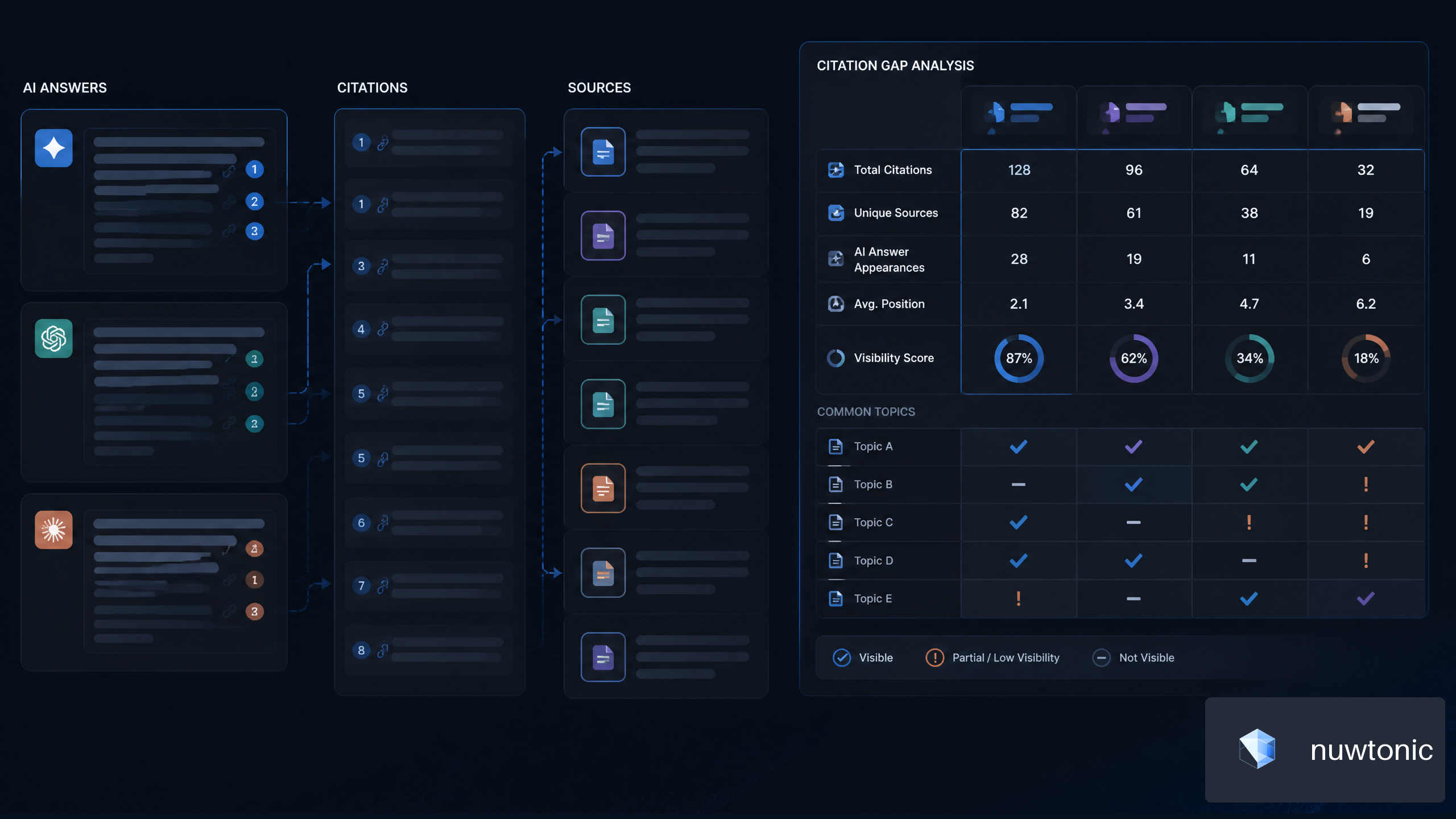

Perplexity doesn't return a ten-blue-link results page — it returns a synthesized answer with inline citations and a sidebar of sources. There's no clean "rank #3" the way there is in Google. What you're actually trying to track is citation presence (did you appear at all), citation order (where in the answer), quote weight (paraphrased vs. quoted verbatim), and answer attribution (was a specific claim credited to you). Two tools can report wildly different numbers for the same prompt and both be technically correct, depending on which of these they measure.
That distinction matters because Perplexity is different from ChatGPT or Google AI Overviews: independent research puts the overlap in citations between ChatGPT and Perplexity for the same query at only around 11% — meaning ranking well in one tells you almost nothing about the other. Perplexity also shows its sources inline on every answer, which makes citation tracking more transparent than most AI engines, but also means a tool that just reports "mentioned: yes/no" is leaving most of the useful signal on the table.
This guide covers 5 tools worth considering, chosen to cover the real range of what teams need: an execution-first pick, a mid-market citation-order specialist, a budget option, an accuracy specialist, and an enterprise-breadth pick.
Quick Comparison
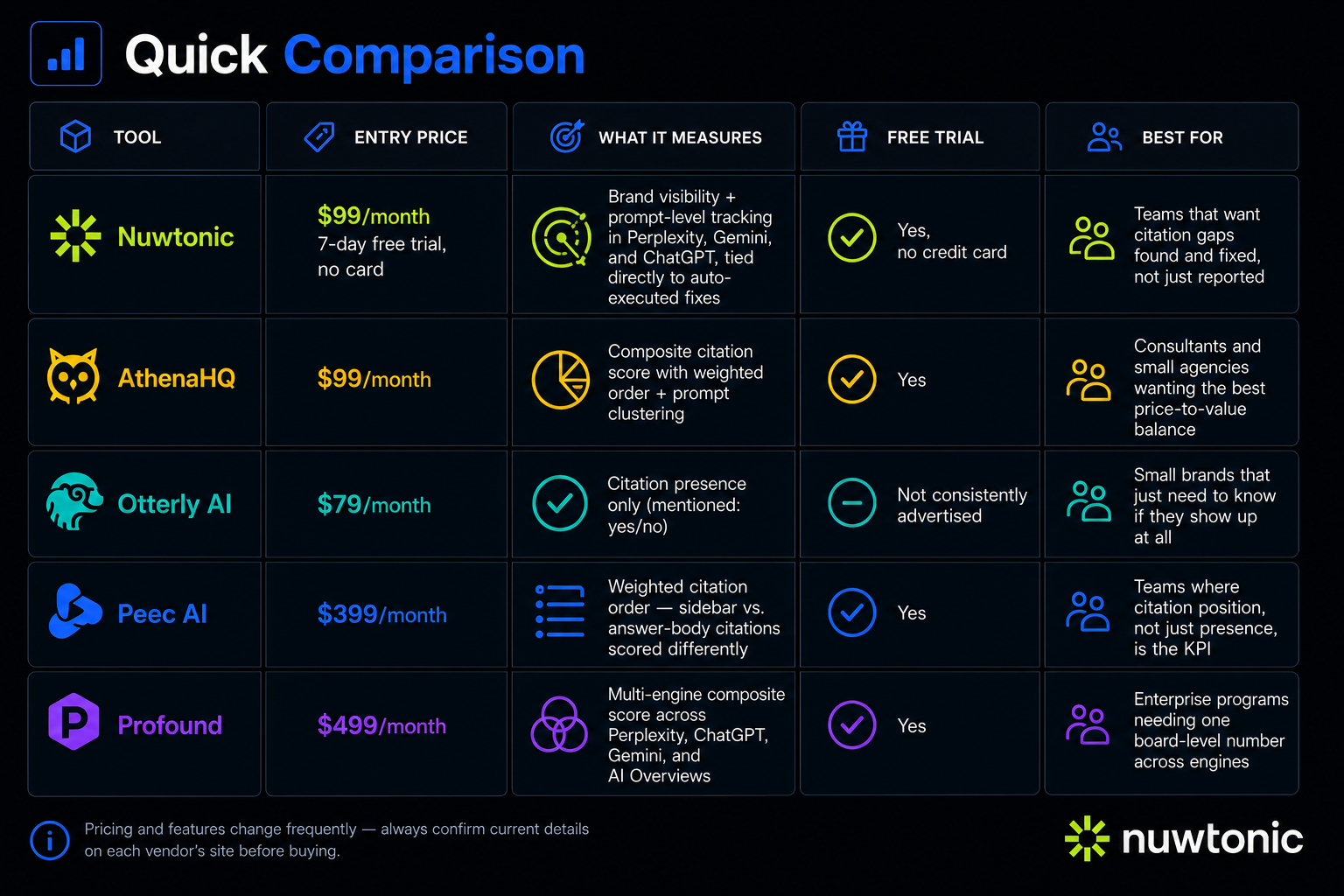
Tool | Entry Price | What It Measures | Free Trial | Best For |
|---|---|---|---|---|
Nuwtonic | $99/month — 7-day free trial, no card | Brand visibility + prompt-level tracking in Perplexity, Gemini, and ChatGPT, tied directly to auto-executed fixes | Yes, no credit card | Teams that want citation gaps found and fixed, not just reported |
AthenaHQ | $99/month | Composite citation score with weighted order + prompt clustering | Yes | Consultants and small agencies wanting the best price-to-value balance |
Otterly AI | $79/month | Citation presence only (mentioned: yes/no) | Not consistently advertised | Small brands that just need to know if they show up at all |
Peec AI | $399/month | Weighted citation order — sidebar vs. answer-body citations scored differently | Yes | Teams where citation position, not just presence, is the KPI |
Profound | $499/month | Multi-engine composite score across Perplexity, ChatGPT, Gemini, and AI Overviews | Yes | Enterprise programs needing one board-level number across engines |
Pricing and features checked against public vendor pages — always confirm current terms before buying, since this category is moving fast.
TL;DR Summary : Which Tool Should You Choose and when?
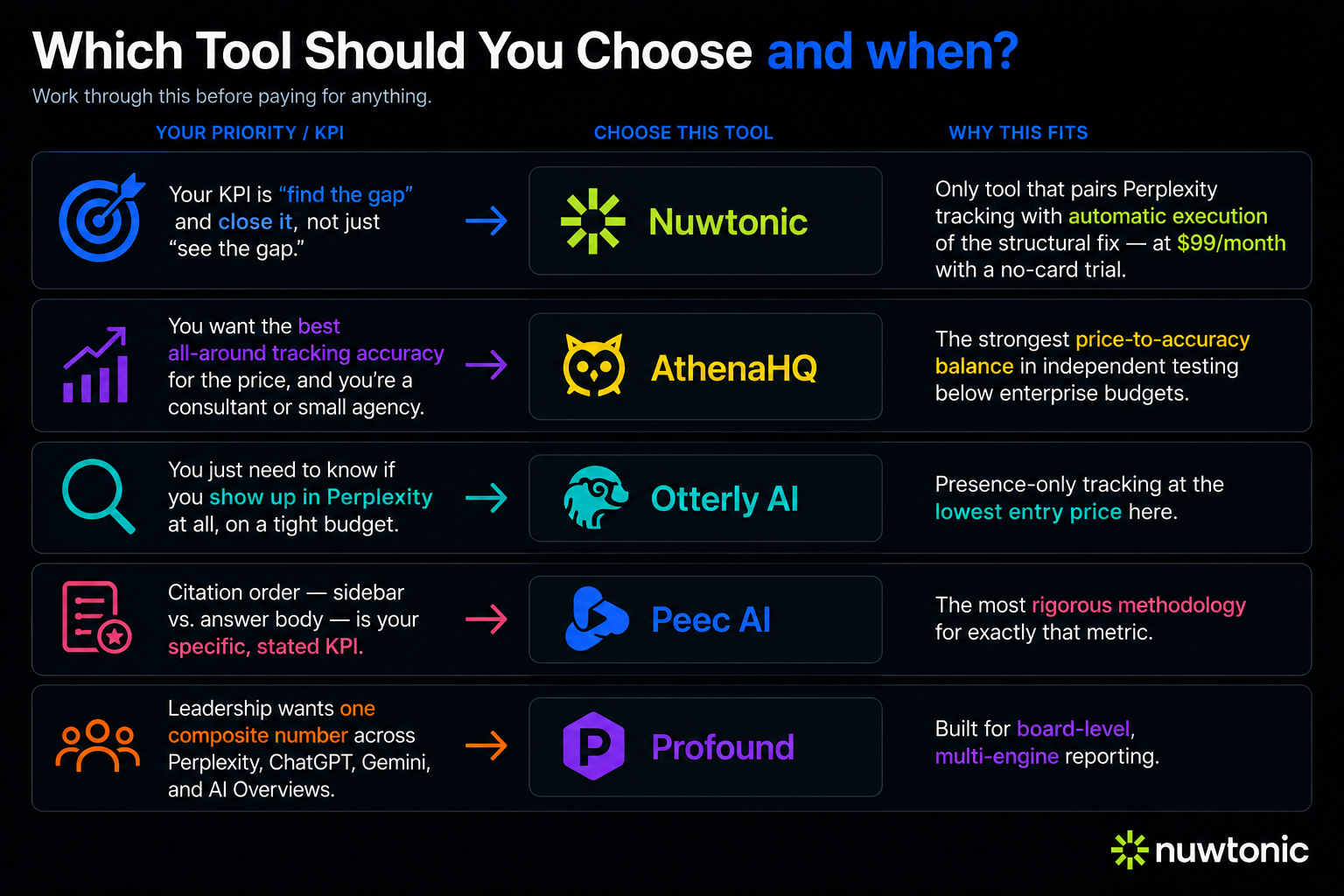
Work through this before paying for anything:
Your KPI is "find the gap and close it," not just "see the gap." → Nuwtonic. It's the only tool here that pairs Perplexity tracking with automatic execution of the structural fix and perplexity visibility optimization— at a transparent $99/month with a no-card trial.
You want the best all-around tracking accuracy for the price, and you're a consultant or small agency. → AthenaHQ. The strongest price-to-accuracy balance in independent testing below enterprise budgets.
You just need to know if you show up in Perplexity at all, on a tight budget. → Otterly AI. Presence-only tracking at the lowest entry price here.
Citation order — sidebar vs. answer body — is your specific, stated KPI. → Peec AI. The most rigorous methodology for exactly that metric.
Leadership wants one composite number across Perplexity, ChatGPT, Gemini, and AI Overviews. → Profound. Built for board-level, multi-engine reporting.
Nuwtonic
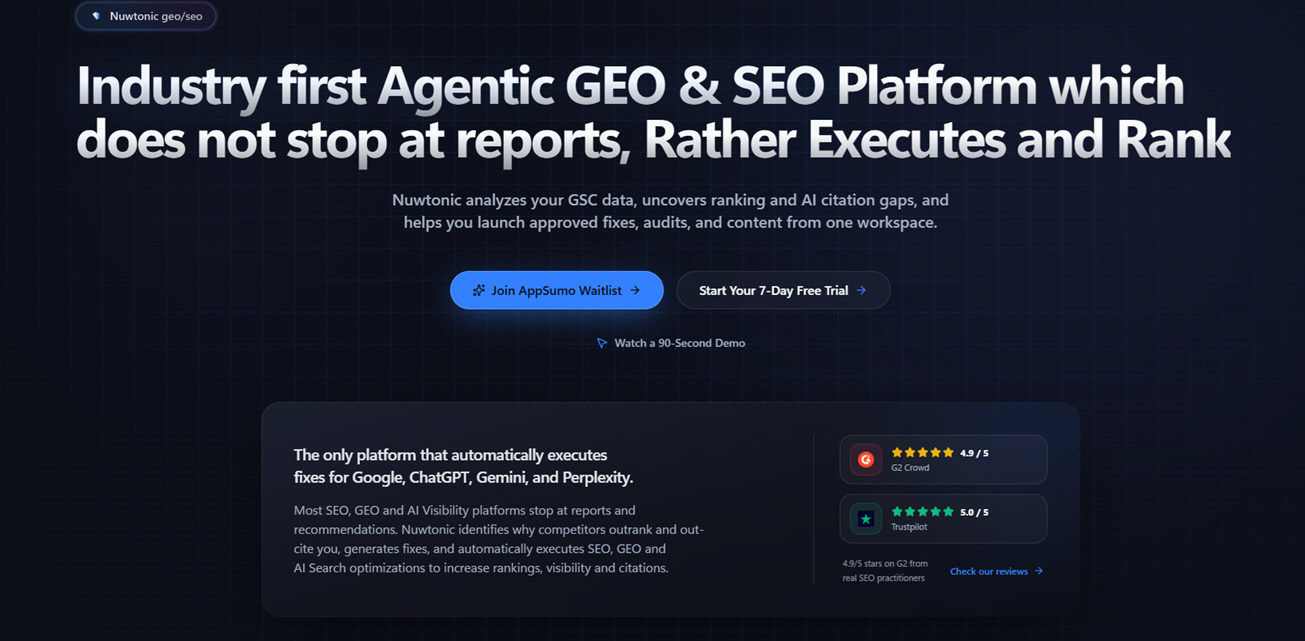
Best for: Teams that don't want Perplexity tracking to be a dead-end dashboard — they want the citation gap found and closed.
Most tools on this list stop at telling you where you stand in Perplexity. Nuwtonic's Perplexity tracking is one module inside a broader agentic platform built to close the loop between "here's your gap" and "here's the fix, live on your site."
How Nuwtonic tracks Perplexity specifically
Brand Visibility Index — shows how often your brand is mentioned and recommended in Perplexity (alongside ChatGPT and Gemini), so you can see the trend over time rather than a single snapshot.
Prompt Tracking — tracks the exact prompts your audience is asking, and compares how Perplexity answers for you versus named competitors, rather than a generic keyword list bolted onto an AI dashboard.
Auto-Fix Visibility Gaps — this is the differentiator. When Perplexity visibility drops for a tracked prompt, the agent detects the missing structural or citation-readiness signals and updates your content and structure automatically (with review before publishing) instead of leaving you a report to act on manually.
Win Competitor Prompts — when a competitor is the one getting cited on a high-value prompt, Nuwtonic surfaces the exact structural changes needed to win that citation back, rather than just flagging that you lost it.
120+ AI-visibility checks as part of its GEO Audit — covering citation references, author trust, and the kind of unique, well-structured detail that tends to get pulled into Perplexity's synthesized answers.
Why it's different from a pure rank tracker
Every other tool in this list answers "where do I stand in Perplexity?" Nuwtonic also answers "why, and what do I do about it?" — because the same workspace that tracks your Perplexity visibility also runs the GEO audit, generates the structural/content fix, and can publish it, with GSC-connected data grounding the fixes in your actual search performance rather than a third-party estimate.
Pricing and trust signals
$99/month (Pro) — with a 7-day free trial and no credit card required, so you can see real Perplexity tracking data before paying anything.
4.9/5 on G2, 5.0/5 on Trustpilot from verified practitioner reviews.
One Nuwtonic plan is built to replace several separate point tools (AI-visibility tracking, citation-gap analysis, GEO content writing) rather than requiring you to stack a tracker with a separate content tool once you want to act on the data.
Ideal for
Teams already running a Perplexity tracker who are frustrated that "insight" never turns into "fixed"
SaaS companies and agencies that want Perplexity, ChatGPT, and Gemini visibility plus Google SEO in one workspace
Anyone who doesn't want a sales call just to see pricing
2\. AthenaHQ
Best for: Consultants and small agencies wanting the best accuracy-to-price ratio in pure tracking.
Independent hands-on testing rates AthenaHQ as the strongest overall balance of accuracy, usability, and price below enterprise budgets — largely on the strength of its weighted citation-order scoring and prompt-cluster organization (grouping related prompts to see aggregate visibility rather than reading them one by one).
Pros
Clean citation-order tracking with weighted scoring, rather than treating every citation as equal
Prompt clustering makes aggregate visibility easier to read at a glance
Competitor view tracks up to several rival domains per prompt
Readable weekly summary emails
Limitations
The entry-tier prompt cap fills up quickly for agency-scale use
CSV-only exports — no white-labeled PDF reporting for client delivery
Coverage is narrower than multi-engine tools; it doesn't track as broadly outside Perplexity and ChatGPT
Entry pricing: $99/month.
3\. Otterly AI
Best for: Small brands that just need a yes/no answer on whether they show up in Perplexity at all.
Otterly tracks on a presence-only basis — it tells you whether you were mentioned, not where in the citation list or how prominently. That's a real limitation, but for a small brand still deciding whether Perplexity visibility matters enough to invest further, presence-only tracking is often enough to start.
Pros
Lowest entry price of the dedicated tracking tools on this list
Simple setup with minimal learning curve
Entry-tier prompt allowance comfortably covers a small brand's core terms
Limitations
No citation-order or quote-weight data — you won't know if you're buried in the sidebar or featured in the answer body
You'll outgrow it the moment citation position becomes something you're actually optimizing for
Entry pricing: $79/month.
4\. Peec AI
Best for: Teams where citation position, not just presence, is the actual KPI.
Peec AI's differentiator is honesty about what a citation is worth: it weights an answer-body citation differently from a sidebar citation, which matches what actually drives click-through, rather than counting every mention the same way many competitors do.
Pros
The most rigorous citation-order methodology among tools reviewed independently
Generous prompt allowance on the entry tier relative to its price band
Strong fit for agency engagements where "move from sidebar to answer body" is the explicit campaign goal
Limitations
Meaningfully more expensive than presence-only tools if that's genuinely all you need
Narrower engine breadth than Profound if a single cross-engine dashboard is the priority
Entry pricing: $399/month.
5\. Profound
Best for: Enterprise programs that want one composite number across every major AI engine, not just Perplexity.
Profound's strength is breadth: Perplexity, ChatGPT, Google AI Overviews, and Gemini in a single dashboard with one composite score, which is what tends to get requested for board-level reporting. Independent testing also noted it handled niche international prompts better than most alternatives.
Pros
Four engines in one dashboard with a single composite visibility score
Large prompt allowance built for multi-brand programs
Content recommendations layered on top of the tracking data
Limitations
Treats a sidebar citation the same as an answer-body citation — less precise on citation-order specifically than Peec AI
Priced and scoped for enterprise use; overkill for a single small site
Entry pricing: $499/month.
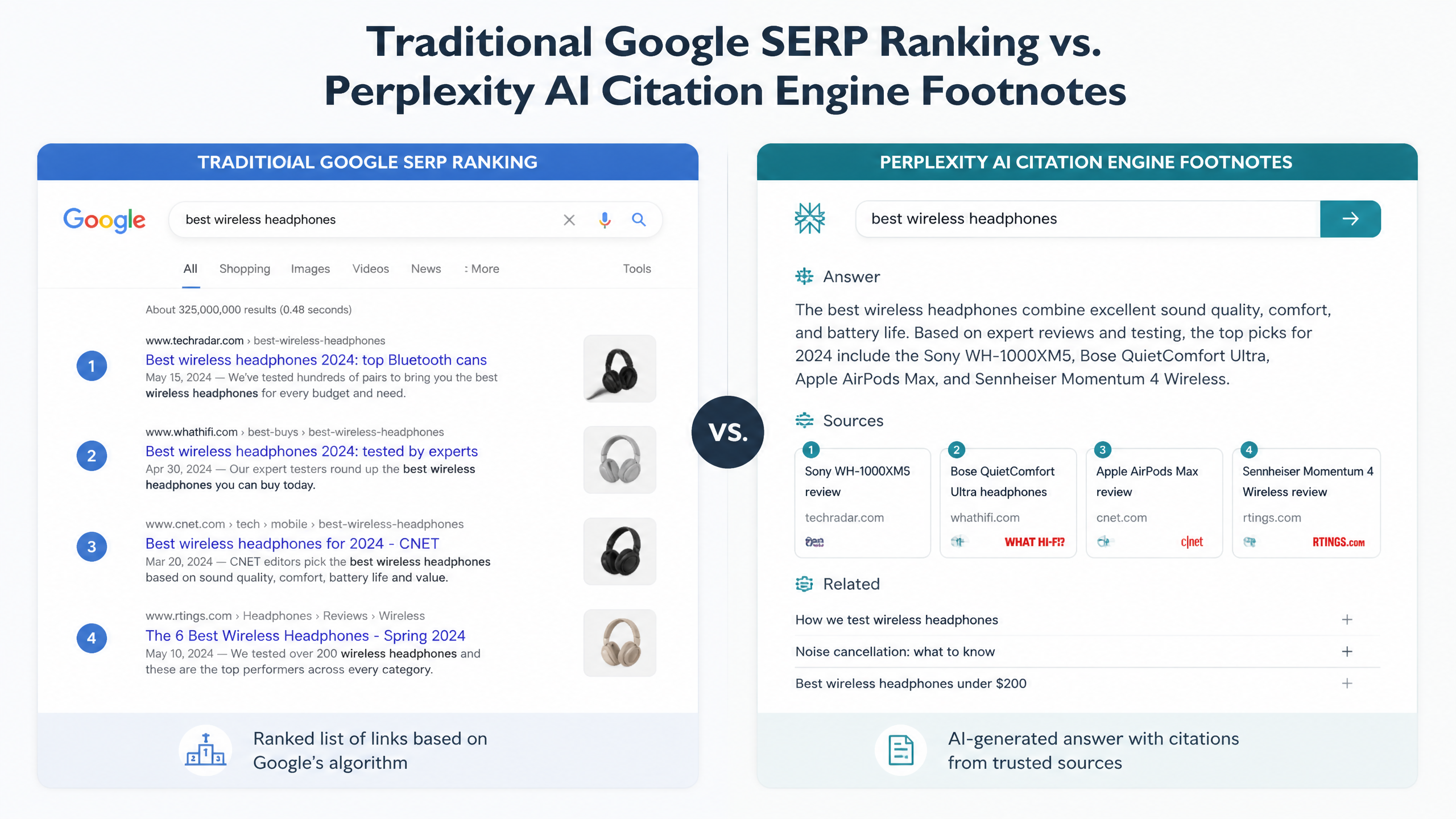
One caution regardless of which you pick: be skeptical of any tool reporting a single "rank #3 in Perplexity" integer — Perplexity doesn't have fixed ranking positions, so that number is more theater than signal. Track presence, order, and attribution over time on a consistent prompt set instead, and prioritize a tool that helps you act on what it finds rather than one that just confirms you're invisible.