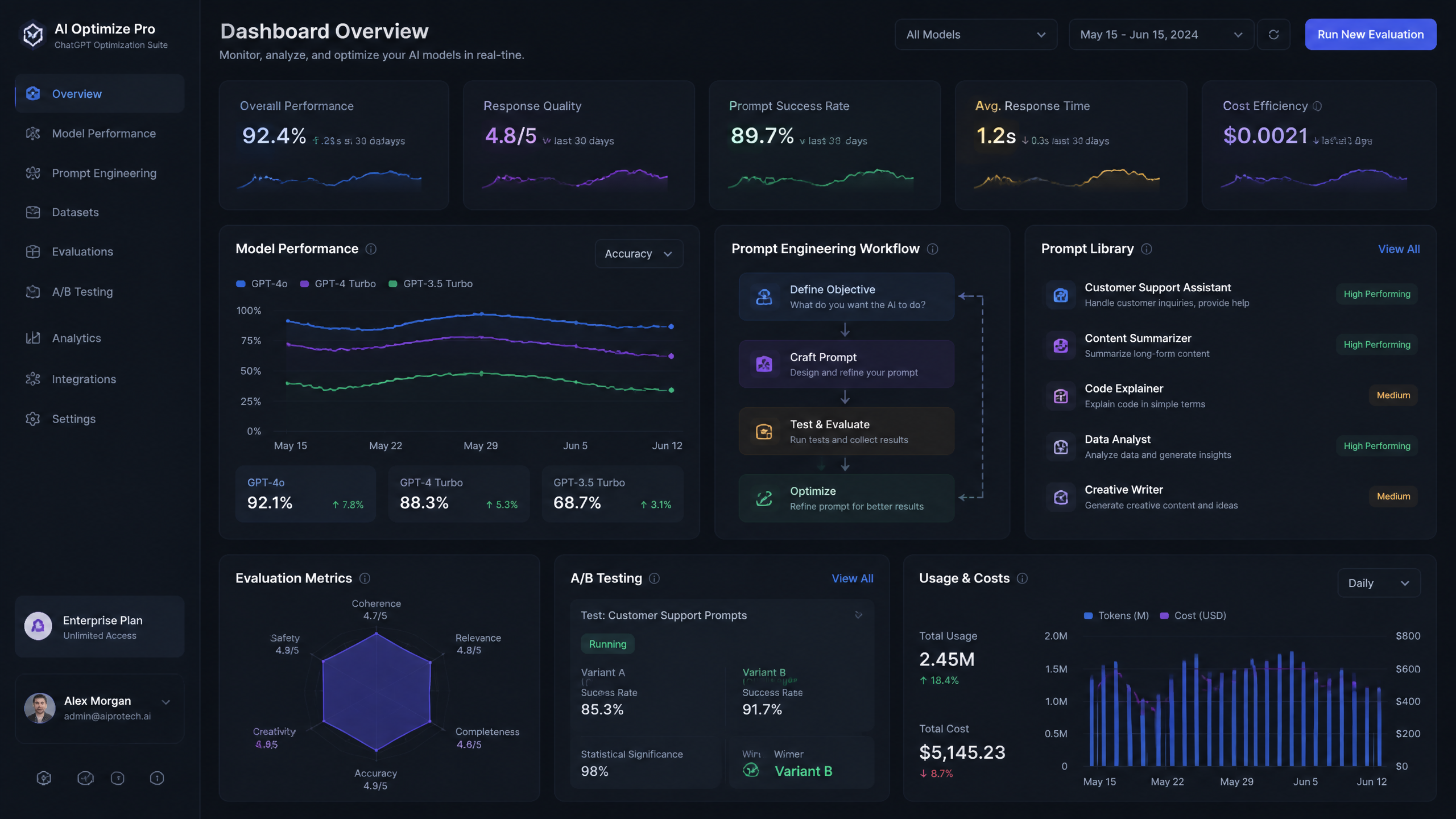
Search "ChatGPT optimization tools" and almost everything that comes back is a tracker wearing an optimization label. It'll show you a visibility score, a citation graph, maybe a sentiment trend , and then hand you a PDF and wish you luck. That's monitoring. It's useful, but it isn't optimization.
Optimization means the tool changes something , your schema, your page structure, your content, the version of your site an AI crawler actually sees — to make ChatGPT more likely to cite you. By that bar, most of the "best ChatGPT tools" lists collapse from 10+ entries down to a handful. This guide only covers tools that genuinely do something to your content or site, not ones that just tell you how you're doing.
A quick gut-check before you buy anything in this category: ask the vendor "what does your tool actually change, and does it publish that change automatically or hand me a to-do list?" The answer sorts every tool in this space into one of three tiers:
Tier 1 — Reports only. Shows visibility/citation data. No optimization capability at all (most of the market: Otterly, Peec AI, Profound, AthenaHQ, etc.).
Tier 2 — Recommends, you implement. Generates content briefs, NLP suggestions, or drafts you still copy into your CMS yourself.
Tier 3 — Executes. Auto-generates and/or auto-publishes the actual fix (schema, structured data, content, page structure), typically with a review step before it goes live.
The five tools below sit in Tier 2 or Tier 3. None of them are pure chatgpt trackers.
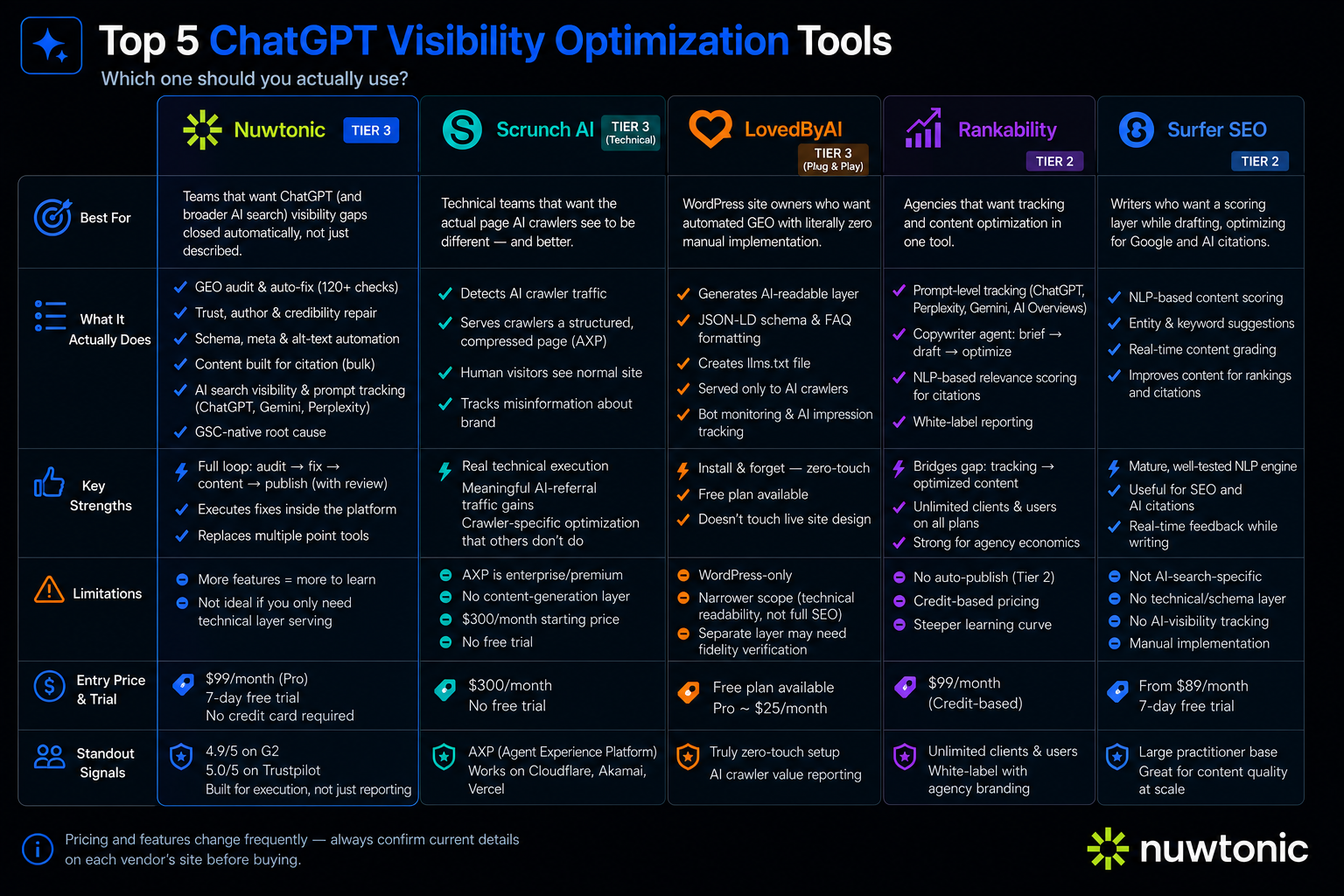
Quick Comparison of Chatgpt Optimization Tools
Tool | Optimization Mechanism | Tier | Entry Price | Best For |
|---|---|---|---|---|
Nuwtonic | Full agentic loop: audits, generates, and auto-executes schema, content, and structural fixes across Google + ChatGPT/Gemini/Perplexity, with human review | 3 — Executes | $99/month, 7-day free trial | Teams that want the fix applied, not just recommended |
Scrunch AI (AXP) | Serves a separate, structured, AI-optimized version of your pages directly to AI crawlers on supported CDNs | 3 — Executes | $300/month | Technical teams on Cloudflare/Akamai/Vercel wanting automated crawler-facing optimization |
LovedByAI | Auto-generates a machine-readable (JSON-LD/llms.txt) layer of your WordPress site for AI crawlers, zero manual work | 3 — Executes | Free plan; Pro from $25/month | WordPress site owners wanting "install and forget" GEO |
Rankability | Copywriter agent builds briefs and drafts optimized specifically to close ChatGPT citation gaps, with NLP-driven relevance scoring | 2 — Recommends | $99/month | Agencies wanting tracking + a content-optimization engine in one seat |
Surfer SEO | NLP-based content scoring and entity suggestions, graded against what's already earning AI citations | 2 — Recommends | From ~$59/month (varies by billing) | Writers wanting a scoring layer while drafting, alongside traditional SEO use |
Pricing changes frequently in this category — confirm current terms on each vendor's site before buying.
Key Takeaways & TL;DR Summary : Which Tool Should You Actually Use?
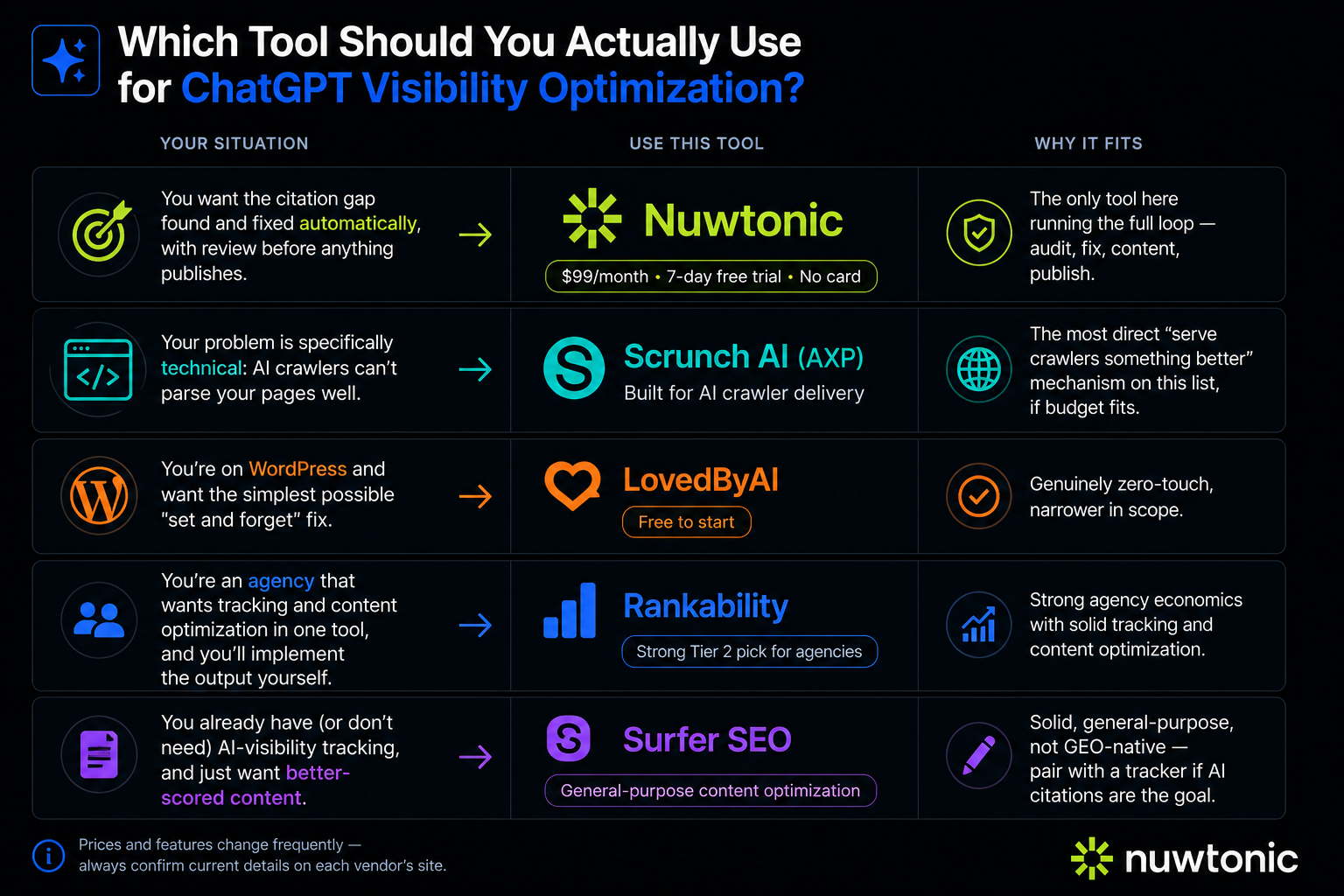
You want the citation gap found and fixed automatically, with review before anything publishes. → Nuwtonic. The only tool here running the full loop — audit, fix, content, publish — for $99/month with a no-card trial.
Your problem is specifically technical: AI crawlers can't parse your pages well. → Scrunch AI (AXP). The most direct "serve crawlers something better" mechanism on this list, if you're on a supported CDN and the budget fits.
You're on WordPress and want the simplest possible "set and forget" fix. → LovedByAI. Free to start, genuinely zero-touch, narrower in scope.
You're an agency that wants tracking and content optimization in one tool, and you're fine implementing the output yourself. → Rankability. Strong Tier 2 pick with real agency economics.
You already have (or don't need) AI-visibility tracking, and just want better-scored content. → Surfer SEO. Solid, general-purpose, not GEO-native — pair it with a tracker if AI citations specifically are the goal.
Nuwtonic
Best for: Teams that want ChatGPT (and broader AI search) visibility gaps closed automatically, not just described.
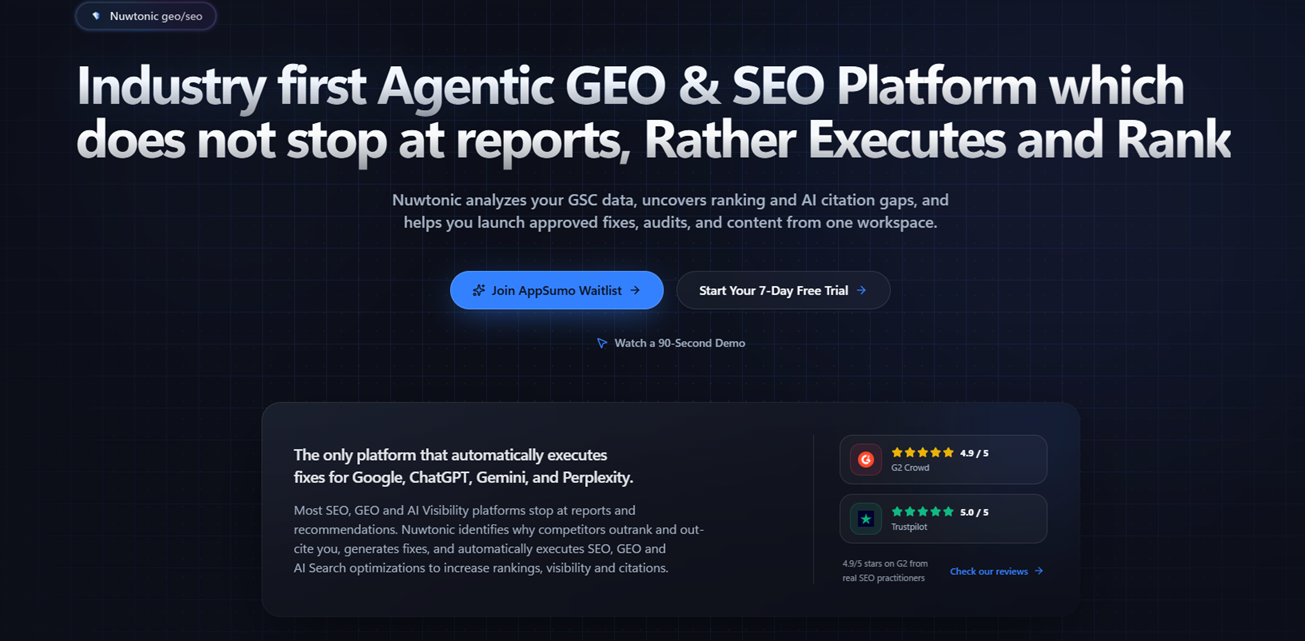
Nuwtonic is the clearest Tier 3 tool in this category — it's built as an agentic platform specifically so that "here's what's wrong" and "here's the fix, live on your site" happen inside the same workspace, instead of requiring you to hand a report to a developer or writer.
What it actually changes (not just reports)
GEO Audit & Auto-Fix — runs 120+ AI-visibility checks (citation references, author trust, structural signals that trigger inclusion in AI answers) against your pages, then executes the fix — updating structure for AI readability, improving conversational-query coverage, and adding citation-reference blocks — rather than only listing what's broken.
Trust & Author Repair — automatically adds the expertise/credibility signals whose absence is a common reason ChatGPT and other engines skip a brand as a source.
Schema, meta, and alt-text automation — generates and applies structured data and metadata fixes with a live preview and review step before anything publishes.
Content built for citation, not just rankings — generates entity-rich articles and topical clusters trained on information-gain principles and AI-citation opportunities, individually or in bulk, and can push them to your CMS.
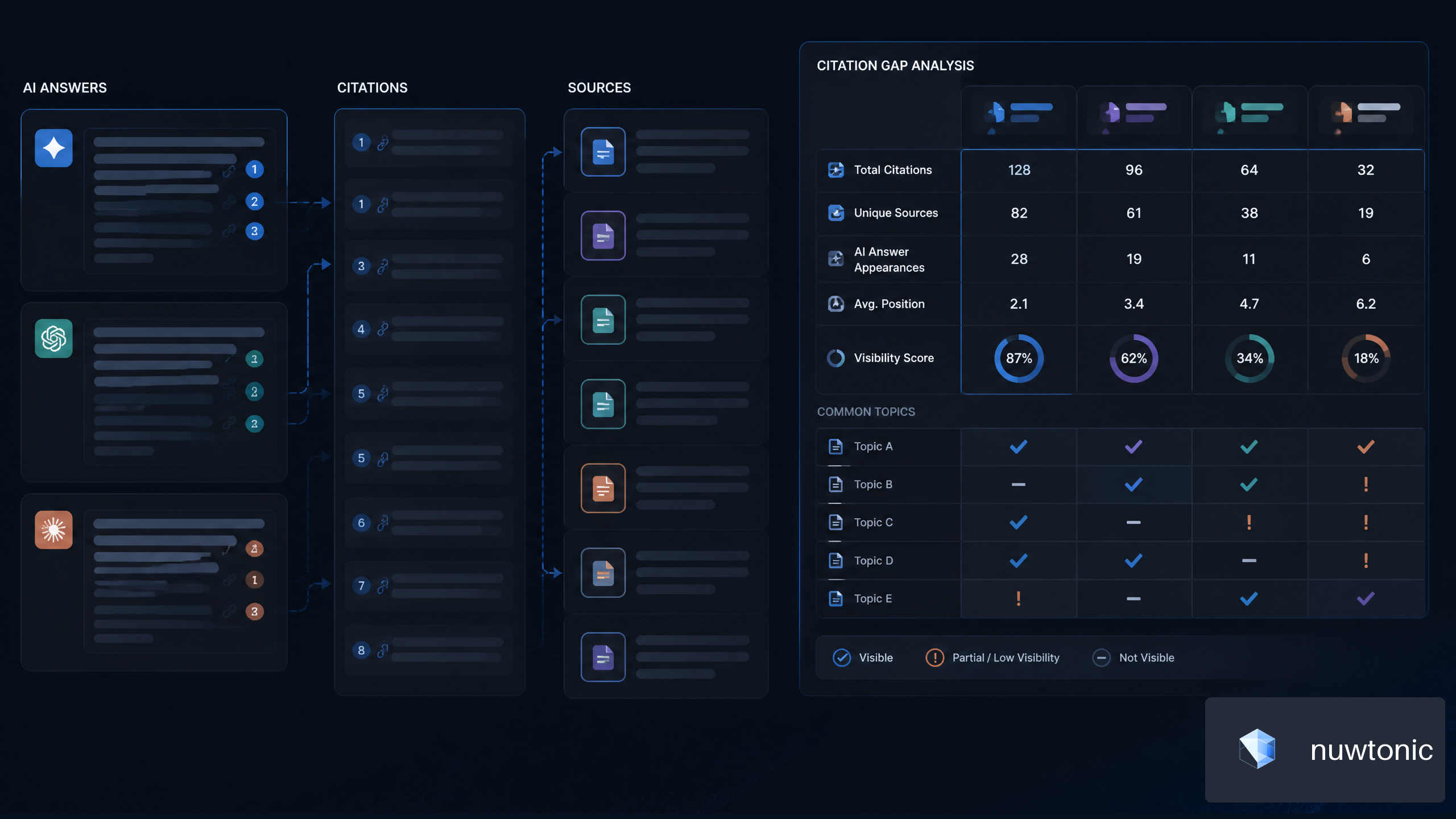
AI Search Visibility & Prompt Tracking — tracks how often your brand is mentioned and recommended in ChatGPT, Gemini, and Perplexity, and compares how each model answers for you versus named competitors — so the optimization loop is grounded in your actual tracked prompts, not guesswork.
GSC-native root cause — connects to Google Search Console so both the traditional-SEO and AI-search fixes are grounded in your real performance data.
Why this matters against the rest of the category
Nearly every other "ChatGPT optimization" tool stops at Tier 2 — a brief or a set of suggestions you still have to implement. Nuwtonic's differentiator is that the same platform that finds the citation gap also builds and applies the fix, with your approval, which is the actual definition of "optimization" rather than "reporting with extra steps."
Pricing and trust signals
$99/month (Pro) — 7-day free trial, no credit card required, so you can see it apply real fixes before paying.
4.9/5 on G2, 5.0/5 on Trustpilot from verified practitioner reviews.
Positioned to replace several separate point tools (visibility tracker + citation-gap tool + GEO writer) with one workspace instead of stacking subscriptions.
Ideal for
Teams that have a tracker already and are tired of the data sitting unused
SaaS companies and agencies wanting ChatGPT/Perplexity/Gemini visibility plus Google SEO fixed in one place
Anyone who wants execution with review, not a black-box auto-publish or a static PDF
2\. Scrunch AI — Agent Experience Platform (AXP)
Best for: Technical teams that want the actual page ChatGPT's crawler sees to be different — and better — than the one it currently gets.
Scrunch's AXP is a genuinely distinct optimization mechanism: instead of only reporting on visibility, it detects AI crawler traffic on supported CDNs (Cloudflare, Akamai, Vercel) and automatically serves those crawlers a compressed, structured version of your page that's built to be parsed cleanly by LLMs — while human visitors see your normal site, untouched.
Pros
Real technical execution: crawlers get a different, optimized artifact automatically, not just a report about the current one
Customers report meaningful gains in AI-referral traffic and visibility after adoption
Also tracks misinformation/misrepresentation about your brand, not just mention counts
Limitations
AXP-level optimization has historically been positioned as an enterprise/premium capability rather than included in entry plans — confirm current plan details before buying if this feature is the reason you're evaluating Scrunch
No content-generation layer — the optimization is structural/technical, not editorial
$300/month starting price with no free trial
3\. LovedByAI
Best for: WordPress site owners who want automated GEO with literally zero manual implementation.
LovedByAI takes a narrower but very clean approach: it scans your WordPress site and automatically generates a separate, structured, AI-readable layer (JSON-LD schema, FAQ formatting, an llms.txt file) served specifically to AI crawlers — without touching your live design or requiring any content rewriting on your end.
Pros
Genuinely "install and forget" — no manual implementation step at all, which is rare even among Tier 3 tools
Free plan available (full homepage optimization, bot monitoring, AI impression tracking), with Pro starting around $25/month
Reporting shows which pages AI crawlers actually value, alongside the automated optimization
Limitations
WordPress-only — not an option if you're not on that CMS
Scope is narrower than a full-stack platform: it optimizes technical/structural readability, not full content strategy or Google SEO
Since the optimization layer is separate from your live pages, some practitioners want to verify how faithfully it represents nuanced product/service claims
4\. Rankability
Best for: Agencies that want ChatGPT tracking and a content-optimization engine under one login.
Rankability pairs prompt-level ChatGPT (and Perplexity, Gemini, AI Overviews) citation tracking with a Copywriter agent that builds the brief, drafts the content, and scores it with NLP-driven relevance analysis aimed specifically at closing the citation gaps the tracker finds.
Pros
Closes real ground between "found the gap" and "here's optimized content to fix it" — genuinely stronger than tracking-only tools
Unlimited clients and users on every plan, which matters for agency economics
White-label reporting with agency branding
Limitations
Tier 2, not Tier 3: you still copy the optimized draft into your CMS yourself — there's no auto-publish step
Credit-based pricing can make monthly cost less predictable than flat plans
Steeper learning curve than a single-purpose tracker, since it's also a content platform
Entry pricing: $99/month.
5\. Surfer SEO
Best for: Writers who want a scoring layer while drafting, and are optimizing for both Google and AI citations at once.
Surfer isn't purpose-built for GEO the way the other tools here are — it's a long-standing content-optimization platform — but its NLP-based content scoring and entity suggestions are genuinely used by practitioners to shape content toward the kind of clear, well-structured, entity-dense writing that tends to earn AI citations, not just Google rankings.
Pros
Mature, well-tested NLP scoring engine with a large practitioner base
Useful whether your priority is traditional rankings, AI citations, or both at once
Real-time content grading while you write, rather than a report after the fact
Limitations
Not AI-search-specific — you're applying a general content-optimization tool to a GEO problem, not using a tool built for it
No technical/schema optimization layer and no direct AI-visibility tracking — you'd need to pair it with a tracker to close the loop
Implementation is manual, same as any Tier 2 tool
Using H2s for each FAQ is better for SEO because each question becomes an individually indexable heading, improves passage ranking, and increases the chance of AI retrieval.
I would also tighten a few answers where the original wording is stronger than current public evidence (especially Google's index access, ChatGPT-User behavior, and the citation statistics).
Few Questions Answered on Chatgpt Optimizations
Does ChatGPT use Google or Bing to find websites?
Primarily Bing.When ChatGPT performs web search, Bing is the primary public search provider used to discover web pages. Bingbot crawls and indexes websites, and ChatGPT can then retrieve and analyze those pages when generating answers.
There is also a separate ChatGPT-User user agent that performs live retrieval of webpages during some conversations after candidate pages have been identified.
Some independent researchers have reported evidence suggesting certain ChatGPT experiences may occasionally access Google's search infrastructure. However, OpenAI has never officially confirmed that Google Search is used as a retrieval source, so this should be treated as an observation rather than an established capability. (OpenAttribution)
Practical takeaway: If your website isn't properly indexed in Bing, your chances of appearing in ChatGPT search results decrease significantly—even if you rank well in Google Search.
Does ranking #1 on Google or Bing guarantee a ChatGPT citation?
No.High rankings increase the likelihood that your content will be discovered, but they do not guarantee ChatGPT will cite your page.
After retrieval, ChatGPT still evaluates which page best answers the user's prompt. Factors such as:
Direct-answer quality
Information gain
Entity clarity
Topical relevance
Freshness
Structured formatting
can outweigh traditional search rankings.
In practice, many lower-ranked pages receive citations because they answer the specific question more directly than higher-ranking competitors.
How long does it take for a new or updated page to appear in ChatGPT?
There is no fixed timeline. For most websites, updated content can begin appearing within 24–72 hours after Bing re-indexes the page, although highly authoritative news publishers may be refreshed much faster.
You can often accelerate discovery by:
Submitting updated URLs through IndexNow
Requesting indexing in Bing Webmaster Tools
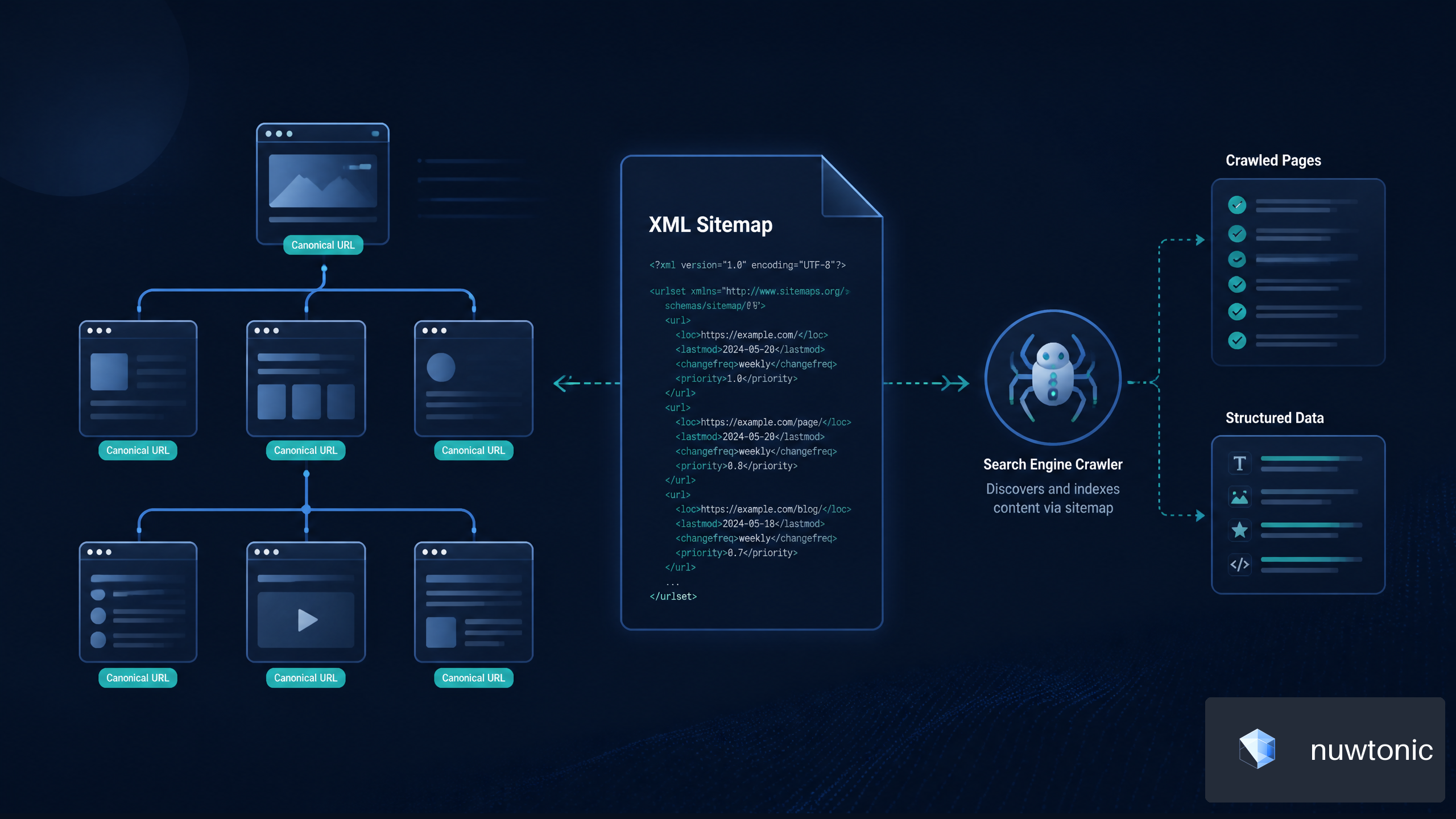
Maintaining XML sitemaps
Publishing clear internal links to new content
Keeping important pages fresh also improves the likelihood of future citations.
Do I need an llms.txt file for ChatGPT to cite my website?
No. There is currently no official evidence that OpenAI requires or prioritizes llms.txt when selecting citations.
While many GEO tools automatically generate an llms.txt file, current industry evidence suggests adoption remains extremely limited. Large-scale measurements found that most published llms.txt files receive little or no traffic from AI systems, and Google has explicitly stated that its Search and AI Search features do not use llms.txt. (Ahrefs)
Treat llms.txt as an optional enhancement—not a substitute for:
proper indexing
crawlability
structured data
high-quality content
topical authority
Can I pay to get my brand cited in ChatGPT?
No. OpenAI does not currently offer sponsored citations or paid placement inside ChatGPT answers.
Citation selection is determined by the retrieval and ranking process used for each query, not by advertising spend.
Be cautious of vendors claiming they can "guarantee ChatGPT citations." While optimization can improve your likelihood of being cited, no legitimate service can purchase citation placement.
Does ChatGPT respect robots.txt?
It depends on which OpenAI crawler you're referring to.
GPTBot (training crawler) respects robots.txt.
OAI-SearchBot (search indexing crawler) is designed to respect robots.txt.
ChatGPT-User, which performs user-requested live retrieval, has different behavior and may access pages even when robots.txt would block traditional crawlers, because it operates on behalf of a user's request rather than general web crawling. Recent research has observed varying compliance across AI assistants and retrieval modes. (OpenAttribution)
For publishers, robots.txt alone should not be considered a complete access-control mechanism. Where access restrictions matter, combine robots.txt with authentication, HTTP controls, or server-side protections.
Is Generative Engine Optimization (GEO) just another name for SEO?
Not entirely. GEO builds on traditional SEO rather than replacing it.
Both disciplines require:
crawlability
indexing
page performance
structured data
technical site health
However, they optimize for different outcomes.
Traditional SEO focuses on ranking pages in search engine results.
GEO focuses on increasing the probability that AI systems retrieve, trust, and cite your content when generating answers.
That means GEO places additional emphasis on:
direct-answer formatting
entity clarity
information gain
citation-worthy content
machine-readable structure
A page can rank highly in Google while still failing to earn AI citations if competing content provides clearer or more complete answers.
Why does ChatGPT keep citing my competitor even though I outrank them on Google?
Because Google rankings and ChatGPT citations are based on different evaluation systems.
Google primarily ranks pages against other pages for a keyword.
ChatGPT first retrieves candidate pages and then decides which content most effectively answers the specific user prompt.
Competitors often earn citations because they:
answer the question immediately
use clearer entity references
avoid unnecessary filler
provide unique information
organize content for easier extraction
In many cases, improving answer quality and information gain has a greater impact on AI visibility than improving traditional rankings alone.
How much do ChatGPT optimization tools cost?
Pricing varies widely.
Current AI visibility platforms generally fall into three groups:
Category | Typical Pricing |
|---|---|
Monitoring tools | Free–$100/month |
Optimization platforms | $99–300/month |
Enterprise AI search platforms | $500+/month |
The overall market is still evolving, so pricing differs substantially depending on features such as AI visibility tracking, technical auditing, content optimization, competitive analysis, and automated execution.
Do ChatGPT optimization tools actually work?
It depends on what the tool actually does. Visibility tracking tools simply measure your current presence—they don't change it.
Optimization platforms attempt to improve citation likelihood by helping you:
fix crawlability issues
improve information architecture
strengthen entity signals
increase information gain
restructure content for AI retrieval
The most reliable way to evaluate any platform is through controlled before-and-after testing using the same prompt set over time.
If citation frequency, visibility, or prompt coverage improves after measurable content and technical changes, the optimization is producing observable results. Otherwise, treat marketing claims with skepticism rather than assuming every reported percentage applies to your website.