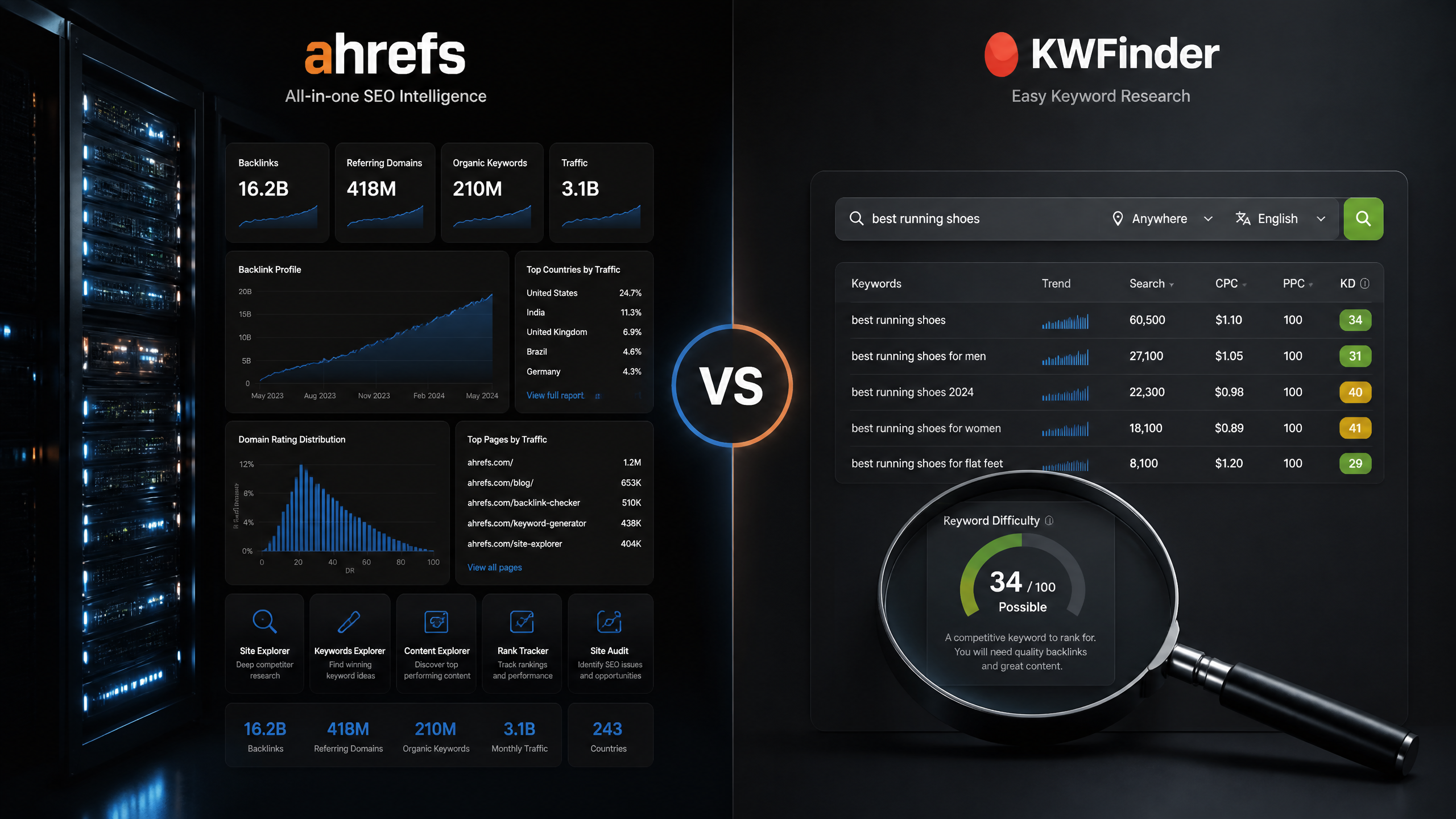
Choosing the right SEO tool can feel like analyzing a complex dataset with too many variables. If you are caught between the raw power of Ahrefs and the streamlined simplicity of KWFinder, you are not alone. Both platforms have dedicated followings, but they serve completely different workflows and philosophies.

Key Takeaways
• Ahrefs Keywords Explorer is an enterprise-grade powerhouse best suited for deep competitive analysis, broad content strategies, and multi-channel keyword tracking.
• KWFinder (by Mangools) is a highly specialized, user-friendly tool optimized for finding long-tail keywords quickly and accurately without overwhelming you with data.
• Pricing remains the biggest differentiator: KWFinder offers highly affordable entry-level plans, while Ahrefs requires a significant monthly investment but provides a complete SEO suite.
• Keyword Difficulty (KD) metrics differ significantly between the two; KWFinder's subjective scale is often more intuitive for beginners, whereas Ahrefs relies heavily on backlink profiles.
Table of Contents
Introduction to the Keyword Tool Showdown
Deep Dive into Ahrefs Keywords Explorer
Deconstructing KWFinder by Mangools
Head-to-Head Comparison: Ahrefs KW Explorer vs KWFinder
Practical Scenarios: Which Tool Should You Choose?
Frequently Asked Questions (FAQ)
Introduction to the Keyword Tool Showdown
Honestly, I've found that many new users overestimate the complexity of keyword research—it's often about finding the right balance between volume and relevance. When you are looking for the Best tools for keyword research, you will inevitably run into a classic debate: the all-in-one suite versus the dedicated specialist.
In my experience, while both tools have their strengths, Ahrefs' KW Explorer tends to provide a broader perspective on keyword potential, which can be a game-changer for content strategy. But that does not mean KWFinder should be ignored. Look, I see a lot of folks jump ship to new tools without fully utilizing what they have—KWFinder can be incredibly effective if you know how to leverage its features.
The Core Philosophy: Heavyweight vs. Specialist
Ahrefs is built to be an all-encompassing search engine intelligence platform. It does not just look at keywords; it crawls the entire web to understand link graphs, domain authority, and content trends. KWFinder, on the other hand, is part of the Mangools suite—a collection of five separate, lightweight SEO tools designed to do one or two things exceptionally well without cluttering your screen.
Why Your Choice of Keyword Tool Dictates Your Content Strategy
Your tool choice shapes how you find opportunities. If you use a tool that focuses heavily on SERP analysis, you will naturally build content clusters around competitive topics. If you use a tool optimized for quick filtering, you will likely target low-hanging, long-tail keywords. Understanding this bias is crucial before you commit to a subscription.
Deep Dive into Ahrefs Keywords Explorer
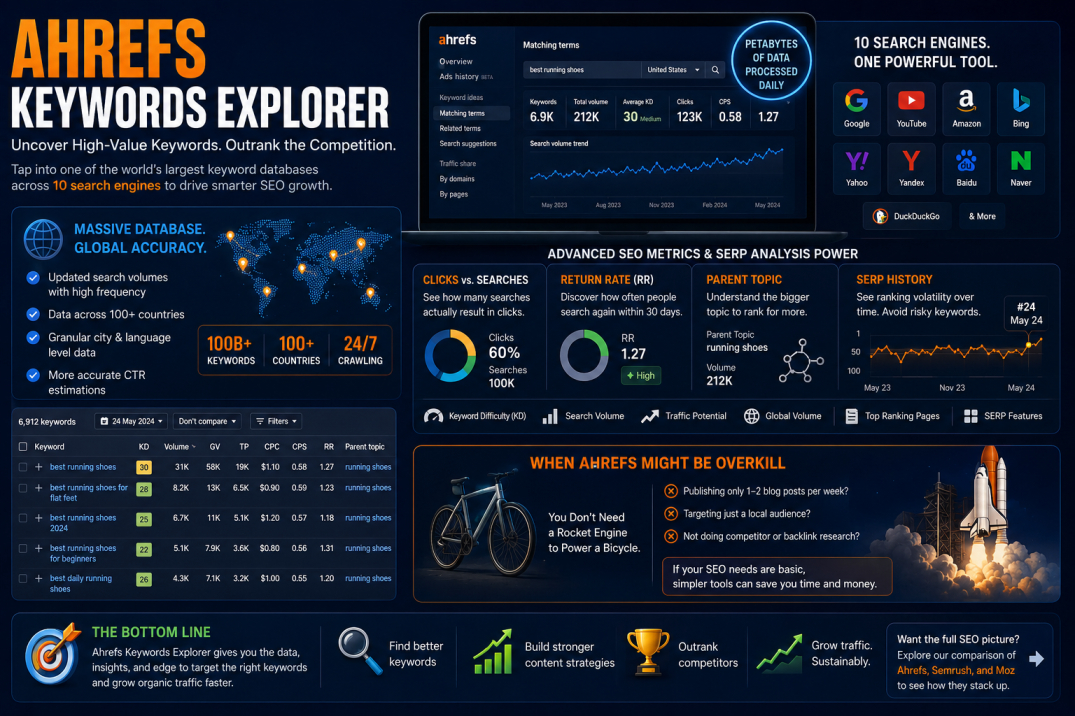
When you log into Ahrefs, you are greeted by an interface that has processed petabytes of search data. It is designed for marketers who want to dissect search queries from ten different search engines, including Google, YouTube, Amazon, and Bing.
Database Scale and Global Search Volume Accuracy
Ahrefs possesses one of the largest active web crawlers in the industry. This massive infrastructure allows them to update search volume and click-through rate (CTR) estimations with impressive frequency. For global campaigns, having access to search data across dozens of countries with granular search volume updates is indispensable.
Advanced SEO Metrics and SERP Analysis Power
One of Ahrefs' standout features is its ability to show you the historical SERP position history. You can see how volatile a keyword has been over the past year—or even several years. This prevents you from targeting keywords that suffer from constant search intent shifts. It also displays advanced SEO metrics like:
• Clicks vs. Searches: How many searches actually result in a click.
• Return Rate: How often people search for that keyword again within 30 days.
• Parent Topic: The broader topic you should target to rank for your target keyword.
When Ahrefs Might Be Overkill for Your Business
If your daily tasks only involve writing two blog posts a week for a local business, Ahrefs' deep backlink analysis, site audits, and complex filtering systems might just slow you down. You do not need a rocket engine to power a bicycle. For a broader look at how Ahrefs stacks up against other industry giants, you can read our Comparison of Ahrefs, Semrush, and Moz.
Deconstructing KWFinder by Mangools
KWFinder is built on the premise that keyword research should be fast, visual, and highly intuitive. It does not try to be a site auditor or a backlink index; it just wants to help you find keywords you can actually rank for today.
Intuitive UX and Finding Long-Tail Keywords Fast
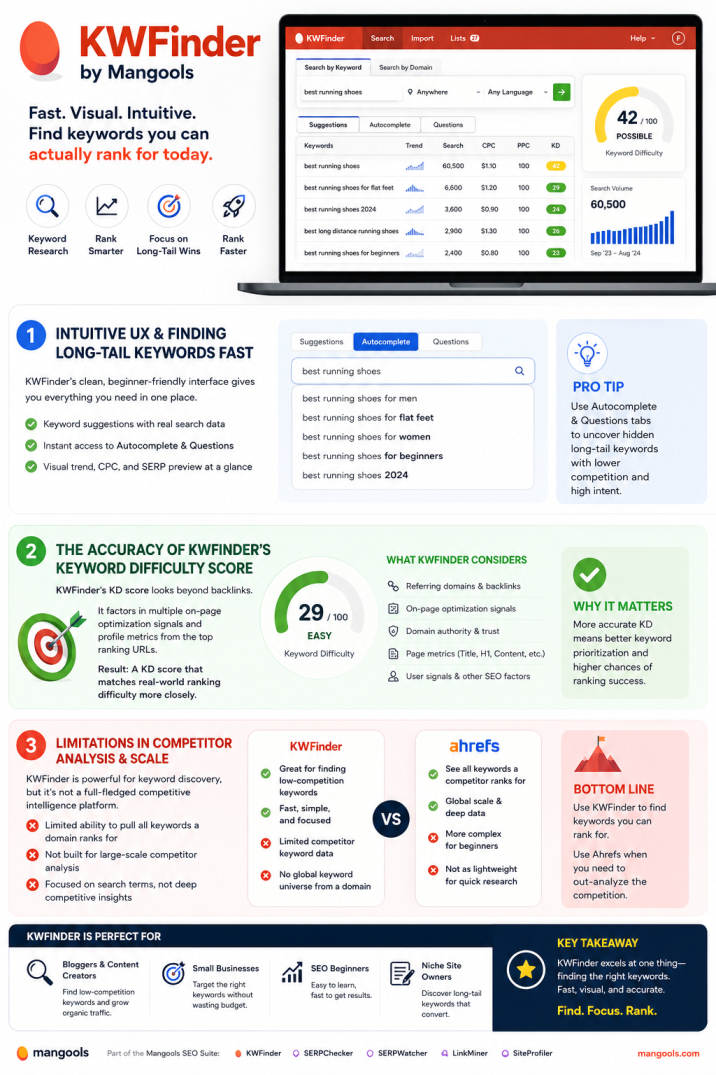
The user interface of KWFinder is a masterclass in clean design. Within a single screen, you get keyword suggestions, search volume trends, CPC data, and a basic SERP preview. Finding long-tail keywords is as simple as toggling the autocomplete or questions tabs at the top of the search bar.
The Accuracy of KWFinder’s Keyword Difficulty Score
Many SEO professionals—myself included—highly respect KWFinder’s Keyword Difficulty (KD) metric. While Ahrefs calculates difficulty almost entirely based on the number of referring domains pointing to the top 10 ranking pages, KWFinder factors in multiple on-page optimization signals and profile metrics from the ranking URLs. This often results in a KD score that aligns more closely with what a real human editor experiences when trying to rank a new page.
Limitations in Competitor Analysis and Scale
Where KWFinder falls short is scale. If you want to paste a competitor’s URL and instantly see every single keyword they rank for across the globe, KWFinder's capabilities are limited compared to Ahrefs. It is a search-term-focused tool, not a competitive intelligence platform. For a deeper look at this specific matchup, check out our dedicated Ahrefs vs KWFinder comparison.
Head-to-Head Comparison: Ahrefs KW Explorer vs KWFinder
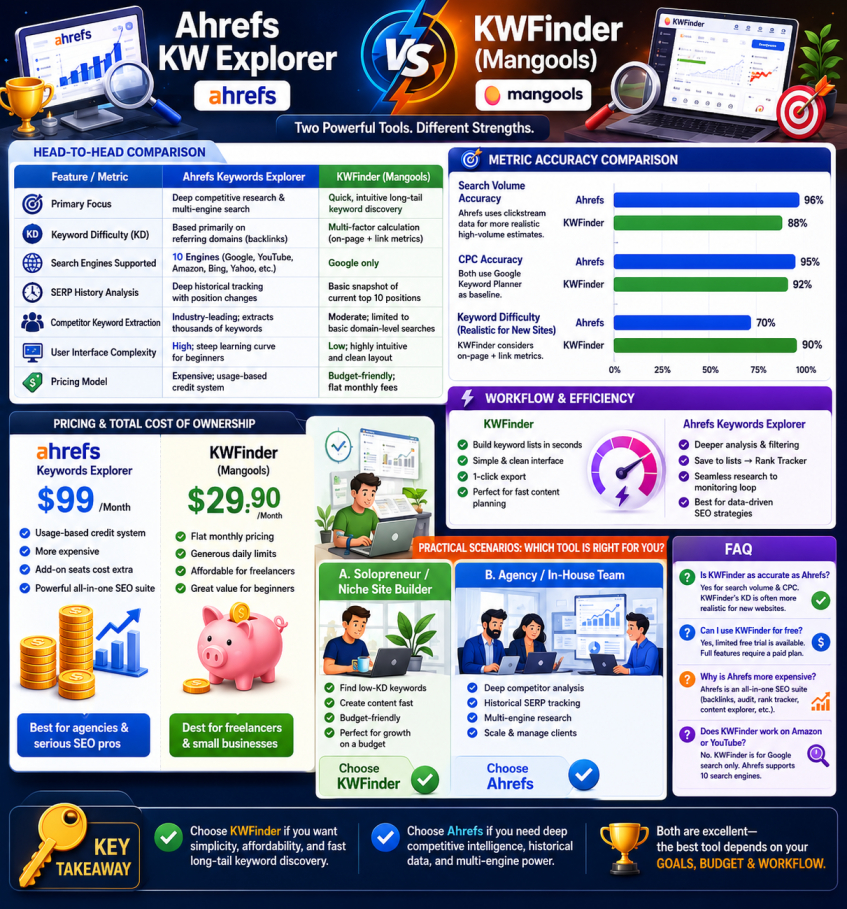
To help you visualize the differences, let us lay out the core features side-by-side. This table highlights how these tools differ across critical metrics, performance, and accessibility.
Feature / Metric | Ahrefs Keywords Explorer | KWFinder (Mangools) |
|---|---|---|
Primary Focus | Deep competitive research & multi-engine search | Quick, intuitive long-tail keyword discovery |
Keyword Difficulty (KD) | Based primarily on referring domains (backlinks) | Multi-factor calculation (on-page + link metrics) |
Search Engines Supported | 10 (Google, YouTube, Amazon, Bing, Yahoo, etc.) | Google only |
SERP History Analysis | Deep historical tracking with position changes | Basic snapshot of current top 10 positions |
Competitor Keyword Extraction | Industry-leading; extracts thousands of keywords instantly | Moderate; limited to basic domain-level searches |
User Interface Complexity | High; steep learning curve for beginners | Low; highly intuitive and clean layout |
Pricing Model | Expensive; usage-based credit system | Budget-friendly; flat monthly fees |
Metric Accuracy: Search Volume, CPC, and Difficulty
While both tools pull data from Google Keyword Planner as a baseline, they process it using proprietary algorithms. Ahrefs blends clickstream data to refine search volume, which often makes its numbers more realistic for high-volume terms. However, for niche, low-volume long-tail keywords, KWFinder's localized data can sometimes be more responsive to real-time search trends.
Workflow Efficiency and On-Page Optimization Integration
With KWFinder, you can build keyword lists in seconds and export them with a single click. It is an incredibly efficient workflow for content creators who need to map out an editorial calendar quickly. Ahrefs, while slower to navigate, allows you to save keywords directly to lists that integrate with their Rank Tracker, creating a seamless loop from research to performance monitoring.
Pricing and Total Cost of Ownership
Let's be realistic: budget is usually the deciding factor. Ahrefs has transitioned to a model that charges for additional user seats and limits monthly reports via a credit-based system. If you run out of credits, your research grinds to a halt unless you pay more. KWFinder remains highly accessible, offering generous daily search limits even on their entry-level plans, making it the clear winner for freelancers and small businesses.
Practical Scenarios: Which Tool Should You Choose?
Before making a final choice, you must analyze your specific business model, team size, and immediate goals. One size never fits all in SEO.
Scenario A: The Solopreneur or Niche Site Builder
If you are a solo creator running a portfolio of affiliate or ad-supported websites, KWFinder is almost always the smarter choice.
• Why it works: You do not need enterprise-level API access or advanced historical SERP tracking. You need to find keywords with low difficulty scores, write high-quality content, and move on.
• When it fails: If you decide to launch a massive digital PR campaign that requires deep backlink auditing of competitor domains, KWFinder will leave you wanting more.
Scenario B: The Enterprise SEO Agency or In-House Team
For agencies managing multiple clients, Ahrefs is a non-negotiable asset.
• Why it works: You need to pitch prospective clients with comprehensive gap analyses, track thousands of keywords across multiple search engines, and audit technical SEO issues.
• When it fails: If you are trying to onboard junior writers who have never done SEO before, the complex interface of Ahrefs can lead to tool fatigue and analytical paralysis.
Frequently Asked Questions (FAQ)
Is KWFinder as accurate as Ahrefs?
Yes, for search volume and CPC data, both tools are highly accurate as they use Google Keyword Planner as their primary baseline. However, their Keyword Difficulty (KD) calculations differ. KWFinder's KD is often considered more realistic for newer sites because it factors in on-page optimization metrics alongside link profiles.
Can I use KWFinder for free?
Mangools offers a limited free trial that allows you to perform a few searches per day. However, to get full access to historical search data, unlimited keyword suggestions, and competitor tracking, you will need to upgrade to a paid plan.
Why is Ahrefs so much more expensive than KWFinder?
Ahrefs is not just a keyword tool; it is an all-in-one SEO suite. The subscription price covers their massive web crawler, backlink index, site auditing tools, content explorer, and rank tracking features. KWFinder is a specialized tool, which allows Mangools to keep operational costs—and pricing—much lower.
Does KWFinder track keywords on Amazon or YouTube?
No. KWFinder is strictly focused on Google search data. If you need to perform keyword research for YouTube, Amazon, Bing, or alternative search engines, Ahrefs Keywords Explorer is the superior option as it supports ten different search platforms.
Conclusion and Final Verdict
At the end of the day, the choice between Ahrefs Keywords Explorer and KWFinder comes down to your operational scale and budget. If you need a comprehensive, data-dense platform to drive a multi-faceted search strategy, Ahrefs is worth every penny. If you want a fast, affordable, and highly intuitive tool to find profitable long-tail keywords without the analytical headache, KWFinder is an exceptional choice.
Avoid the common pitfall of paying for features you do not use. Evaluate your actual weekly workflow, test both tools using their trial options, and choose the one that keeps your content production moving forward.