Key Takeaways
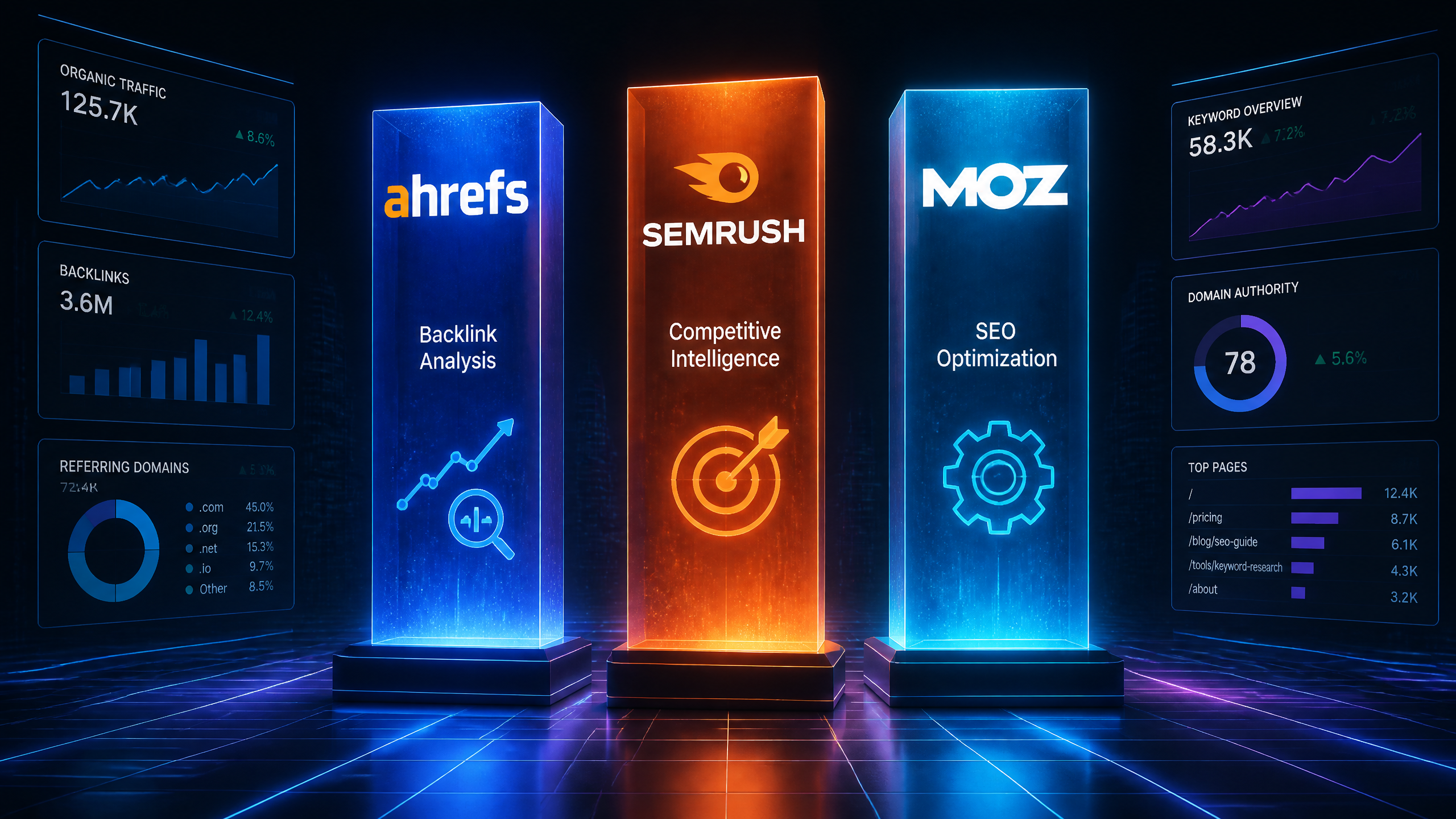
• Semrush remains the undisputed champion for comprehensive competitive analysis and paid search intelligence, though its interface can feel cluttered.
• Ahrefs dominates backlink analysis with its superior link index and intuitive UI, but recent credit-based pricing updates have frustrated heavy users.
• Moz Pro offers a beginner-friendly environment and highly accurate proprietary metrics like Domain Authority, but its feature set has fallen slightly behind its faster-moving competitors.
• Choosing the right tool depends entirely on your specific workflow—whether you prioritize deep link building, aggressive competitor tracking, or straightforward technical site audits.
Table of Contents
- The SEO Triad: A Realist's Overview of Ahrefs, Semrush, and Moz
- Direct Comparison: Feature-by-Feature Breakdown
- Practical Workflows: Which Tool Wins in the Trenches?
- Pricing, Value, and Hidden Costs
- The Evolving Landscape: Traditional Tools vs AI-Driven Workflows
- Frequently Asked Questions (FAQ)

The SEO Triad: A Realist's Overview of Ahrefs, Semrush, and Moz
If I had a dollar for every time someone asked if DA is the only metric that matters—or which of these three giant platforms they should blindly throw their marketing budget at—I’d probably be retired on a beach in Maui right now. The reality of digital marketing is that there is no single "perfect" tool. Having spent over eight years optimizing e-commerce and SaaS sites, I have used Ahrefs, Semrush, and Moz across dozens of campaigns. Each platform has a distinct DNA, built to solve different problems for different types of marketers.
Ahrefs: The Backlink Heavyweight
Honestly, when it comes to dissecting a competitor's link-building strategy, Ahrefs is almost always my first stop. It started its life primarily as a backlink analysis tool, and that legacy shows in its incredibly robust crawler. Over the years, Ahrefs has expanded into a full-featured SEO suite, offering keyword tracking, content research, and technical audits.
Its interface is notoriously clean and logical. If you need to understand the structural integrity of a competitor's backlink profile, Ahrefs makes it remarkably easy to filter out the noise and find the high-value referring domains that are actually driving their organic performance.
Semrush: The All-in-One Swiss Army Knife
Look, if you want a tool that tries to do absolutely everything—from organic search tracking and PPC analysis to social media scheduling and PR monitoring—Semrush is the clear frontrunner. In my experience, SEMrush often provides richer competitive insights, but Ahrefs has the edge on backlink analysis.
Semrush is a massive database of search intent, advertising history, and SERP features. It can feel overwhelming at first—the dashboard looks like the cockpit of a commercial airliner—but once you learn to filter the data, it becomes an incredibly powerful asset for aggressive, multi-channel growth strategies.
Moz Pro: The Legacy Educator
Moz is the grandfather of the modern SEO industry. Its community-first approach and educational resources have trained an entire generation of digital marketers. Moz Pro, the flagship software, centers around core metrics that have become industry standards, such as Domain Authority (DA) and Page Authority (PA).
While Moz’s community is great for learning, but sometimes I find their metrics a bit behind the curve compared to the others. Moz has struggled to match the rapid feature deployment and database scaling of Ahrefs and Semrush. However, for agencies that require straightforward, client-ready reporting and clean, reliable metrics, Moz Pro remains a highly respected and dependable option.
Direct Comparison: Feature-by-Feature Breakdown
To help you make an informed decision, let’s look at how these three platforms stack up across the core pillars of search engine optimization.
| Feature Category | Ahrefs | Semrush | Moz Pro |
|---|---|---|---|
| Primary Strength | Backlink analysis & clean UI | Competitive intelligence & PPC | Educational resources & standard metrics |
| Database Size | Exceptionally deep link index | Massive keyword & advertising index | Moderate, highly vetted link index |
| Keyword Research | Excellent (Keyword Explorer) | Outstanding (Keyword Magic Tool) | Good (Keyword Explorer) |
| Backlink Indexing | Best-in-class | Highly competitive, very fast | Reliable, but slower updates |
| Technical Audit | Visual, highly customizable | Fast, actionable, great alerts | Straightforward, beginner-friendly |
| Ease of Use | High (very intuitive) | Moderate (steep learning curve) | High (simple layout) |
Keyword Research and SERP Analysis
Understanding user intent requires more than just looking at raw search volume. You need to grasp the difference between SEO and keyword research to appreciate how these tools process search data.
Semrush's Keyword Magic Tool is arguably the most powerful keyword generator on the market. It groups keywords semantically, allowing you to map out entire topical clusters in seconds. Ahrefs' Keywords Explorer is also excellent, offering unique metrics like "clicks per search" and parent topics, which prevent you from targeting dead-end phrases. Moz Pro offers a solid keyword tool, but it lacks the deep filtering options and instant grouping features that make the other two so efficient for large-scale campaigns.
Backlink Profiles and Link Building Metrics
Let’s get technical for a moment. A healthy backlink profile is still one of the most critical ranking signals in search engine algorithms.

When evaluating referring domains, Ahrefs' Live/Recent/Historical index separation is a lifesaver. It allows you to see exactly when a competitor lost a link and whether it was due to a 404 error or a manual removal. Semrush has closed the gap significantly in recent years, boastfully claiming the largest backlink database. While their raw numbers are impressive, I still find Ahrefs' link categorization and UI cleaner for manual link auditing. Moz Pro's Link Explorer is highly accurate, but its index updates less frequently, which can be frustrating when you are actively running a digital PR campaign and waiting to see new links register.
Site Audit and On-Page SEO Capabilities
Many users overlook the importance of site audits — a solid audit can often reveal quick wins that tools don't always highlight.
I learned this lesson the hard way early in my career. I spent three months rewriting content for a client, wondering why their traffic was flatlining, only to realize their developer had accidentally left a noindex tag on their primary product categories. A proper technical site audit would have flagged that in five minutes.
• Ahrefs Site Audit runs in the cloud, offering incredibly detailed visual charts and a customizable crawl setup that is perfect for complex JavaScript-heavy websites.
• Semrush Site Audit is highly actionable, categorizing issues into "Errors," "Warnings," and "Notices," making it incredibly easy to hand off a prioritized task list to a web developer.
• Moz Pro Site Crawl is highly accessible, explaining exactly why an issue matters and how to fix it, which is fantastic for junior marketers or business owners learning the ropes.
Practical Workflows: Which Tool Wins in the Trenches?
Features on a pricing page look great, but how do these platforms actually perform when you are staring at a screen at 8:00 PM trying to hit a deadline?
The Competitive Analysis Workflow
If your primary goal is to reverse-engineer what your competitors are doing, Semrush is almost impossible to beat. Its Organic Research tool allows you to type in any competitor’s domain and immediately see their exact traffic trajectory, their top-performing pages, and the specific search queries driving that traffic.
More importantly, Semrush integrates organic data with paid search (PPC) history. You can see the exact ad copy they’ve run over the last year, giving you a clear window into their paid conversion strategy. Ahrefs offers similar organic tracking, but its historical PPC data is less robust. Moz Pro provides competitive metrics, but lacks the deep, granular keyword-level history of its rivals.
The Day-to-Day Rank Tracking Drill
Rank tracking is a daily reality for most SEO professionals, even if search results are increasingly personalized and localized.
- Semrush Position Tracking updates daily by default on most plans and offers incredibly precise geo-targeting down to the ZIP code level.
- Ahrefs Rank Tracker is highly visual, but depending on your pricing tier, updates may only occur weekly unless you pay for expensive add-ons.
- Moz Pro Rank Tracker is highly reliable and provides clean historical charts, but lacks the real-time volatility tracking (like Semrush's Sensor) that alerts you to algorithm updates as they happen.
Uncovering Quick Wins with Audits
When taking on a new client, I always run a technical site audit first. Semrush's audit tool is particularly great for this because of its historical comparison feature. It allows you to show clients a side-by-side comparison of their technical errors from month to month, proving the value of your development work.
Ahrefs, however, excels at showing you "Content Gaps"—keywords your competitors rank for but you do not. This is the fastest way to build a content calendar that yields immediate traffic gains.
Pricing, Value, and Hidden Costs
Let's address the elephant in the room: none of these professional tools are cheap. In recent years, the pricing models have shifted dramatically, causing quite a stir in the marketing community.
Understanding Tier Limits and Add-ons
Ahrefs famously transitioned to a usage-based pricing model. This means you are charged "credits" for actions like opening a report, applying a filter, or viewing a backlink profile. For power users who love to click around and explore data, these credits can vanish incredibly quickly, leading to unexpected overage charges.
Semrush has kept a more traditional user-license model, but their entry-level plans limit the number of projects you can run and keywords you can track. Moz Pro remains the most straightforward with its pricing, but you may find yourself hitting limits on keyword lists if you manage a large portfolio of sites.
Who Offers the Best Return on Investment?
Your return on investment depends heavily on your team's size and daily output.
• Choose Semrush if you are an agency or an in-house team that needs a single, multi-user platform to manage SEO, PPC, and social media under one roof.
• Choose Ahrefs if your primary strategy revolves around digital PR, link building, and deep content research, and you have the budget to manage their credit system.
• Choose Moz Pro if you are a small business owner, a marketing generalist, or an agency looking for simple, dependable client reporting without a steep learning curve.
When to Look for Alternatives
If the high monthly fees of these major suites are hard to justify, or if you find yourself only using a fraction of their features, it might be time to explore the best alternatives to Ahrefs. There are many specialized, budget-friendly tools on the market that focus on doing one thing exceptionally well—such as rank tracking or backlink monitoring—without forcing you to pay for a massive, bloated platform.
The Evolving Landscape: Traditional Tools vs AI-Driven Workflows
As we navigate 2026, the SEO industry is undergoing a massive paradigm shift. The rise of generative search and machine learning has changed how search engines evaluate content quality and technical health.
How AI is Changing the SEO Playbook
Traditional tools are built to analyze what has already happened—they look at historical backlink data and existing search engine results pages. However, modern search optimization requires a forward-looking approach.
Understanding the transition from traditional SEO vs AI SEO is crucial for anyone trying to maintain organic visibility today. AI-driven systems can analyze search intent anomalies, predict algorithm shifts, and automate repetitive tasks like schema markup generation and internal linking optimization far faster than legacy platforms.
The Limitations of Legacy Platforms
While Ahrefs, Semrush, and Moz have all integrated AI features—such as automated meta description writers or basic keyword grouping assistants—their core architectures are still fundamentally built around manual analysis.
You still have to log in, run the export, analyze the spreadsheet, and manually implement the fixes. For busy marketing teams, this manual workflow represents a massive bottleneck that can delay optimization cycles by weeks or even months.
Finding Your Perfect Tech Stack Setup
Ultimately, your ideal setup might not be a single tool. Many advanced marketers use a hybrid approach:
- Semrush for high-level competitive intelligence and PPC tracking.
- Ahrefs for precision link-building campaigns and backlink audits.
- An AI automation platform to actually execute the technical fixes and generate optimized content based on real-time search data.
By combining the analytical depth of traditional suites with the execution speed of modern automation, you can build an SEO workflow that is both highly strategic and incredibly efficient.
Frequently Asked Questions (FAQ)
Which tool is better for beginners?
Moz Pro is generally considered the most beginner-friendly tool due to its intuitive interface, clear explanations of technical issues, and extensive educational resources. However, Ahrefs also offers a very clean, easy-to-navigate user interface once you get past the initial terminology.
Why did Ahrefs change its pricing model?
Ahrefs introduced usage-based credit pricing to prevent API abuse and to ensure that users pay proportionally to the amount of data they consume. While this helps keep their servers running fast, it has made the tool significantly more expensive for power users who perform heavy manual analysis.
Can I use Semrush for PPC campaigns?
Yes, Semrush is widely considered the best of the three tools for PPC and paid search analysis. It provides historical data on competitors' ad spend, their top-performing ad copy, and the specific keywords they are bidding on in Google Ads.
Is Domain Authority (DA) an official Google ranking factor?
No, Domain Authority is a proprietary metric developed by Moz. Google does not use DA to determine search rankings. However, it remains a highly useful comparative metric for evaluating the relative strength of different websites in the same niche.
Sources and References
• Ahrefs Official Product Documentation & Feature Indices
• Semrush Knowledge Base & Database Statistics
• Moz Pro Help Center & Domain Authority Methodology