The most common advice about an agency SEO platform is wrong. Agencies don't lose because their dashboard is weak, they lose because their stack stops at diagnosis while the work still has to get approved, edited, pushed, checked, and explained to clients. If your team can spot the problem but can't ship the fix cleanly across many client sites, you've bought visibility theater, not an operating system.
| Platform type | What it really optimizes for | Main trade-off |
|---|---|---|
| Insight-only suite | Reporting, rank visibility, audits | Manual execution across other tools |
| Hybrid platform | Some automation, some workflow support | Gaps in approval, deployment, and attribution |
| Execution-first workspace | Closed-loop delivery and governed change | Requires discipline and process |
The market context is clear. The SEO services market is already large and still expanding, with one 2026 estimate at $83.98 billion and a forecast of $148.86 billion by 2031 with a 12.12% CAGR Mordor Intelligence. That scale matters because agencies aren't buying a toy. They're deciding how to spend inside a category where small gains in delivery speed and operating efficiency compound across many accounts.
Table of Contents
- Why Dashboards Are Not Enough in 2026
- What an Agency SEO Platform Must Do in 2026
- The Three Execution Tiers Agencies Fall Into
- Seven Evaluation Criteria That Actually Predict Outcomes
- 1. Can the platform consolidate the work you already do?
- 2. Does it protect approvals and prevent accidental edits?
- 3. Is prioritization grounded in GSC?
- 4. Can it defend AI visibility attribution?
- 5. Can your team produce enough content or fixes without breaking process?
- 6. Will the reporting survive a QBR?
- 7. What is the true cost per client?
- Comparing Four Representative Platforms
- Three Agency Scenarios and the Right Platform for Each
- A Repeatable Scoring Method for Your Shortlist
- Choosing the Right Platform and Defending It in a QBR
Why Dashboards Are Not Enough in 2026
A dashboard can tell you what broke. It can't fix it, route it for approval, push it into a CMS, and prove the result later. That gap is the entire buying decision in 2026, and too many teams still confuse reporting with delivery.
The real bottleneck is the last mile
Agency economics make this obvious. Ahrefs' survey of 439 providers found an average monthly SEO fee of about $3,209, and another industry benchmark says 78.2% of SEOs charge monthly retainers while many retainers sit at or below $10,000 per month Ahrefs. That means every hour wasted on exports, handoffs, and rework hits margin fast. The platform question isn't “Which tool shows the cleanest charts?” It's “Which tool helps my team deliver more billable outcomes without adding coordination overhead?”
Practical rule: If a platform doesn't shorten the path from issue found to fix deployed, it's not solving your actual agency problem.
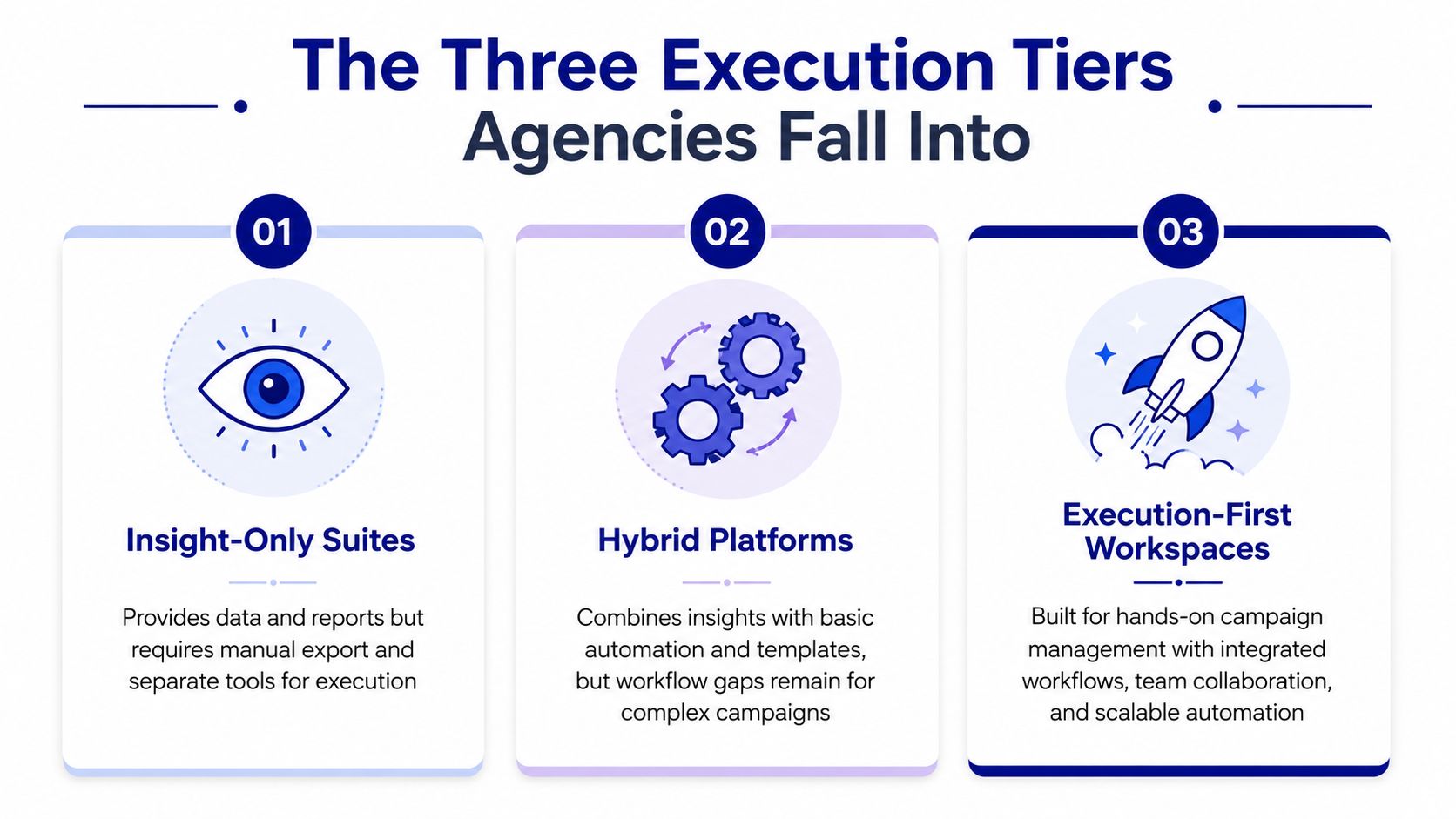
The best way to think about the stack is in three tiers. Insight-only tools diagnose. Hybrid tools help a little with action. Execution-first workspaces are built to move work through review, deployment, and verification inside one system. Most agencies buy one tier lower than they need because the demo looks polished and the reporting export feels safe.
That mistake hurts most when teams manage multiple client CMSs, because the operational bottleneck isn't spotting the problem. It's who approves the change, who applies it, and how you avoid accidental edits. If you want a cleaner mental model for the reporting side of this, pair that with a strong view of SEO dashboard reporting, then ask what happens after the chart is generated.
The deeper issue is timing. SEO results don't show up instantly. A 2026 benchmark source covering 40+ marketing agency sites says ranking movement usually needs 4 to 6 months before it becomes measurable, and lead flow often compounds over 9 to 12 months Ahrefs. A platform that cuts cycle time on the work itself matters more than a prettier weekly snapshot, because the agency that ships cleaner fixes sooner usually creates its own reporting story later.
What an Agency SEO Platform Must Do in 2026
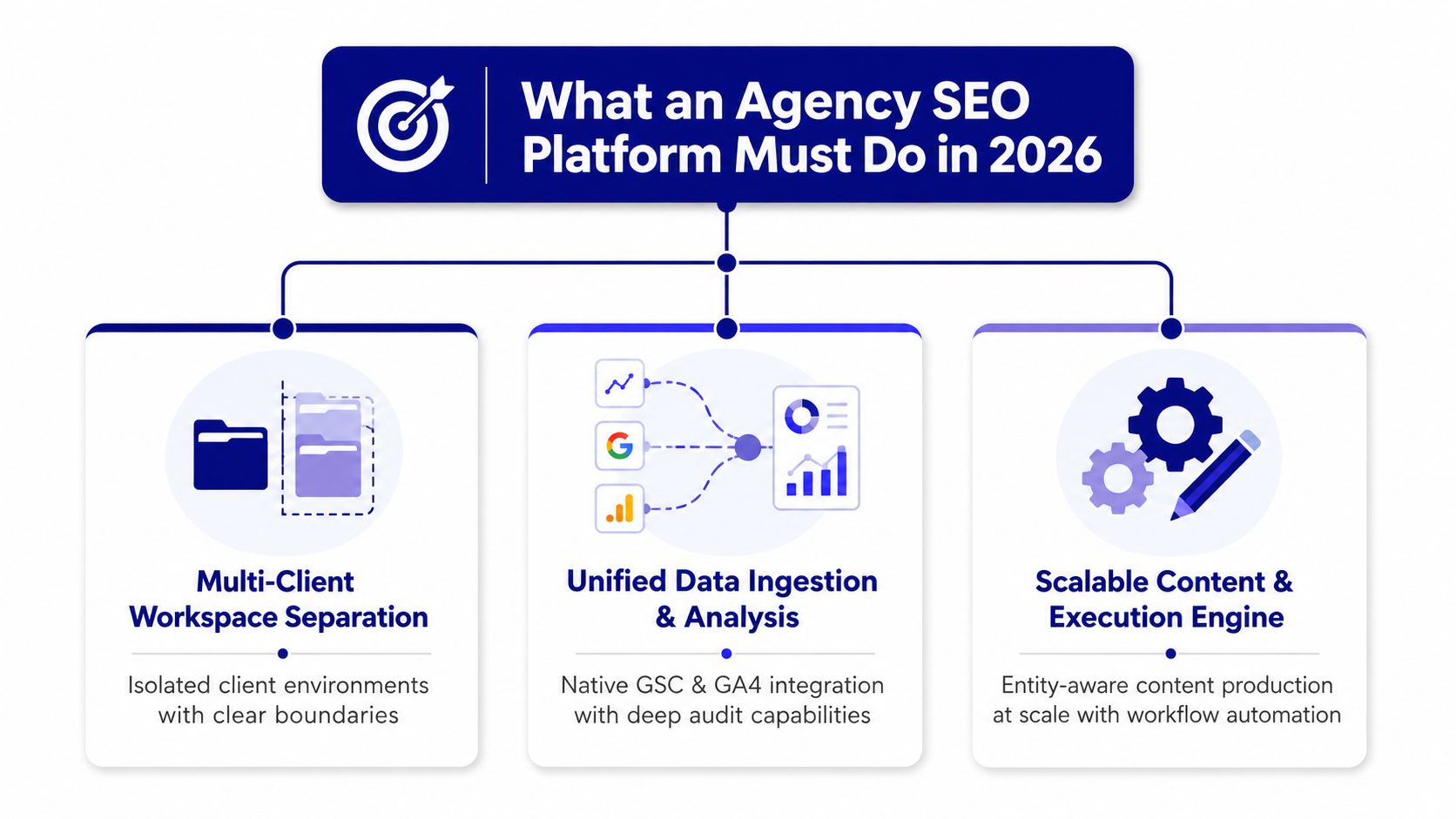
A real agency SEO platform has to answer operational questions, not just feature questions. If it can't separate clients, ingest first-party data, support governed changes, and survive a QBR, it's incomplete. That's the standard I'd use in an RFP.
Start with workspace separation and permissions
Ask whether each client gets an isolated workspace with clean boundaries, role-based access, and review-before-deploy controls. If the answer is vague, assume the vendor expects your team to manage governance outside the product. That's fine for a solo consultant, but it breaks fast in a multi-client environment.
Force first-party data into the center
The foundation should be Google Search Console and GA4, not generic traffic estimates. Industry guidance for agency stack selection explicitly treats Google Search Console + Google Analytics 4 as free, official data, and that's the right baseline. GSC gives you ranked issues from first-party search data, which means prioritization should come from actual search demand and not from a platform's guess about what matters.
Separate classic SEO, technical audit, and AI visibility
Classic rank tracking answers where a keyword sits. Technical auditing answers what's broken on the site. AI visibility tracking answers whether your brand is being cited, mentioned, or included on AI surfaces. Those are different jobs, and vendors love to blur them in the demo.
A good platform should also support reporting artifacts that survive client review. Monthly reporting should include completed tasks, top-performing keywords, organic traffic trends, new backlinks, technical issues fixed, and next month's plan Ingenious Netsoft. If the system can't produce that kind of output without manual cleanup, it's not a real operating layer.
For a broader comparison of the agency tool market, the MyMentions SEO platform guide is a useful reference point because it makes the same distinction between search visibility and delivery workflow. I'd also compare any vendor's automation claims against SEO automation platform thinking, because automation without change control is just risk at scale.
The Three Execution Tiers Agencies Fall Into
The market splits into three tiers, and each one fits a different kind of agency reality. Pick the wrong tier and you'll spend months trying to force the tool to behave like a different product.
Insight-only suites
These platforms are built to show what happened. They're good for keyword monitoring, audits, and polished reports. They fit small teams that still do most execution in spreadsheets, CMS dashboards, and ad hoc checklists.
Their failure mode is predictable. The platform becomes a reporting island, and the team spends time exporting data into another system just to make changes. That's tolerable if your client load is light. It gets expensive when every account needs recurring technical work.
Hybrid platforms
Hybrid tools combine insight with limited automation. They're often the right step for agencies that have outgrown pure reporting but aren't ready for a full execution workspace. These tools can be useful when you need templates, light workflows, or a partial bridge into content operations.
The problem is fragmentation. Hybrid products usually solve one part of delivery well and leave another part manual. That's where teams start stacking point tools around the platform, which brings back the complexity they were trying to remove.
Execution-first workspaces
Execution-first workspaces are for teams that want the platform to participate in delivery. These systems aim to move from issue detection to reviewable fix to deployment and then track the effect. That makes them a better fit for larger agencies, regulated clients, or any team with formal approvals.
If your agency has more handoffs than analysts, buy for workflow first.
A five-person boutique shop can survive on insight-heavy tooling if the team is disciplined. A twenty-person performance agency usually needs the middle tier at minimum. A fifty-person enterprise agency with compliance pressure should be looking for execution-first design from day one.
Seven Evaluation Criteria That Actually Predict Outcomes
Forget the vanity checklist. Ask these seven questions and score the answers accurately.
1. Can the platform consolidate the work you already do?
If it still needs three separate tools for audit, reporting, and deployment, you haven't reduced complexity. You've just renamed it. A strong answer sounds like one workspace, shared data, and fewer handoffs. A weak answer talks about integrations but can't show how the team works inside the product.
2. Does it protect approvals and prevent accidental edits?
Ask how clients, strategists, and implementers move through review. If the vendor says “you can manage that in process,” they're pushing governance back onto your team. Good platforms make permissions and review logic part of the system.
3. Is prioritization grounded in GSC?
A good platform explains why one issue should be fixed before another using first-party data. It doesn't just hand you a long list of “critical” alerts. Prioritization should connect to query data, impressions, clicks, and the likelihood of impact.
4. Can it defend AI visibility attribution?
This is the big one in 2026. You need to know whether mentions, citations, or inclusions on AI surfaces can be tied back to URLs and client KPIs. Industry GEO guidance now points agencies toward citation frequency, source mention rates, visibility across AI platforms, Brand Representation Accuracy, and AI Inclusion Rate Linkflow AI. If a vendor can't explain measurement design, the AI visibility feature is mostly decoration.
5. Can your team produce enough content or fixes without breaking process?
Don't ask whether the platform can generate content. Ask whether it can do so at a pace your editors can govern. Strong answers include workflow, review states, and structured update paths. Weak answers lean on automation without telling you who approves the output.
6. Will the reporting survive a QBR?
Reporting has to hold up when a client asks what changed, why it changed, and what happened next. The benchmark I use is whether a report can show completed work, ranking movement, technical fixes, and next actions without a manual rewrite.
7. What is the true cost per client?
Seat price is only part of the equation. Count admin time, duplicated tools, implementation labor, and the cost of fixing mistakes. If the platform saves $500 on software but adds five hours of coordination every week, the math is bad.
Common mistake: Agencies overweight daily rank tracking because it demos well and feels tangible. Daily ranks matter, but they don't tell you whether work was deployed or whether the client's pipeline moved.
Comparing Four Representative Platforms
The right comparison isn't “Which vendor has the longest feature list?” It's “Which platform matches the way my agency delivers?” That's why I'd compare platforms by execution tier and operational fit, not by checkbox count.
| Platform | Tier | Strongest Criteria | Weakest Criteria | Best Fit Agency |
|---|---|---|---|---|
| Legacy all-in-one suite | Insight-only | Reporting defensibility, classic rank tracking | Execution depth, governed workflows | Agencies that need visibility more than deployment |
| Point-tool stack alternative | Insight-only to hybrid | Specialized depth in separate tools | Consolidation, cost control, approval flow | Small teams that prefer best-of-breed components |
| AI-native execution workspace | Execution-first | GSC-grounded prioritization, AI visibility attribution | Can feel heavier to adopt if the team wants passive reporting | Agencies that want closed-loop delivery and QBR-ready outputs |
| Reporting-led agency tool | Hybrid | White-label reporting, client-friendly outputs | Workflow completeness, AI visibility depth | Agencies selling reporting polish as part of service |
The legacy suite usually wins on familiarity. It tends to be strong at classic reporting and keyword visibility, which is why many agencies keep it around longer than they should. The constraint is that reporting comfort can hide workflow weakness.
The point-tool stack gives specialists more depth, especially if one vendor is strong on technical crawling and another is strong on reporting. The problem is operational sprawl. You can end up with the best pieces and the worst handoffs.
The AI-native execution workspace is where the market is moving when agencies care about delivery, not just diagnosis. That's the category where GSC signals, content operations, and AI search visibility can live together. If you need a broader market lens on reporting-focused tooling, SEO reporting solutions for agencies 2026 is a good way to understand where reporting-led products still fit.
The reporting-led agency tool is fine when the agency product is mostly communication. If clients mainly pay for polished updates and white-label dashboards, it can work. It breaks when you need the platform to coordinate changes across many sites or explain AI visibility in a way a buyer can defend.
The blunt truth is that backlink depth and seat-based pricing still vary a lot across vendors, while daily tracking and white-label reporting have become more common Sitechecker. That's useful context, but it doesn't change the central question. The winner is the platform that matches your delivery model.
Three Agency Scenarios and the Right Platform for Each
A small agency shouldn't buy like an enterprise. A big agency shouldn't buy like a freelancer. The wrong comparison is how teams waste money on tooling that doesn't fit their process.

Three-person local SEO agency
This team usually wins by staying lean. They need reliable audits, clean reports, and enough structure to avoid chaos, but they don't need a heavy execution layer if most fixes happen directly in a small number of CMSs. A hybrid tool is often enough.
The mistake here is buying enterprise workflow before the agency has the headcount to use it. That creates process overhead faster than it creates value. If the team can still review every change manually, don't pay for layers you won't activate.
Fifteen-person performance agency
The wrong stack starts to hurt. Client load is high enough that manual handoffs slow delivery, and the team needs better prioritization from GSC plus clearer deployment control. An execution-first workspace starts to make sense if the agency is shipping content and technical fixes every week.
A team at this stage should also care about AI search visibility tooling for agencies, because clients are already asking why AI surfaces aren't reflected in the reporting deck. The trap is copying the tiny agency's stack and then trying to layer process around it. That usually ends in spreadsheet sprawl.
Forty-person enterprise agency with regulated clients
This is the strongest case for execution-first. Large teams need permissioning, review history, and a clean audit trail for every change. A reporting-led stack can't absorb that complexity without a lot of outside process.
The mistake here is treating the platform as a reporting layer and leaving implementation to scattered human steps. That's how risk gets introduced. Compliance-heavy clients need systems that can prove what changed, who approved it, and why it shipped.
Five signals usually mean the current platform is the wrong tier. The team exports data constantly. Approvals happen in chat threads. Reporting takes manual cleanup before every client meeting. AI visibility questions keep coming up, but the stack can't answer them. And fixes are found faster than they're deployed.
A Repeatable Scoring Method for Your Shortlist
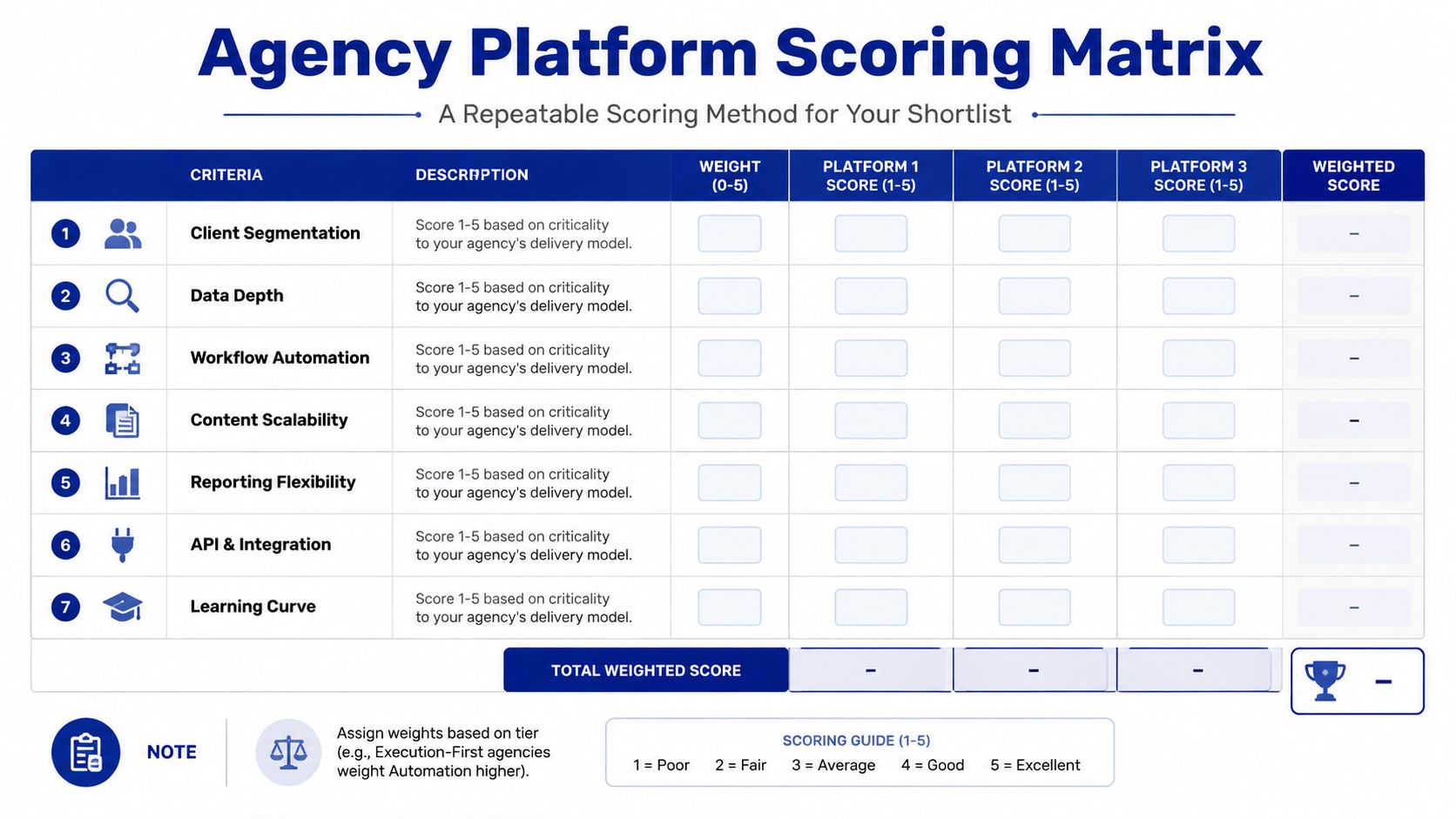
Run the shortlist like a buying committee, not like a product tour. Give each of the seven criteria a weight based on your delivery model, then score every vendor from 1 to 5. If you're an execution-first shop, weight automation and governance higher. If you're a boutique team, weight reporting defensibility and setup speed higher.
Don't let demo polish dominate the score
Score the demo on how it handles your real work, not on how clean the UI looks. Have a strategist, an operator, and someone who ships changes in the room. If only one person attends the demo, you'll end up buying on vibe instead of operational fit.
The most common scoring error is overweighting daily rank tracking because it's easy to show. That metric matters, but it should never drown out workflow, approvals, and attribution.
Run a two-week pilot
Ask the vendor to prove three things quickly. Can the team separate clients cleanly? Can it surface one real issue from GSC and move it into action? Can it track whether the fix changed the result? If the pilot only proves onboarding was smooth, it didn't prove enough.
Before signing, negotiate contract terms around data portability, permissioning, and exit paths. If the platform is becoming your delivery layer, you need confidence that exports, access controls, and workflow history won't disappear the moment the relationship changes.
Choosing the Right Platform and Defending It in a QBR
The right choice depends on agency size, delivery model, and client mix. Small teams can survive on lighter tooling if they're disciplined. Mid-sized and enterprise agencies should lean toward execution-first because the cost of manual coordination gets ugly fast. If your clients expect clear proof, the platform has to help you produce it.
A client-facing QBR should not sound like software appreciation. It should sound like operational proof. Use citation frequency, AI Inclusion Rate, and Brand Representation Accuracy when AI visibility is part of the stack, because those metrics connect the platform to the business question clients ask: are we present where buyers now search? GEO guidance already frames these as the right success measures Linkflow AI.
For measurement hygiene, I'd also borrow the mindset behind analytics QA for marketing teams. If the data feeding your QBR isn't trustworthy, the client conversation will drift into opinions. A good platform should help you defend the numbers, not just display them.
My recommendation is direct. Most agencies in 2026 should choose an execution-first workspace, but only if they're ready to govern it properly. An ungoverned execution layer creates more client risk than the reporting suite it replaced. If your team isn't willing to manage permissions, approvals, and review discipline, stay with a lighter tier until you are.
Nuwtonic is built for agencies that want an execution layer, not another reporting island. It connects to Google Search Console, surfaces prioritized issues and AI visibility opportunities, and supports reviewable fixes through governed workflows. If you're comparing stacks for 2026, visit Nuwtonic and see how that approach fits your delivery model.