Key Takeaways & TL;DR
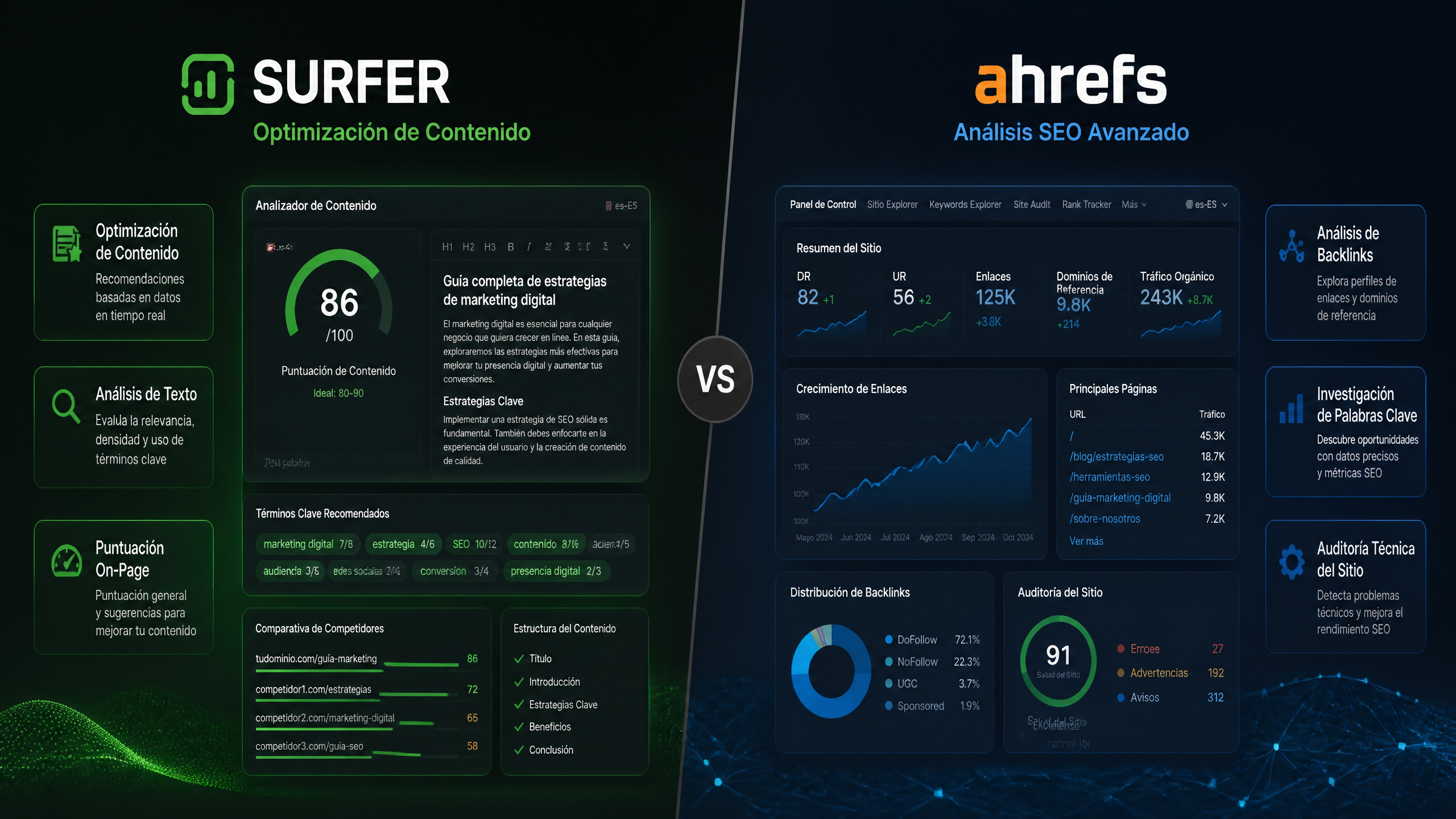
Choosing between SurferSEO and Ahrefs is not a matter of finding the "better" software; it is about identifying which tool solves your specific bottlenecks. If your primary goal is to write content that ranks without getting lost in technical data, SurferSEO is your go-to partner. If you need to map out an entire site architecture, monitor competitor backlinks, and run deep technical audits, Ahrefs remains the industry gold standard.

Quick Comparison Table
| Feature | SurferSEO | Ahrefs |
|---|---|---|
| Primary Focus | On-page SEO & Content Optimization | Off-page SEO & Competitive Intelligence |
| Core Strength | Real-time SERP analysis & NLP guidelines | Backlink analysis & massive keyword index |
| Keyword Clustering | Automated by search intent | Manual grouping required |
| Site Audits | On-page content gaps only | Technical, crawlability, and link audits |
| Link Building | No native backlink tracking | Industry-leading backlink database |
| Best For | Content writers, editors, and niche site owners | SEO agencies, technical auditors, and link builders |
The Core Difference in a Nutshell
Look, let's be real: comparing these two platforms is like comparing a high-performance sports car to an all-terrain utility truck. Both will get you where you need to go, but they are built for entirely different roads.
SurferSEO is a specialized tool designed to help you write and optimize on-page content based on real-time SERP data and Natural Language Processing (NLP). It tells you exactly how many times to use a keyword, what headings to include, and how to structure your article to please search engines.
Ahrefs, on the other hand, is an all-in-one search marketing suite. Its strengths lie in its massive database of backlinks, organic traffic estimates, and competitive intelligence. While Ahrefs has introduced content tools over the years, its core identity is rooted in data extraction, site auditing, and link building.
Understanding the Core Specialties of SurferSEO and Ahrefs
SurferSEO: The King of On-Page Content Optimization
In my experience, many users overlook the power of content optimization tools like SurferSEO when they can significantly enhance their existing strategies. When you plug a target keyword into Surfer, it does not just look at search volume. It actively crawls the top-ranking pages on the SERP, analyzes their structure, and uses NLP to determine which entities and semantic terms are driving those rankings.
This means you get a real-time, data-driven blueprint for your content. Instead of guessing how long your post should be or which subheadings to use, Surfer provides a clear, numerical Content Score that updates as you write. It simplifies the execution of complex on-page SEO tasks, making it accessible even to writers who do not have a formal technical background.
Ahrefs: The Powerhouse of Off-Page SEO and Competitive Intelligence
Ahrefs is fantastic for backlink analysis, but I've seen users get bogged down in data that doesn't always translate to actionable insights. If you are trying to understand why a competitor is outranking you despite having inferior content, Ahrefs will give you the answer. It maps out their entire backlink profile, reveals their referring domains, and shows you exactly which pages are driving their organic traffic.
Its crawler is second only to Google, meaning you get incredibly fresh data on link acquisitions, lost links, and broken redirects. Beyond links, Ahrefs offers a comprehensive Site Audit tool that scans your website for technical issues like duplicate content, broken links, and crawl budget inefficiencies.
The Common Pitfalls of Choosing the Wrong Tool
Before diving into solutions, I always like to mention the common pitfalls I observe when consulting for brands. The most frequent mistake is buying a subscription to Ahrefs when your team only needs to write three blog posts a month. You end up paying a premium for backlink data you will never look at, while your writers struggle to format their content for search engines.
Conversely, some teams try to use SurferSEO as their sole SEO platform. They write perfectly optimized articles but wonder why they still cannot rank on page one. The harsh reality is that if your website has zero domain authority, even a perfect Surfer score of 100 won't save you from being buried by high-authority competitors. You need to understand the difference between SEO and keyword research and how off-page authority influences your on-page efforts.
Feature-by-Feature Breakdown: On-Page vs. Off-Page Capabilities
Content Editor and Real-Time SERP Analysis
Surfer’s Content Editor is the crown jewel of the platform. It integrates directly with Google Docs and WordPress via a browser extension, allowing your writing team to optimize content within their native workflows. The tool uses a proprietary algorithm to compare your draft against the top 10 or 20 ranking pages, adjusting its recommendations based on the specific competitors you choose to benchmark against.

While Ahrefs has a Content Explorer tool, it is primarily designed for content discovery—finding popular articles on the web to pitch for links—rather than real-time optimization. If you want to refine a draft line-by-line, Ahrefs cannot match Surfer’s real-time feedback loop.
Link Building and Backlink Auditing
When it comes to link building, Ahrefs is the undisputed heavyweight champion. It allows you to perform deep link intersection analyses, find broken link-building opportunities, and monitor your competitors’ link velocity.
SurferSEO has virtually no off-page capabilities. It does not track backlinks, it cannot show you referring domains, and it won't help you find guest post opportunities. If your growth strategy relies heavily on outreach and digital PR, Ahrefs is non-negotiable.
Keyword Research and Clustering Methodologies
Most people think they need a complex tool for basic SEO tasks—sometimes simpler solutions yield better results. Let's look at how both tools handle keywords:
- Ahrefs Keywords Explorer: This tool provides massive datasets, showing search volume, keyword difficulty (KD), click metrics, and parent topics. It is perfect for deep-dive research and finding long-tail variations across search engines like Google, YouTube, and Amazon.
- Surfer Keyword Research: Instead of just listing keywords, Surfer automatically groups them into topical clusters based on search intent. This allows you to plan an entire content hub in minutes, ensuring you cover a topic comprehensively to build topical authority.
If you want to understand the broader market, Ahrefs is superior. If you want an actionable writing roadmap, Surfer's clustering is far more efficient.
Pricing, Value, and Learning Curves
Cost Analysis and Value for Money
Honestly, budget is where the rubber meets the road for most businesses. Ahrefs has transitioned to a usage-based pricing model that charges for additional export credits and user seats, which can quickly become expensive for active agencies. SurferSEO offers flat-rate tiers but limits the number of Content Editor credits you can use per month.
| Pricing Tier | SurferSEO | Ahrefs |
|---|---|---|
| Entry Level | ~$89/mo (Essential) | ~$129/mo (Lite) |
| Mid-Tier | ~$179/mo (Advanced) | ~$249/mo (Standard) |
| Enterprise/Agency | Custom pricing available | ~$449/mo+ (Advanced/Enterprise) |
| Usage Limitations | Limited by Content Editor credits | Limited by crawl credits and user seats |
If you want a broader comparison of SEO tools like Ahrefs to see how these prices stack up against other industry players, you will find that both platforms sit on the premium end of the spectrum.
Ease of Use and Workflow Integration
SurferSEO has a remarkably flat learning curve. A freelance writer can log in and start using the Content Editor productively within ten minutes. The visual interface—complete with green, yellow, and red dials—makes optimization intuitive.
Ahrefs has a much steeper learning curve. Its dashboard is packed with dense charts, metrics like Domain Rating (DR) and URL Rating (UR), and complex filtering options. While incredibly powerful, it requires training to prevent team members from getting lost in data that does not drive immediate business outcomes.
Which Tool Should You Choose for Your SEO Strategy?
When to Choose SurferSEO
I recommend choosing SurferSEO if your primary marketing channel is content creation and you already have a healthy website with decent domain authority. It is the perfect tool for:
• In-house content teams looking to streamline their editorial workflow.
• Freelance writers who want to deliver SEO-ready drafts to clients.
• Niche site publishers focusing on rapid content deployment and topical authority.
If you are on a tight budget and need other options, you can explore some of the best alternatives to Ahrefs to handle your basic keyword research while keeping Surfer as your primary writing assistant.
When to Choose Ahrefs
Choose Ahrefs if you are building an SEO strategy from scratch, running an agency, or focusing heavily on technical optimization and link building. It is indispensable for:
• Agency professionals managing multiple client audits and reporting.
• Technical SEO specialists diagnosing crawlability and indexing issues.
• Link builders and digital PR professionals searching for outreach targets.
Can They Coexist in Your Tech Stack?
In my own consulting practice, I rarely choose one over the other. For mid-to-large enterprises, using both tools in tandem is the ultimate workflow. You use Ahrefs to discover high-value keyword opportunities, map out competitor gaps, and monitor your link profile. Then, you export those keywords into SurferSEO to cluster them and write highly optimized content.
If your budget allows, combining Ahrefs' analytical power with Surfer’s execution-focused interface creates a highly efficient SEO engine.
Frequently Asked Questions (FAQ)
Common User Inquiries Answered
Can SurferSEO replace Ahrefs entirely?
No. SurferSEO cannot track backlinks, perform technical site audits, or provide deep competitor traffic analytics. It is an on-page optimization tool, not an all-in-one SEO suite.
Is SurferSEO's Content Score accurate?
Yes, but with a caveat. The score is a relative metric based on top-ranking competitors. If the top-ranking pages have poor content, a score of 100 in Surfer simply means you are the best of a weak group. Always write for human readers first.
Does Ahrefs have a content optimization tool?
Ahrefs has a Content Explorer and basic on-page recommendations in its Site Audit tool, but it lacks a real-time, interactive editor like Surfer's Content Editor.
Which tool is better for beginners?
SurferSEO is much easier for beginners to grasp because its recommendations are visual, direct, and actionable for content creation.
References and Methodology
Our comparison is based on hands-on testing of both platforms across multiple client campaigns, evaluating feature updates, pricing changes, and API integrations. We also synthesize user feedback from active digital marketing communities to ensure our insights reflect real-world execution rather than marketing hype.