Choosing the right SEO software can feel like buying a car. Do you need a reliable, fuel-efficient sedan that gets you from point A to point B without breaking the bank, or do you need a high-performance sports car with all the premium specs? In the digital marketing world, this is the exact choice you face when looking at se ranking vs ahrefs. Both platforms promise to help you conquer the search engine results pages, but they target wildly different budgets and operational workflows.

Years ago, during my third year as an SEO specialist, I made a classic rookie mistake. I was managing a site migration for a mid-sized e-commerce store and completely ignored the site audit crawl errors. I thought, "Hey, our backlink profile is massive, we'll survive." Spoiler alert: we didn't. Our organic traffic plummeted by 40% in a single week because of broken redirect loops. That painful lesson taught me that while fancy metrics get all the glory, the fundamentals—like a robust site audit and accurate rank tracking—make or break your strategy. Let's look at how these two tools stack up when the rubber meets the road.
The Core Dilemma: SE Ranking vs Ahrefs
TL;DR Summary: The Quick Verdict
Here's the thing: if you are a freelancer, an in-house marketer at an SMB, or a budget-conscious agency, SE Ranking offers about 85% of the features of Ahrefs at a fraction of the cost. However, if you are an enterprise agency or a hard-core link builder who relies on a massive, real-time backlink profile database, Ahrefs remains the gold standard—despite its increasingly restrictive credit-based pricing model.
I find that SE Ranking is often underestimated, especially for budget-conscious businesses looking for solid features without the hefty price tag of Ahrefs. To help you visualize the core differences, I have compiled a direct comparison of their primary capabilities.
Feature / Metric | SE Ranking | Ahrefs |
|---|---|---|
Starting Price (Monthly) | ~$55 (Billed monthly) | ~$129 (Billed monthly) |
Rank Tracking Frequency | Daily, every 3 days, or weekly | Daily (Requires premium add-on) |
Backlink Index Size | ~3 trillion links | ~35 trillion links |
Technical Site Audit | Fast, highly customizable | Comprehensive, slower on massive sites |
Keyword Database Size | ~3.2 billion keywords | ~20+ billion keywords |
Pricing Model | Flat-rate user seats | Credit-based consumption |
Key Takeaways
Before we dive into the weeds, here are the main points you need to keep in mind:
• Value vs. Power: SE Ranking is a highly cost-effective, all-in-one platform with flexible rank tracking options, while Ahrefs is a premium, data-dense powerhouse specializing in link intelligence.
• Backlink Analysis: Ahrefs maintains a massive lead in backlink index size and historical link data, making it indispensable for advanced link-building campaigns.
• Rank Tracking: SE Ranking offers superior value for day-to-day rank tracking, allowing you to track keywords across multiple search engines and locations without exhausting your monthly credits.
• Usability: SE Ranking features a cleaner, more intuitive user interface for beginners, whereas Ahrefs provides deeper, more granular technical data that requires a steeper learning curve.
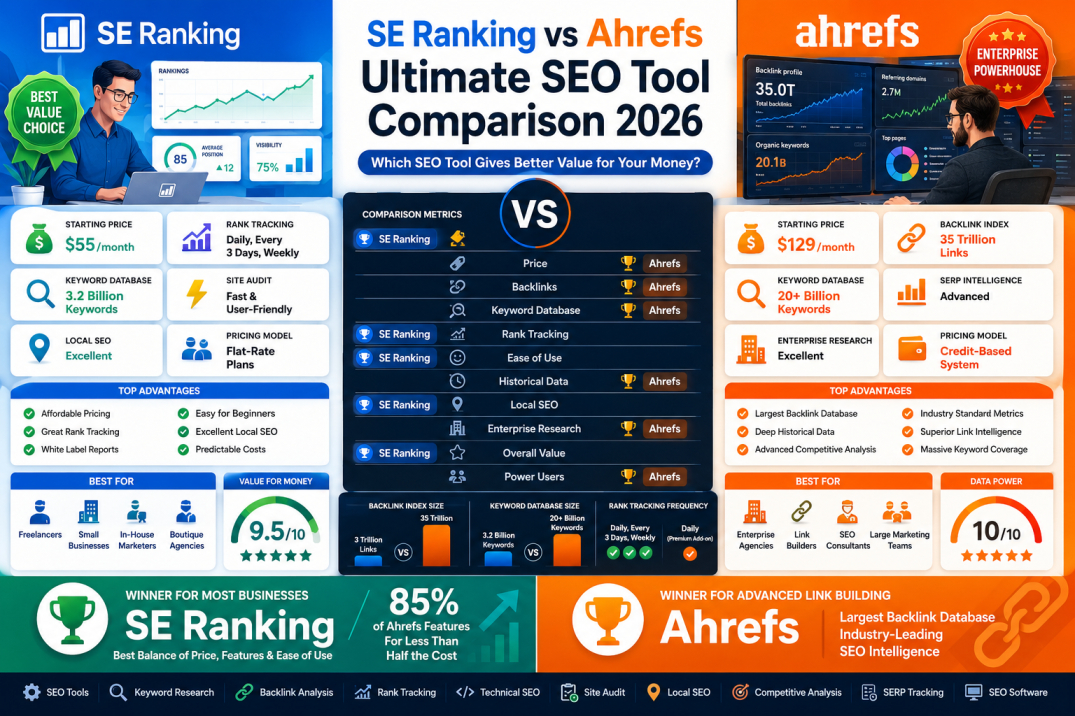
Table of Contents
To navigate this comprehensive comparison, use the guide below:
Database Power and Keyword Research Capabilities
Backlink Profiles and Link Building Metrics
Site Audit and Technical SEO Capabilities
Pricing Tiers and Value for Money
Frequently Asked Questions (FAQ)
The Final Verdict: My Personal Recommendation
Database Power and Keyword Research Capabilities
Keyword Difficulty and Search Volume Accuracy
Ever wonder why your rankings aren’t improving even when you target keywords with supposedly "low" difficulty? The truth is, every SEO tool calculates keyword difficulty differently. Ahrefs bases its difficulty score primarily on the number of referring domains pointing to the top 10 ranking pages. It is a straightforward, backlink-centric calculation.
SE Ranking, on the other hand, takes a more holistic approach. It factors in domain authority, on-page SEO parameters, and search intent alongside backlink metrics. In my experience, this often results in a more realistic difficulty score for smaller websites that cannot compete purely on link authority.
Unpacking the Difference Between SEO and Keyword Research
Here's the thing: many marketers confuse basic search volume lookups with a comprehensive organic strategy. Understanding the difference between SEO and keyword research is crucial when evaluating these platforms. Keyword research is about finding the right search queries; SEO is about the execution, technical health, and content structure required to rank for those queries.
While Ahrefs has a massive database of over 20 billion keywords globally, SE Ranking's database is rapidly expanding. If you are targeting highly localized niches, you might find that SE Ranking's regional databases are surprisingly robust. However, for sheer international volume and historical search trends, Ahrefs still holds the crown.
SERP Analysis and Competitive Intelligence
Analyzing the SERP is about more than just looking at who is in position one. You need to see SERP features—like featured snippets, local packs, and people also ask boxes—that might steal your organic clicks.

Ahrefs provides a highly detailed SERP history chart, showing how positions have fluctuated over time. This is incredibly useful for identifying volatile search queries. SE Ranking offers a similar SERP analyzer, but it integrates more directly with its content marketing module, helping you draft content briefs based on top-ranking competitors almost instantly.
Backlink Profiles and Link Building Metrics
Live Backlink Index Size and Freshness
Let’s not beat around the bush—Ahrefs has an edge in backlink analysis, but for day-to-day rank tracking, SE Ranking can be just as effective. Ahrefs crawls the web constantly, and its link index is second only to Google. If you are running an active digital PR campaign and need to see links go live within hours, Ahrefs is unmatched.
SE Ranking’s backlink checker is powered by its own database, which is respectable but noticeably smaller. If you run a search for a brand-new local business, SE Ranking might take a few weeks to pick up new links that Ahrefs finds in a few days.
Domain Authority and Proprietary Metrics
Both platforms use proprietary authority metrics to help you quickly judge a site's strength. Ahrefs uses Domain Rating (DR), while SE Ranking uses Domain Trust (DT).
• Domain Rating (DR): Calculated purely based on the quality and quantity of external backlinks pointing to a site. It is widely accepted as an industry standard for link brokers and guest bloggers.
• Domain Trust (DT): An aggregate score that evaluates both link quality and the overall trustworthiness of the referring domains, making it slightly harder to manipulate with spammy link networks.
Historical Backlink Data Retrieval
What happens when a competitor’s traffic suddenly spikes and you need to know why? Ahrefs allows you to look back years into their link-building history to see exactly which pages they redirected or which high-authority domains they acquired. SE Ranking provides historical backlink data as well, but its historical depth is limited on lower-tier plans.
If you are doing deep forensic SEO or competitive intelligence for enterprise clients, Ahrefs' historical index is worth the premium price.
Site Audit and Technical SEO Capabilities
Crawl Errors and Site Health Scoring
Many users overlook the importance of a good site audit; without it, you might miss crucial optimization opportunities regardless of the tool you choose. Both SE Ranking and Ahrefs offer cloud-based crawlers that scan your website for crawl errors, broken links, duplicate content, and slow-loading pages.
I have found that SE Ranking’s site audit tool is exceptionally user-friendly. It groups issues into clear categories (Errors, Warnings, and Notices) and provides straightforward explanations of how to fix them.
Actionable Fixes and Speed Analysis
When it comes to speed, Ahrefs' Site Audit tool can feel a bit sluggish on massive websites with hundreds of thousands of pages. However, it offers unparalleled customization, allowing you to run custom JavaScript crawls to analyze client-side rendered websites.
SE Ranking is faster out of the box for standard HTML sites and integrates Core Web Vitals data seamlessly into its main dashboard. This makes it incredibly easy to hand off a list of technical fixes to a developer without overwhelming them with raw data exports.
Rank Tracking Consistency and Geolocation Limits
Rank tracking is where SE Ranking truly shines. It allows you to track rankings down to the postal code level across Google, Bing, Yahoo, and YouTube. You can also choose how often your rankings update—daily, every three days, or weekly—which directly lowers your subscription cost.
Ahrefs, conversely, has moved toward a model where daily rank tracking is a premium add-on. If you want daily updates for a large keyword list on Ahrefs, prepare to watch your monthly bill climb significantly.
Pricing Tiers and Value for Money
Cost Breakdown for Solopreneurs and Small Teams
Let's talk numbers. Ahrefs famously updated its pricing model to a pay-per-result / credit-consumption system. If you click too many reports, view too many SERPs, or open too many tabs, you run out of credits and have to pay more. For a small business, this can make monthly budgeting a nightmare.
SE Ranking operates on a traditional SaaS subscription model. You pay a flat rate based on the number of keywords you want to track and how often you want them updated. There are no surprise charges for clicking around your own dashboard.
When to Choose Ahrefs (and When to Run)
Choose Ahrefs if you are an established agency where client retainers easily cover the tool's cost and you absolutely require the most comprehensive link index available. Do not choose Ahrefs if you are just starting out, or if you have a team of junior SEOs who will accidentally burn through your monthly credits in the first week of the month.
Exploring the Best Alternatives to Ahrefs
If you are looking beyond these two, a broader comparison of SEO tools can help you weigh your options against other industry giants like Semrush and Moz. If your primary goal is to find the best alternatives to Ahrefs that won't drain your bank account, SE Ranking stands out as a top contender alongside free options like Google Search Console and various specialized rank trackers.
Frequently Asked Questions (FAQ)
Is SE Ranking as accurate as Ahrefs?
For rank tracking and on-page SEO analysis, yes. SE Ranking pulls directly from search engine APIs and is highly accurate. For backlink data and search volume estimates on low-volume search queries, Ahrefs still holds a slight accuracy advantage due to its larger proprietary database.
Can I run a complete agency on SE Ranking alone?
Absolutely. SE Ranking includes white-label reporting, a lead generation widget for your agency website, a client portal, and a marketing planner. Many boutique agencies use it as their primary tool to keep software overhead low.
Why is Ahrefs so much more expensive?
Ahrefs maintains its own massive web crawler and index, which requires immense server infrastructure and computational power. They position themselves as an enterprise-grade data provider rather than a budget-friendly utility.
The Final Verdict: My Personal Recommendation
Choose SE Ranking If...
• You are a freelancer, small business owner, or in-house marketing team.
• You want predictable, flat-rate monthly pricing without credit limitations.
• Your primary focus is rank tracking, local SEO, and technical site audits.
• You need white-label reports to send to clients without paying for an enterprise tier.
Choose Ahrefs If...
• You are an enterprise agency or a dedicated link-building specialist.
• You require the absolute largest, freshest backlink database on the market.
• You need extensive historical data to analyze long-term competitor strategies.
• Budget is not a primary constraint for your marketing operations.
Sources and References
Our evaluation of these tools is based on over seven years of hands-on industry experience, active testing of both platforms across dozens of client websites, and consensus data from the professional SEO community. For further reading on standard digital research and data evaluation methodologies, you can consult resources like the Princeton guidelines on citing facts and the USC guidelines on structured source analysis.