
Choosing the right tools for your marketing stack often feels like walking through a minefield of overhyped promises. If you are trying to decide between Keysearch and Ahrefs, you are looking at two entirely different philosophies of search engine optimization. One is a lightweight, budget-friendly keyword research tool designed for bloggers and niche site creators; the other is an enterprise-grade, data-rich ecosystem built for agencies and corporate SEO teams.
Choosing between Keysearch and Ahrefs is like deciding between a reliable, fuel-efficient commuter car and a high-performance, track-ready sports car. Both will get you to your destination, but one does it with telemetry sensors, custom suspension, and a price tag that makes your accountant sweat.

TL;DR Summary
If you want the quick answer: Keysearch is an incredible, cost-effective tool for bloggers, affiliate marketers, and small businesses who primarily need solid keyword research and basic rank tracking without breaking the bank. Ahrefs is an industry-standard powerhouse that is indispensable for serious link building, deep technical site audits, and competitor analysis—provided you have the budget to support its credit-based pricing model.
Key Takeaways
• Keyword Research: Keysearch is fantastic for beginners but lacks some advanced functionalities that Ahrefs offers, though its keyword difficulty scoring is surprisingly accurate.
• Backlink Analysis: Ahrefs' backlink analysis is unparalleled, boasting a massive crawler index, while Keysearch relies on smaller, limited databases.
• Pricing: Keysearch starts at a fraction of the cost of Ahrefs, making it the clear winner for budget-conscious creators.
• Ideal Use Case: Use Keysearch for niche site building and basic on-page optimization; use Ahrefs for enterprise SEO, client reporting, and active digital PR campaigns.
Table of Contents
Core Architecture and Keyword Research Capabilities
Backlink Profile Analysis and Link Building Databases
On-Page Optimization, Site Audits, and Technical SEO
Pricing Tiers, Value Proposition, and ROI Analysis
Frequently Asked Questions
Final Verdict and Strategic Recommendations
Core Architecture and Keyword Research Capabilities
Keysearch's Approach to Keyword Discovery and Difficulty
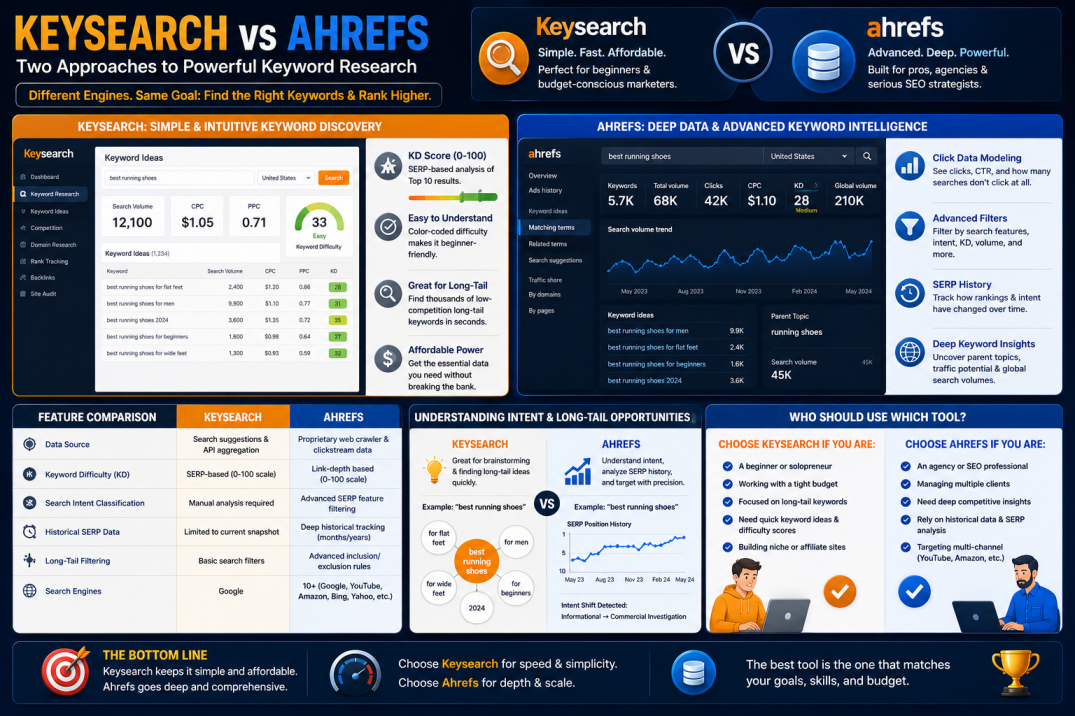
Honestly, Keysearch punch above its weight class when it comes to basic keyword discovery. The tool functions primarily by scraping search suggestions and utilizing API integrations to pull search volume, CPC, and PPC data. For users searching for long-tail keywords, Keysearch provides a straightforward, easy-to-understand interface.
Its proprietary keyword difficulty (KD) score is calculated by analyzing the top 10 search results on the SERP. It looks at domain authority, page authority, trust flows, and whether the keyword is used in the title or URL. In my 7+ years of digital marketing experience, I have found that Keysearch's KD score is often more intuitive for beginners than other mid-tier tools because it color-codes the difficulty instantly, helping you spot low-hanging fruit without overcomplicating the analysis.
Ahrefs' Keyword Explorer and Search Volume Modeling
To be clear, Ahrefs does not just scrape keywords; it models search behavior using massive clickstream data. This allows Ahrefs to estimate not just how many people search for a term, but how many of those searches actually result in a click. Many users overlook the importance of keyword intent — it's not just about the volume. Ahrefs shows you the percentage of clicks that go to paid vs. organic results, and how many searches end without any clicks at all.
When comparing premium suites, much like we see in the Ahrefs vs Ubersuggest matchup, Ahrefs' data granularity is hard to match. Its Keyword Explorer lets you filter by parent topics, search features (like featured snippets or people also ask), and advanced search operators, making it an analytical playground for deep content planning.
Analyzing Keyword Intent and Long-Tail Opportunities
Keysearch relies heavily on database integrations to suggest related terms, which is perfect for brainstorming. However, it lacks the ability to group keywords by search intent automatically.
In contrast, Ahrefs allows you to dissect the SERP history over time to see if Google has shifted its preference from informational blog posts to transactional landing pages for a specific query. This historical SERP tracking prevents you from targeting keywords that you can never realistically rank for due to intent mismatch.
Keyword Feature | Keysearch | Ahrefs |
|---|---|---|
Data Source | Search suggestions & API aggregation | Proprietary web crawler & clickstream data |
Keyword Difficulty (KD) | SERP-based (0-100 scale) | Link-depth based (0-100 scale) |
Search Intent Classification | Manual analysis required | Advanced SERP feature filtering |
Historical SERP Data | Limited to current snapshot | Deep historical tracking |
Long-Tail Filtering | Basic search filters | Advanced inclusion/exclusion rules |
Backlink Profile Analysis and Link Building Databases
The Scale and Recency of Ahrefs' Backlink Index
Ahrefs' backlink analysis is unparalleled, but its pricing can be a barrier for small businesses. Ahrefs runs one of the most active commercial web crawlers in the world, meaning its index of live backlinks is updated constantly. If you are executing an active link-building campaign—such as guest posting, resource page outreach, or digital PR—you need to know exactly when your competitors acquire new links.
With Ahrefs, you can see the exact anchor text distribution, the velocity of link acquisition, and the historical growth of a site's backlink profile. This data is critical for identifying toxic link patterns or reverse-engineering a competitor’s outreach strategy.

Keysearch's Backlink Checker Limitations
To be clear, Keysearch is not built to be a primary backlink analysis tool. While it does include a backlink checker, the database is significantly smaller and does not update with the same frequency as Ahrefs.
If you try to run a deep competitor analysis on Keysearch, you will likely miss a massive chunk of their lower-authority or newly acquired links. For basic checks—like verifying if a guest post link has been indexed—it works fine. But for building a comprehensive off-page optimization strategy, it is like trying to map the ocean floor with a flashlight.
Practical Workflows for Link Acquisition
If your strategy revolves heavily around digital PR, evaluating enterprise suites like in our Ahrefs vs Semrush vs Moz review becomes essential. To illustrate this, let me share a personal anecdote from a past project.
Back in 2019, I was managing a portfolio of niche affiliate sites on a shoestring budget. Ahrefs was eating up a massive chunk of my monthly cash flow, so I decided to migrate entirely to Keysearch for six months. While my keyword tracking and basic research didn't suffer, my link-building outreach hit a brick wall. I couldn't find the broken backlink opportunities or the niche-relevant resource pages that my competitors were exploiting because Keysearch simply didn't index those smaller, highly specific referring domains. I ended up returning to Ahrefs for my link-building phases because the data gap was too wide to ignore.
To execute link building effectively, you generally need to follow these steps:
Identify competitor pages with high referring domains.
Filter those backlinks to find high-quality, do-follow links.
Analyze the anchor text to understand the context of the link.
Reach out to the site editors with a superior content piece.
Keysearch makes step 1 difficult and steps 2 and 3 almost impossible at scale, whereas Ahrefs streamlines the entire workflow.
On-Page Optimization, Site Audits, and Technical SEO
Executing a Comprehensive Site Audit
A successful SEO strategy requires a healthy technical foundation. Ahrefs features a robust, cloud-based site audit tool that crawls your website just like Googlebot does. It flags everything from broken links (404 errors) and duplicate content to complex issues like hreflang misconfigurations and crawl budget waste.
Keysearch offers a basic "Explorer" audit tool, but it is highly simplified. It will give you a quick overview of your meta tags, page speed scores, and basic on-page elements, but it won't help you diagnose deep technical indexing issues that prevent your pages from showing up in the SERP.
Keysearch's Content Assistant vs Ahrefs' Content Gap Tool
Where Keysearch surprises many is in its Content Assistant tool. This feature analyzes the top-ranking pages for your target keyword and provides a list of LSI (Latent Semantic Indexing) keywords and entities you should include in your text. It is a highly practical, straightforward helper for on-page optimization.
Ahrefs approach to content optimization is different. Instead of an interactive content editor, it relies on its Content Gap tool. This tool identifies keywords that your competitors rank for, but you do not. This approach is similar to how other lightweight tools attempt to compete with giants, as discussed in our breakdown of Ahrefs vs KWFinder.
Technical SEO Execution and Issue Resolution
If you are a technical SEO specialist, Keysearch will feel incredibly limiting. It does not provide the log file analysis, schema markup validation, or core web vitals tracking that modern search engines demand.
• Ahrefs Technical Focus: Deep crawl analysis, JavaScript execution rendering, and internal link distribution mapping.
• Keysearch Technical Focus: Basic on-page checklists, title/description length checks, and simple response code verification.
Pricing Tiers, Value Proposition, and ROI Analysis
Breakdown of Keysearch Subscription Plans
Keysearch is widely celebrated for its disruptive pricing. It offers two main plans: Starter and Pro. Even at the Pro level, the monthly cost is lower than almost any other professional SEO tool on the market. They also frequently offer lifetime discounts, making it an incredibly attractive option for boot-strappers.
Deconstructing Ahrefs' Credit-Based Pricing Model
Honestly, Ahrefs' pricing model has become a major pain point for the SEO community. In recent years, they transitioned to a credit-based system where every single report, keyword search, or page crawl consumes a credit. If you have a large team or run extensive keyword research sessions, you can burn through your monthly allotment in a matter of days, leading to unexpected overage charges.
This pricing structure makes Ahrefs a significant financial commitment, especially for freelance writers or small agencies who cannot easily pass these software costs onto their clients.
Choosing the Right Tool for Your Budget and Scale
When evaluating the return on investment, you must calculate how much of the tool's power you actually use. If you are only using 10% of Ahrefs' features, you are essentially paying for a Ferrari to drive to the end of your driveway.
Pricing Metrics (2026 Estimates) | Keysearch | Ahrefs |
|---|---|---|
Starting Price | ~$17 / month | ~$99 / month (Lite) |
Pricing Model | Flat monthly fee | Credit-based (pay per action) |
User Seats Included | 1 | 1 (additional seats cost extra) |
Rank Tracking Limits | 80 to 200 keywords | 500 to 750+ keywords |
Best For | Budget bloggers, solo creators | Agencies, enterprise marketing teams |
Frequently Asked Questions about Keysearch vs Ahrefs
Is Keysearch accurate enough for professional client work?
Yes, but with caveats. Keysearch is accurate enough for standard keyword research and basic position tracking. However, if you need to present comprehensive backlink audits, competitor gap analyses, or technical crawl reports to high-paying clients, Keysearch lacks the depth and professional reporting templates that clients expect from an agency.
Can I completely replace Ahrefs with Keysearch for local SEO?
If you are running local SEO campaigns for small businesses (like a local plumber or dentist), Keysearch is often more than enough. Local SEO relies heavily on Google Business Profile optimization, local citations, and targeting geo-specific long-tail keywords. You do not need a multi-million link database like Ahrefs to rank for "emergency plumber in Boise."
Why is Ahrefs so much more expensive than Keysearch?
Ahrefs maintains its own infrastructure, including thousands of servers that crawl the web 24/7. The cost of processing, storing, and updating petabytes of link and keyword data is astronomical. Keysearch avoids these massive infrastructure costs by operating on a smaller scale and utilizing third-party APIs for some of its data, allowing them to pass those savings on to the user.
Final Verdict and Strategic Recommendations
When to Choose Keysearch
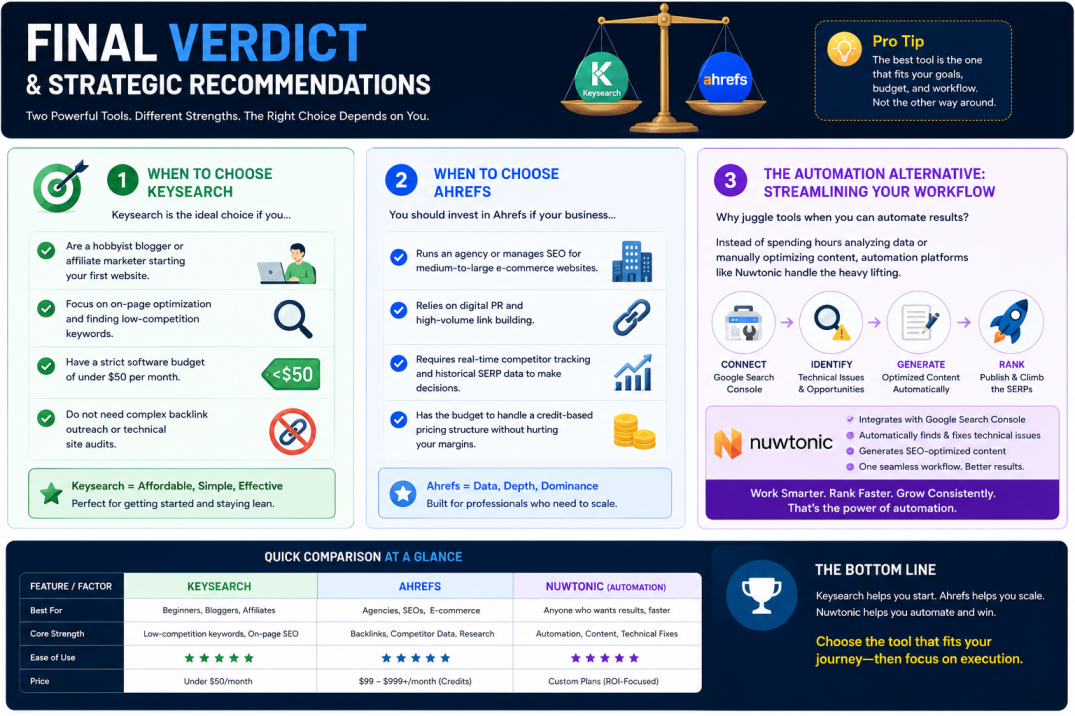
Keysearch is the ideal choice if you fall into any of the following categories:
• You are a hobbyist blogger or affiliate marketer starting your first website.
• Your primary focus is on-page optimization and finding low-competition keywords.
• You have a strict software budget of under $50 per month.
• You do not need to perform complex backlink outreach or technical site audits.
When to Choose Ahrefs
You should invest in Ahrefs if your business demands the following:
• You run an agency or manage SEO for medium-to-large e-commerce websites.
• Your primary acquisition channel is digital PR and high-volume link building.
• You require real-time competitor tracking and historical SERP data to make decisions.
• You have the budget to handle a credit-based pricing structure without hurting your margins.
The Automation Alternative: Streamlining Your Workflow
While choosing between these two tools often feels like a compromise between budget and power, the industry is moving toward automation. Instead of spending hours manually analyzing keyword difficulty in Keysearch or burning through expensive credits in Ahrefs, modern platforms like Nuwtonic are simplifying the execution. By integrating directly with your Google Search Console data, automated tools can identify technical issues and generate optimized content in one seamless workflow—eliminating the need to juggle multiple expensive subscriptions just to get your pages to rank.