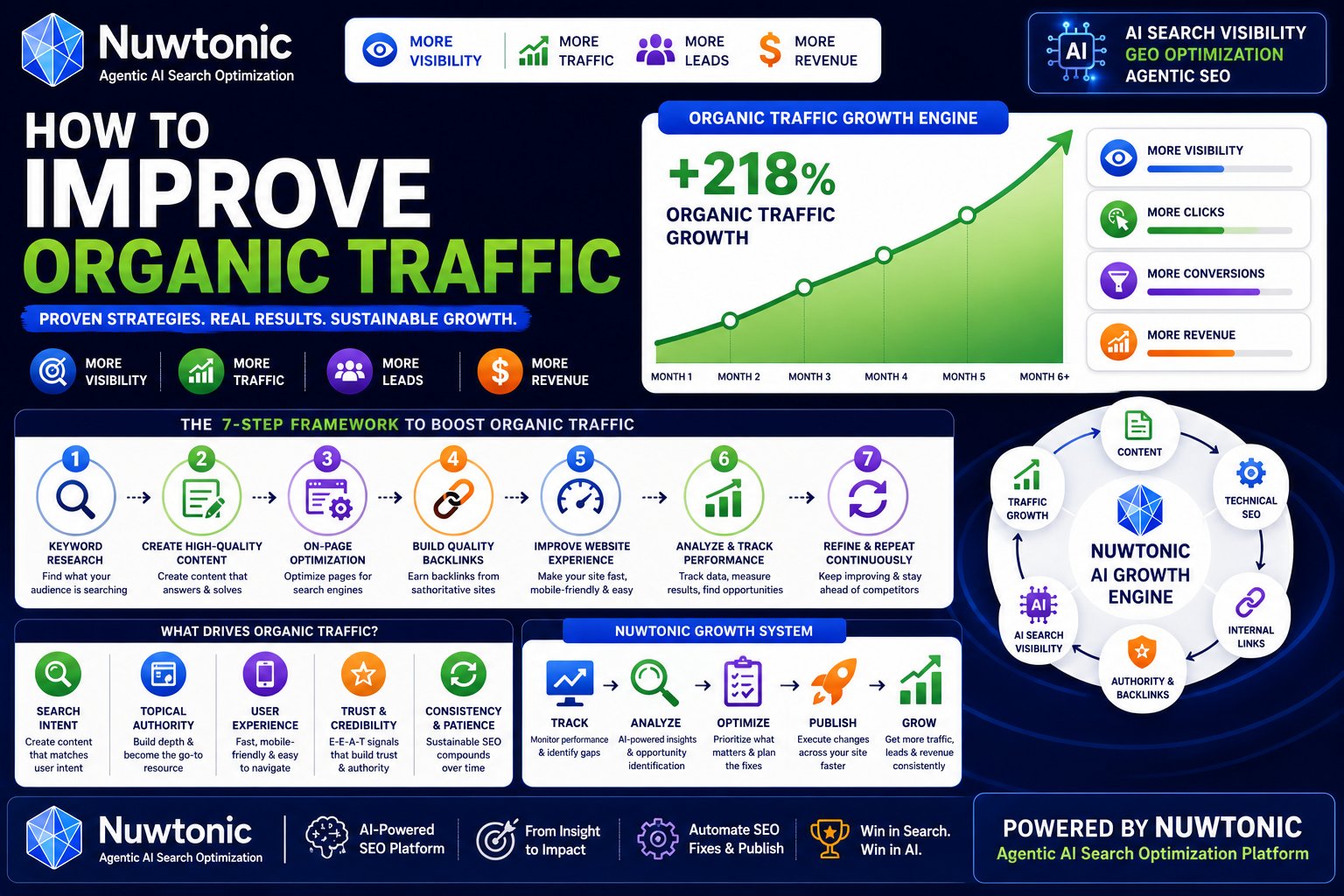
Most advice on how to improve organic traffic fails for one reason. It treats SEO like a bag of tactics instead of an operating system. You get told to publish more, build links, add schema, refresh content, improve Core Web Vitals, and post on social. None of that is wrong. It's just incomplete.
The fundamental problem is sequence. Teams waste months fixing pages that had little upside, rewriting articles that needed only a better title and stronger internal links, or launching net-new content while older URLs' rankings diminish. That's how SEO turns into motion without progress.
A prioritized approach matters because organic search still carries outsized business impact. BrightEdge reports that 53.3% of all website traffic comes from organic search and 62% of marketers say organic search generates more traffic than any other channel (BrightEdge on increasing organic traffic). If that much of your inbound traffic depends on search, random execution is expensive.
The useful question isn't “what are all the SEO tasks we should do?” It's “what should we fix first, on which URLs, and why?” That's where organic growth stops being vague and starts being manageable.
Table of Contents
- Stop Guessing and Start Prioritizing
- Diagnose First Your Traffic Triage System
- Execute High-Impact Technical and On-Page Fixes
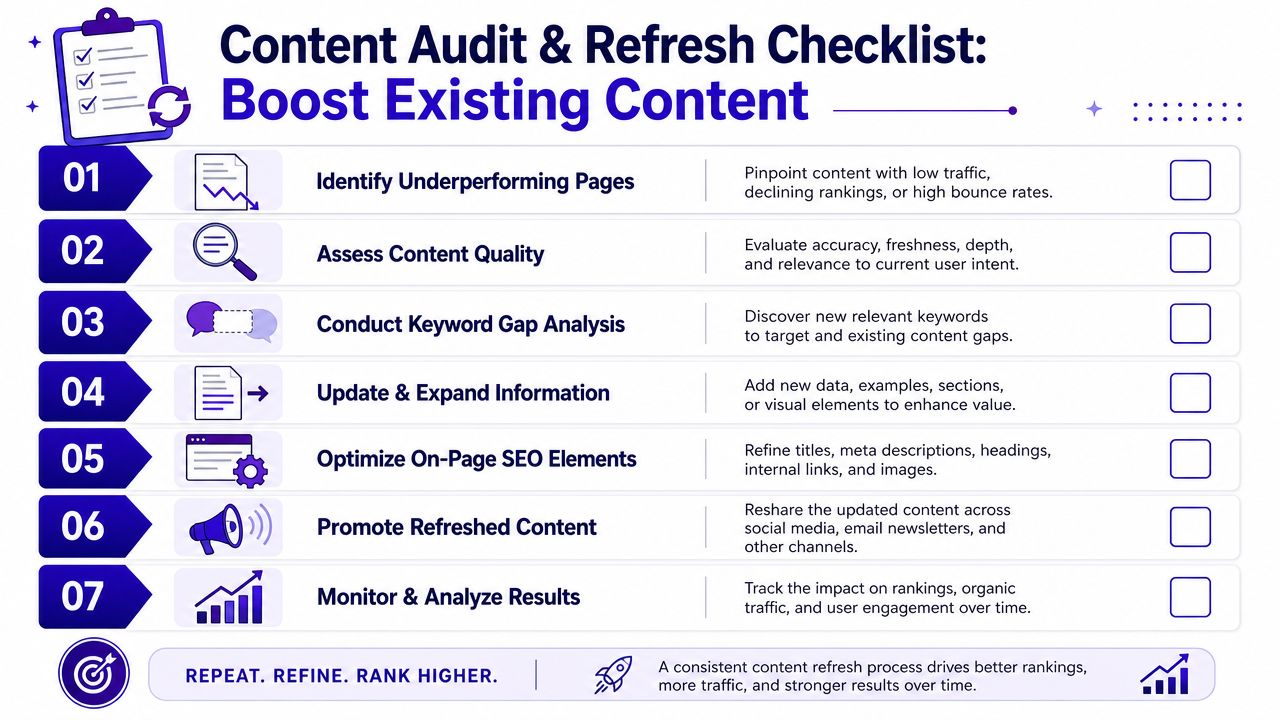
- Scale Your Content with Audits and Refreshes
- Win in AI Search with Generative Engine Optimization
- Answering Your Toughest Organic Traffic Questions
Stop Guessing and Start Prioritizing
Most SEO teams don't have a knowledge problem. They have a prioritization problem.
The common playbook goes like this: run a giant audit, export hundreds of issues, hand the list to content, engineering, and marketing, then hope something moves. That approach usually spreads effort across too many tasks with no clear connection to traffic recovery or growth. A broken pagination detail on a low-value section gets treated with the same urgency as a decaying commercial page that already has impressions.
A better system starts with one rule. Diagnosis comes before optimization. If you haven't identified the exact URLs and queries with the highest upside, keyword research and link outreach can become expensive detours.
Practical rule: Don't start with “what can we improve?” Start with “where is traffic already close to improving, falling, or underperforming?”
That changes how teams work. Instead of a broad sitewide cleanup, you focus on high-impact pages first. Instead of rewriting from scratch, you decide whether the page needs a CTR lift, content expansion, internal-link support, or a complete repositioning against search intent.
This is also where experienced operators separate from checklist SEO. Traffic gains usually come from a handful of compounding actions done in the right order:
- Find the right URLs: Look for pages already earning impressions, slipping over time, or sitting just outside stronger positions.
- Match fix to failure mode: A low CTR problem needs a different intervention than a relevance problem or crawl discovery problem.
- Ship in batches: Update clusters of related pages, not isolated URLs with no supporting structure.
- Review outcomes: Keep the feedback loop tight enough to learn what moved clicks.
If you want to know how to improve organic traffic sustainably, stop collecting tactics. Build a ranking system for decisions.
Diagnose First Your Traffic Triage System
A common tendency is to touch titles first because titles are easy. That's backwards. The first move is diagnosis at the single-URL level, because Google's own guidance emphasizes analyzing traffic loss that way rather than studying the site too broadly (Google guidance on analyzing traffic loss by URL).
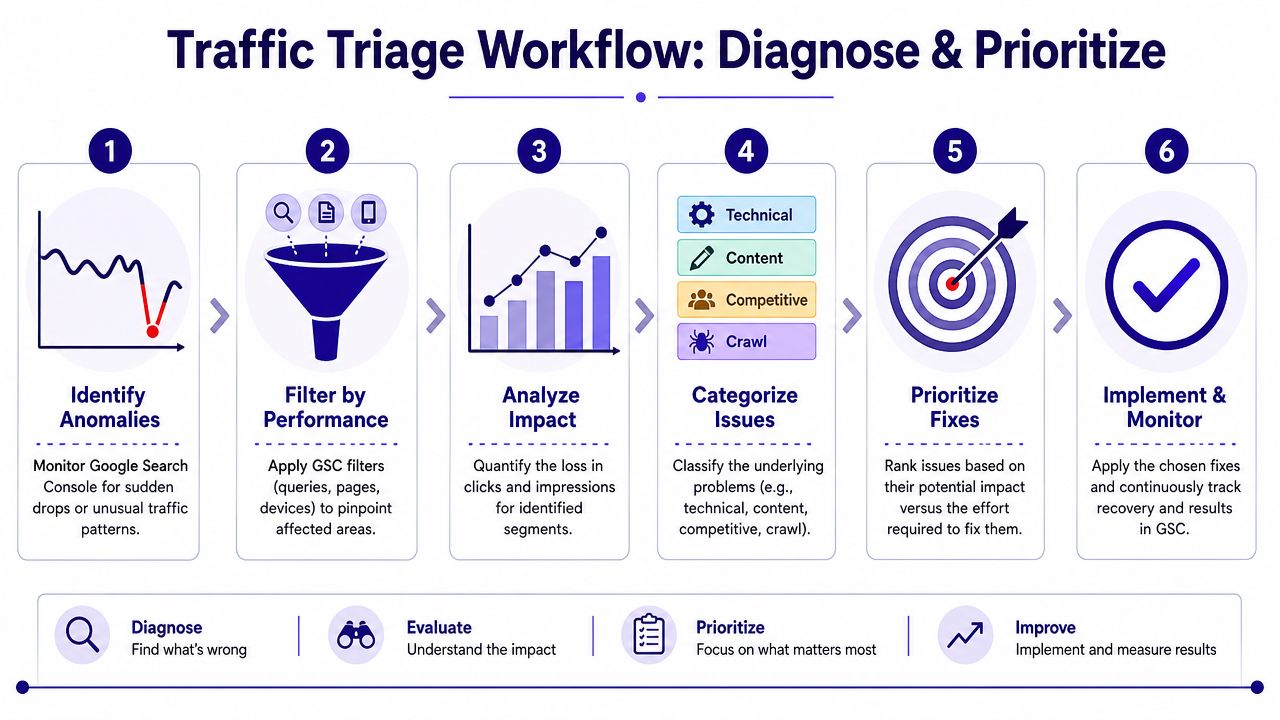
Look at URLs before sitewide averages
Open Google Search Console and export page and query data. Don't lump branded and non-brand demand together. Non-brand queries tell you where organic discovery is weak or expanding. Brand traffic can hide underlying decline.
At minimum, build a sheet with these fields:
- URL
- Primary query group
- Clicks trend
- Impressions trend
- Average position
- CTR pattern
- Page type
- Likely issue
- Recommended action
- Effort level
If you already have a broader audit process, fold this into it. A practical reference point is a structured SEO audit checklist so the triage doesn't ignore technical blockers while you focus on content.
Build three working buckets
You don't need a complex scoring model on day one. Start by sorting URLs into three opportunity buckets.
Declining pages
These pages used to perform better and are now slipping. The issue may be content decay, competitor improvement, outdated examples, weaker internal links, or a SERP change. These are often the fastest recovery opportunities because the page already has relevance history.
Low-CTR pages on page one
If impressions are healthy and rankings are decent but clicks are weak, don't rewrite the full article yet. Look at title tags, meta descriptions, SERP alignment, and whether the page answers the query in a visible, immediate way.
High-impression pages stuck on page two
These pages often need stronger depth, better internal linking, clearer query targeting, or content restructuring. They already have evidence of demand. That's why they deserve attention before speculative new articles.
A page with impressions and weak performance is usually a better bet than a brand-new page with no search signal at all.
Use a simple prioritization matrix
This is enough for many teams:
| Opportunity Type | Primary Signal | Typical Fix | Impact/Effort |
|---|---|---|---|
| Declining traffic page | Clicks and impressions trending down | Refresh content, repair internal links, update stale sections | High impact, medium effort |
| Low CTR on page one | Strong impressions, weak CTR | Rewrite title and meta, improve SERP match, sharpen intro | Medium to high impact, low effort |
| High impressions on page two | Good demand, middling position | Expand content, strengthen topical coverage, add supporting links | High impact, medium effort |
| Misaligned page intent | Query doesn't match page purpose | Reframe content or map query to another URL | High impact, high effort |
| Crawl-discovery issue | Important page lacks internal support | Add hub links, spoke links, descriptive anchors | Medium impact, low effort |
A good triage system also borrows from topic-level opportunity analysis. Re:signal recommends exporting non-brand queries from Search Console, categorizing them, and mapping them to target positions to prioritize by traffic potential versus effort (Re:signal on estimating organic traffic potential). That method keeps teams from optimizing whatever feels urgent instead of what has visible upside.
If your backlog is huge, don't score every page. Score only pages with one of these traits: traffic loss, strong impressions, weak CTR, or clear commercial value. That filter alone removes a lot of noise.
Execute High-Impact Technical and On-Page Fixes
When teams ask how to improve organic traffic, they often jump straight into deep technical work. In practice, a smaller set of fixes usually drives most of the result because those fixes change crawl paths, page understanding, and click behavior on the URLs that already matter.

Fix architecture before you chase edge cases
Internal linking is one of the most effective technical controls because it influences discovery, context, and authority flow. Agency guidance consistently recommends a hub-and-spoke structure, where supporting pages link back to the pillar and related spokes cross-link with descriptive anchor text (12A Agency on internal-link architecture).
That means you should audit links in this order:
- Pillar pages first: Make sure core category, service, or primary educational pages receive links from relevant supporting content.
- Supporting pages second: Every spoke should point back to the page you want search engines to understand as central.
- Related subtopics third: Cross-link pages that answer adjacent questions so crawlers and users can move naturally through the topic.
What doesn't work well is random “related posts” logic with weak anchors like “learn more” or “click here.” Descriptive anchors carry context. They also help you indicate which page should lead on a topic.
Tighten the page elements that affect discovery and clicks
After architecture, move to the pages you prioritized in triage. Don't treat every element equally.
Use this order of operations:
- Title tags: Rewrite for intent match and clarity. If the query implies comparison, process, or definition, reflect that directly.
- Meta descriptions: Think of them as click support, not ranking magic. They should reinforce relevance and reduce ambiguity.
- Headings: Tighten the hierarchy so the page's primary question is obvious.
- Image alt text: Add useful, descriptive context. Don't dump keywords into every image.
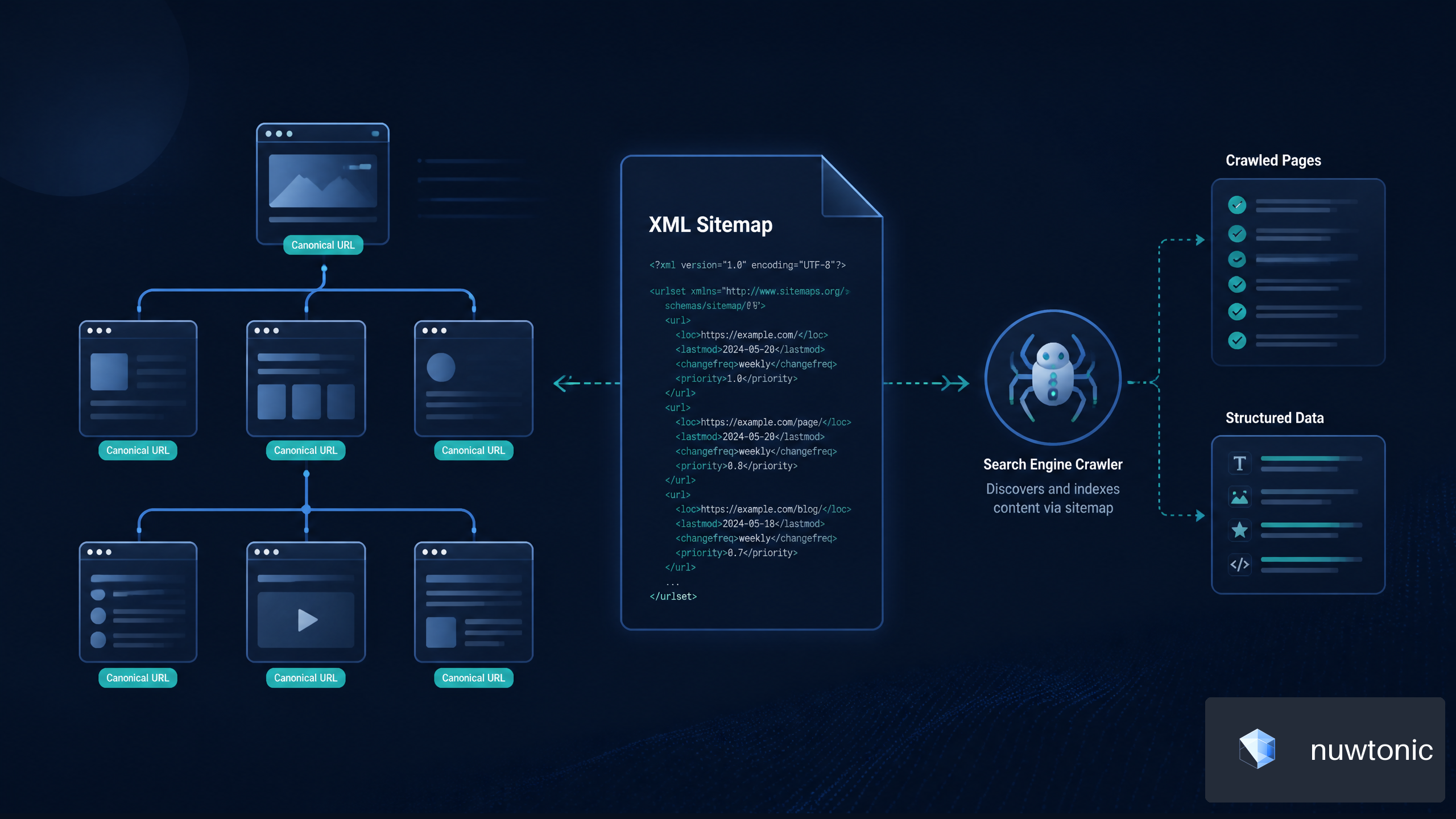
- Schema and page elements: Use structured markup where it clarifies content type and entities. The point is machine readability, not box-checking.
If you need a practical framework for page-level implementation, a focused on-page SEO process helps standardize these changes across larger content sets.
Here's a useful walkthrough before making broad edits:
Apply changes with controls, not guesswork
A common failure mode is shipping too many changes at once and then not knowing what worked. Keep page interventions narrow enough to learn from them.
A practical split looks like this:
- CTR issue: Change title, meta, and opening section first.
- Coverage gap: Expand missing subtopics, examples, FAQs, or comparisons.
- Crawl issue: Improve internal links and remove orphan-like behavior.
- Mixed intent: Rework the page angle or split the topic across more suitable URLs.
If a page has the wrong search intent, no amount of metadata polishing will save it.
Workflow matters. Some teams use Search Console exports plus spreadsheets. Others use platforms that connect diagnostics to execution. For example, Nuwtonic connects to Google Search Console, ranks issues by impact, and supports reviewable fixes for on-page SEO and AI visibility. That's useful when you need URL-level action without handing teams another static report.
Scale Your Content with Audits and Refreshes
Publishing new content feels productive. It's also where teams lose discipline. Many sites have more upside in existing pages than in the next dozen drafts.
Long-term organic growth depends heavily on content freshness and maintenance, including regular updates to existing pages and consolidation of thin or overlapping content (Umbrex on organic search traffic analysis). The reason is simple. Search demand shifts, examples age, SERPs change, and older pages slowly stop matching what users want.
Audit for overlap, decay, and thin coverage
A useful content audit is not a spreadsheet graveyard. It should force a decision for every page:
- Keep as is
- Refresh
- Merge
- Reposition
- Retire
Start with the URLs flagged in your triage sheet, then inspect nearby pages targeting similar query groups. You're looking for three things.
Overlap
Multiple pages chase the same intent but none of them wins decisively. That splits internal links, backlinks, and relevance signals.
Decay
The page still ranks for something, but sections are stale, examples are weak, and competitor pages answer the query more completely.
Thin support
The target page may be solid, but the surrounding topical cluster is weak. Search engines don't just judge one article. They infer whether the site understands the subject.
Refresh pages by rewrite depth, not by instinct
Not every page deserves a full rewrite. Assign one of three refresh levels.
| Refresh Level | When to Use It | Typical Work |
|---|---|---|
| Light | CTR weak, content still relevant | Update title, meta, intro, headings, internal links |
| Moderate | Rankings softening, partial decay | Add missing sections, refresh examples, improve structure |
| Heavy | Intent mismatch or outdated core angle | Rebuild page outline, consolidate overlap, rewrite major sections |
This keeps content operations efficient. A lot of teams waste editorial time because every underperforming page gets treated like a blank-page project.
Editorial shortcut: If the page still ranks for the right query family, refresh it. If it ranks for the wrong query family, reposition it.
Use your topical map to decide what gets published next
New content still matters. It just shouldn't be driven by random keyword lists. Use your audit findings to decide where a new page strengthens an existing cluster versus where it creates more fragmentation.
A structured topical map for SEO helps here because it forces a relationship between pillar topics, supporting questions, and adjacent entities. That reduces duplicate coverage and gives internal linking a logical shape.
A strong content maintenance loop usually looks like this:
- Audit query and URL performance
- Refresh pages already earning signals
- Consolidate overlap
- Publish supporting pages only where a cluster is incomplete
- Reinforce the cluster with internal links
What doesn't scale is writing into gaps without checking whether the site already has near-duplicates, stale assets, or underlinked high-potential pages. That creates more content inventory, not more traffic.
Win in AI Search with Generative Engine Optimization
Classic SEO still matters, but search behavior is fragmenting. Users now ask questions in conversational form, compare responses across engines, and often consume an answer before deciding whether to click. That changes how content earns visibility.
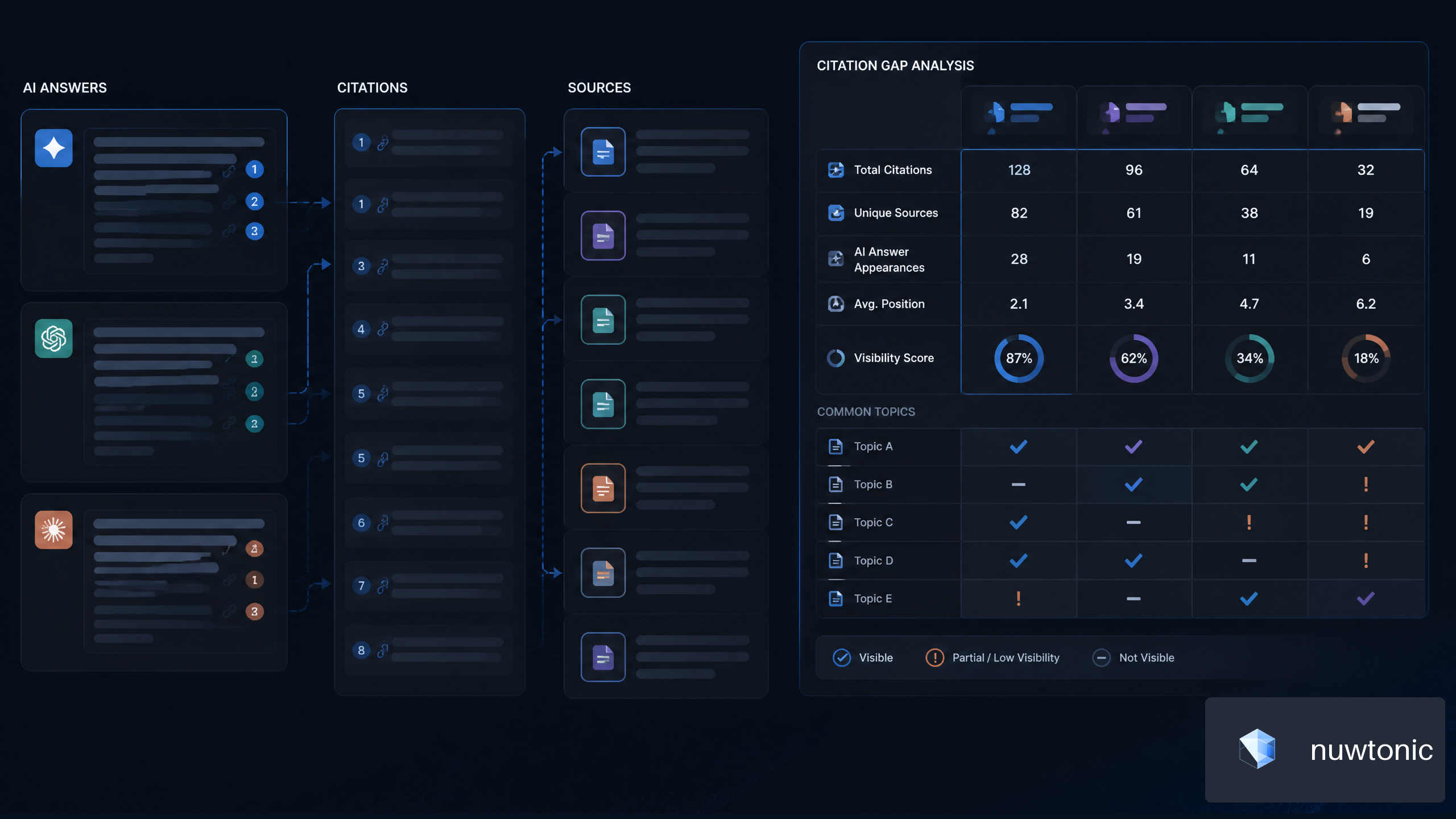
Many guides still under-explain this shift. The more useful question is which content structures increase the chance of being cited, summarized, or surfaced by AI systems, and how teams can measure that visibility in practice (Trustpilot on traffic beyond traditional SEO).
Structure content for extraction and citation
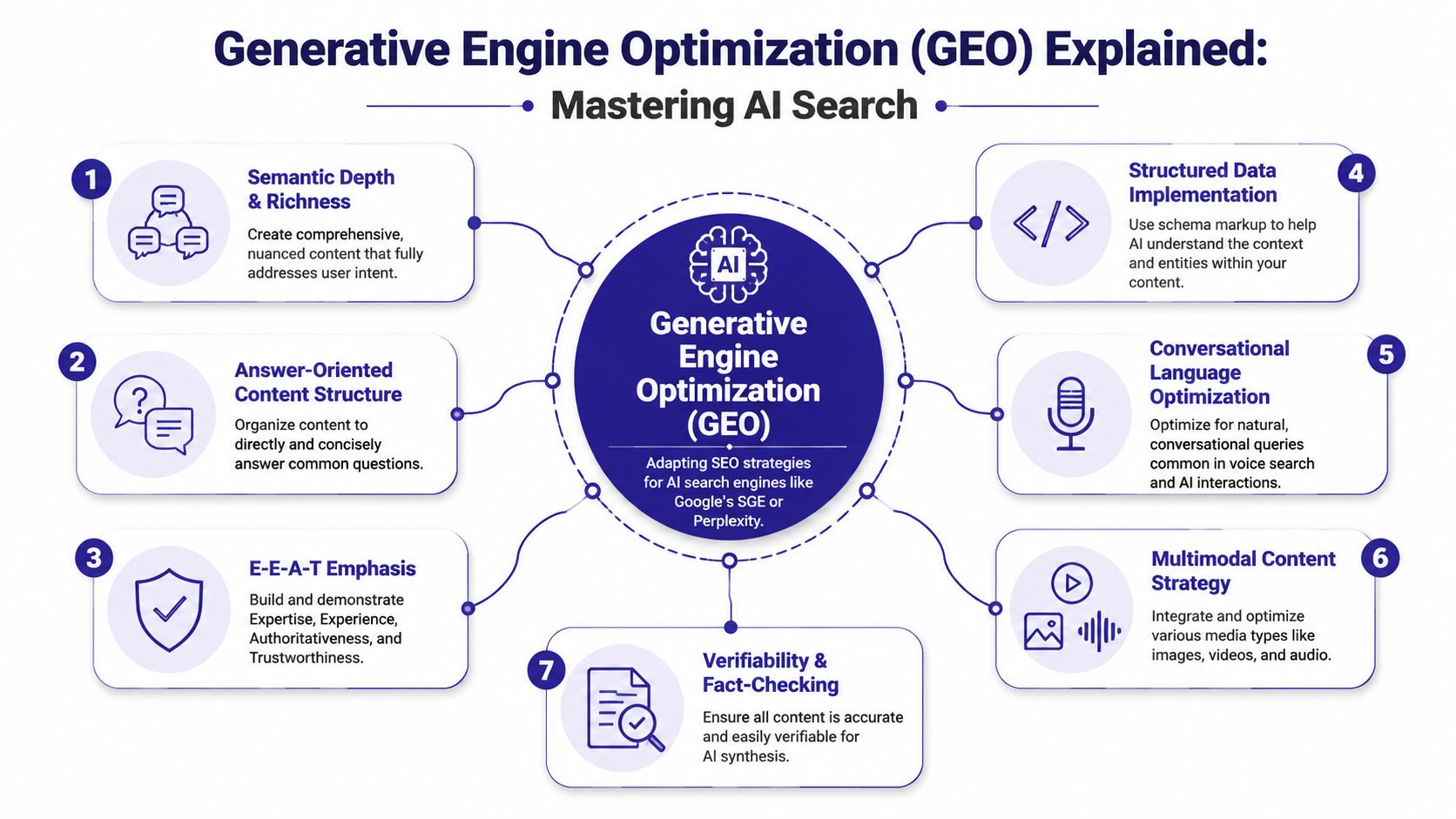
AI systems favor content they can parse cleanly. That doesn't mean writing robotic FAQ sludge. It means making answers explicit.
Good patterns include:
- Question-led subheadings: Use natural-language prompts that mirror how people ask.
- Direct answers early: Put the concise answer near the top of the section, then expand.
- Entity clarity: State who, what, where, and when without ambiguity.
- Scoped comparisons: If the query implies alternatives, list clear distinctions instead of vague prose.
Pages that bury the answer under brand storytelling or generic introductions are harder to extract from. AI systems can summarize them, but they often prefer cleaner sources.
Make pages easier for machines to verify
Verification matters because generative systems are more cautious with fuzzy claims. If a page makes a claim, the support should be visible and easy to check.
That means:
- Use clear attributions when facts are cited
- Keep definitions stable and consistent across the site
- Use structured data where it clarifies entities or content type
- Avoid contradictory pages on the same topic
- Update stale examples before they become credibility debt
AI search and traditional SEO overlap. Internal consistency, schema, descriptive headings, and well-maintained content help both crawlers and answer engines understand what your page is saying.
The page most likely to be cited is often the one that is easiest to parse, verify, and trust.
Measure AI visibility with assisted signals
Measurement is still messy. AI answer engines don't always provide the clean referral data people want. So you need proxy signals and assisted indicators.
Track patterns like these:
- Branded search lift after AI visibility work
- Query classes where impressions improve after structural changes
- Landing-page growth on pages designed for answer extraction
- Referral traces from AI tools when available
- Assisted conversions from informational pages that now pull earlier-stage discovery
The mistake is waiting for perfect attribution. You won't get it. Treat AI search visibility the way SEO teams once treated featured snippets. Measure directional gains, test structural changes, and compare before-and-after behavior at the page set level.
Answering Your Toughest Organic Traffic Questions
Advanced SEO work usually stalls on edge cases, not basics. These are the issues that keep teams stuck even after they've done the obvious fixes.
How do you handle cannibalization without deleting useful pages
Start by separating duplicate intent from adjacent intent. Two pages can target similar language and still deserve to exist if one is a broad guide and the other solves a narrower problem.
Use this process:
- Export non-brand queries and map them by URL
- Check whether the same query families rotate between pages
- Decide which URL should be primary for that intent
- Consolidate, redirect, reframe, or internally re-anchor the secondary page
If both pages are useful, don't rush to delete one. Sometimes the fix is as simple as changing the weaker page's angle and internal anchors so search engines stop treating it as a substitute.
What should you do when rankings are stable but clicks fall
That's usually a SERP presentation problem or an intent-perception problem. The page may still rank, but users now prefer a different result format, or your snippet no longer matches what they expect.
Check three things:
- Snippet fit: Does the title reflect the current query intent?
- SERP competition: Are results with richer formatting or sharper positioning outranking your click appeal?
- Opening section: Does the page answer quickly enough once users land?
If rankings hold and clicks slide, don't start with a deep rewrite. Start with the listing and the first screen of content.
How do you estimate where the next traffic lift is likely to come from
Use a topic-level opportunity analysis, not intuition. A practical workflow is to export non-brand queries from Google Search Console, categorize them, and map each to a target position so you can prioritize by traffic potential versus effort (Re:signal's topic-level opportunity workflow).
That approach helps you answer questions like:
- Which query groups already show demand?
- Which URLs have room to climb with moderate work?
- Which topics need one supporting page versus a full cluster?
- Which pages are better candidates for metadata edits versus full rewrites?
This is also how you keep teams from overproducing net-new content while near-win pages sit untouched.
How do you measure AI search contribution if attribution is messy
Use layered measurement instead of one dashboard.
A workable model includes:
- Visibility checks: Track whether your brand or page appears in AI-generated answers for target prompts.
- URL response tracking: Watch the pages designed for extraction and citation for changes in impressions, branded discovery, and assisted conversions.
- Prompt clusters: Group related user questions and monitor whether your content starts showing up across them.
- Change logs: Record structural edits so you can compare output before and after.
You're not looking for a single perfect source of truth. You're building enough evidence to know whether your structural changes are improving discoverability.
The broader pattern is simple. Organic growth improves when you stop asking “what SEO tactics are left?” and start asking “which page has the clearest upside, what's blocking it, and what is the smallest effective fix?”
If you want a system for that workflow instead of another static audit, Nuwtonic is built around the exact problems this article covered: connecting Google Search Console data to prioritized actions, surfacing page-level SEO and GEO issues, and turning reviewable fixes into execution across technical, content, and AI search visibility work.