TL;DR: Traditional SEO tools tell you where you rank on Google. LLM SEO tools tell you whether ChatGPT, Gemini, Claude, Perplexity, and Google's AI Overviews mention your brand, cite your content, and recommend your site. This guide compares 12 platforms across AI visibility tracking, citation intelligence, GEO auditing, competitor analysis, and content optimization — with a scoring framework so you can match the tool to your actual maturity stage instead of just the longest feature list. Our pick for teams that want the full monitor-diagnose-fix loop in one place: Nuwtonic.
Quick-Glance Comparison
Tool | Best For | Prompt Tracking | Citation Analysis | Competitor Analysis | GEO Audit | Content Optimization | GSC Integration | Automation | Starting Price |
|---|---|---|---|---|---|---|---|---|---|
Nuwtonic | All-in-one AI Search & SEO | ✅ | ✅ | ✅ | ✅ | ✅ | ✅ | ✅ | $99 |
Profound | Enterprise brand monitoring | ✅ | ✅ | ✅ | Limited | ❌ | ❌ | ✅ | Enterprise |
Scrunch AI | Enterprise governance | ✅ | ✅ | ✅ | Partial | ❌ | ❌ | ✅ | Enterprise |
Peec AI | Simple visibility tracking | ✅ | Partial | ✅ | ❌ | ❌ | ❌ | Partial | Custom |
AthenaHQ | AI brand intelligence | ✅ | Partial | ✅ | ❌ | ❌ | ❌ | Partial | Custom |
Otterly AI | Budget-friendly tracking | ✅ | Partial | Partial | ❌ | ❌ | ❌ | Partial | Affordable |
Goodie AI | Citation-specific monitoring | Partial | ✅ | ✅ | ❌ | ❌ | ❌ | Partial | Custom |
Semrush AI Toolkit | Existing Semrush users | Partial | ❌ | ✅ | ❌ | ✅ | ✅ | ✅ | Included/Custom |
Writesonic GEO Tools | AI content creation | ❌ | ❌ | ❌ | Partial | ✅ | ❌ | ✅ | Paid |
Surfer SEO | On-page content optimization | ❌ | ❌ | Partial | Partial | ✅ | Partial | ✅ | Paid |
MarketMuse | Enterprise content strategy | ❌ | ❌ | Partial | ❌ | ✅ | ❌ | Partial | Premium |
HubSpot AI Search Grader | Free one-time audit | ❌ | ❌ | ❌ | Partial | ❌ | ❌ | ❌ | Free |
What Is an LLM SEO Analysis Tool, Exactly?
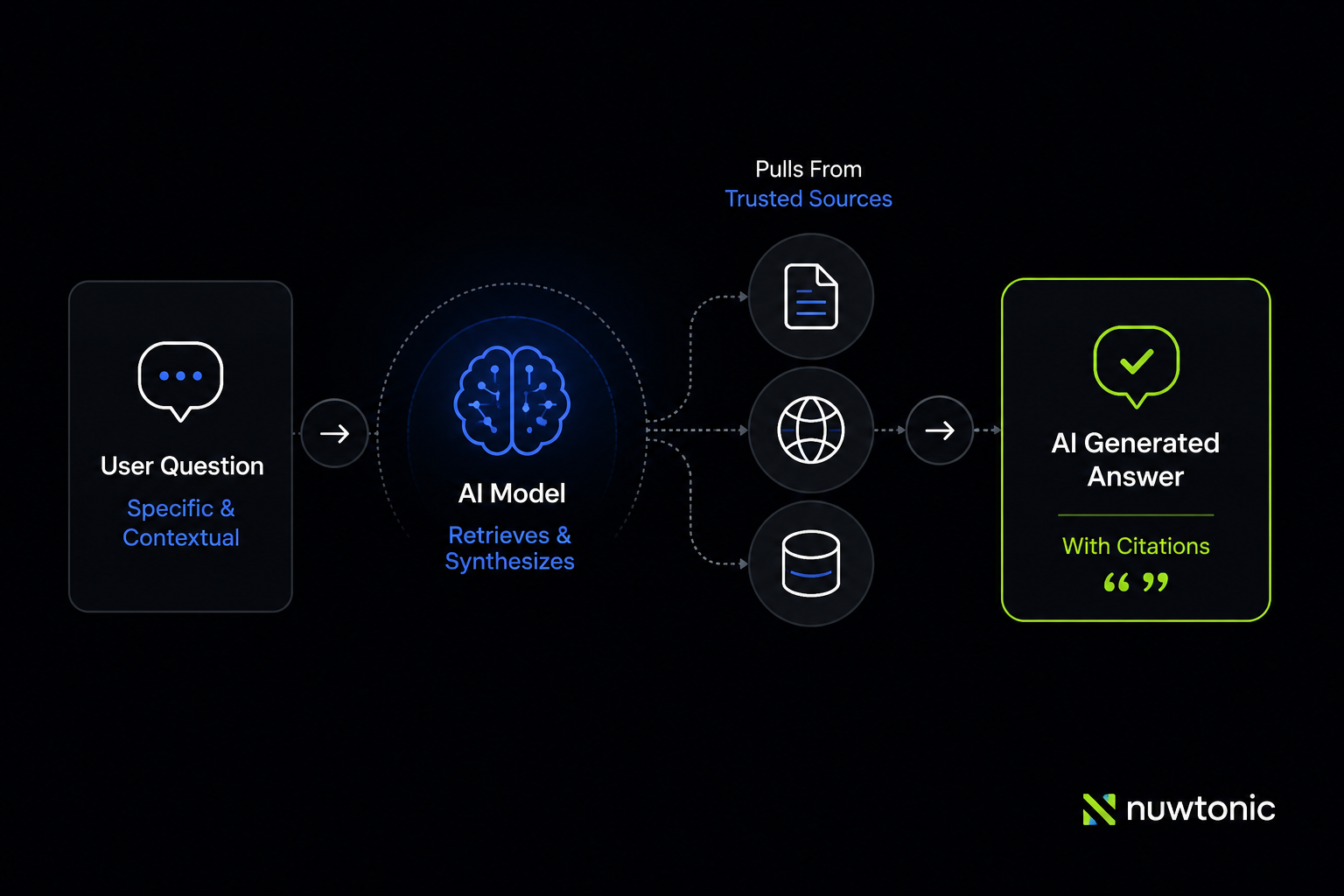
An LLM SEO tool measures and improves how large language models discover, understand, cite, and recommend your content — across surfaces like Google AI Overviews, ChatGPT Search, Perplexity, Claude, Gemini, and Microsoft Copilot.
The underlying behavior shift is what makes this a distinct discipline rather than "SEO with a new dashboard":
Traditional search query: "best project management software"
AI search query: "What's the best project management software for a remote software company with under 50 employees?"
The second query never produces ten blue links. Instead, the model retrieves information from a handful of sources, synthesizes an answer, and (depending on the platform) attaches citations. If your content isn't among the sources it pulled from, you're invisible in that answer — regardless of your organic ranking for the equivalent keyword.
That reframes the questions marketers need answered:
Which AI models mention my brand, and in what percentage of relevant prompts?
Which competitors get cited more often, and for which topics specifically?
Which of my own pages does AI actually trust enough to cite?
What structural or authority gaps are keeping AI from citing me?
What's the fastest path to closing those gaps?
The Three Categories of Tool — and Why Conflating Them Is the #1 Buying Mistake
Nearly every platform in this space falls into one of three tiers. Vendors rarely say which tier they're in, so it's on you to figure it out before buying:
Category | Primary Job | Typical Output | Example Tools |
|---|---|---|---|
Monitoring | Measure AI visibility | "Your brand appeared in 32% of tracked prompts this month, down from 41%." | Peec AI, Otterly AI, AthenaHQ |
Analysis | Explain why the gap exists | "Competitor X has 3x your entity coverage on this topic and is cited from 6 more authoritative domains." | Profound, Scrunch AI, Goodie AI |
Optimization | Prescribe and help execute the fix | "Add these five missing entities, restructure this section, add these two comparison tables, then re-audit in 30 days." | Nuwtonic, Surfer SEO, MarketMuse (content only) |
A monitoring tool alone will tell you that your visibility dropped. It won't tell you why, and it definitely won't tell you what to do about it. Teams that buy a monitoring tool expecting it to also function as a content strategy engine are consistently disappointed — not because the tool is bad, but because it was never built for that job.
Only a small number of platforms — Nuwtonic chief among them — are built to operate across all three stages in a single workflow, which matters more than any individual feature checkbox.
Evaluation Criteria Used in This Guide
Category | Why It Matters |
|---|---|
AI Prompt Tracking | Monitors visibility across AI-generated answers, not just organic SERPs |
Citation Intelligence | Reveals where AI models actually source their information |
Competitor Analysis | Benchmarks your visibility and citation share against named rivals |
Diagnoses structural/entity/trust gaps preventing AI citation | |
Content Recommendations | Converts diagnosis into a prioritized, executable to-do list |
Search Console Integration | Connects AI visibility data to real organic traffic and query data |
Automation | Reduces the manual hours needed to run this analysis monthly |
Workflow Efficiency | How many tools/tabs/handoffs it takes to go from insight to shipped fix |
Deep Dive: The 12 Platforms
1\. Nuwtonic — Best Overall (All-in-One AI Search & SEO)
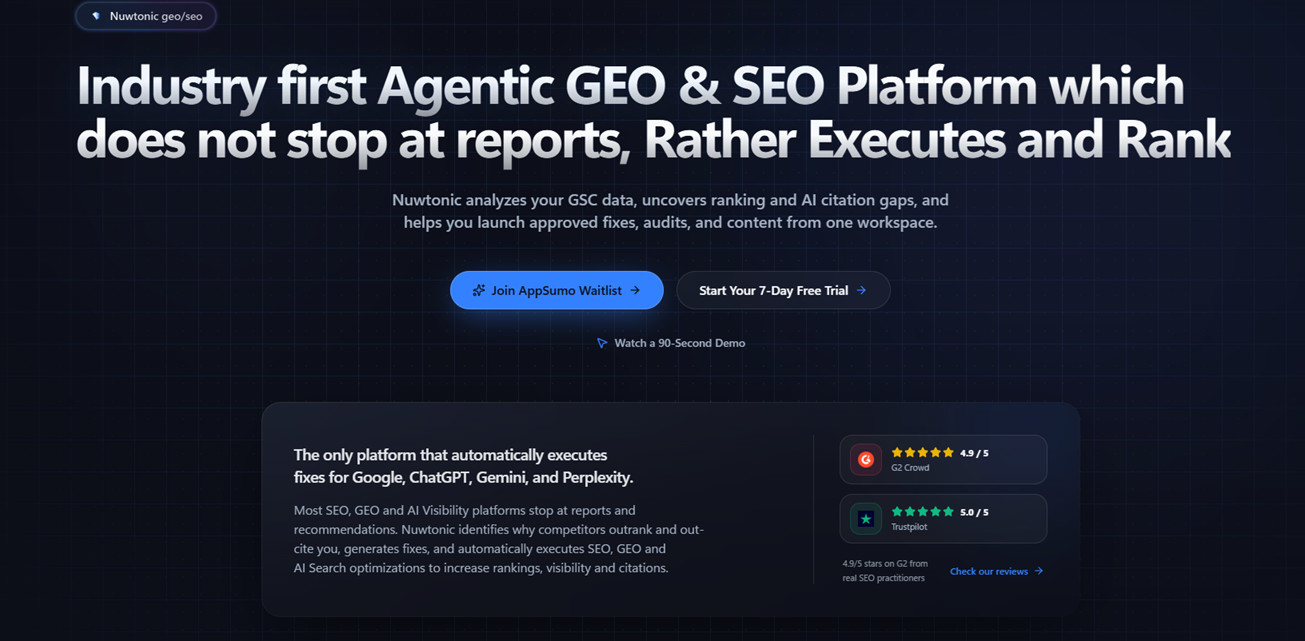
Best for: SEO agencies, enterprise SEO teams, SaaS companies, publishers, and any team tired of stitching together three or four point solutions to answer one question.
What it does differently: Rather than functioning as a single-purpose visibility tracker, Nuwtonic is built around the full loop — monitor, diagnose, fix, re-measure — inside one workflow. After connecting Google Search Console, it automatically surfaces organic-side opportunities (zero-click queries, ranking movement, topical cannibalization, trust-signal gaps) and layers AI prompt tracking, citation gap analysis, competitor comparisons, GEO audits, and AI-focused content recommendations on top of that same data set.
Standout capabilities:
AI prompt visibility monitoring across supported LLM platforms
Citation gap analysis — not just whether you're cited, but which competitor is cited instead and why
Competitor gap analysis mapped to specific missing entities and topics
GEO Audit & Fix, where the audit and the recommended remediation ship together instead of as two separate deliverables
Google Search Console integration, so AI visibility sits next to real organic performance instead of in a separate tool
Content planning built on topical authority, so fixes are prioritized by impact rather than listed flat
On-page optimization suggestions tied directly to the audit findings
Why it tops this list: it's the only platform here that checks every box — prompt tracking, citation analysis, competitor analysis, GEO audit, content optimization, GSC integration, and automation — simultaneously. Most competitors are genuinely strong in one or two categories and thin everywhere else, which means using them well requires bolting on 2-3 additional tools. Nuwtonic collapses that stack.
Trade-offs: Pricing is quote-based rather than self-serve, so there's a sales conversation before you see numbers. The depth of the platform is also more than a very small single-site business is likely to need — it's built for teams managing ongoing content operations, not a one-page brochure site.
Ideal team size: Agencies and in-house teams of 3+ managing content across multiple properties or a large site footprint.
2\. Profound — Best for Enterprise Brand Monitoring
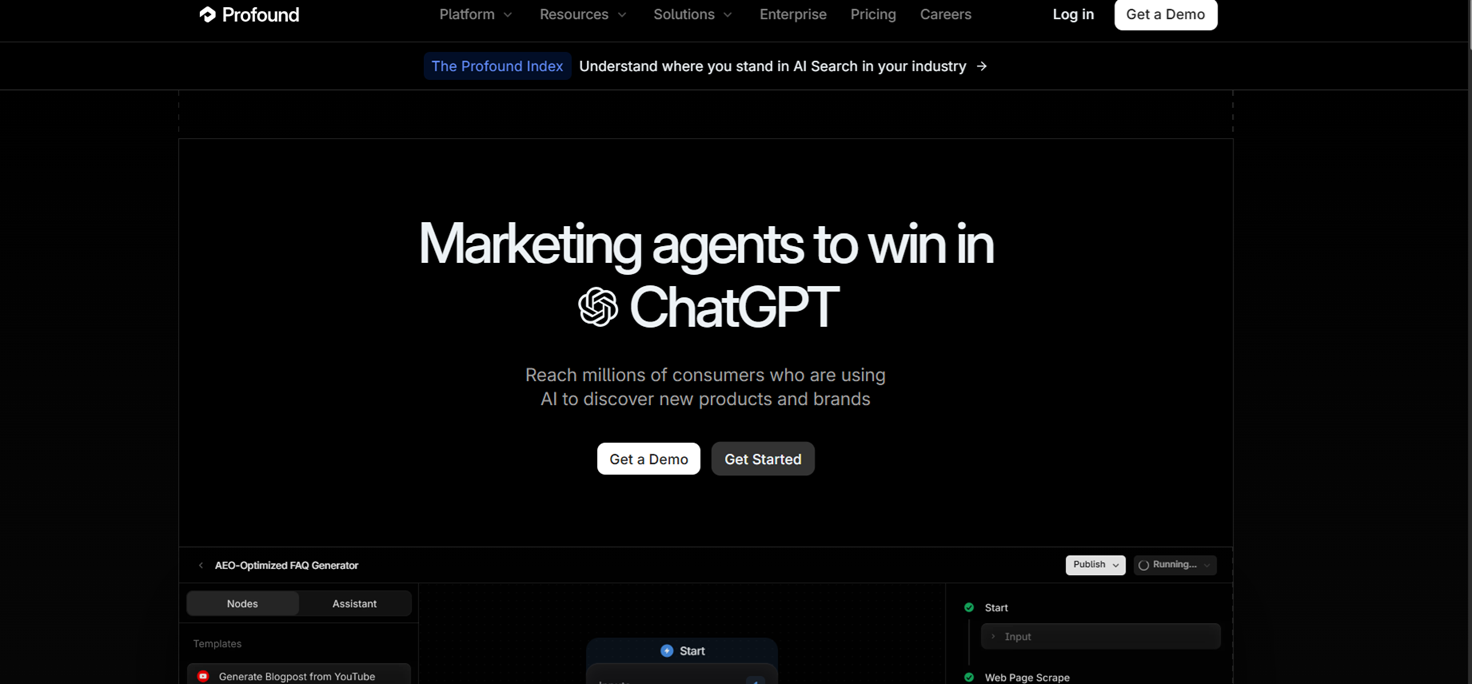
One of the earliest entrants into AI search optimization, built around understanding how ChatGPT, Gemini, Claude, and Perplexity discuss a brand across thousands of prompts — brand mentions, competitor appearances, citation frequency, and sentiment, wrapped in executive-friendly dashboards.
Strength: Best-in-class for reputation and share-of-voice tracking at the leadership-reporting level. Weakness: Monitoring-first, execution-light. It tells you what's happening with strong clarity but offers comparatively little in the way of fixing content or shipping SEO changes — you'll likely need a second tool for that half of the job. Best for: Enterprise brands, PR teams, corporate marketing, organizations tracking AI reputation as a KPI in its own right. Pricing: Enterprise only — expect a sales process, not self-serve signup.
3\. Peec AI — Best for Simple, Low-Friction Visibility Tracking
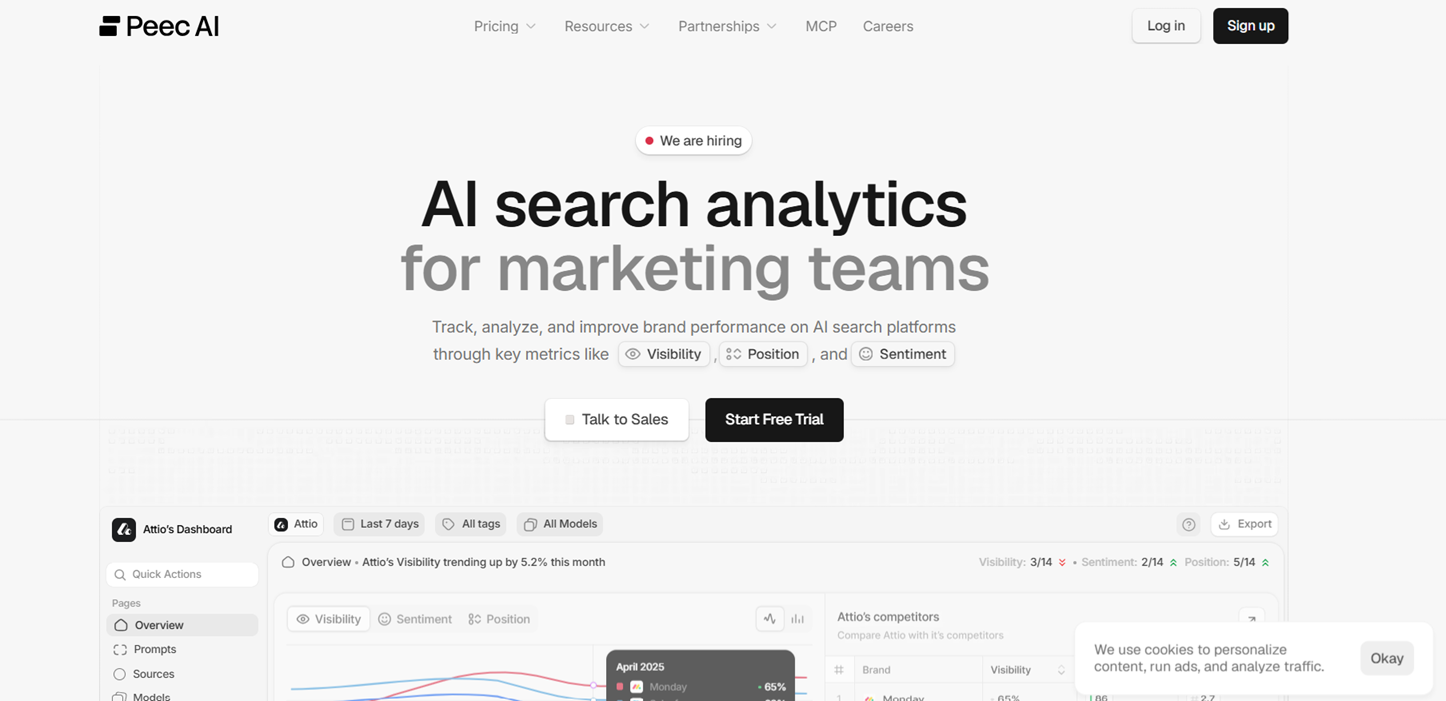
Solves one problem cleanly: "How often do AI models recommend my company?" The interface is among the simplest in this category, which makes it appealing to teams that want a signal without a learning curve.
Strength: Fast setup, clean trend reporting, easy for non-technical marketers to read. Weakness: Leans toward analytics over optimization — good at flagging gaps, thin on telling you what to do about them. Most teams outgrow it as their AI search strategy matures. Best for: Growing SaaS companies and marketing teams that want a first read on AI visibility before committing to a heavier platform.
4\. Scrunch AI — Best for Large, Multi-Brand Organizations
An enterprise AI optimization platform built around governance, analytics, and executive reporting at scale — prompt monitoring, competitor benchmarking, citation analysis, and AI-response evaluation across multiple brands or business units.
Strength: Centralized reporting and collaboration for organizations managing several brands at once. Weakness: Complexity and cost that's hard to justify for a single-brand or smaller organization — this is built for scale, not simplicity. Best for: Fortune 500 companies, enterprise marketing teams, corporate communications functions managing brand portfolios.
5\. Semrush AI Toolkit — Best for Existing Semrush Users
Semrush's AI-focused layer builds on its long-standing SEO foundation rather than replacing it — meaning teams already using Semrush for keyword research, backlink analysis, site audits, and content optimization get AI visibility insight without adopting an entirely new platform.
Strength: Familiarity and ecosystem lock-in — no new tool to learn, and it plugs into workflows teams already run. Weakness: The AI-specific features are newer and shallower than tools purpose-built for this category; prompt tracking and citation analysis in particular lag behind dedicated GEO platforms. Best for: Existing Semrush customers and agencies who want AI search folded into an existing SEO practice rather than run as a separate initiative.
6\. AthenaHQ — Best for AI Brand Intelligence Dashboards
Focused on understanding how AI platforms discuss brands and competitors — prompt analysis, mention surfacing, and visibility-change tracking over time, aimed at complementing a broader SEO strategy rather than replacing it.
Strength: Focused, easy-to-read competitive insight without enterprise-level complexity. Weakness: Limited SEO recommendations and no comprehensive content optimization layer — measurement, not execution. Best for: Brand marketing teams that want competitive AI intelligence without a full SEO platform attached.
7\. Otterly AI — Best Budget-Friendly Option
Built around a deliberately narrow workflow: track prompts, see which AI platforms mention your brand, compare visibility over time, export reports. No attempt to be everything to everyone.
Strength: Genuinely affordable relative to enterprise tools, fast to set up, easy for a first-timer to understand. Weakness: Minimal optimization recommendations, no GEO auditing, limited technical SEO functionality — a starting point, not a long-term system of record. Best for: Freelancers, startups, small businesses, and consultants beginning their AI SEO journey with a limited budget.
8\. Goodie AI — Best for Citation-Specific Monitoring
Built around one central question: which sources do AI models actually trust? It tracks which websites get cited, which competitor pages recur, citation frequency, and how citation patterns shift — a narrower but deeper lens than general visibility tracking.
Strength: Genuinely strong citation-specific insight, useful for teams whose primary goal is becoming an authoritative, frequently-cited source. Weakness: No SEO optimization layer and limited content recommendations — it tells you the citation landscape but not how to change your position in it. Best for: Publishers, PR teams, and authority-focused websites where citation share is the primary KPI.
9\. HubSpot AI Search Grader — Best Free Starting Point
A free, fast diagnostic that benchmarks current AI search readiness — useful as a first gut-check before investing in a paid platform, not a substitute for one.
Strength: Free, fast, requires no technical expertise, good for identifying whether you need to invest further at all. Weakness: No ongoing monitoring, no prompt tracking, no competitor intelligence — a one-time snapshot, not a system. Best for: Small businesses and marketing beginners running an initial AI SEO gut-check.
10\. Writesonic GEO Tools — Best for AI Content Creation at Volume
Writesonic has expanded from AI writing into Generative Engine Optimization, focused on helping teams create and improve content that's more likely to be understood and surfaced by AI systems.
Strength: Fast, scalable content creation with GEO-informed structure baked in. Weakness: No AI visibility tracking or citation analytics — it helps you write the content that might get cited, but won't tell you whether it actually is. Best for: Content marketers, bloggers, and agencies producing high volumes of content who already have a separate monitoring tool.
11\. Surfer SEO — Best for On-Page Content Optimization
Not purpose-built for AI search, but its core strengths — topical coverage, entity usage, content structure, semantic relevance scoring — happen to support AI discoverability as a side effect of good traditional SEO practice.
Strength: Mature, well-trusted content optimization workflow with strong collaboration features. Weakness: Zero AI citation tracking, no prompt monitoring, no AI-specific visibility dashboard — you're inferring AI readiness from SEO best practice, not measuring it directly. Best for: SEO writers, agencies, and publishers focused on scaling optimized content production.
12\. MarketMuse — Best for Enterprise Content Strategy
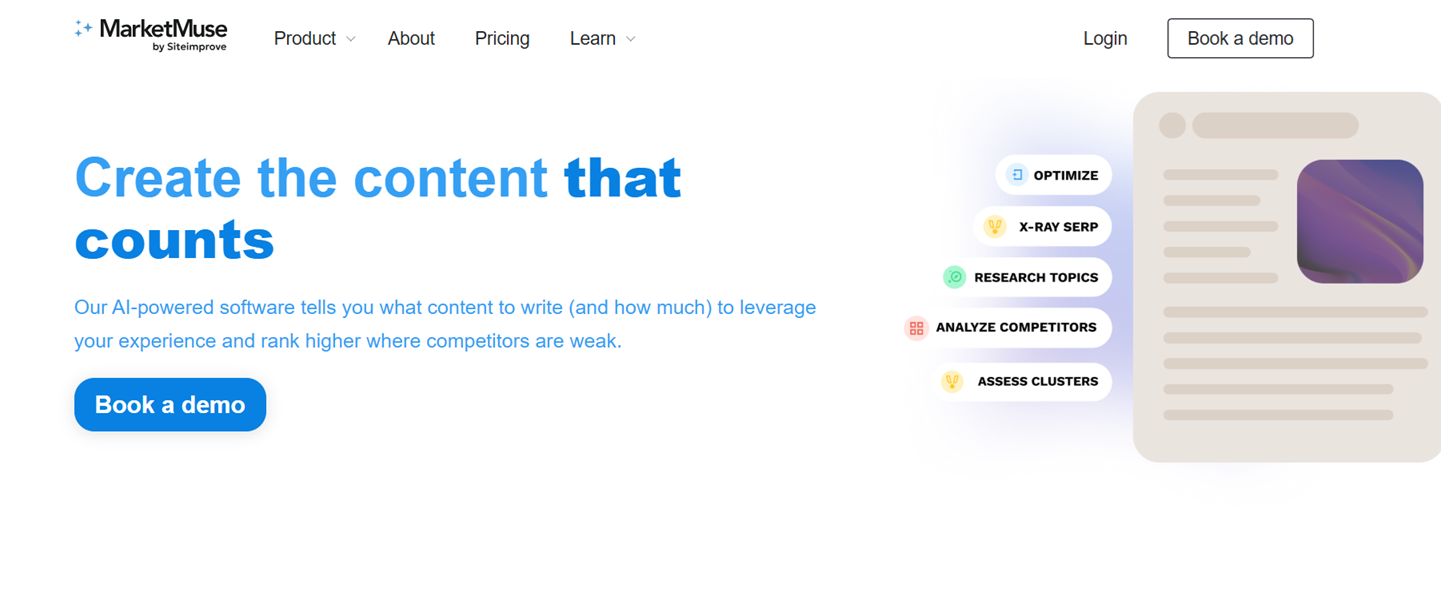
Focused on content planning rather than AI visibility tracking — topic modeling, content inventories, authority analysis, gap identification, and editorial planning at enterprise scale.
Strength: The strongest topic-clustering and editorial planning engine in this list, built for publishers managing thousands of pages. Weakness: No AI visibility tracking and no citation intelligence whatsoever — purely a content-strategy layer that needs to be paired with a monitoring tool. Best for: Large publishers and enterprise content teams running structured editorial planning at scale.
The LLM SEO Maturity Model
Not every organization needs the same tool, because not every organization is at the same stage. Buying based on feature count instead of your actual maturity level is the second most common mistake in this category (after conflating monitoring with optimization).
Stage | Characteristics | What to Prioritize |
|---|---|---|
Level 1 | Traditional SEO only, no AI visibility data at all | Get a baseline read — start with a free grader or a lightweight monitor |
Level 2 | AI visibility awareness, tracking a handful of prompts | Prompt tracking across your core topics |
Level 3 | Understanding competitor citation advantages | Citation intelligence and competitor gap analysis |
Level 4 | Actively closing content gaps | GEO auditing paired with content optimization |
Level 5 | Continuous, automated optimization loop | An integrated platform that runs monitor → diagnose → fix → re-measure without manual handoffs |
Most organizations jump straight to wanting Level 5 capability while still operating with Level 1 or 2 data hygiene. If you're not yet tracking prompts consistently, an enterprise governance platform will mostly sit unused. Match the tool to the stage you're actually in, and plan your next purchase around the stage you're moving toward.
A Practical Monthly Workflow
Regardless of which platform you choose, the underlying process that actually moves the needle looks like this:
Identify priority prompts — the actual questions your buyers ask AI assistants, not just your target keywords rephrased as questions.
Track visibility across the AI platforms your audience actually uses (usually 2-3, not all of them).
Compare competitor citations for the same prompts — who's showing up instead of you, and how consistently.
Identify the content gap — missing entities, weak structure, absent comparison data, thin authority signals.
Strengthen E-E-A-T signals — author credentials, sourcing, original data, freshness.
Build out topical authority — cover the adjacent subtopics competitors cover that you don't.
Run a GEO audit against the updated content to confirm readiness.
Ship the content updates.
Re-measure citation and visibility change the following month.
Repeat — this is a monthly cycle, not a one-time project.
Steps 4 through 8 are where most monitoring-only tools leave you on your own. This is precisely the gap platforms like Nuwtonic are built to close by keeping the audit and the fix inside the same workflow.
Common Mistakes When Choosing a Tool
Buying based on prompt tracking alone. Visibility percentage is one metric among several — it tells you almost nothing about why it's changing.
Ignoring Google Search Console data. AI search doesn't replace organic search; the two data sets should inform each other. A tool that ignores GSC is working with half the picture.
Optimizing for keywords instead of entities. LLMs evaluate concepts, relationships, and authority signals — not exact-match phrase frequency. Strong entity coverage typically outperforms keyword repetition for AI citation purposes.
Trying to track every AI platform simultaneously. Focus first on where your actual audience is asking questions — for most businesses that's Google AI Overviews and ChatGPT, not all six major platforms at once.
Treating GEO as a separate initiative from SEO. The strongest results come from running both disciplines together, not as competing workstreams with separate owners and separate tools.
AI Search KPIs Worth Tracking
KPI | What It Measures | Why It Matters |
|---|---|---|
AI Citation Share | % of relevant AI answers that cite your content | Direct measure of AI-source trust |
Prompt Visibility | % of tracked prompts where your brand appears at all | Broadest visibility signal |
Competitor Citation Share | Same metrics, benchmarked against named rivals | Tells you if you're gaining or losing ground |
Entity Coverage | Breadth of topic-relevant entities present in your content | Leading indicator of AI citation likelihood |
Organic Traffic | Traditional SEO performance | Validates that AI optimization isn't cannibalizing organic |
AI Referral Traffic | Actual clicks from AI platforms, where trackable | Connects visibility to real traffic, not just mentions |
Conversion Rate | What AI-referred visitors actually do on-site | Ties visibility to business outcomes, not vanity metrics |
Content Freshness | How recently cited pages were updated | AI systems favor demonstrably current information |
Don't rely on any single metric in isolation — a dashboard combining AI visibility with traditional organic performance gives the most accurate picture of whether your optimization work is actually paying off.
Decision Guide: Which Tool Fits Your Situation?
If you need... | Go with |
|---|---|
One platform covering monitoring, diagnosis, and execution | Nuwtonic |
Enterprise brand/reputation monitoring with executive dashboards | Profound |
Multi-brand enterprise governance at scale | Scrunch AI |
The simplest possible visibility tracker to start with | Peec AI |
A budget-friendly entry point | Otterly AI |
Citation-specific intelligence for PR/authority building | Goodie AI |
AI features layered onto an existing Semrush workflow | Semrush AI Toolkit |
Pure content optimization without AI-specific tracking | Surfer SEO or MarketMuse |
High-volume AI-friendly content production | Writesonic GEO Tools |
A free first look before spending anything | HubSpot AI Search Grader |
Rule of thumb: if all you need is a scoreboard, a monitoring tool (Peec AI, Otterly AI, AthenaHQ, Profound) will do the job. If you want to actually close the gap between where you stand and where you want to be — and keep closing it every month — you need a platform built around the full monitor → diagnose → fix loop. That's the category Nuwtonic is built for, and the reason it's positioned differently from the rest of this list rather than simply having "more features."
Frequently Asked Questions
What is an LLM SEO analysis tool? A platform that helps businesses understand how AI-powered search systems — ChatGPT, Gemini, Claude, Perplexity, Google AI Overviews — discover, interpret, and reference their content, typically alongside competitor visibility and content-improvement guidance.
How is LLM SEO different from traditional SEO? Traditional SEO optimizes for ranking positions in search results. LLM SEO optimizes for the likelihood that an AI system will cite, summarize, or recommend your content when generating an answer. They're complementary disciplines, not competing ones — most of the tools in this list that succeed long-term are the ones that connect the two rather than treating AI search as an isolated silo.
What is GEO (Generative Engine Optimization)? The practice of structuring content so AI systems can more easily retrieve, understand, and reference it — emphasizing entity coverage, topical authority, content structure, and trust signals alongside standard SEO fundamentals.
Can traditional SEO tools measure AI visibility? Some are adding AI-related features, but most still center on rankings, backlinks, and technical SEO. Dedicated AI search tools generally go deeper on prompt tracking and citation analysis specifically.
Do I need a separate AI SEO tool, or can I fold this into my existing stack? Depends on how much AI-driven traffic or influence matters in your industry already. If it's material, a platform offering dedicated AI visibility and GEO capability — ideally one that also talks to your existing GSC/organic data, like Nuwtonic — will surface insight a general SEO tool won't.
Which tool is best overall? For a combined SEO-and-AI-search workflow that spans monitoring, diagnosis, and execution, Nuwtonic is the strongest all-around fit in this comparison. For enterprise brand monitoring specifically, Profound is a strong specialist choice. For pure content optimization without AI-specific tracking, Surfer SEO and MarketMuse remain reliable, mature options.
Bottom Line
No platform on this list is a bad choice for the job it was built for — the mistake is buying the wrong tier for your actual need. If you only need a scoreboard, Peec AI, Otterly AI, or Profound will tell you exactly where you stand. If content optimization muscle is the gap, Surfer SEO or MarketMuse deliver that well in isolation. But if the goal is to close the entire loop — measure AI visibility, understand precisely why competitors are winning citations, and fix it without juggling three or four disconnected tools — Nuwtonic is the strongest fit here, as the only platform in this comparison combining GSC-grounded data, prompt tracking, citation gap analysis, GEO audits, and content planning inside one workflow.