Here's the thing: most of what you hear about the AI search query is complete nonsense. For years, self-proclaimed gurus have told you that search is changing overnight, that keywords are dead, and that you need to completely rewrite your digital strategy to survive.
In my eight years of optimizing search algorithms for major tech companies, I've learned that while the technology evolves, the core principles remain remarkably stable. An ai search query isn't a magical construct—it is simply a highly contextual, computationally enriched prompt that modern systems parse to deliver direct answers.
To truly master how search engines interpret these queries, we have to look past the marketing buzzwords and analyze the actual mechanism under the hood. Let's break down how search engines process user intent, reformulate queries, and generate relevance scores in 2026.
Anatomy of an AI Search Query
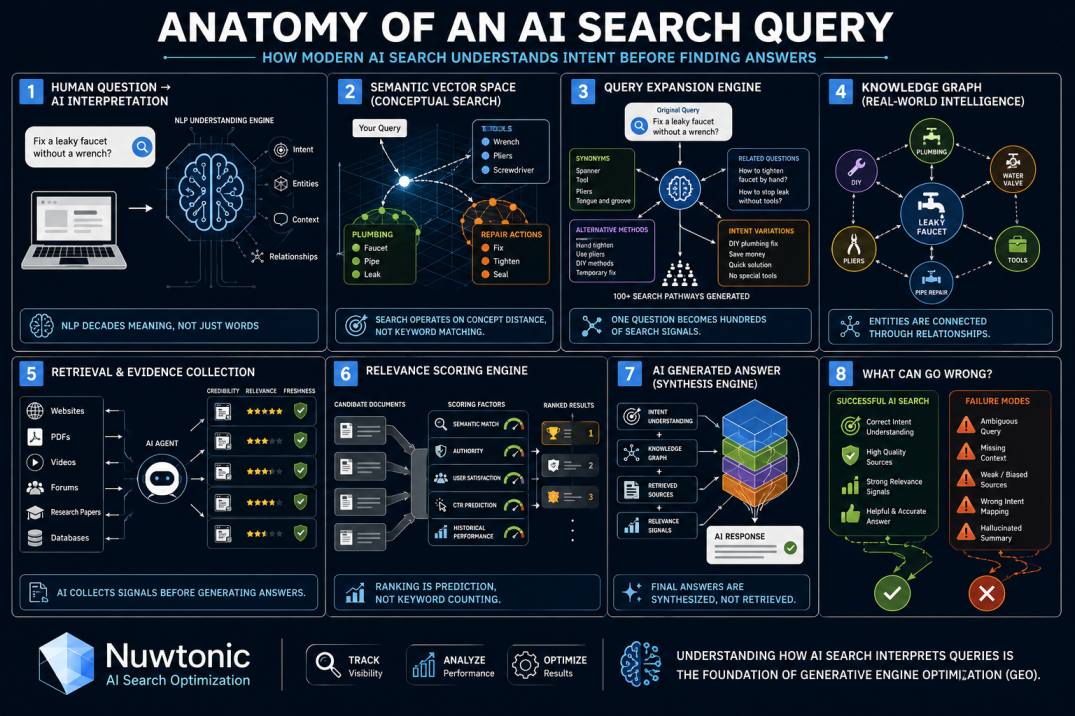
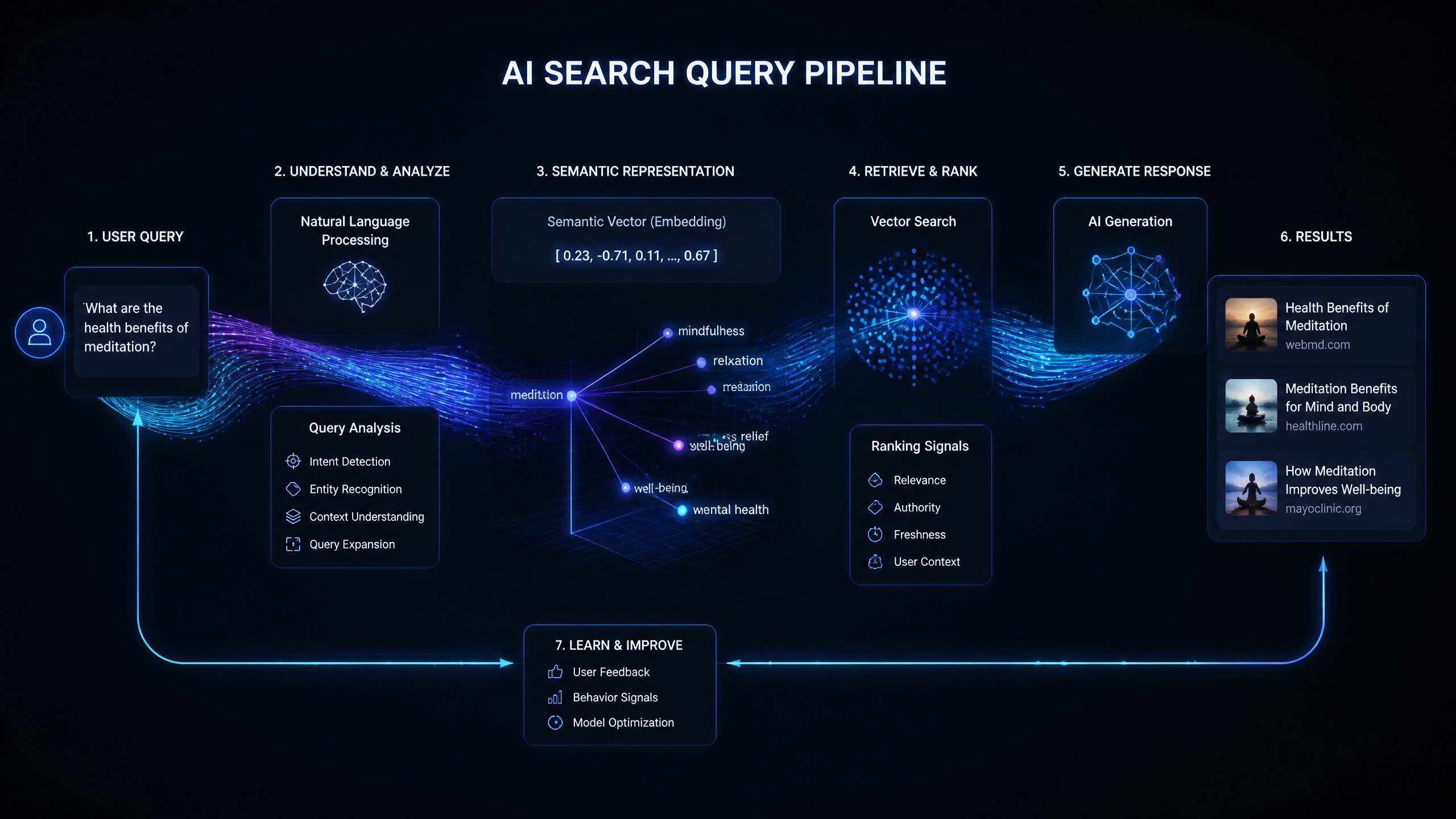
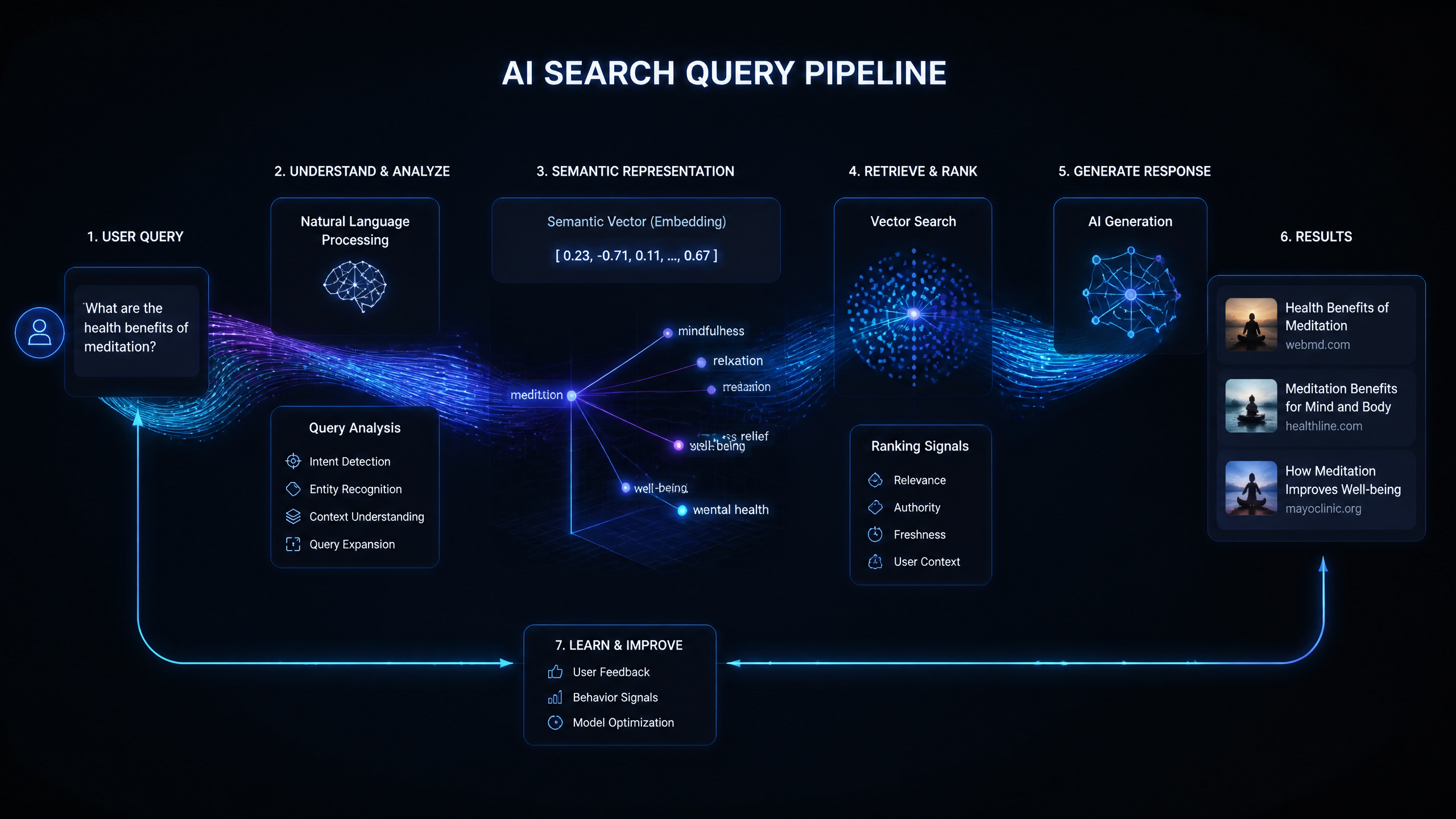
When a user enters a query today, the system doesn't just look for exact character matches. Instead, it initiates a complex multi-step pipeline designed to understand the underlying context of the request.
Understanding Natural Language Processing (NLP) and Semantic Search
At the core of every modern AI search query is natural language processing (NLP). NLP allows the search engine to dissect conversational phrasing, identify parts of speech, and extract entities. This is the foundation of semantic search, which focuses on the meaning behind the words rather than the literal text strings.
In my experience, search engines are getting better at understanding context, but many still miss the mark on nuanced queries. When a user inputs a complex question, the NLP model maps the entities to a vector space, measuring the distance between concepts to determine what the user actually wants. To understand how these systems compare to what we used to build, you can explore the Differences between traditional and AI SEO.
The Role of Query Expansion and the Knowledge Graph
Once the system processes the initial input, it rarely searches for those exact words. Instead, it performs query expansion—a process where the search engine adds synonyms, related concepts, and contextual modifiers to the query behind the scenes.
This expansion relies heavily on a knowledge graph, a massive database of real-world entities and their interrelations. For example, if you query "how to fix a leaky faucet without a wrench," the search engine uses its knowledge graph to understand that "wrench" is a tool, "leaky faucet" is a plumbing issue, and it should look for alternative tools or manual methods. It expands the query to include terms like "pliers," "hand-tighten," and "plumbing bypass."
How Relevance Scoring Dictates the Final Answer
After expanding the query and retrieving potential documents, the engine applies a relevance scoring algorithm. This score determines which content appears in the coveted "position zero" or AI-generated summaries.
Now, let's be clear—relevance scoring isn't just about matching keywords. It incorporates user engagement metrics and historical data to predict which answer will actually satisfy the user. If the system predicts a low click-through rate (CTR) or poor engagement for a specific result, that result is quickly demoted, regardless of how optimized its metadata might be.
Intent Detection: The Core of AI-Powered Search
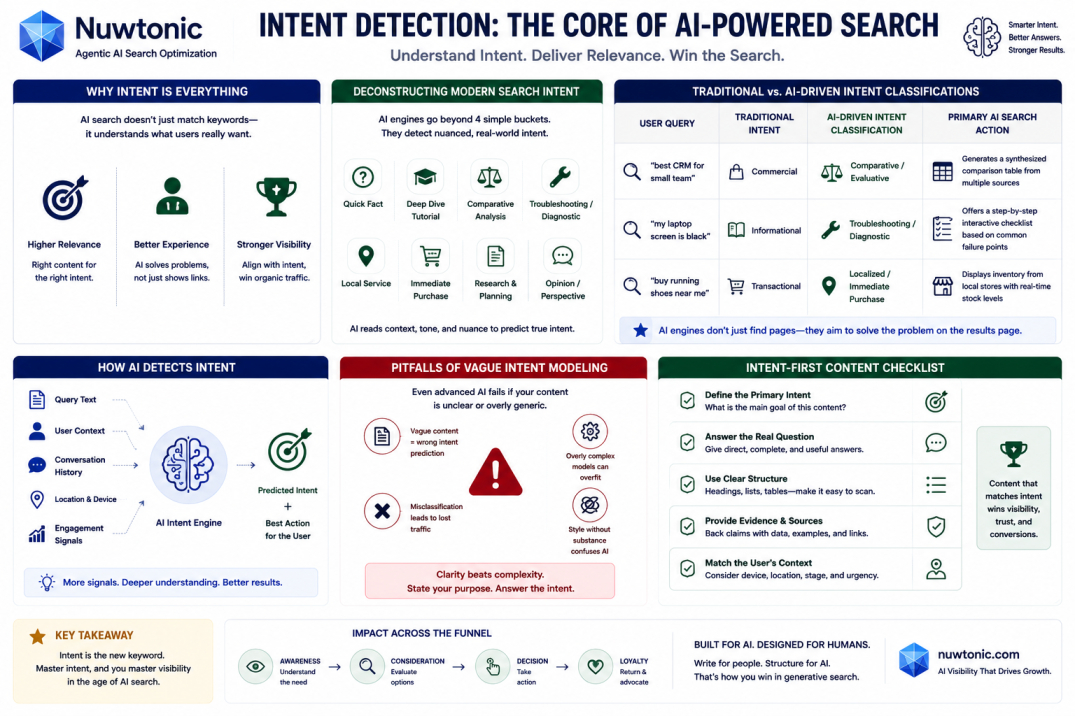
Most AI search models are overhyped; focusing on user intent usually yields better results. If you don't understand the exact intent behind a query, no amount of algorithmic tweaking will save your organic traffic.
Deconstructing Modern Search Intent
Traditional search engines categorized intent into four neat buckets: informational, navigational, commercial, and transactional. Today, AI search engines use far more granular classifications. They analyze conversational nuances to determine if a user is looking for a quick fact, a deep-dive tutorial, a local service, or a comparative analysis.
To keep pace with these shifts, understanding BrightEdge AI Search Intent Insights is crucial for digital marketers who want to align their content with evolving user behaviors.
Traditional vs. AI-Driven Intent Classifications
To see how much the landscape has shifted, let's compare how traditional search engines and modern AI engines classify the exact same queries:
User Query | Traditional Intent | AI-Driven Intent Classification | Primary Search Engine Action |
|---|---|---|---|
"best CRM for small team" | Commercial | Comparative / Evaluative | Generates a synthesized comparison table from multiple sources |
"my laptop screen is black" | Informational | Troubleshooting / Diagnostic | Offers a step-by-step interactive checklist based on common failure points |
"buy running shoes near me" | Transactional | Localized / Immediate Purchase | Displays inventory from local physical stores with real-time stock levels |
By analyzing these differences, we can see that AI engines don't just find pages; they attempt to solve the user's problem directly on the search results page. For a deeper look at how search platforms are evolving, check out our AI search engine insights.
Pitfalls of Vague Intent Modeling
I've seen teams waste resources on fancy algorithms when basic query optimization solves most problems. Don't fall for the trap of assuming the AI will magically figure out what your page is about if your writing is vague or overly stylistic.
In a past project optimizing an e-commerce search engine, our development team spent three months building a hyper-complex intent classification model. We thought we were being revolutionary. However, we quickly realized the model was misclassifying basic transactional queries because we had over-engineered the semantic layers. The lesson? If your content doesn't clearly state its purpose, even the most advanced AI search query parser will misclassify it.
How AI Reformulates Your Query
Under the hood, platforms like Microsoft Azure and OpenAI use specialized pipelines to translate raw user input into structured search queries.
The AI Enrichment Pipeline
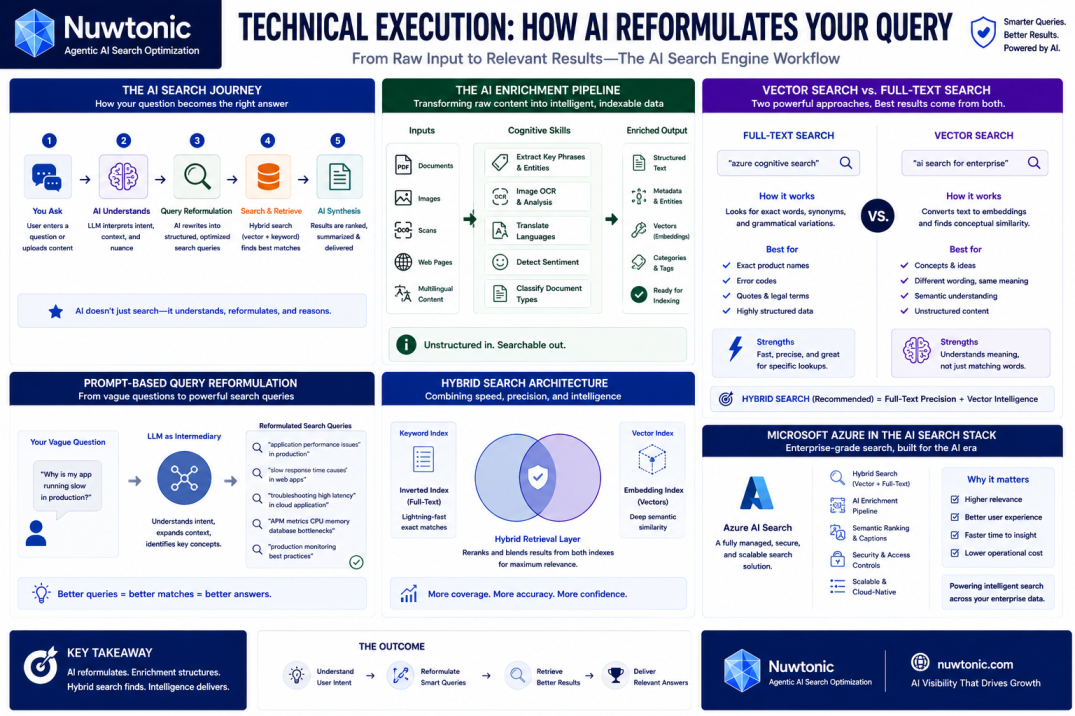
When an unstructured document or a complex query enters an enterprise search system, it goes through an enrichment pipeline. For example, the Cognitive Search AI Enrichment Pipeline transforms content that is not searchable in raw form into structured, highly indexable data.
This pipeline uses cognitive skills to:
• Extract key phrases and entities
• Perform image OCR and analysis
• Translate multilingual content
• Detect sentiment and classify document types
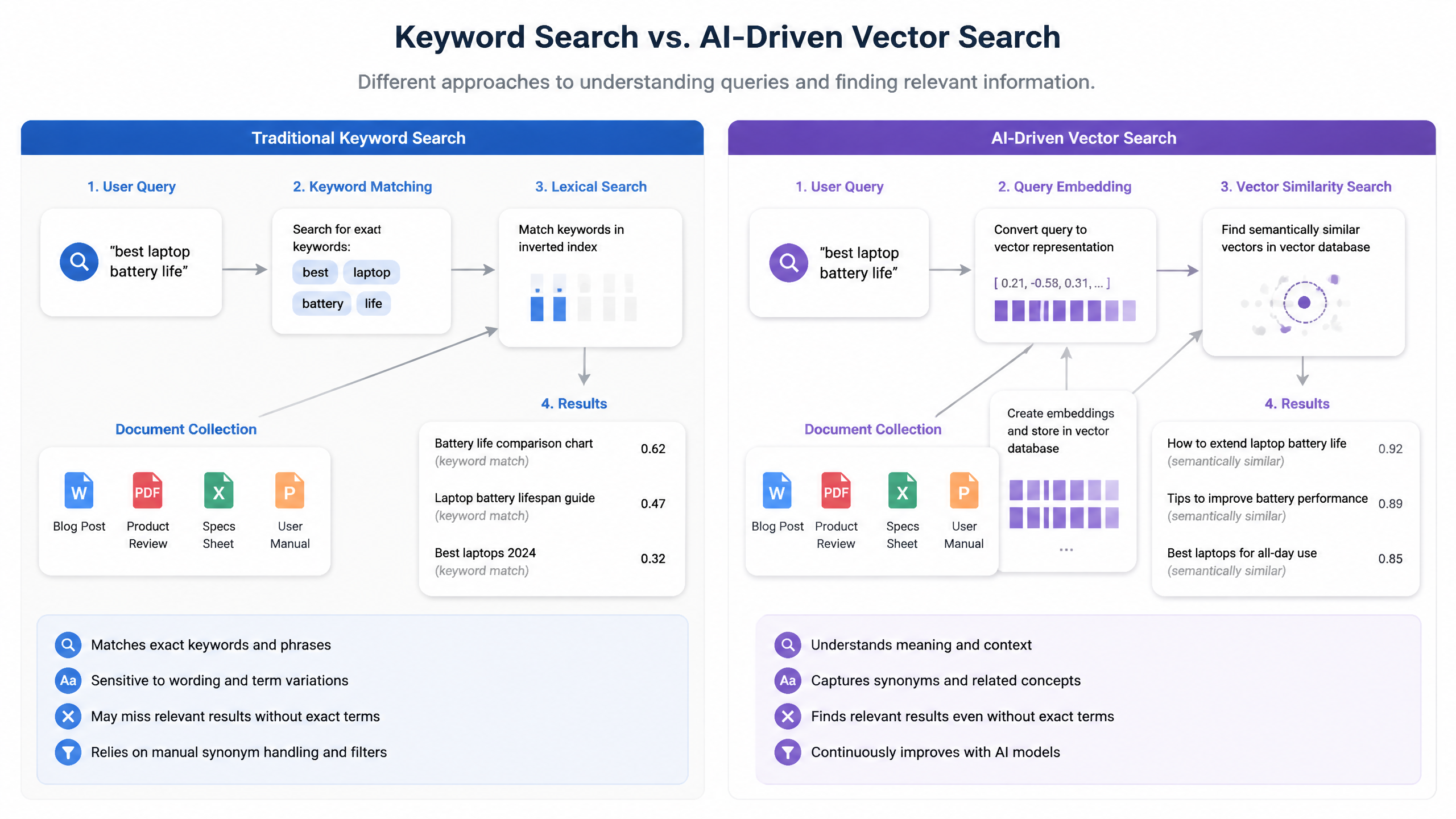
Vector Search vs. Full-Text Search
Modern search architectures often combine traditional keyword matching with vector-based retrieval. This is known as hybrid search. According to the Azure AI Search Feature Documentation, optional AI integration allows systems to leverage vector search alongside traditional full-text search to maximize retrieval accuracy.
Let's compare these two approaches:
Full-Text Search: Looks for exact word matches, synonyms, and grammatical variations. It is incredibly fast and highly effective for specific product names, error codes, or exact quotes.
Vector Search: Converts text into numerical representations (embeddings) in a high-dimensional space. It retrieves documents based on conceptual similarity, even if the query and the document share zero common words.
Prompt-Based Query Reformulation
In many modern integrations, when you type a question into an AI search interface, an LLM acts as an intermediary. It takes your vague, conversational input and reformulates it into a structured search query. This process ensures that the underlying search engine receives a clean, optimized query that is highly likely to return precise results.
Optimizing Content for AI Search Queries
Knowing how these systems work is only half the battle. The real question is: how do you optimize your digital footprint so that AI engines select your content as the definitive answer?
Shifting Your Strategy to Contextual Optimization
To rank for modern search queries, you must stop writing for simple keyword density. Instead, focus on answering complex questions thoroughly and structuring your data so that machines can easily parse it. Utilizing AI SEO optimization techniques will help you structure your content for maximum semantic relevance.
Measuring Success Beyond Traditional CTR
With AI search engines answering more queries directly on the search results page, traditional metrics like CTR are changing. You need to focus on brand citations, inclusion in AI summaries, and downstream conversion rates rather than raw, unsegmented organic traffic.
Common Optimization Traps to Avoid
Don't fall for the trap of over-optimizing your content for a single AI engine. These models are updated constantly. If you write content solely to exploit a specific algorithm's quirk, your traffic will plummet when the next update rolls out. Focus on clear, authoritative, and structured writing.
Frequently Asked Questions
What is an AI search query?
An AI search query is a user request processed by search engines using artificial intelligence, natural language processing, and semantic understanding to interpret the user's intent rather than just matching literal keywords.
How does Azure AI Search handle query enrichment?
Azure AI Search uses an enrichment pipeline that extracts key phrases, performs OCR, detects entities, and translates text, transforming raw, unstructured data into searchable, structured indexes.
Why is search intent more critical than raw keywords?
Because AI engines reformulate queries and use vector search to find conceptual matches. If your content matches the keyword but fails to satisfy the user's underlying search intent, the relevance scoring algorithm will quickly demote your page.
Summary and Strategic Action Plan
Understanding the mechanics of the AI search query is no longer optional—it is the baseline for modern digital visibility. To stay ahead, you must build content that satisfies deep user intent, structure your data for semantic engines, and measure success through holistic engagement metrics rather than legacy keyword rankings.
Key Takeaways
• AI search queries rely on NLP, semantic search, and query expansion to understand user context.
• Hybrid search, combining vector search and full-text search, delivers the most accurate retrieval results.
• Success in the modern search landscape requires moving away from keyword stuffing and focusing entirely on satisfying granular search intent.
Sources and References
• Azure AI Search Feature Documentation
• Cognitive Search AI Enrichment Pipeline
• BrightEdge AI Search Intent Insights