
Honestly, most discussions around AI search history overlook the importance of user consent , it’s a critical piece of the puzzle. We treat our digital footprints as if they are static impressions left in the mud. They are not. In the era of generative AI, those footprints are scooped up, analyzed, and used to reconstruct a model of how we think.
As an AI ethics researcher who has spent the last decade advising tech giants and legislative bodies on transparency frameworks, I've noticed that many companies still treat user data as an afterthought, when in reality, it's foundational to trust. There's a lot of hype about AI's capabilities, but the real challenge lies in how we handle the data it uses.
To be clear, when you use an AI search or conversational tool, you aren't just leaving a trail of visited URLs. You are feeding an optimization engine. This guide dismantles the black box of AI search history and AI memory, giving you the practical clarity you need to navigate this shift.
TL;DR Summary
• AI Search History stores raw transcripts of what you said, while AI Memory synthesizes and retains behavioral conclusions about who you are.
• Google Chrome’s new AI-powered history search is currently restricted to U.S. users operating in English and returns up to three "best matches" per query.
• U.S. government agencies (like the DHS and State Department) are actively expanding their data scraping capabilities to include search results and social media histories.
• Legal professionals warn that AI interaction histories are increasingly discoverable in court proceedings and administrative disputes.
Key Takeaways
• Privacy is not anonymity: Deleting a chat conversation does not automatically wipe the underlying vector embeddings or training backups.
• Strict regional boundaries: Consumer-facing AI history features are heavily gatekept by geographic region and language settings.
• Evolving legal frameworks: State-level regulations in California and Washington are setting new precedents for AI transparency and disclosure.

Table of Contents
What is AI Search History?
At its core, AI search history is the conversational, semantic record of your interactions with an artificial intelligence system. Unlike traditional browser history, which simply logs a timestamped URL and a page title, AI search history captures the full contextual relationship of your queries.
The Shift from Keywords to Natural Language
Traditional search relies on exact keyword matching. If you search for "dog food recall 2026," a standard browser database looks for those exact strings. AI search history, however, utilizes semantic search to interpret intent. It understands that "Why is my golden retriever sick after eating his kibble?" is fundamentally related to the same recall data.
If you want to understand how these systems process live queries differently than traditional indexers, our AI Search Engine insights offers a deep dive into the underlying mechanics.
Why Context Changes Everything
Because AI systems process prompts using natural language processing (NLP), your history contains far more sensitive data than a list of websites. It contains your reasoning, your anxieties, your unfinished business plans, and your proprietary code snippets. It is a mirror of your cognitive workflow.
AI Search History vs. AI Memory: The Crucial Distinction
One of the most persistent misconceptions I encounter when auditing enterprise AI systems is the conflation of history with memory. They are entirely different subsystems, governed by distinct data retention rules.
How AI Memory Differs from History
To put it simply: History records events; memory records conclusions.
If you tell an AI, "I am preparing for an AWS certification exam because my startup is migrating away from local servers," the system handles this information in two ways:
• The History Layer: Stores the exact transcript of the conversation.
• The Memory Layer: Extracts a metadata tag: User is a startup founder migrating to AWS and saves it to a persistent user profile.
Even if you delete that specific chat thread from your history, the synthesized memory may remain active, silently shaping future answers.
Feature | AI Search History | AI Memory |
|---|---|---|
Primary Function | Records exact transcripts and logs | Synthesizes and extracts behavioral facts |
User Visibility | Usually fully visible in a sidebar | Often hidden or partially accessible in settings |
Data Format | Raw conversational text and uploaded files | Condensed, vectorized data points (embeddings) |
Systemic Impact | Does not actively alter future prompts | Directly influences personalization and system tone |
Deletion Behavior | Clearing it removes the visible chat log | Requires separate memory-clearing actions |
How Google Chrome's AI History Search Works under the Hood
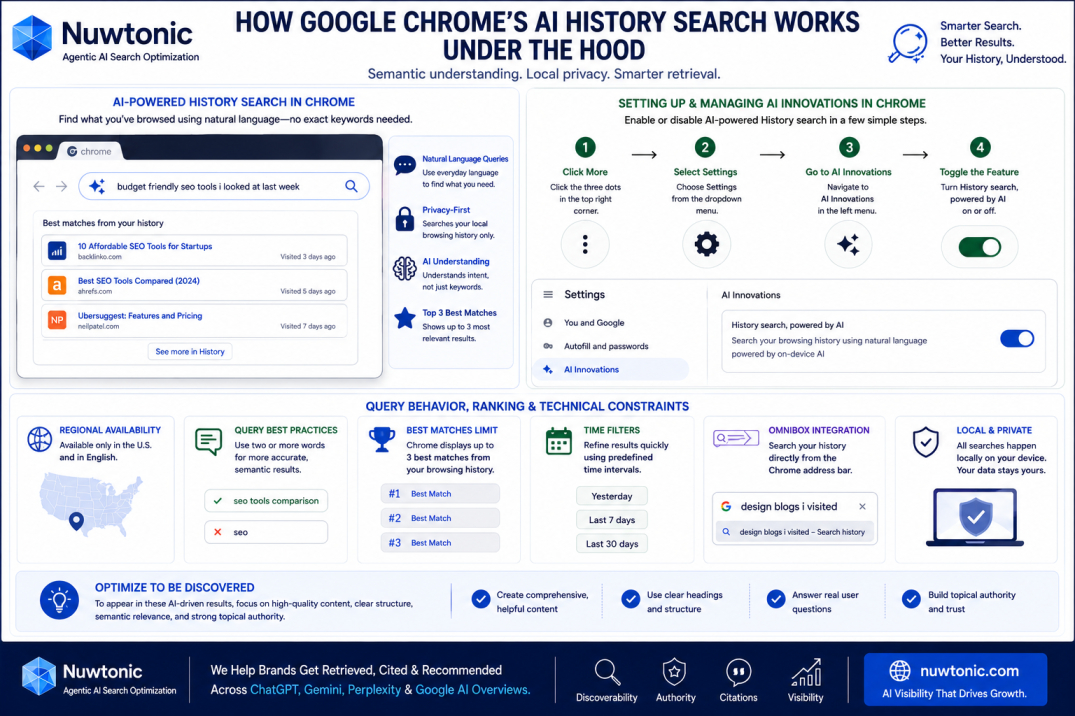
To see a real-world, consumer-facing implementation of this technology, we only have to look at Google’s recent updates to its browser ecosystem.
Setting Up and Managing AI Innovations in Chrome
According to official documentation from the Google Chrome Help Center, Chrome now includes a feature called "History search, powered by AI." This allows users to search their local browsing history using everyday language instead of exact keywords.
To manage this feature, users must navigate through a specific settings path:
Click More (the three dots in the top right corner).
Select Settings.
Navigate to AI Innovations.
Toggle History search, powered by AI on or off.
Query Behavior, Ranking, and Time Filters
This system is not a wild, unconstrained search of the entire web. It operates under strict technical and geographical boundaries:
• Regional Limitations: The feature is currently available only to users located in the U.S. and using Chrome in English.
• Query Best Practices: Chrome suggests using two or more words for more precise, semantic AI-powered results.
• Strict Constraints on Output: The browser shows up to 3 best matches from your browsing history in a dedicated "Best matches from your history" section.
• Time-Scoping: Users can quickly filter their semantic history searches using predefined intervals: Yesterday, Last 7 days, or Last 30 days.
• Omnibox Integration: Users can also execute these semantic history queries directly from the Chrome address bar.
For digital marketers trying to optimize for these semantic retrieval systems, understanding AI SEO optimization techniques is crucial to appearing in these highly coveted "best matches."
The Privacy, Policy, and Legal Exposure of Your AI History
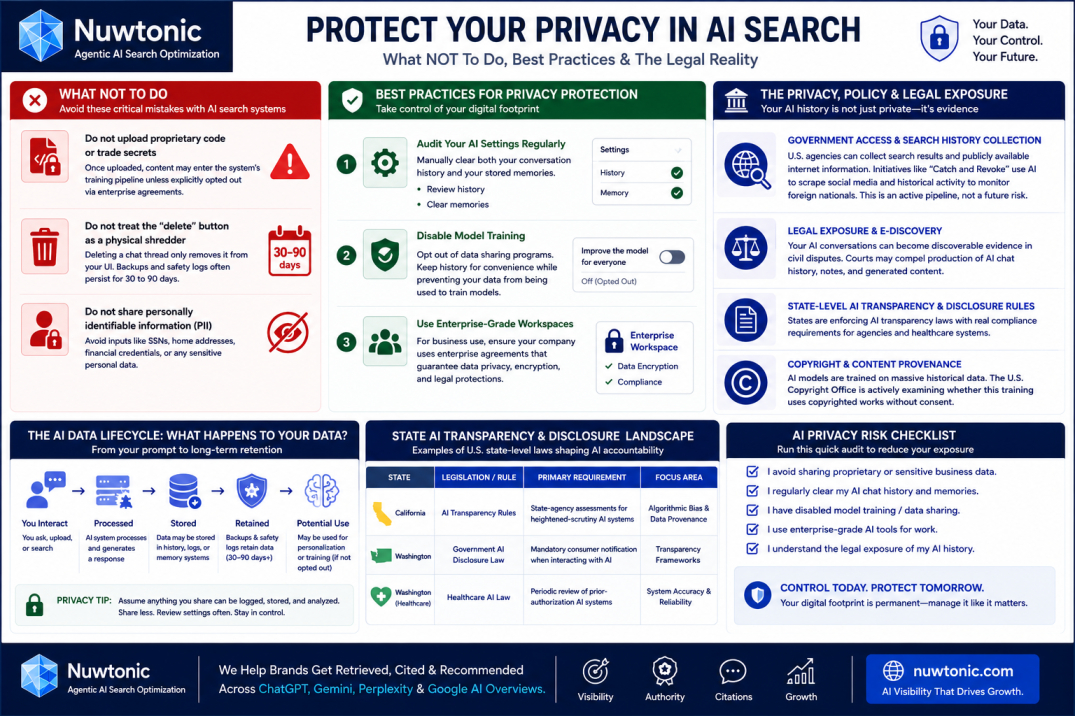
Now, let's step away from consumer convenience and look at the compliance and legal reality. During my time analyzing data provenance and privacy by design, I have watched the boundary between private search and public evidence dissolve.
Government Access and Search History Collection
Many users assume their search histories are shielded by standard consumer privacy expectations. However, U.S. federal agencies are rapidly codifying the collection of historical digital traces.
For instance, according to reporting on changes to Department of Homeland Security (DHS) records, the U.S. government planned to expand collected records to include search results and publicly available internet information for certain immigrants.
Similarly, the State Department’s "Catch and Revoke" initiative showcases how AI-enabled systems are being deployed to scrape social media and historical online activity to monitor foreign nationals, as detailed in a critical Brennan Center Analysis. This is not a hypothetical future; it is an active operational pipeline.
Legal Exposure and E-Discovery
It's not just government agencies you have to worry about. If you are involved in a civil dispute, your AI search history is a goldmine for opposing counsel. In a notable online discussion, legal professionals warned that AI message history may be used in legal disputes, underscoring concerns that AI-related history can easily become discoverable evidentiary material in court.
State-Level AI Transparency and Disclosure Rules
As federal protections remain fragmented, U.S. states are stepping in with localized transparency frameworks. According to the Orrick U.S. AI Law Tracker, we are seeing a patchwork of state-level oversight:
• California: The state's AI transparency rules require specific state-agency assessments for heightened-scrutiny AI systems to prevent algorithmic bias.
• Washington: Washington’s government AI disclosure law requires agencies to explicitly tell consumers when they are interacting with an AI system.
• Washington Healthcare: The state's healthcare AI law mandates that prior-authorization AI systems must be reviewed periodically for accuracy and reliability.
State | Legislation / Rule | Primary Requirement | Focus Area |
|---|---|---|---|
California | AI Transparency Rules | State-agency assessments for heightened-scrutiny systems | Algorithmic Bias & Data Provenance |
Washington | Government AI Disclosure Law | Mandatory consumer notification when interacting with AI | Transparency Frameworks |
Washington | Healthcare AI Law | Periodic review of prior-authorization AI systems | System Accuracy & Reliability |
Copyright and Content Provenance
This data collection loop also flows in reverse. The models you interact with are trained on massive scrapes of historical data. The U.S. Copyright Office AI Initiative, which launched in early 2023, has been examining the legal implications of using copyrighted materials in AI training.
This initiative issued a Federal Register notice of inquiry that received over 10,000 comments by December 2023. The office subsequently published Part 1 of its AI report on July 31, 2024, followed by Part 2 on January 29, 2025. The core issue here is content provenance: did the AI have the right to ingest the history of human creativity to generate its current search responses?
This shift in data retrieval marks a stark Comparison of traditional SEO and AI SEO, highlighting how search is moving from public indexing to hyper-personalized, private data synthesis.
What NOT to Do (And How to Protect Your Privacy)
In my experience, users make the same critical mistakes when interacting with AI search systems. Before discussing how to manage your settings, let us establish what you should absolutely avoid.
What NOT to Do
Do not upload proprietary code or trade secrets: Once a document is uploaded to a standard consumer AI, it enters the system's training pipeline unless you have explicitly opted out via enterprise agreements.
Do not treat the "delete" button as a physical shredder: Deleting a chat thread merely removes it from your client-side UI. Backups and safety logs often persist for 30 to 90 days.
Do not share personally identifiable information (PII): Avoid inputs like social security numbers, home addresses, or financial credentials in conversational prompts.
Best Practices for Privacy Protection
To regain control over your digital footprint, implement these three steps:
Audit Your AI Settings Regularly: Go into your AI assistant's settings panel and manually clear both your conversation history and your stored memories.
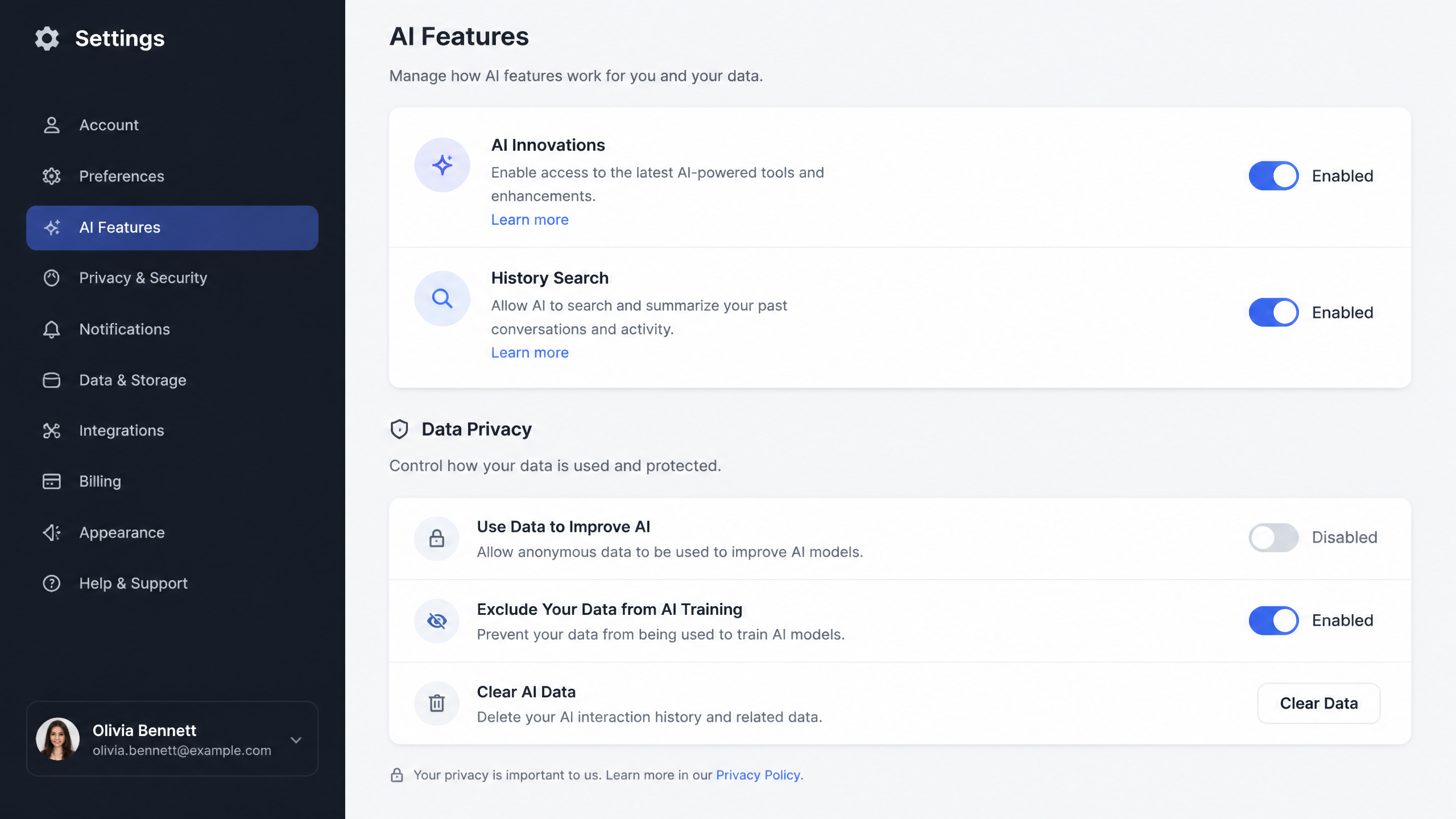
Disable Model Training: Opt out of data sharing programs. Most platforms allow you to keep your history active for convenience while disabling the use of your chats for model training.
Use Enterprise-Grade Workspaces: If you are using AI for business, ensure your company uses an enterprise agreement that guarantees data privacy,
What Is AI Search History?
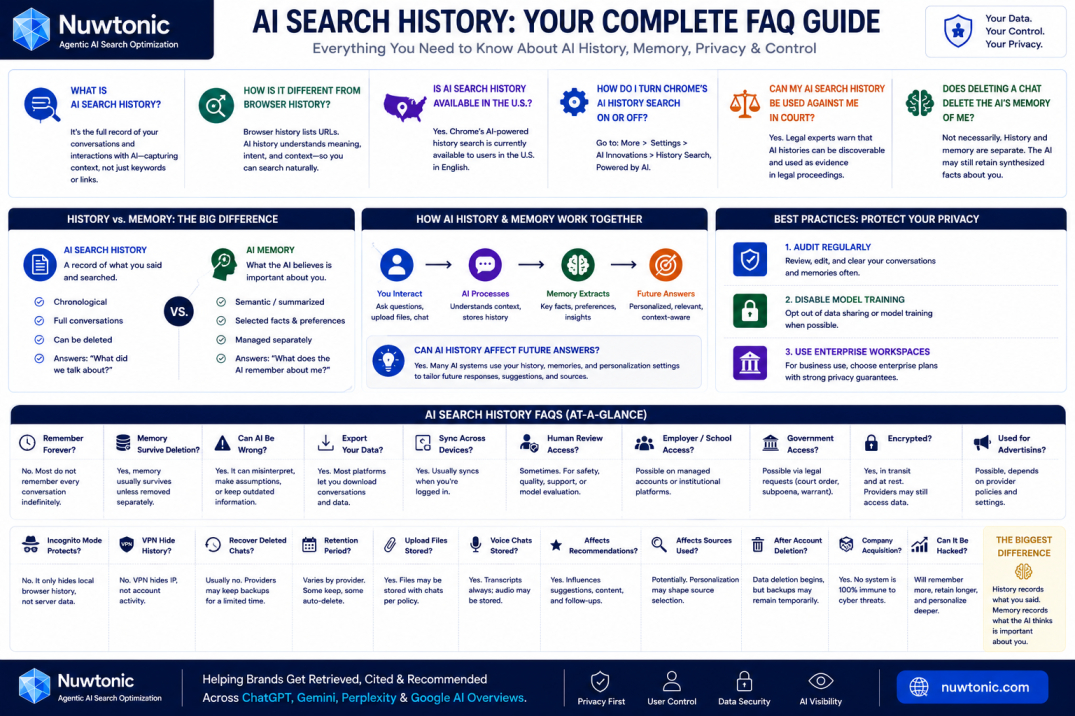
AI search history is the semantic and conversational record of your prompts and the AI's responses, capturing the full context of your interactions rather than just keyword-to-URL mappings.
How Is AI Search History Different From a Normal Browser History Search?
Traditional browser history is a simple, chronological list of visited web addresses. AI history search uses semantic understanding to allow you to search your past activity using natural, conversational language.
Is AI Search History Available in the U.S.?
Yes. Google Chrome's AI-powered history search, for example, is currently available exclusively to users located in the U.S. who are using Chrome in English.
How Do I Turn Chrome's AI History Search On or Off?
In Google Chrome, navigate to More > Settings > AI Innovations > History Search, Powered by AI to toggle the feature on or off.
Can My AI Search History Be Used Against Me in Court?
Yes. Legal experts warn that AI chat and search histories are discoverable in legal proceedings and can be used as evidentiary material in disputes.
Does Deleting a Chat Delete the AI's Memory of Me?
Not necessarily. History and memory are separate systems. Deleting a conversation removes the transcript, but the AI may still retain synthesized facts about you in its persistent memory profile.
Can AI search history affect future answers?
Yes. Many AI systems use previous conversations, saved memories, and personalization settings to tailor future responses. The extent varies by platform and user settings.
Does AI remember every conversation forever?
No. Most AI platforms do not remember every interaction indefinitely. Conversations may be deleted, archived, expire under retention policies, or never enter long-term memory in the first place.
What is the difference between AI search history and AI memory?
AI search history is a record of past conversations and searches. AI memory is a separate system that stores selected facts, preferences, or information the AI believes may be useful in future interactions.
Can AI memory survive after I delete my search history?
Yes. On platforms that support memory, deleting a conversation does not automatically remove associated memories. Memory usually needs to be managed separately.
How can I see what an AI remembers about me?
Some AI platforms provide dedicated memory settings where users can review, edit, or delete stored memories. Other platforms may not currently offer this visibility.
Can AI forget specific information about me?
Often yes. Many AI services allow users to remove specific memories or clear all stored memories through account settings.
Can AI memory be wrong?
Yes. AI systems can misinterpret conversations, make incorrect assumptions, or retain outdated information. Users should periodically review stored memories when memory controls are available.
Does AI search history sync across devices?
Usually yes. If you are logged into the same account on multiple devices, your search history, conversations, and memories may synchronize across those devices.
Can I export my AI search history?
Many providers allow users to download their conversations, account data, and activity history through privacy or account settings.
Can deleted AI chats be recovered?
In most cases, permanently deleted conversations cannot be restored by users. However, providers may temporarily retain backups for operational, security, or legal reasons.
How long do AI companies keep search history?
Retention periods vary by provider. Some conversations may remain until manually deleted, while others may be automatically removed after a defined period.
Is AI search history encrypted?
Most major AI platforms use encryption to protect data during transmission and storage. However, encryption does not mean the provider itself cannot access the information under certain circumstances.
Can AI companies read my conversations?
Potentially. Depending on the provider and account settings, limited access may occur for safety reviews, abuse investigations, technical support, or quality assurance purposes.
Can human reviewers see my AI searches?
In some cases, yes. Providers may use trained reviewers to evaluate a small subset of interactions for quality improvement, safety testing, or model evaluation.
Can my employer see my AI search history?
If you use an employer-provided AI account, enterprise workspace, or company-managed device, administrators may have access to certain usage records, logs, or compliance reports.
Can schools or universities access AI search history?
Potentially. If the AI service is provided through a school account or institution-managed platform, administrators may have additional visibility into account activity.
Can governments access AI search history?
Governments may obtain access through legal processes such as court orders, subpoenas, or warrants, depending on local laws and jurisdiction.
Can AI search history be used for advertising?
Some providers may use account activity, preferences, or behavioral signals to improve services or personalization. Whether it is used for advertising depends on the provider's policies.
Does using a VPN hide my AI search history?
No. A VPN hides your internet traffic from external observers but does not prevent an AI platform from associating activity with your logged-in account.
Does incognito mode prevent AI history from being stored?
Not necessarily. Browser incognito mode primarily prevents local browser storage. AI providers may still store interactions on their servers if you are using their service.
Can AI search history reveal personal information?
Yes. Conversations often contain goals, opinions, work projects, personal interests, uploaded files, and other details that can reveal far more than traditional search history.
Is AI search history more sensitive than browser history?
In many cases, yes. AI conversations typically contain complete thoughts, intentions, documents, and context rather than isolated search keywords.
Can uploaded files become part of AI search history?
Often yes. PDFs, spreadsheets, presentations, images, and other uploaded files may be associated with conversation history and stored according to platform policies.
Does AI store voice conversations?
Many AI platforms store voice transcripts, and some may temporarily retain audio recordings depending on user settings and product features.
Can AI search history affect recommendations?
Yes. Previous searches and conversations may influence recommendations, suggested prompts, follow-up questions, and personalized responses.
Can AI search history influence what sources the AI uses?
Potentially. Personalization systems may prioritize information, examples, or explanations that align with a user's previous interests and activity.
What happens to my AI history if I delete my account?
Most providers begin a deletion process that removes account data from active systems. Some information may temporarily remain in backups or retention systems before final deletion.
What happens to my AI history if the company is acquired?
Under many privacy policies, user data may transfer to a successor organization as part of a merger, acquisition, or business restructuring.
Can AI search history be hacked?
Like any cloud-based service, AI platforms can be targets for cyberattacks. While providers implement security measures, no system can guarantee absolute protection.
Should I avoid sharing confidential information with AI?
Yes. Sensitive business secrets, passwords, private financial information, legal documents, and confidential data should be shared cautiously and only after understanding the platform's policies.
Will future AI systems remember more than today's systems?
Most likely. AI assistants are rapidly evolving toward persistent memory, long-term personalization, and cross-session continuity, allowing them to remember more context over time.
What is the biggest difference between AI search history and AI memory?
History records what you said. Memory records what the AI believes is important enough to remember about you for future interactions.
Sources and References
• Google Chrome Help: Google Chrome Help Center
• U.S. Copyright Office: U.S. Copyright Office AI Initiative
• Brennan Center for Justice: Brennan Center Analysis