You know what’s funny? I spent my entire first year as an independent SEO consultant trying to stretch every single dollar. I bought the cheapest tools, manually scraped SERPs until my fingers cramped, and avoided premium subscriptions like the plague. When I finally decided to invest in professional software, I faced the classic dilemma: Ahrefs Lite vs Standard.
At first glance, the price gap seems straightforward, but the devil is in the details—specifically, the features and data limits that can make or break your workflow. Many users underestimate the value of Ahrefs Lite for smaller projects—it's often more than enough for basic needs. However, choosing the wrong plan can either drain your budget unnecessarily or leave you hitting a brick wall mid-analysis. Let's break down these two tiers honestly so you can make the right choice for your business in 2026.
Key Takeaways
What You Need to Know First
Before looking at individual features, you must understand how your daily workflow impacts tool selection. The primary differences between these plans lie in historical data access, keyword tracking capacity, and advanced analysis tools.
Summary of Recommendations
• Choose Lite if you run a single website, focus primarily on basic keyword research, and do not need deep historical backlink data.
• Choose Standard if you are an agency, manage multiple client sites, need historical data to spot trends, or rely heavily on competitor content gap analysis.
Table of Contents
The Core Differences at a Glance
Deep Dive into Site Explorer and Backlink Profiles
Keyword Research and Content Strategy
Choosing the Right Plan for Your Business
Common Misconceptions and Pitfalls
Frequently Asked Questions
Conclusion and Final Verdict
The Core Differences at a Glance
Pricing and Credit Systems
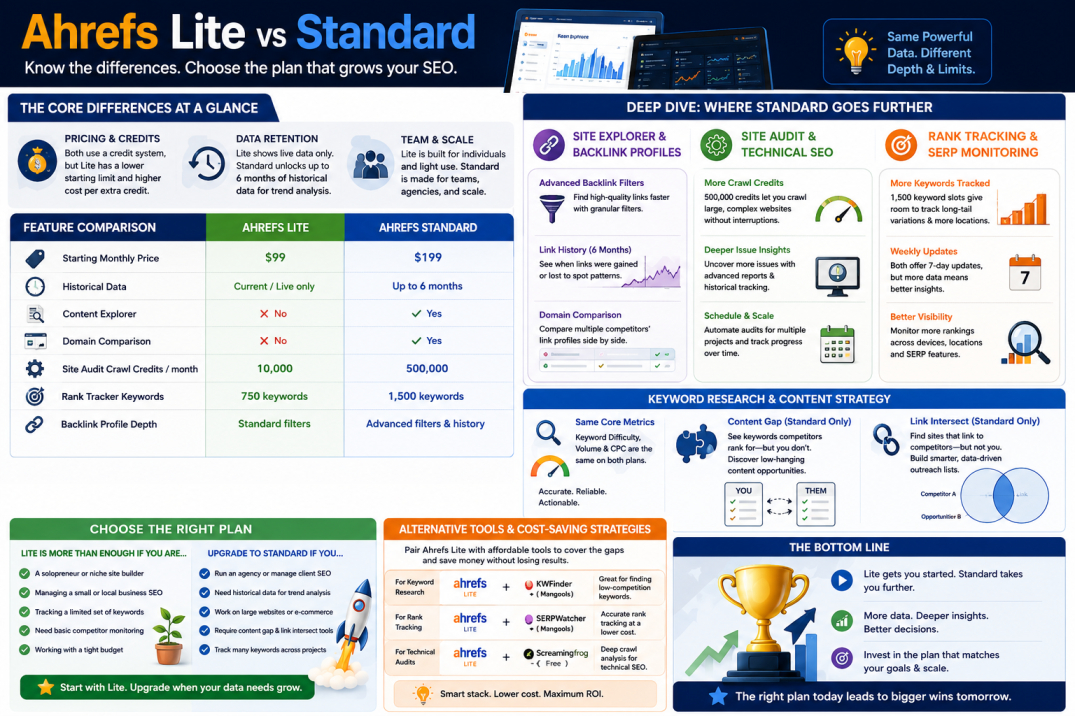
Ahrefs operates on a consumption-based credit system. Every search, filter, and report consumes credits, regardless of whether you are on Lite or Standard. However, the starting limits and the cost of additional credits differ. On the Lite plan, you get a baseline of credits that can disappear quickly if you are running multiple deep site audits. Standard provides a larger cushion, making it more suitable for teams where multiple people are querying the database daily.
Data Retention and Historical Access
One of the most significant limitations of the Lite tier is the lack of historical data. With Lite, you only see the "live" state of the web. If a competitor lost a major backlink three months ago, you won't see that trend line. Standard, on the other hand, gives you up to six months of historical data. This historical depth is crucial for identifying when a competitor's organic traffic began to decline or when they started a massive link building campaign.
Feature Comparison Table
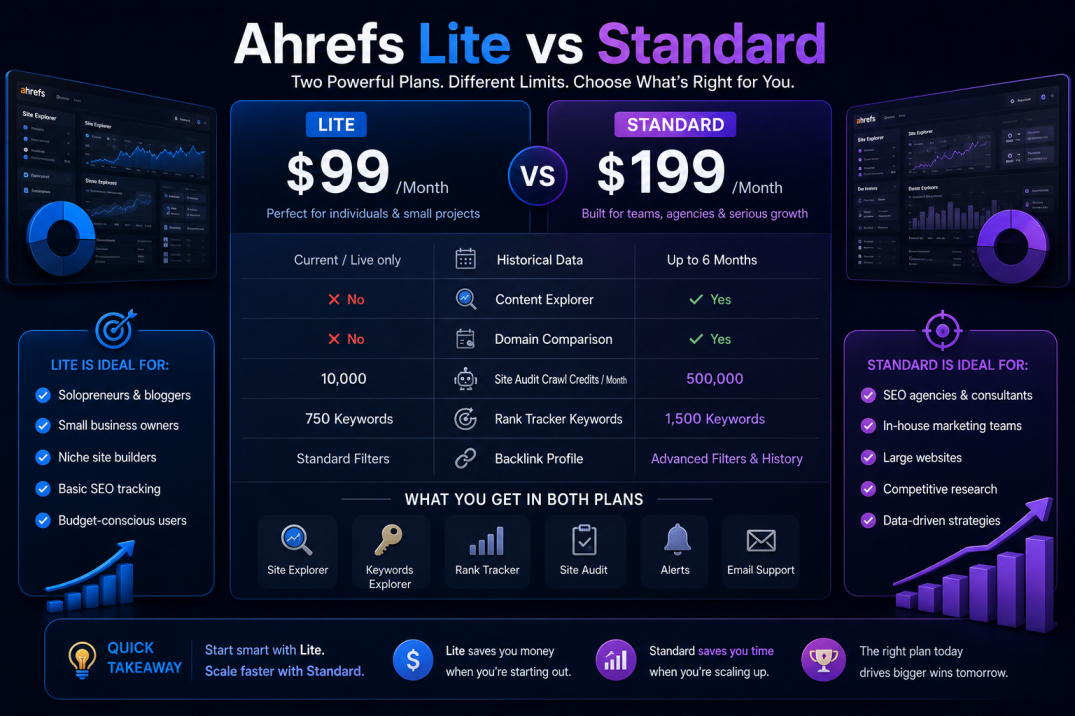
To help you visualize the differences, here is a direct comparison of the key limits and features available in both tiers:
Feature | Ahrefs Lite | Ahrefs Standard |
|---|---|---|
Starting Monthly Price | $99 | $199 |
Historical Data | Current / Live only | Up to 6 months |
Content Explorer | No | Yes |
Domain Comparison | No | Yes |
Site Audit Crawl Credits | 10,000 per month | 500,000 per month |
Rank Tracker Keywords | 750 keywords | 1,500 keywords |
Backlink Profile Depth | Standard filters | Advanced filters & history |
Deep Dive into Site Explorer and Backlink Profiles
Backlink Profile Analysis Capabilities
Analyzing a competitor's backlink profile is the bread and butter of off-page SEO. While Lite allows you to see who links to a target domain, it limits your ability to slice and dice that data. In my early consulting days, I tried to run a link reclamation campaign using a basic account. I quickly realized that without advanced backlink filters—which are restricted on Lite—I was spending hours manually sorting through low-quality forums instead of finding high-authority editorial links.
Crawl Errors and Site Audit Depth
Both plans include the Site Audit tool, which is fantastic for diagnosing crawl errors and on-page SEO issues. However, the crawl limits on Lite (10,000 credits) mean that if you are auditing a large e-commerce site with thousands of product variations, you will run out of credits before the crawl even finishes. Standard provides 500,000 crawl credits, which is usually more than enough to map out technical issues on complex websites without constantly watching your credit meter.

Organic Traffic and SERP Tracking Limits
Tracking your organic traffic progress requires accurate SERP data. Lite allows you to track up to 750 keywords with updates every seven days. If you are managing a local business, that is plenty. But if you are managing multiple clients or a medium-sized blog, those 750 slots fill up incredibly fast. Standard doubles this limit to 1,500 keywords, giving you the breathing room to track long-tail variations and monitor how your on-page SEO tweaks impact rankings in real time.
Keyword Research and Content Strategy
Keyword Difficulty and Volume Metrics
Both plans use the same underlying keyword database, meaning your keyword difficulty and search volume metrics will be identical. The difference lies in how many keywords you can export and how deeply you can analyze the SERP history. Lite is perfect for quick, ad-hoc keyword research. If you just need to write a blog post and need a few solid ideas, Lite will do the job beautifully.
Competitor Content Gap Analysis
This is where the Standard plan really starts to justify its higher price tag. The Content Gap tool—which allows you to see keywords your competitors rank for but you do not—is a staple of modern content strategy. Lite does not give you full access to this feature. If you want to scale your organic traffic by targeting low-hanging fruit that your competitors have already proven is valuable, the Content Gap tool on the Standard plan is almost mandatory.
Link Building Opportunities
Finding link building opportunities requires looking at intersecting link profiles. The Link Intersect tool helps you find websites that link to multiple competitors but not to you. Like the Content Gap tool, this is highly restricted or unavailable on the Lite plan. Without it, your link building efforts will rely on manual outreach and guesswork rather than data-driven targeting.
Choosing the Right Plan for Your Business
When Ahrefs Lite is More Than Enough
It's essential to evaluate your actual needs before upgrading; often the Lite version will suffice if you're just starting out. If you are a solopreneur, a niche site builder, or an in-house marketer for a small local business, Lite is incredibly capable. You can monitor your site's health, track your main keywords, and keep an eye on your primary competitors. If you find that neither plan fits your current workflow, you might want to look at a comparison of Ahrefs and Ubersuggest to see if a lighter tool is better.
When You Absolutely Must Upgrade to Standard
I've seen teams jump to the standard version without realizing they can achieve their goals with the Lite plan first. That said, you absolutely must upgrade if you are doing client work. Agencies cannot survive on Lite; the lack of historical data and the low keyword limits will choke your operations. For a broader market perspective, checking out a comparison of Ahrefs, Semrush, and Moz can help clarify where Ahrefs stands in the wider SEO tool ecosystem.
Alternative Tools and Cost-Saving Strategies
If you are on a tight budget, you do not have to settle for a plan that doesn't fit. You can pair Ahrefs Lite with other specialized, lower-cost tools to fill the gaps. For example, if your primary focus is purely finding low-competition keywords without the heavy backlink analysis, you might want to see how Ahrefs compared to KWFinder stacks up. This hybrid approach can save you hundreds of dollars a year while still giving you elite-level data.
Common Misconceptions and Pitfalls
Underestimating the Lite Plan
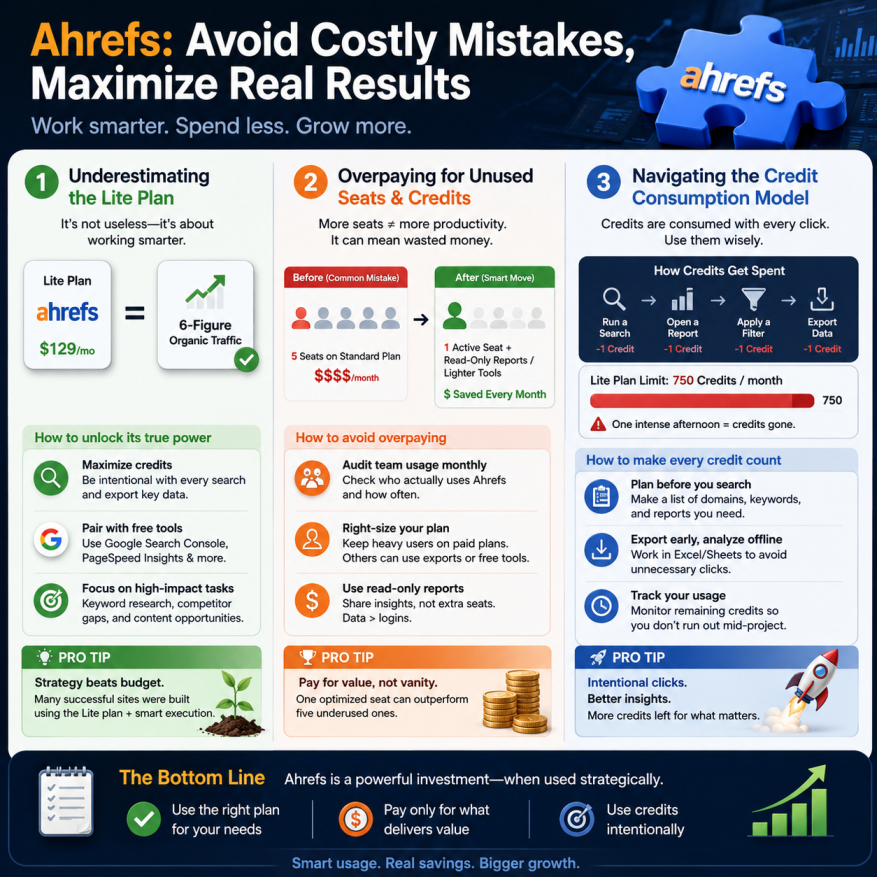
The biggest misconception is that the Lite plan is "useless" for professional work. That is simply marketing hype. If you know how to maximize your credits and use free tools like Google Search Console alongside it, the Lite plan can easily power a site to six figures in organic traffic. It requires more manual work, but the cost savings are real.
Overpaying for Unused Seats and Credits
Many agencies buy the Standard plan and then purchase extra seats for team members who only log in once a week. Because of Ahrefs' pricing model, this can lead to massive monthly bills. Always audit your team's usage. If only one person is doing the heavy lifting, keep them on Standard and let others use lighter tools or read-only reports.
Navigating the Credit Consumption Model
Ahrefs' credit system means that clicking a nested report or applying a filter costs one credit. If you are not careful, you can burn through your monthly Lite limits in a single afternoon of intense research. To avoid this, plan your searches before you log in. Know exactly what domains you want to analyze and export your data immediately so you can work with it offline in Excel or Google Sheets.
Frequently Asked Questions
Can I upgrade or downgrade at any time?
Yes, Ahrefs allows you to change your subscription plan at any point during your billing cycle. If you have a temporary project that requires deep historical data, you can upgrade to Standard for a month and then downgrade back to Lite once the research is complete.
Does the Lite plan include the Content Explorer?
No, the Content Explorer is reserved for the Standard plan and higher. If your strategy relies heavily on finding highly shared content or unlinked brand mentions, you will need the Standard plan.
How do credits work across different plans?
Both plans grant you a set number of credits per month, but the Standard plan offers a much larger pool for site audits and rank tracking. If you exceed your limit, you will be charged for auto-added credit blocks unless you disable auto-renewing credits in your settings.
Conclusion and Final Verdict
The Verdict
Ultimately, the choice between Ahrefs Lite and Standard comes down to scale and historical depth. If you are managing your own web properties and do not need to look back in time to analyze historical trends, start with Lite. It is a powerful entry point that will save you $1,200 a year. But if you are managing clients, running deep technical audits on large sites, or relying on competitive content strategies, the Standard plan is a necessary cost of doing business.
Sources and References
• Ahrefs Pricing and Subscription Documentation (2026)
• Industry community discussions on credit usage patterns