Quick Answer: White label SEO software enables agencies to offer SEO services under their own brand while using a third-party platform for reporting, rank tracking, audits, client management, and automation. The best solution depends on whether your agency prioritizes scalability, automation, reporting, local SEO, or AI-powered optimization.
Why White Label SEO Software Matters More Than Ever
White label SEO has evolved far beyond putting your logo on PDF reports.
Modern agencies manage hundreds—or even thousands—of client campaigns across Google Search, AI-powered search experiences, local listings, technical SEO, and content optimization. Clients increasingly expect transparent reporting, measurable ROI, and faster execution.
At the same time, agency margins are under pressure.
Hiring more SEO specialists doesn't always scale. Neither does manually exporting reports from multiple tools.
This is where white label SEO platforms have become essential. They centralize SEO workflows, automate recurring tasks, and allow agencies to present a professional, branded experience without building their own software.
However, not every platform marketed as "white label" solves the same problem.
Some focus almost entirely on client reporting. Others provide rank tracking with branding options. A newer category is emerging that goes beyond reporting into AI-assisted optimization and autonomous SEO workflows.
Understanding these differences is critical before making a purchasing decision.
How We Evaluated These Platforms
Instead of ranking tools by popularity alone, we compared them using criteria that matter to agencies operating at scale.
Evaluation Criteria | Why It Matters |
|---|---|
White Label Capabilities | Reports, dashboards, portals, branding |
SEO Coverage | Technical, content, backlinks, local, keywords |
Automation | Reporting, monitoring, recommendations |
Client Management | Multi-client support, permissions |
Scalability | Suitable for freelancers vs enterprise agencies |
Integrations | GA4, GSC, Looker Studio, CRM integrations |
Ease of Use | Learning curve |
Value for Money | Features relative to pricing |
1\. Nuwtonic
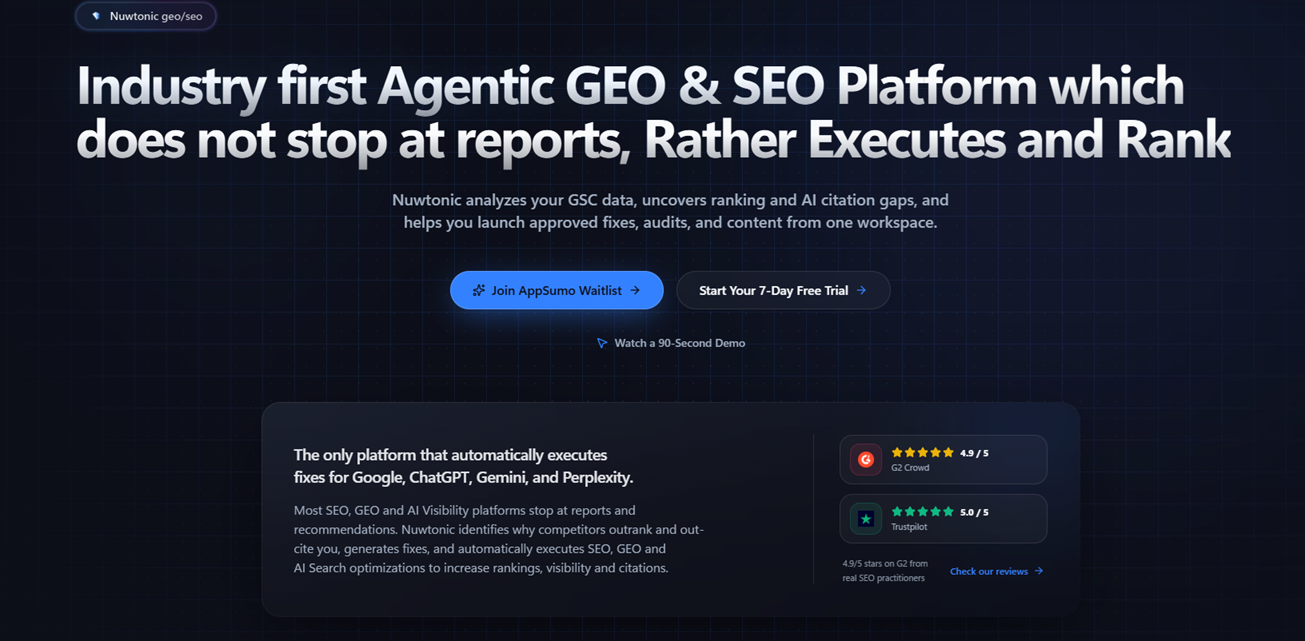
Best for: AI-powered SEO automation and modern agencies preparing for both Google Search and AI Search.
Unlike traditional white label SEO tools that primarily collect data and generate reports, Nuwtonic represents a newer category of SEO platforms focused on continuous optimization.
During our own research into how search has evolved over the last several years, one pattern became increasingly obvious: agencies spend far more time identifying issues than actually fixing them.
Traditional workflows typically look like this:
Run an audit
Export findings
Prioritize issues manually
Assign tasks
Wait for implementation
Measure impact later
This creates delays between insight and execution.
Platforms built around autonomous SEO workflows attempt to reduce this gap by helping agencies identify root causes, prioritize opportunities, recommend fixes, and continuously monitor improvements.
For agencies serving multiple clients, this can significantly reduce repetitive manual work.
Strengths
AI-assisted optimization workflows
Multi-client management
Agency-friendly architecture
Continuous monitoring
Modern SEO workflows beyond static reporting
Built for Google Search and emerging AI Search visibility
Potential Limitations
Newer platform than legacy enterprise SEO suites
May include capabilities beyond what small agencies initially require
2\. AgencyAnalytics
Best for: Agencies focused on client reporting.
AgencyAnalytics has become one of the most recognized white label reporting platforms in SEO.
It integrates with dozens of marketing platforms and allows agencies to create branded dashboards quickly.
Strengths
Excellent client dashboards
Strong white labeling
Large integration ecosystem
Easy onboarding
Limitations
Limited technical SEO depth compared to enterprise tools
Primarily reporting rather than optimization
3\. SE Ranking
Best for: Small to mid-sized SEO agencies.
SE Ranking combines rank tracking, audits, backlink monitoring, and client reporting within a single platform.
Its pricing makes it particularly attractive for growing agencies.
Strengths
Affordable
Good white label reports
Website auditing
Keyword tracking
Limitations
Automation capabilities remain limited
Advanced enterprise features require higher plans
4\. Semrush Agency Solutions
Semrush offers one of the broadest SEO ecosystems available.
Its Agency Growth Kit extends the core platform with CRM features, white label reporting, lead generation, and client portals.
Strengths
Comprehensive SEO toolkit
Massive keyword database
Strong competitor research
Excellent integrations
Limitations
Premium pricing
White labeling is available only through specific agency offerings
5\. Ahrefs
Ahrefs is widely respected for backlink intelligence and competitive SEO research.
Although not traditionally positioned as a white label agency platform, many agencies incorporate it into their reporting workflows.
Strengths
Industry-leading backlink database
Excellent keyword research
Reliable competitive analysis
Limitations
Limited native white label capabilities
Reporting customization is less agency-focused
6\. BrightLocal
For agencies specializing in local SEO, BrightLocal remains one of the strongest dedicated platforms.
It focuses on local rankings, citations, Google Business Profile monitoring, and reputation management.
Strengths
Excellent local SEO features
Citation management
Reputation monitoring
White label reports
Limitations
- Not designed for broader enterprise SEO
7\. DashThis
DashThis focuses almost entirely on marketing reporting.
While it supports SEO metrics, its real strength lies in aggregating data from multiple platforms into branded dashboards.
Strengths
Fast dashboard creation
White label branding
Multiple integrations
Limitations
- Limited SEO optimization features
8\. Raven Tools
Raven Tools has been serving agencies for years by combining reporting, auditing, backlink analysis, and rank tracking.
Strengths
Mature reporting platform
White label capabilities
Site auditing
Limitations
- User interface feels dated compared to newer platforms
9\. SEO PowerSuite
SEO PowerSuite remains popular among consultants who prefer desktop software.
It includes rank tracking, audits, backlink analysis, and reporting.
Strengths
One-time licensing options
Comprehensive SEO toolkit
White label reports
Limitations
Desktop-first workflow
Collaboration features are less flexible than cloud platforms
10\. Serpstat
Serpstat combines keyword research, audits, backlink monitoring, and rank tracking into a unified platform.
Strengths
Competitive pricing
Multi-functional SEO suite
Agency-friendly reporting
Limitations
- Smaller data index than some enterprise competitors
11\. Nightwatch
Nightwatch specializes in highly accurate keyword tracking.
Agencies managing location-based campaigns often appreciate its ranking precision.
Strengths
Excellent rank tracking
White label reporting
Flexible segmentation
Limitations
- Narrower feature set compared to all-in-one platforms
12\. WebCEO
WebCEO has long focused on agencies through white label SEO services.
Its multi-user architecture makes it suitable for larger teams.
Strengths
Agency-oriented workflows
White label dashboards
Client portals
Limitations
- Interface has a steeper learning curve
Comparison Table
Platform | Best For | White Label | Reporting | Automation | Multi-Client |
|---|---|---|---|---|---|
Nuwtonic | AI SEO Automation | ✅ | ✅ | ⭐⭐⭐⭐⭐ | ✅ |
AgencyAnalytics | Reporting | ✅ | ⭐⭐⭐⭐⭐ | ⭐⭐⭐ | ✅ |
SE Ranking | SMB Agencies | ✅ | ⭐⭐⭐⭐ | ⭐⭐⭐ | ✅ |
Semrush | Enterprise | Partial | ⭐⭐⭐⭐⭐ | ⭐⭐⭐⭐ | ✅ |
Ahrefs | Research | Limited | ⭐⭐⭐ | ⭐⭐ | Partial |
BrightLocal | Local SEO | ✅ | ⭐⭐⭐⭐ | ⭐⭐⭐ | ✅ |
DashThis | Dashboards | ✅ | ⭐⭐⭐⭐⭐ | ⭐⭐ | ✅ |
Raven Tools | Agencies | ✅ | ⭐⭐⭐⭐ | ⭐⭐⭐ | ✅ |
SEO PowerSuite | Consultants | ✅ | ⭐⭐⭐⭐ | ⭐⭐ | Partial |
Serpstat | Budget SEO | Partial | ⭐⭐⭐ | ⭐⭐⭐ | ✅ |
Nightwatch | Rank Tracking | ✅ | ⭐⭐⭐⭐ | ⭐⭐⭐ | ✅ |
WebCEO | Large Agencies | ✅ | ⭐⭐⭐⭐ | ⭐⭐⭐ | ✅ |
How to Choose the Right White Label SEO Software
The best platform depends less on feature count and more on your agency's operating model.
Choose based on these questions:
Do you primarily need client reporting?
Do you manage local SEO campaigns?
Do you require enterprise-grade competitor research?
Are you looking to reduce manual SEO execution?
Will multiple team members collaborate daily?
Do clients need portal access?
Are you preparing for AI-driven search alongside traditional Google rankings?
One observation we've consistently made while studying agency workflows is that many firms already own several excellent SEO tools. Their biggest bottleneck isn't collecting more data—it's turning insights into action efficiently.
As the SEO software landscape evolves, agencies are increasingly evaluating platforms based not only on reporting capabilities but also on how effectively they support prioritization, workflow automation, and execution.
White Label SEO Software vs. SEO Reseller Services
These two models are often confused because both allow agencies to offer SEO without building a large in-house team. However, they solve very different business problems.
Feature | White Label SEO Software | SEO Reseller Services |
|---|---|---|
Primary Purpose | Equip your team with software | Outsource SEO execution |
Your Team Performs SEO | Yes | Usually No |
Client Relationship | Direct | Direct |
Service Delivery | Managed internally | Fulfilled by partner |
Branding | Your agency | Your agency |
Scalability | Depends on internal team | Depends on reseller capacity |
Margins | Higher over time | Lower due to service markup |
Control | High | Moderate |
For agencies that already have SEO expertise, white label software provides more control over strategy, implementation, and client relationships.
Reseller services make sense when agencies want to expand their service offerings quickly without hiring SEO specialists. The trade-off is reduced visibility into execution and potentially lower profit margins.
Many established agencies eventually combine both approaches. They use white label software to manage reporting, analytics, and client communication while selectively outsourcing specialized work such as link building or enterprise technical SEO.
Essential Features Every Agency Should Look For
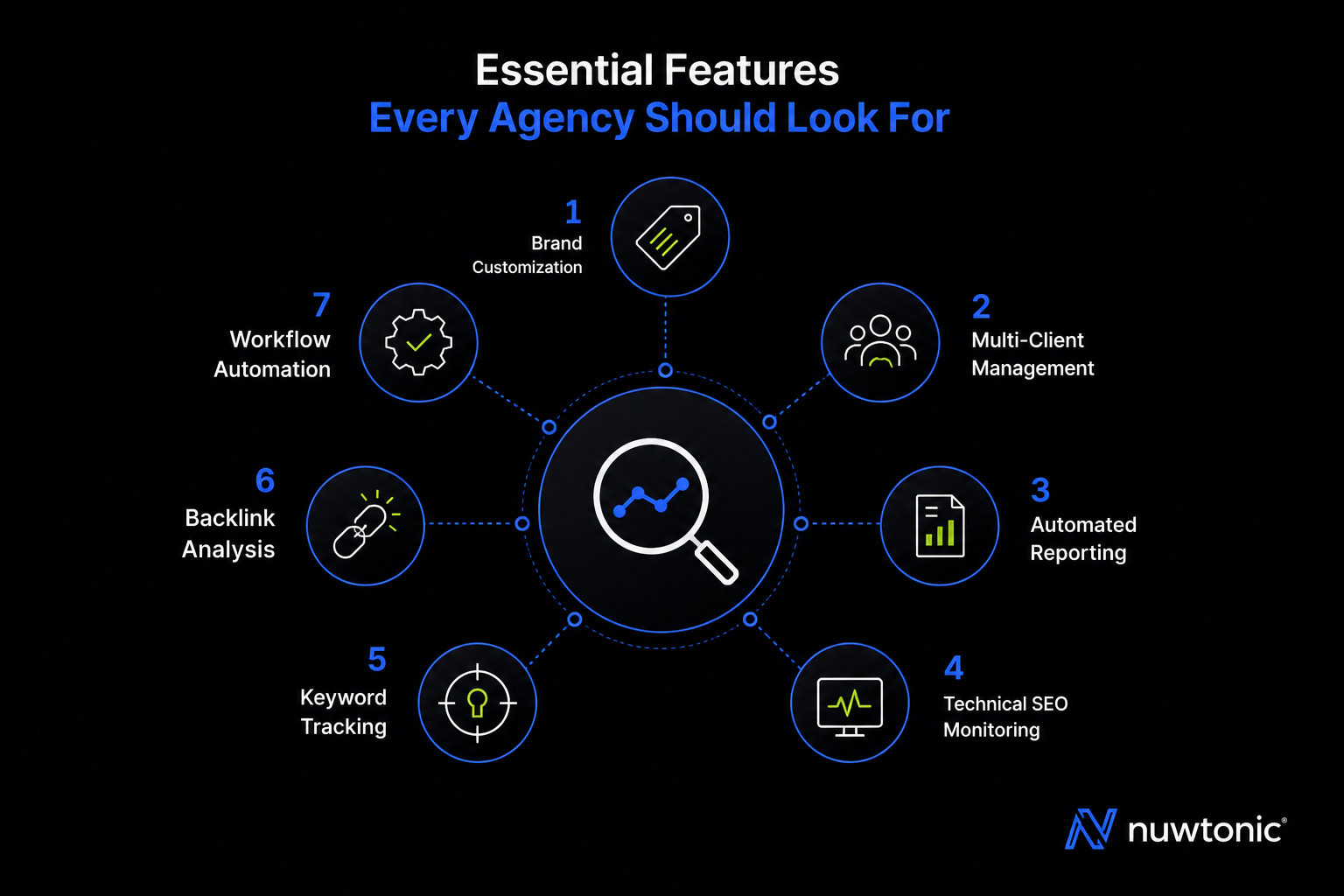
Not every platform advertising "white label SEO" offers the capabilities agencies need to scale efficiently. Instead of comparing feature lists, evaluate how each platform improves your daily operations.
1\. Complete Brand Customization
Basic logo replacement is no longer enough.
A professional white label platform should support:
Custom domain or client portal
Agency logo and colors
Branded PDF reports
Custom email notifications
Personalized dashboards
The goal is to create a seamless experience where clients interact with your agency—not the underlying software provider.
2\. Multi-Client Management
As client portfolios grow, managing campaigns individually becomes inefficient.
Look for features such as:
Client workspaces
Folder organization
Team permissions
Account segmentation
Bulk reporting
Bulk keyword management
These capabilities become increasingly important once an agency manages more than 30–50 active clients.
3\. Automated Reporting
Reporting often consumes several hours each month.
An effective platform should automate:
Monthly reports
Weekly summaries
Scheduled email delivery
Performance dashboards
Executive summaries
KPI tracking
Automation reduces administrative work while ensuring clients receive consistent updates.
4\. Technical SEO Monitoring
A white label platform should continuously monitor technical health rather than relying on occasional audits.
Key capabilities include:
Crawl error detection
Broken link monitoring
Indexability checks
Core Web Vitals tracking
Duplicate content detection
Redirect analysis
Structured data validation
Early detection helps agencies address issues before they impact organic performance.
5\. Keyword Tracking
Keyword tracking remains a foundational SEO capability, but modern agencies require more than daily position updates.
Evaluate whether the platform supports:
Local rankings
Mobile vs. desktop rankings
Competitor comparisons
SERP feature tracking
Historical visibility trends
Share of voice reporting
These insights help demonstrate progress beyond individual keyword movements.
6\. Backlink Analysis
Although Google continues to evolve its ranking systems, backlink intelligence remains valuable for competitive analysis and authority building.
Useful features include:
New and lost backlinks
Referring domains
Anchor text distribution
Toxic link detection
Competitor backlink analysis
The depth and freshness of backlink data vary significantly between platforms.
7\. Workflow Automation
One of the biggest shifts in SEO software is moving beyond reporting toward execution.
Traditional tools typically identify problems and leave implementation to agency teams.
Modern platforms increasingly assist with:
Opportunity prioritization
Task generation
Content recommendations
Technical issue classification
Performance monitoring
Workflow automation
From our perspective, this represents one of the most important developments in agency software. As agencies scale, operational efficiency often becomes a greater competitive advantage than simply collecting more SEO data.
Common Mistakes Agencies Make When Choosing White Label SEO Software
Choosing Based on Price Alone
Lower monthly costs can be appealing, but agencies should consider the total operational impact.
A platform that saves several hours of manual reporting each week may provide a stronger return on investment than a less expensive alternative with limited automation.
Prioritizing Reports Over Results
Beautiful dashboards are valuable, but clients ultimately care about business outcomes.
Before investing in software, ask:
Does it help identify high-impact opportunities?
Does it reduce repetitive work?
Does it improve decision-making?
Does it support implementation—not just reporting?
These questions often reveal greater differences between platforms than branding features alone.
Ignoring Scalability
Many agencies outgrow their software within two or three years.
Evaluate whether the platform can support:
Additional team members
Hundreds of clients
Multiple office locations
Expanded service offerings
API integrations
Custom workflows
Planning for growth reduces the likelihood of disruptive platform migrations later.
Overlooking Client Experience
Clients interact with reports far more frequently than agencies sometimes realize.
A confusing dashboard can create unnecessary support requests, while clear visualizations improve transparency and trust.
Consider:
Dashboard usability
Mobile accessibility
Custom KPIs
Executive summaries
Report readability
The reporting experience often becomes part of your agency's perceived value.
How AI Is Changing White Label SEO Software
Artificial intelligence is reshaping agency workflows, but not always in the ways marketing materials suggest.
Many platforms have introduced AI-generated content, automated summaries, or chatbot interfaces. While these features can improve productivity, they don't fundamentally change how SEO work is performed.
A more significant shift is occurring in operational automation.
Instead of simply answering questions or generating reports, newer platforms are beginning to:
Detect anomalies automatically
Surface root causes behind ranking changes
Prioritize recommendations by likely business impact
Suggest implementation paths
Monitor outcomes continuously
This reflects a broader movement toward intelligent workflow support rather than isolated AI features.
For agencies, the practical benefit is reduced time spent interpreting data and more time executing high-value work.
Can White Label SEO Software Help With AI Search?
Search behavior is expanding beyond traditional search engines.
Users increasingly discover businesses through conversational AI platforms, AI Overviews, and answer engines that synthesize information from multiple sources.
While white label SEO software has historically focused on Google rankings, agencies should consider whether future platforms also support visibility across emerging AI-driven search experiences.
Key areas to evaluate include:
Entity optimization
Structured content analysis
Brand mention monitoring
Knowledge graph consistency
Citation opportunities
Cross-platform visibility reporting
Although this area is still evolving, agencies planning for long-term growth may benefit from platforms designed with both traditional search and AI-powered discovery in mind.
Who Should Use White Label SEO Software?
White label SEO software is well suited for:
SEO agencies managing multiple clients
Digital marketing agencies expanding into SEO
Web design firms offering recurring SEO services
Freelancers building scalable client operations
Franchise marketing teams
Enterprise organizations managing multiple brands
The ideal solution depends on your operational model, reporting requirements, and long-term growth plans rather than the size of your agency alone.
Frequently Asked Questions About White Label SEO Software
What is white label SEO software?
White label SEO software is a platform that agencies use to deliver SEO services under their own brand. Instead of developing proprietary software, agencies license an existing platform and customize reports, dashboards, portals, and communications with their own branding.
Most platforms include features such as keyword tracking, website audits, backlink monitoring, competitor analysis, and automated reporting.
How is white label SEO software different from traditional SEO software?
Traditional SEO platforms are designed primarily for in-house marketing teams or individual SEO professionals.
White label platforms add agency-specific capabilities such as:
Branded reports
Client portals
Multi-client management
Team permissions
Scheduled reporting
Agency dashboards
Some platforms also include CRM integrations, proposal tools, and client onboarding workflows.
Is white label SEO software worth it for small agencies?
For agencies managing more than 10–15 recurring SEO clients, white label software often becomes a worthwhile investment.
The primary benefits include:
Reduced reporting time
More professional client communication
Easier campaign management
Better scalability
Consistent branding
The return on investment typically comes from operational efficiency rather than direct ranking improvements.
Can freelancers use white label SEO software?
Yes.
Many freelancers use white label platforms to present themselves as a full-service SEO consultancy.
Features such as branded reports, automated dashboards, and client portals can help create a more professional client experience without requiring a large internal team.
Which white label SEO software is best for local SEO agencies?
Agencies specializing in local SEO often prioritize:
Google Business Profile monitoring
Local rank tracking
Citation management
Review monitoring
Location-specific reporting
Platforms like BrightLocal are purpose-built for local search, while broader SEO suites may offer local SEO as part of a larger feature set.
Can clients access the platform directly?
Many white label platforms provide secure client portals where customers can:
View keyword rankings
Monitor traffic trends
Access reports
Review completed tasks
Track campaign progress
Providing clients with self-service access can reduce routine reporting requests and improve transparency.
Does white label SEO software improve rankings?
Not directly.
SEO software provides insights, monitoring, diagnostics, and workflow support. Rankings improve through effective strategy, implementation, technical optimization, content quality, and ongoing performance analysis.
One common misconception is that purchasing better software automatically produces better SEO results.
In reality, software improves the efficiency and quality of decision-making. Results still depend on execution.
What integrations should agencies look for?
The most valuable integrations often include:
Google Analytics 4
Google Search Console
Google Business Profile
Looker Studio
Google Ads
Microsoft Ads
CRM platforms
Slack
Zapier
Project management tools
These integrations reduce manual work and centralize reporting.
What is the biggest limitation of traditional white label SEO platforms?
Many platforms excel at collecting and presenting SEO data but stop short of helping agencies execute improvements.
As agency workloads increase, teams often spend considerable time:
Reviewing reports
Prioritizing issues
Creating task lists
Assigning work
Following up on implementation
This is one reason newer platforms are increasingly focusing on workflow automation and intelligent prioritization rather than simply expanding reporting capabilities.
White Label SEO Software Buyer's Checklist
Before selecting a platform, use this checklist to evaluate your options.
Agency Requirements
Supports unlimited or scalable client accounts
Offers branded reports and dashboards
Includes user permissions and team roles
Provides automated report scheduling
Supports local and national SEO campaigns
Offers reliable customer support
Includes API access if required
Integrates with your existing marketing stack
SEO Capabilities
Keyword tracking
Technical SEO auditing
Competitor analysis
Backlink monitoring
Site health monitoring
Performance reporting
Local SEO support
Content optimization tools
Scalability
Ask these questions during product demonstrations:
How many clients can we manage?
What happens as our agency grows?
Can reports be fully customized?
Are additional users included?
How are data limits handled?
What automation features reduce manual work?
How to Choose the Right Platform for Your Agency
There isn't a single "best" white label SEO platform for every agency.
Instead, consider your business model.
Choose AgencyAnalytics if:
Client reporting is your highest priority.
You need a polished dashboard experience.
You rely on multiple marketing integrations.
Choose SE Ranking if:
You're a growing agency with a limited budget.
You want an all-in-one SEO toolkit.
Ease of use is important.
Choose Semrush if:
You require enterprise-level keyword and competitor research.
Your agency manages complex SEO campaigns.
Budget is less of a concern.
Choose BrightLocal if:
Most of your clients are local businesses.
Citation management is a core service.
Local ranking accuracy is critical.
Choose Ahrefs if:
Backlink analysis is central to your SEO strategy.
Competitive intelligence drives your campaigns.
You already use complementary reporting tools.
Consider Nuwtonic if:
Your agency is looking beyond traditional reporting and wants to improve how SEO work gets prioritized, executed, and measured.
Rather than treating reporting as the end goal, platforms in this emerging category aim to reduce the operational gap between identifying opportunities and implementing improvements. For agencies managing dozens or hundreds of campaigns, this shift can help streamline workflows and improve scalability.
Final Takeaway
White label SEO software has become a foundational investment for agencies that want to scale recurring SEO services without compromising client experience.
While reporting and branding remain essential, the market is gradually shifting toward platforms that also improve operational efficiency through automation, intelligent diagnostics, and workflow optimization.
When evaluating solutions, avoid focusing solely on the length of a feature list. Instead, assess how well each platform helps your team:
Deliver consistent client value
Reduce repetitive manual work
Scale operations efficiently
Support data-driven decision-making
Adapt to the evolving landscape of search, including AI-powered discovery
The strongest agencies over the next few years are unlikely to be those with the most dashboards—they'll be the ones that can turn SEO insights into measurable business outcomes quickly and consistently.
Key Takeaways
White label SEO software enables agencies to deliver branded SEO services without developing proprietary tools.
The best platforms differ in their strengths, ranging from reporting and local SEO to backlink intelligence and AI-assisted optimization.
Choose software based on your agency's workflow, scalability needs, and client expectations—not feature count alone.
Automation is becoming a key differentiator as agencies seek to reduce manual reporting and accelerate execution.
As AI-driven search continues to evolve, agencies should consider platforms that can support visibility across both traditional search engines and emerging AI search experiences.