
How do I find competitor content gaps?
If you’ve asked How do I find competitor content gaps?, the short answer is this: compare what your competitors rank for, publish, and get cited for against what you cover, then prioritize the gaps that match your audience, your authority, and your resources.
Now, let’s be real—most teams make this harder than it needs to be. They open five tools, export twelve CSVs, squint at a bloated spreadsheet, and somehow end up publishing another “ultimate guide” nobody asked for. I’ve seen that movie before. It rarely ends well.
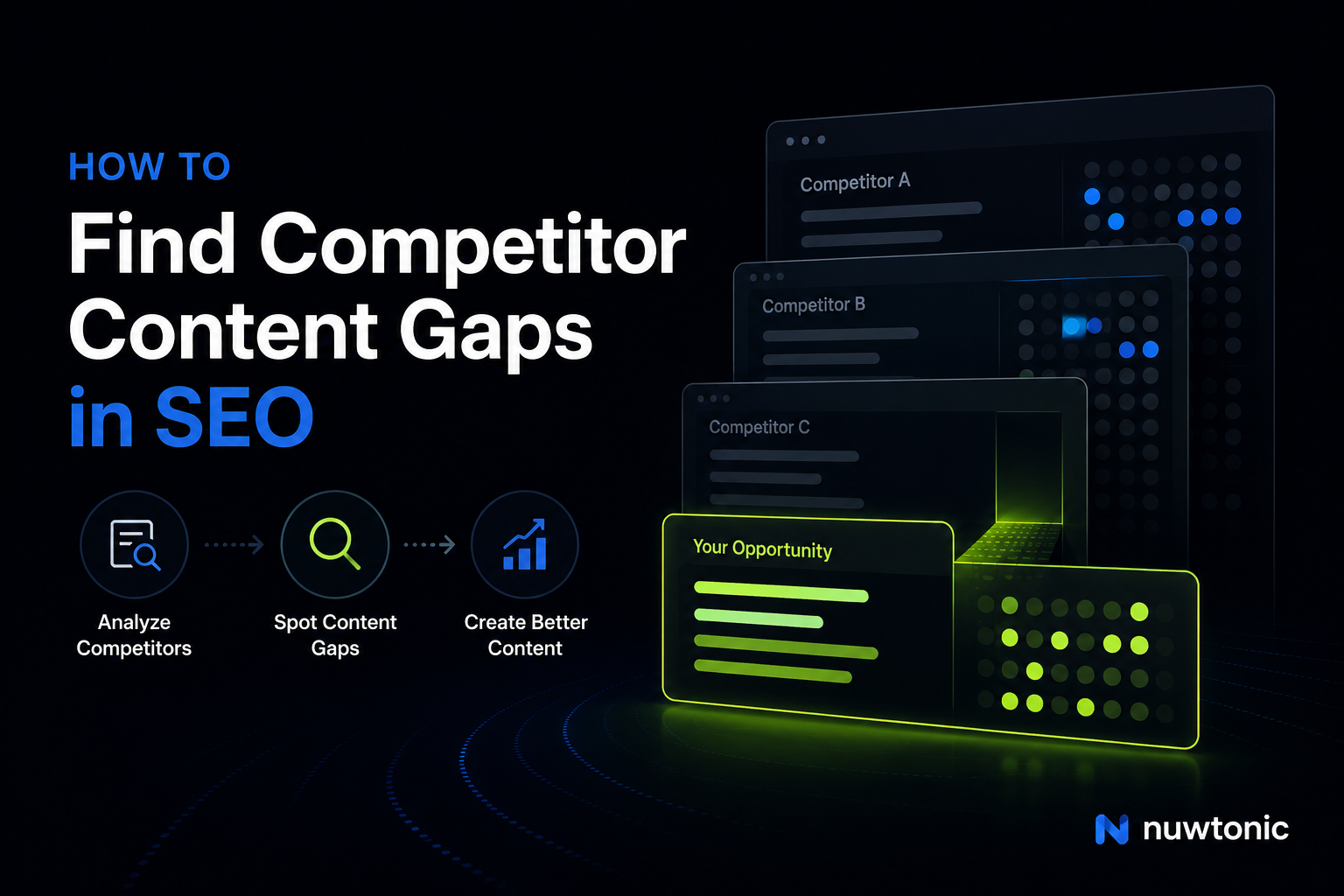
What actually works is a tighter process:
Find the right competitors in organic search, not just business rivals.
Separate gap types so you know whether you’re missing content, missing quality, or missing AI visibility.
Group opportunities into semantic clusters instead of chasing isolated keywords.
Prioritize by relevance, difficulty, and buyer’s journey stage.
Move from analysis to execution quickly—because a perfect spreadsheet is not a content strategy.
For that last part, this is where Nuwtonic is especially useful for this specific problem. Instead of making you stitch together competitor research, Google Search Console signals, topic clustering, AI citation tracking, and content planning manually, it identifies actual competitors by niche, maps keyword overlap, surfaces quick wins, and flags what to target versus skip. That matters because content gap analysis is only valuable when it leads to better pages, not prettier reports.
TL;DR Summary
• Competitor content gaps are the topics, keywords, formats, and AI citation opportunities your competitors cover better than you—or cover at all while you do not.
• There are 3 core gap types: missing content gaps, quality gaps, and AI visibility gaps.
• The most reliable process combines keyword gap analysis, manual site review, topic cluster mapping, format analysis, and buyer’s journey mapping.
• A practical competitor set is usually 3 to 5 primary competitors for clean analysis, even though tools may allow more. Moz notes that effective gap work often starts by identifying 5 to 10 significant competitors in a niche, but in practice I narrow the active comparison set to avoid noise.
• Missing keywords are typically stronger signals than untapped keywords because multiple competitors already validate the opportunity.
• Staleness is a gap metric too—if a competitor’s content is over 12 to 24 months old and lightly maintained, it may be ripe to supersede.
• Nuwtonic helps by identifying real competitors, showing keyword overlap, highlighting quick wins, and connecting that analysis directly to content creation and AI visibility work.
Key Takeaways
• Don’t confuse absence with weakness. Some gaps mean you have no content. Others mean your existing page simply isn’t good enough.
• Analyze organic competitors, not just commercial competitors. The site outranking you may not sell what you sell.
• Target clusters, not only single keywords. That’s how you build topical authority rather than a random pile of posts.
• Use buyer’s journey mapping. Many marketers overlook the importance of understanding the customer journey when identifying content gaps—it’s crucial to know what your audience is really looking for.
• Include AI citation gaps. Traditional SEO-only analysis misses where competitors are appearing in AI-generated answers and you are not.
• Prioritize opportunities you can realistically win. Quick wins beat ambitious irrelevance every time.
Table of Contents
What competitor content gaps actually are
A content gap is not just “keywords I don’t rank for”
A lot of articles flatten this topic into a keyword spreadsheet. That’s too simplistic.
A competitor content gap can mean several different things:
Gap Type | What it means | Typical signal | What to do |
|---|---|---|---|
Missing content gap | You have no page for a topic competitors cover | Competitors rank, you do not | Create new content |
Quality gap | You have a page, but it’s weaker than competing pages | Low rankings, poor engagement, weak depth | Upgrade or consolidate content |
Format gap | Competitors use a content type you don’t | They rank with videos, templates, comparisons, or tools | Match or improve the format |
AI visibility gap | Competitors are cited in AI answers while you are not | Low mention share in AI search | Improve citation readiness and entity coverage |
Journey gap | You cover one stage of the funnel but ignore others | Awareness-heavy blog, no decision content | Add content by buyer stage |
Staleness gap | Competitor content is outdated and vulnerable | Old publish dates, no refreshes, stale examples | Publish fresher, more useful content |
That distinction matters because the solution changes. If you treat a quality gap like a missing keyword gap, you’ll create duplicate content and cannibalization issues. If you treat an AI visibility gap like a normal on-page tweak, you’ll miss the structural and citation signals that matter.
Commercial competitors are not always your SEO competitors
This trips people up constantly.
A commercial competitor sells something similar to you. An organic search competitor simply outranks you for the queries you want. Andava’s 2024 guide makes this distinction clearly, and it’s one of the most useful framing points in this whole topic.
For example:
Competitor Type | Example | Useful for gap analysis? | Why |
|---|---|---|---|
Commercial rival | Same product category, same customer | Sometimes | Good for messaging and product pages |
Organic competitor | Different business model but ranks for your target SERP | Yes, often more useful | Reveals what search engines reward |
Publisher/media site | Blog or review site in your niche | Yes, selectively | Useful for top-of-funnel and comparison SERPs |
Massive authority site | Wikipedia, Forbes, Amazon | Usually limited | Hard to benchmark directly for actionable wins |
In my experience, the sweet spot is analyzing 3 to 5 competitors deeply. Yes, Ahrefs’ Help documentation says you can compare up to 10 competitors, and SEO Clarity allows a domain plus up to 5 domains in comparison. But more inputs often create more noise, not more insight. Your mileage may vary, but once a report starts mixing niche peers with giant publishers, prioritization gets messy fast.
The best gap opportunities usually sit inside clusters
One of the more useful insights from Microniche Browser’s 2024 analysis is that many niche SaaS blogs put 70% to 80% of their content into just 1 or 2 topic clusters. That tells me two things:
• Competitors often over-invest in obvious clusters.
• There are often under-covered adjacent themes where you can build topical authority faster.
So yes, individual keywords matter. But the better question is this: which semantic clusters are competitors winning that you barely cover?
Most people think they need to reinvent the wheel to fill content gaps, but often, it’s about refining what’s already out there. A cluster-based approach helps you do that without producing disconnected articles.
The 3 gap types you need to separate
1\. Missing and untapped keyword gaps
This is the classic starting point.
12am Agency’s 2026 guide defines Missing keywords as terms where at least two competitors rank in the top 10 and your site does not rank at all. The same guide defines Untapped keywords as terms where at least one competitor ranks and you do not.
That distinction is more useful than people realize:
Keyword Gap Label | Competitive validation | Risk level | Typical priority |
|---|---|---|---|
Missing | 2+ competitors rank in top 10 | Lower uncertainty | Higher |
Untapped | 1 competitor ranks | More variable | Medium |
Why I like this framework: Missing keywords imply established demand with multiple winners, so they’re often stronger bets. Untapped terms can still be valuable, but they need more scrutiny for intent, relevance, and SERP fit.
A content audit often reveals more than advanced tools; sometimes, you just need to look at what your competitors are missing. But when you want scale, a proper keyword gap tool saves a lot of repetitive work.
2\. Quality gaps in pages you already have
This is where many teams underperform.
If you already have a page on the topic, the gap may not be “publish more.” It may be:
• Better structure
n• Stronger entity coverage
• Clearer alignment with search intent
• More recent examples
• Better on-page depth
• More useful formatting, such as comparisons, tables, or FAQs
Hash Meta’s 2024 framework separates quality gaps from plain topic gaps, which is the right way to think about it. If your article exists but barely addresses the user’s real question, you don’t have topic coverage—you have the appearance of coverage.
Now, let’s be real—I once led a content refresh project where we kept publishing adjacent posts instead of fixing a thin, underperforming core page. Traffic stayed flat, cannibalization got worse, and we lost weeks. The page didn’t need a sibling. It needed a spine.
3\. AI visibility gaps
This is the newer layer that too many “content gap” guides still treat as optional.
Semrush notes that its Topic Opportunities view can reveal prompts where competitors are mentioned but your brand is not. That’s not a normal ranking gap. That’s an AI visibility opportunity.
For SEO teams in 2026, that matters because users increasingly get synthesized answers before they ever click through to a site.
Here’s how I frame it:
AI Visibility Signal | What it suggests | Action |
|---|---|---|
Competitor cited, you absent | You’re not seen as a source on the topic | Improve content depth, structure, authority cues |
Your page ranks, but is not cited | Ranking alone isn’t enough for AI mention | Improve answer clarity and citation readiness |
You’re cited on some prompts only | Patchy topic authority | Build supporting cluster content |
Competitors dominate prompt categories | They own the entity association | Expand topic map and supporting evidence |
This is one area where Nuwtonic is particularly relevant to the question you asked. Its AI search visibility section lets you track prompts, see whether your site is being cited, and run citation gap analysis on URLs where you are missing visibility. That directly addresses competitor content gaps in AI search—not in a theoretical sense, but in an operational one.
A step-by-step process to find competitor content gaps
Step 1: Pick the right competitor set
Start with 3 to 5 meaningful competitors. Keep a wider watchlist if you want, but don’t cram everything into one working analysis.
Use this filtering logic:
Include competitors ranking for your target SERPs.
Include at least one peer with a similar authority profile.
Include one aspirational competitor if they’re still relevant.
Exclude giant outliers unless you’re studying format patterns.
Separate commercial rivals from organic competitors in your spreadsheet.
Selection Rule | Include | Exclude |
|---|---|---|
SERP overlap | Domains ranking for your target queries | Sites with no topical overlap |
Authority comparability | Peers within a realistic reach | Dominant sites you can’t benchmark against usefully |
Audience similarity | Content serving a similar customer journey | Irrelevant publishers with mismatched intent |
Format relevance | Sites succeeding with content forms you can replicate | Platforms requiring resources you don’t have |
Fair warning: if you compare against the wrong sites, everything downstream becomes misleading.
Step 2: Run a keyword gap analysis
This is the fastest way to answer How do I find competitor content gaps? at scale.
Ahrefs’ 2024 guide explains the core mechanism simply: take all keywords a competitor ranks for and subtract the keywords your site ranks for. Backlinko also describes the process as entering a competitor URL into a tool, reviewing top-performing keywords, and checking first-page results individually.
If you want tool-supported workflows, these are solid references:
• Ahrefs content gap analysis guide
• Semrush content gap analysis walkthrough
Prioritize these filters:
Relevance to your offer or audience
Search intent fit
Keyword difficulty
Search volume
Number of competitors ranking
Existing topical authority on your domain
Semrush specifically notes that setting KD to “Very easy” isolates terms that are very easy to rank for in the top 10. That’s useful if you need quick wins—not glamorous, but useful.
Step 3: Do a manual site and sitemap review
Paid tools are efficient. They are not omniscient.
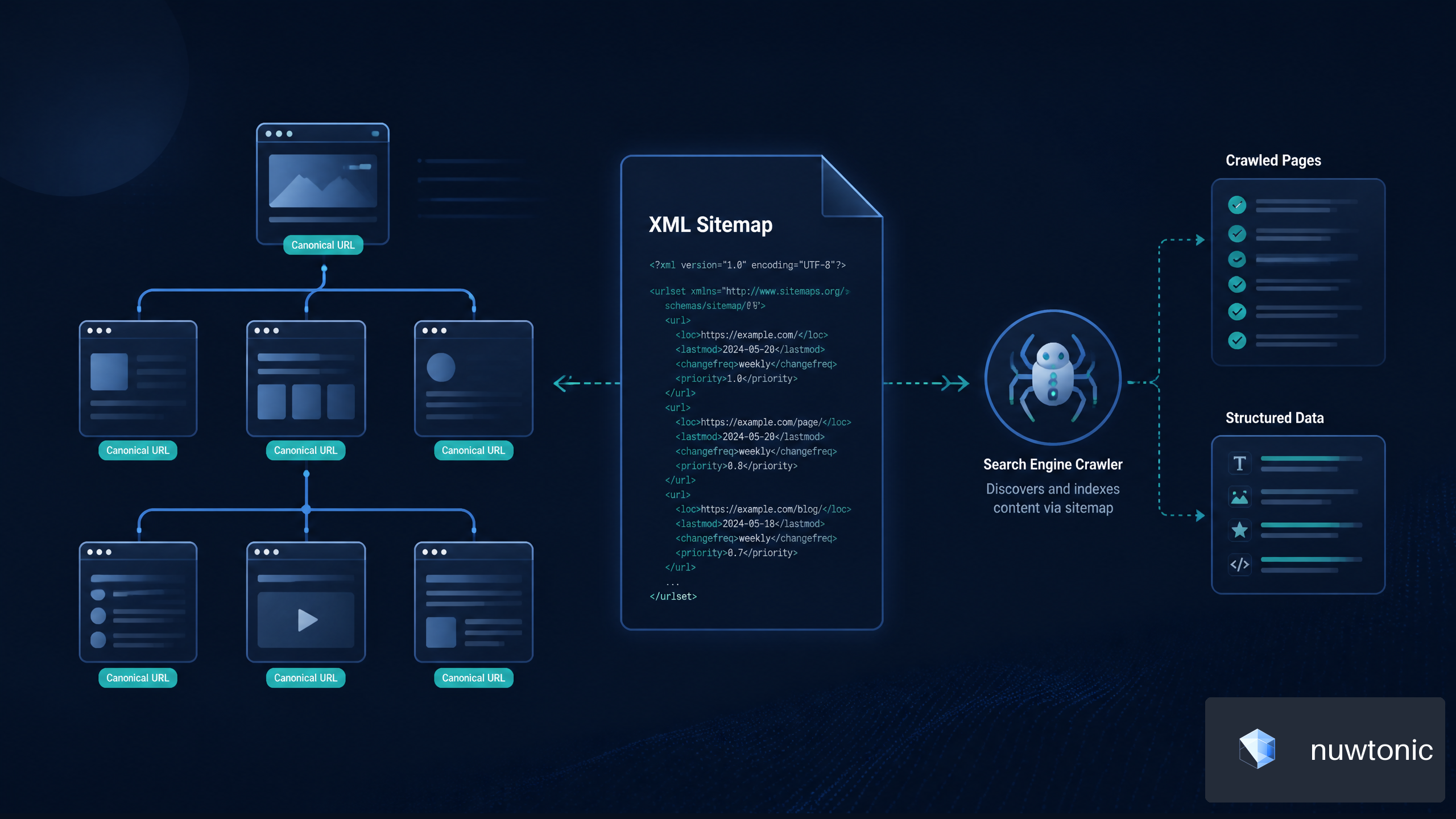
12am Agency recommends using the site: operator and checking a competitor’s sitemap.xml as a literal roadmap of content strategy. I like this because it reveals categories and page types that keyword tools sometimes flatten.
Use searches like:
• site:competitor.com/blog your topic
• site:competitor.com "comparison"
• site:competitor.com "template"
• site:competitor.com "how to"
And then review:
Topic categories
Content formats
Naming patterns
Update cadence
Hub pages versus standalone posts
Manual Source | What it reveals | Best use case |
|---|---|---|
| Indexed content by topic or format | Free discovery |
| Full URL inventory | Category-level gap mapping |
Blog index | Editorial priorities | Format and frequency review |
SERP inspection | Intent and page type | Validation before writing |
This is also where you can spot format gaps—for instance, competitors winning with checklists, calculators, side-by-side comparisons, or short explainer pages while your blog leans on long-form opinion pieces.
Step 4: Group findings into semantic clusters
This step is often skipped because it feels less exciting than exporting a CSV. It is not optional.
Create a simple content matrix with these columns:
Cluster | Supporting keywords | Search intent | Buyer stage | Current asset? | Competitor strength | Priority |
|---|---|---|---|---|---|---|
Topic cluster name | Related terms | Informational, commercial, navigational | Awareness, consideration, decision | Yes/No | Weak/Medium/Strong | High/Medium/Low |
Group by theme, not exact-match wording.
For example, instead of treating these as separate isolated keywords:
• competitor content gaps
• content gap analysis process
• find missing keywords
• identify keyword overlap
You’d group them into a cluster like Content Gap Analysis Methods.
That matters because cluster coverage improves internal coherence, topical authority, and content planning efficiency. It also makes your editorial roadmap less chaotic.
Step 5: Check buyer’s journey coverage
Moz’s perspective on gap analysis reinforces something I wish more teams took seriously: your content should map across the buyer’s journey.
Many marketers overlook the importance of understanding the customer journey when identifying content gaps—it’s crucial to know what your audience is really looking for.
Use a simple mapping framework:
Buyer Stage | Search behavior | Content examples | Common gap |
|---|---|---|---|
Awareness | Learning and diagnosis | How-to guides, definitions, checklists | Too much generic traffic content |
Consideration | Comparing methods or tools | Comparisons, workflows, case-style pages | Missing evaluation content |
Decision | Vendor or solution selection | Product-led pages, alternatives, ROI content | Weak bottom-of-funnel support |
One pattern I keep seeing is teams with 40 awareness posts and almost no decision-stage content. Traffic looks healthy, pipeline looks confused, and everyone wonders why content “isn’t converting.” That’s not a traffic problem. It’s a customer journey gap.
Step 6: Evaluate staleness and update opportunities
Microniche Browser’s 2024 guidance points out that competitor content calendars often show visible gaps, such as months with no publication or clusters not updated in two years.
I use this practical rule of thumb:
Content age | What it usually means | Recommended action |
|---|---|---|
0 to 6 months | Fresh enough | Compete only if you have a materially better angle |
6 to 12 months | Watch closely | Check for outdated examples or weaker formatting |
12 to 24 months | Potentially stale | Strong candidate for superseding if SERP has shifted |
24+ months | Often vulnerable | High-priority freshness gap if topic is active |
There’s no universal standard here, so I’ll be careful not to overstate certainty. But for fast-moving SEO, AI search, SaaS, ecommerce, or compliance topics, content older than 12 months can already be shaky. For slower-moving subjects, 24 months may still be fine. This depends heavily on query volatility.
Step 7: Export, score, and prioritize
This is where strategy becomes action.
Export your data to a spreadsheet or content planning system and score each opportunity using a few consistent criteria.
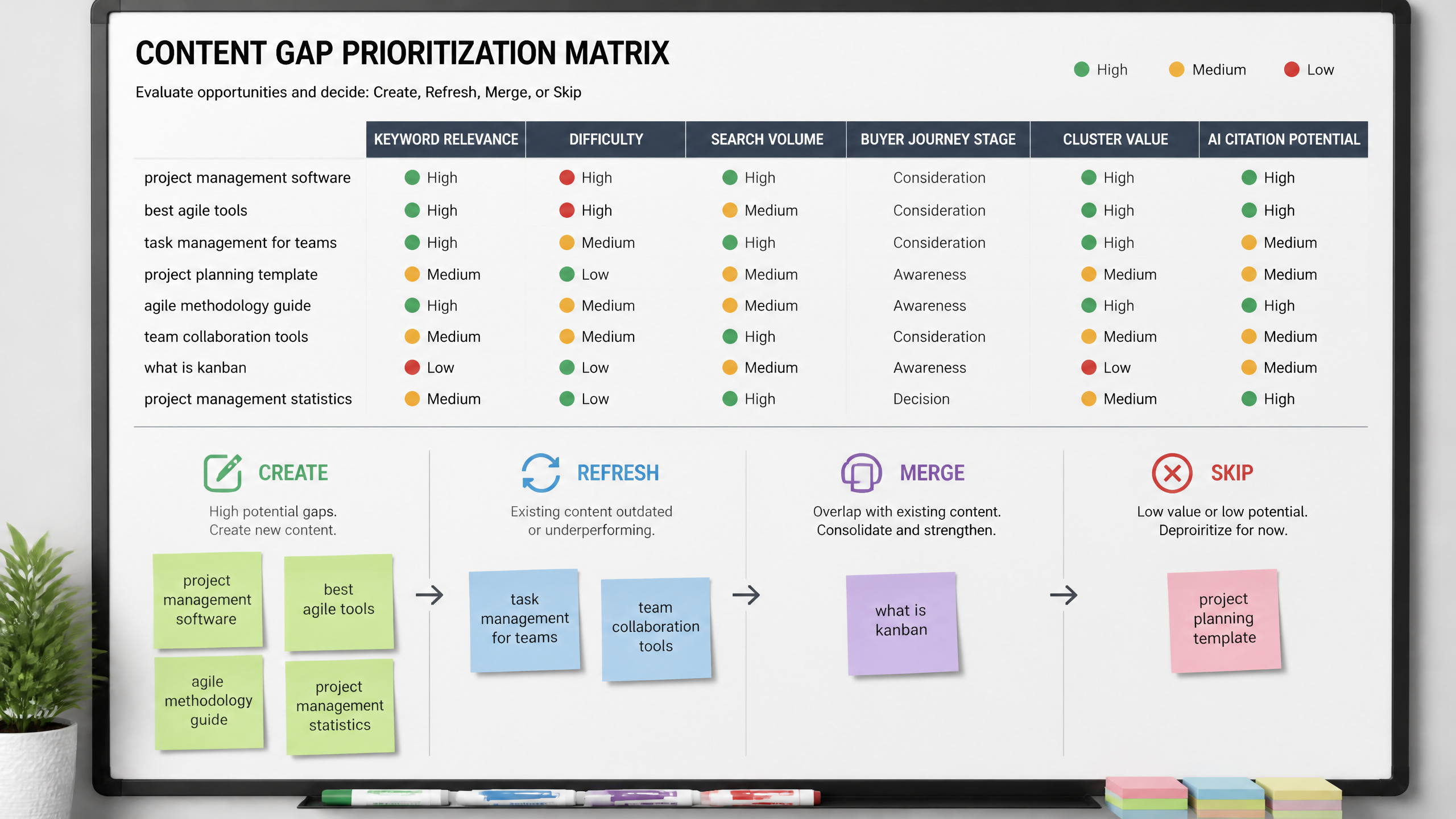
Use a scoring model like this:
Factor | Weight suggestion | What to ask |
|---|---|---|
Business relevance | 30% | Does this attract the right audience? |
Ranking feasibility | 20% | Can we realistically compete? |
Search demand | 15% | Is there enough traffic potential? |
Cluster value | 15% | Does it support broader topical authority? |
Buyer stage importance | 10% | Does it fill a funnel gap? |
AI citation potential | 10% | Could this improve AI visibility? |
What to do:
Score every candidate 1 to 5 on each factor.
Multiply by weight.
Sort by total score.
Label each item as create, refresh, merge, or skip.
What definitely NOT to do:
• Don’t prioritize by search volume alone.
• Don’t chase every untapped keyword.
• Don’t create new pages where a refresh would be smarter.
• Don’t ignore AI visibility if your niche is already seeing citation competition.
How to prioritize the gaps worth pursuing
Use a quick-win versus strategic-bet framework
Not every gap deserves immediate action.
I like splitting opportunities into two buckets:
Opportunity Type | Characteristics | Best for |
|---|---|---|
Quick win | Lower KD, clear intent, relevant cluster, weak competition | Near-term traffic gains |
Strategic bet | Higher difficulty, bigger cluster, stronger business value | Long-term topical authority |
Semrush’s KD filter is useful here. If a term is marked Very easy, it can be a sensible place to start. But a low-difficulty keyword with weak business relevance is still a distraction.
Validate the SERP before writing anything
Backlinko’s process of checking the first page manually still matters. Tools can tell you that a gap exists. The SERP tells you what kind of page Google actually wants.
Before assigning content, review:
Dominant page type
Search intent pattern
Content depth level
Presence of videos, tools, or comparison pages
Recency of top results
If the SERP is full of product pages and you publish an educational blog post, don’t act surprised when it stalls.
Prioritize clusters over one-off articles
Here’s one of the big strategic insights most articles miss: single-keyword wins decay faster than cluster wins.
Why?
• Clusters reinforce internal relevance.
• Supporting pages improve the pillar page’s authority.
• You can reuse research, examples, and entities across content.
• AI systems often respond better to coherent topic coverage than isolated pages.
A niche SaaS scenario I’ve seen repeatedly looks like this: a team notices a competitor dominates two obvious clusters, but leaves a third adjacent cluster underdeveloped. They build 5 to 7 tightly related pieces in that under-served area, connect them well, and suddenly they’re not fighting head-on for the loudest category—they’re owning the neglected one.
That’s smarter than trying to outrank a giant head term with one heroic article.
How Nuwtonic solves competitor content gap discovery
It identifies the right competitors instead of making you guess
One of the most annoying parts of content gap analysis is choosing comparison domains. Nuwtonic’s competitor gap section identifies your actual competitors by niche, which helps avoid the classic mistake of comparing yourself to the wrong websites.
That matters because bad inputs produce bad keyword mapping.
With Nuwtonic, the workflow is more focused:
Problem in traditional workflow | What Nuwtonic does |
|---|---|
You manually choose competitors and hope they’re relevant | Identifies actual competitors by niche |
You compare random keyword sets in separate tools | Maps keyword overlap in one place |
You get overwhelmed by raw keyword exports | Highlights quick wins |
You waste time on weak opportunities | Flags what to target versus skip |
For this topic specifically, that last row is the real win. Gap analysis should reduce decision fatigue, not create more of it.
It connects GSC reality to gap discovery
Most competitor gap tools are useful—but disconnected. They show market opportunity without grounding it in your actual site performance.
Nuwtonic starts from your Google Search Console data, then layers its analyses on top of that foundation. That means your gap analysis is not just “what competitors rank for,” but also how those opportunities relate to:
• Existing topic clusters
• Zero-CTR queries
• Ranking gaps by device
• Cannibalization patterns
• Trust-related signals
Now, let’s be real—this is exactly where a lot of SEO stacks get messy. One tool tells you what competitors are doing. Another tells you what your site is doing. Then you become the API between them. That’s not strategy. That’s unpaid data plumbing.
Nuwtonic removes a lot of that friction for this exact use case.
It helps with AI visibility gaps, not just SEO gaps
This is where Nuwtonic is more aligned with 2026 search behavior than many standard content gap workflows.
Its AI search visibility system lets you:
Add prompts you want to track
Monitor whether your site is being cited across AI platforms
See ranking and share-of-voice patterns
Run a full citation gap analysis when your site is missing
And the citation gap analysis goes beyond “you’re not mentioned.” It can surface:
• Content gaps
• Structural gaps
• E-E-A-T gaps
• Competitor gaps
That matters because AI visibility is often lost for reasons a traditional rank tracker won’t explain.
It shortens the path from gap to publishable content
This is the part I appreciate most as a content strategist: finding a gap is only useful if the team can actually move on it.
Nuwtonic lets you move from a quick-win keyword in the competitor gap section toward article generation without leaving the workflow. Its content writer uses your GSC data and existing topical authority to generate a topical map and draft content around what Google already trusts your site for.
That’s useful for competitor content gaps because it reduces a common failure point:
Stage | Traditional process | Nuwtonic approach |
|---|---|---|
Gap discovery | Manual exports from multiple tools | Competitor gap section |
Prioritization | Spreadsheet triage | Quick-win and skip guidance |
Topic planning | Separate keyword mapping process | Topical map based on site authority |
Draft creation | Another tool or blank doc | Built-in content generation |
I’m deliberately not turning this into a generic product overview because that would miss your question. For finding competitor content gaps specifically, Nuwtonic’s value is that it combines:
• Competitor identification
• Keyword overlap mapping
• Quick-win detection
• AI citation gap analysis
• Direct handoff into content planning
That’s the exact chain most teams struggle to connect.
Common mistakes and what definitely NOT to do
Mistake 1: Using too many competitors
More data is not always better data.
If you analyze 10 wildly different sites, you’ll often end up with:
• Bloated keyword lists
• Mixed search intents
• Unrealistic benchmarks
• Confused prioritization
What to do instead:
• Start with 3 to 5 close competitors
• Add outliers only for secondary review
• Keep your comparison set consistent for scoring
Mistake 2: Treating every gap like a new article
A gap can mean:
• Create a new page
• Refresh an old page
• Merge overlapping pages
• Add a missing section to an existing asset
What definitely NOT to do:
• Publish near-duplicate pages for every variation
• Ignore cannibalization signals
• Split one cluster into ten weak posts without a hub
Mistake 3: Ignoring format gaps
If competitors rank because they use:
• Tables
• Comparisons
• Templates
• Videos
• FAQ blocks
• Tools or calculators
…and you respond with a generic blog post, you’re not really addressing the gap.
A content gap is sometimes a format mismatch, not a topic mismatch.
Mistake 4: Chasing AI mentions without relevance
Semrush’s AI-oriented opportunity views are useful, and Nuwtonic’s prompt tracking is useful too—but not every absent mention is a problem.
Ask:
Is my brand actually a credible source for this prompt?
Do I have content that deserves citation?
Is the prompt commercially or strategically relevant?
If the answer is no, skip it. Not every mention is worth pursuing.
Mistake 5: Skipping the manual review
One situation I keep seeing is marketers relying entirely on automated reports, then producing content that technically targets the keyword but misses the SERP’s actual format or audience expectation. The result is familiar: a decent brief, a polished draft, and no ranking momentum.
Automation is great. Blind automation is expensive.
FAQ
How do I find keywords where competitors rank but I don’t without paying for a tool?
You can use a manual process:
Search target queries in Google.
List recurring competitor domains from page one.
Use the
site:operator to inspect their topic coverage.Review their blog categories and
sitemap.xml.Compare that against your own content matrix.
12am Agency specifically recommends site:competitor.com "keyword" searches and checking sitemap.xml for a complete roadmap. The trade-off is time—Backlinko’s description of checking first-page keywords one by one captures the manual pain pretty well.
What’s the difference between missing and untapped keywords?
12am Agency’s 2026 framework is the clearest version:
Term | Definition |
|---|---|
Missing keywords | Keywords where at least 2 competitors rank in the top 10 and you do not rank at all |
Untapped keywords | Keywords where at least 1 competitor ranks and you do not |
I generally prioritize missing keywords first because they show broader competitive validation.
How many competitors should I include in a content gap analysis?
Moz suggests identifying 5 to 10 significant competitors in your niche, and Ahrefs allows comparison against up to 10. In actual execution, I usually recommend 3 to 5 core competitors for cleaner prioritization, then keeping others as reference domains.
How do I identify format gaps?
Review competitor pages for recurring formats:
• Tutorials
• Comparison pages
• Videos
• Infographics
• Templates
• Tools
• FAQ-heavy pages
If several top-ranking results use a format you don’t, that’s a gap. Andava’s guidance supports comparing not just topics, but how content is presented.
Can I use Google’s `site:` operator to find competitor content gaps manually?
Yes. It’s one of the best free methods for manual discovery. 12am Agency explicitly recommends using the site: operator and reviewing sitemap.xml to map a competitor’s content categories.
How do I prioritize content gaps based on keyword difficulty and search volume?
Use at least these filters:
Relevance
Intent match
Keyword difficulty
Search volume
Cluster value
Buyer stage importance
Semrush notes that the “Very easy” KD filter is helpful for isolating easier ranking opportunities. Just don’t let low difficulty override business relevance.
How do I know if a competitor’s content is stale?
A useful practical framework is:
• 12+ months old in fast-moving categories: check carefully
• 24+ months old with no visible updates: often a strong superseding opportunity
• Outdated examples, screenshots, stats, or product references: likely vulnerable regardless of date
Microniche Browser specifically highlights clusters not updated in two years as visible opportunity areas.
Is it better to target semantic clusters or single keywords?
Usually semantic clusters.
Single keywords are useful for discovery and prioritization, but clusters are better for:
• Topical authority
• Internal linking logic
• SERP coverage
• AI visibility consistency
• Editorial efficiency
A single keyword can win a click. A cluster can build a durable presence.
Can I find content gaps by analyzing forums and Reddit?
Yes, especially for pain-point discovery. The research base here is lighter on direct forum citations, so I won’t overclaim specifics. But as a method, reviewing Reddit, niche forums, sales call notes, and support tickets often reveals questions competitors either answer poorly or ignore entirely.
How does Nuwtonic help me find competitor content gaps faster?
For this exact problem, Nuwtonic helps by:
• Identifying actual competitors by niche
• Mapping keyword overlap
• Highlighting quick-win opportunities
• Flagging what to target versus skip
• Tracking AI prompt visibility and citation gaps
• Connecting gap findings directly to content planning and generation
So instead of juggling separate tools for competitor discovery, GSC analysis, AI visibility tracking, and article production, you can work from one workflow.
Sources and references
• Backlinko on content gap analysis
• 12am Agency competitor content gap analysis guide
• Semrush content gap analysis guide
• Ahrefs content gap analysis guide
• Moz content gap analysis guide
• Surfer SEO content gap analysis guide
• Andava content gap analysis guide
Final thought
If you want the honest answer to How do I find competitor content gaps?, it’s this: don’t just look for keywords competitors rank for. Look for missing topics, weak pages, stale clusters, format mismatches, funnel blind spots, and AI citation gaps.
Now, let’s be real—that’s a lot to manage manually. And that’s exactly why teams end up with half-finished spreadsheets and delayed content calendars.
If your goal is to solve this specific problem faster, Nuwtonic is useful because it narrows the process to what matters: identifying real competitors, surfacing keyword overlap, highlighting quick wins, spotting AI citation gaps, and moving directly into execution. That’s a much better use of your time than playing spreadsheet archaeologist for a week.
The best content gap analysis is the one that leads to a smarter publish decision this week—not a prettier report next month.