TL;DR Summary
Can AI build my topical map? Yes—but only if it works from real site data, search intent, and content gaps rather than generic keyword brainstorming.
Honestly, this is where a lot of teams go wrong. They ask AI for a map, get a polished list of topics, and assume strategy is done. It usually is not. A useful SEO roadmap needs to reflect:
• What your site already ranks for
• Where your authority already exists
• Which content gaps are worth filling
• What competitors are winning on
• Which topics support business outcomes, not just traffic vanity
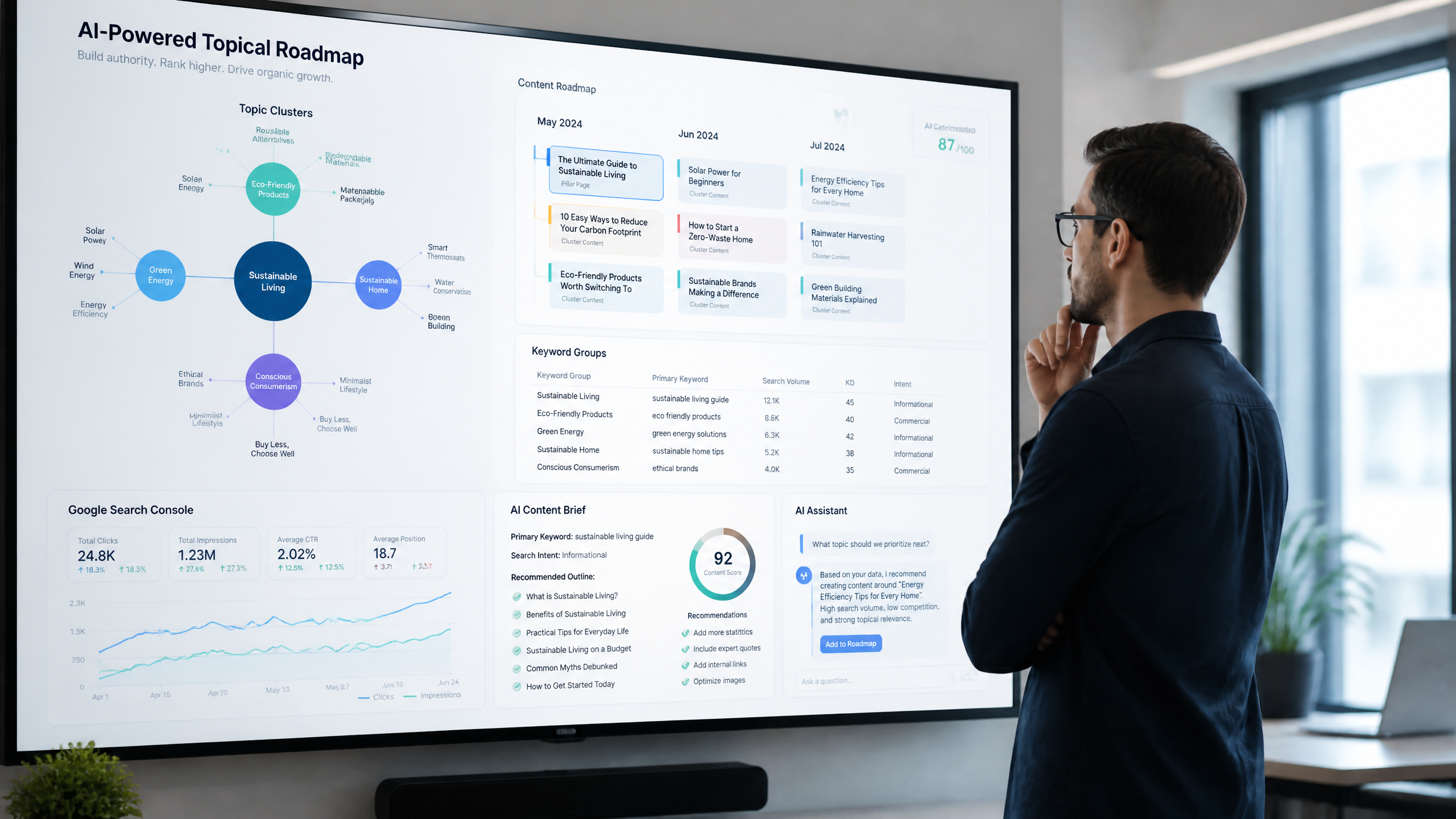
Nuwtonic solves this specific problem well because it builds from your Google Search Console data, existing topical authority, topic clusters, competitor gaps, and page-level opportunities—instead of starting from a blank prompt.
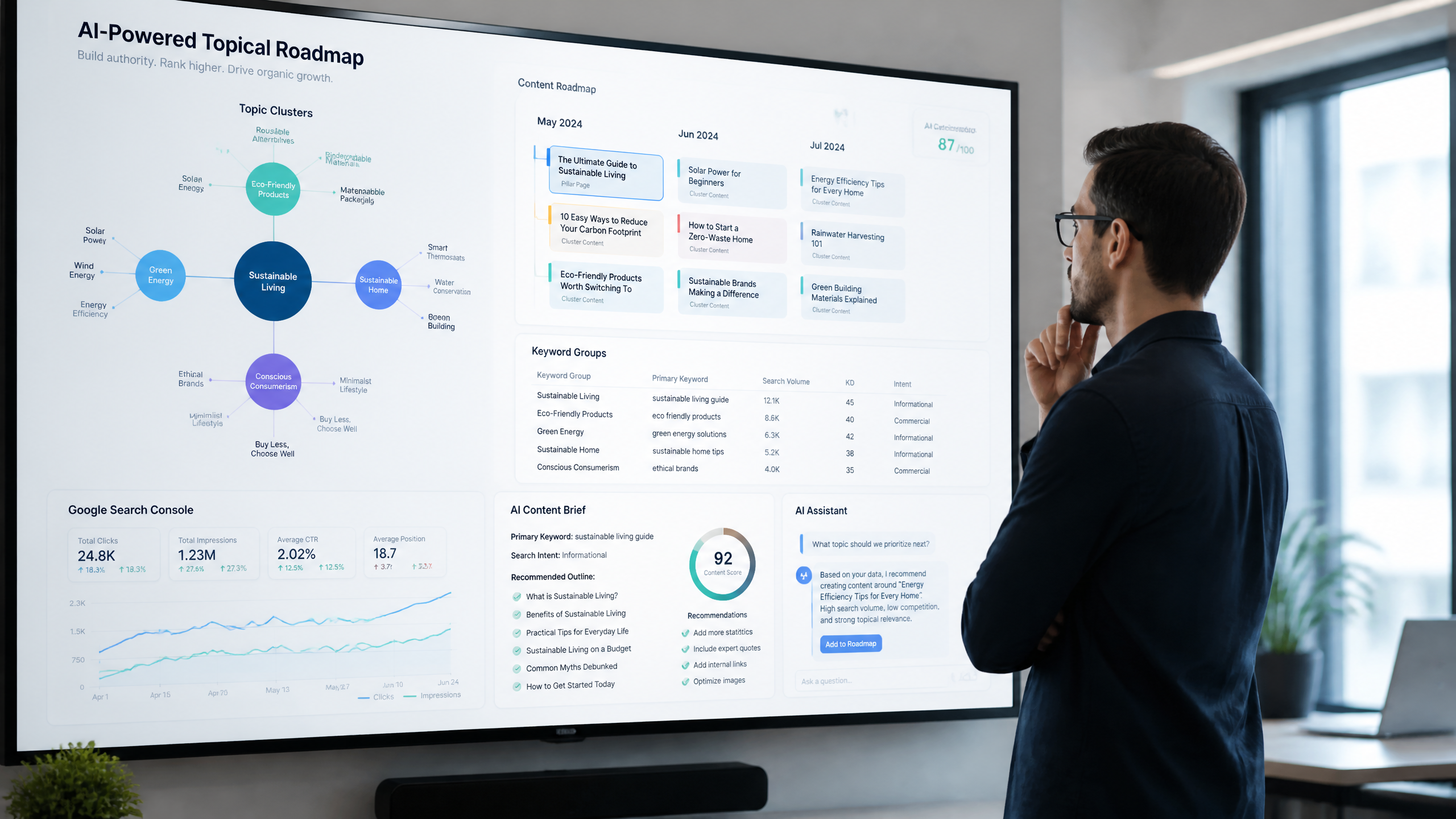
Table of Contents
Key Takeaways
• AI can build a topical roadmap, but the output quality depends heavily on inputs, constraints, and validation.
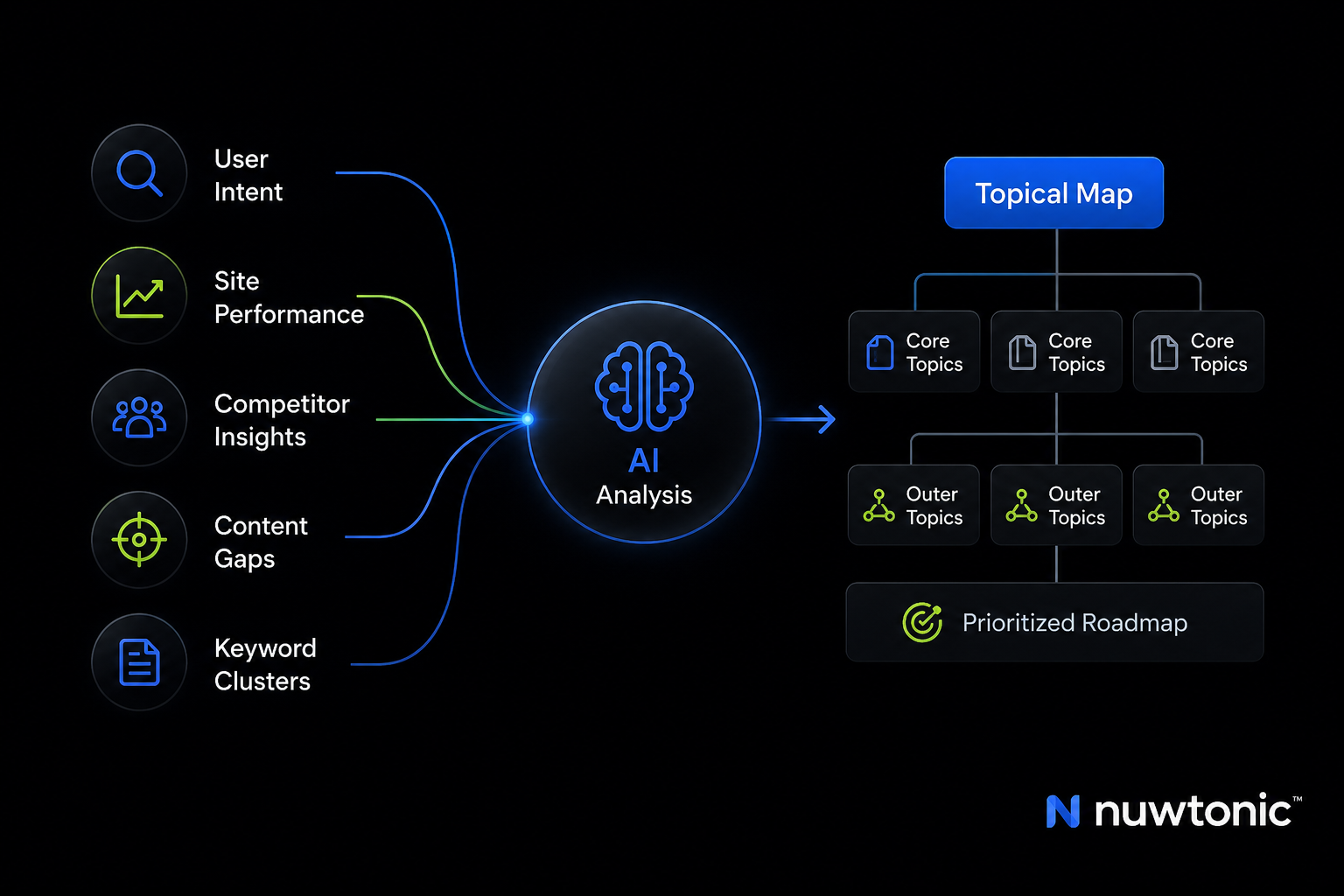
• The strongest systems do more than keyword clustering—they connect user intent, content gaps, competitor data, and current site performance.
• Tool demos in the market show fast generation. For example, Toolsolved says Topical Map AI can generate a map in 60 seconds, while Moonlit Platform says its app can create a 100 topic cluster plus 10 future clusters in minutes.
• Most AI roadmaps should be treated as a first draft, not a final strategy.
• Nuwtonic’s advantage for this exact use case is that it grounds topical planning in your Google Search Console data and existing authority instead of producing a disconnected list of ideas.
Can AI build my topical map?
The short answer: yes, but not by magic
Yes, AI can build your topical map. The better answer is that AI can assemble the raw strategic structure of a map much faster than a human doing everything manually.
That includes:
• Keyword clustering
• Topic expansion
• Content gap analysis
• Competitor comparison
• Search intent grouping
• Prioritization support
Data from Topical Map AI says a topical map can be generated in 60 seconds, which captures the obvious benefit: speed. Moonlit Platform’s topical map generator goes further, describing a workflow that outputs 50 core topics, 50 outer topics, and 10 future clusters from six plain text inputs.
That said, speed is not the same as strategic fit.
I’ve found that AI can streamline the map process, but it’s crucial not to overlook the human touch — context matters. A map is not just a content wishlist. It is a decision system.
What “topical map ” actually means
Look, a lot of people mix up three different things:
Term | What it is | What it is not |
|---|---|---|
Keyword list | Raw search phrases to target | A publishing strategy |
Topic cluster | A grouped set of related content ideas | A prioritized map |
Topical map | A sequenced plan showing what to publish, improve, and connect based on authority, intent, and business goals | Just AI-generated brainstorm output |
A real topical map usually includes:
Core topics that support your money pages or primary conversions
Outer topics that expand authority and capture informational demand
Content gaps where competitors cover intent better than you do
Order of operations so your cluster structure builds logically
KPIs tied to rankings, CTR, visibility, and conversions
Why marketers are asking this question now
The question “Can AI build my topical map ?” keeps coming up because the old process is slow and fragmented.
One pattern I keep seeing is this: a team exports keyword sets from Ahrefs or Semrush, drops them into spreadsheets, debates search intent for days, then still ends up with content clusters that don’t match what the site can realistically rank for. By the time they publish, the plan already feels stale.
That pain is exactly why AI map tools are getting traction. Miro frames AI as a way to organize scattered notes and suggest next steps quickly, while Venngage positions AI roadmap generation around defined goals, KPIs, and audience insights. The signal here is clear: people do not just want ideas—they want structure.
What a real topical map needs to include
Central entity and search intent come first
Before AI can produce anything useful, it needs a clear subject entity and the right intent framing.
Moonlit Platform’s workflow is helpful here because it explicitly requires six inputs, including the website name, source context, central entity, search intent, and starter ideas. That matters more than it might seem. If your central entity is fuzzy, the map drifts. If intent is mixed, the clusters become noisy.
For example:
Input quality | Likely AI output |
|---|---|
“Coffee” with no intent | Broad, messy, generic cluster |
“Espresso machines for home use” with commercial intent | Tighter map with product-supporting content |
“AI SEO automation for SME marketers” with mixed informational and commercial intent | Better pillar/cluster separation |
Many businesses jump straight to AI tools without understanding their audience first, which can lead to wasted resources. I’ve seen teams ask for 100 topics when they really needed 12 high-intent pages and 8 support articles.
Core topics, outer topics, and sequencing
A map only works if it separates what drives revenue from what builds topical authority.
Moonlit Platform’s model of 50 core topics and 50 outer topics is useful because it forces this distinction. Core topics are the pages closer to monetization. Outer topics support breadth, internal relevance, and discovery.
Nuwtonic approaches this from a more practical SEO angle: it uses your existing topical authority and GSC-backed signals to extend what Google already associates with your site. That’s more operationally sound than starting with a huge speculative map.
Gap analysis is the difference between theory and execution
A generic map says, “Here are topics in your niche.”
A useful map says:
• Here is where your site already has traction
• Here are the zero-CTR or underperforming opportunities
• Here are the missing subtopics competitors cover
• Here are the structural or E-E-A-T gaps blocking visibility
• Here is what to publish next and what to fix first
A 2024 TopicalMap.ai test reported that AI could analyze existing content, identify knowledge gaps, and output keywords needed to fill those gaps. That’s the right direction. But in practice, the real value comes when those gaps are tied back to your own site data—which is exactly where Nuwtonic is stronger than a prompt-only tool.
Where generic AI Topical map building falls short
Fast output often means shallow prioritization
Honestly, this is the first thing I tell teams: do not confuse volume with strategy.
An LLM can generate 100 topics in minutes. Moonlit Platform openly demonstrates this. But that doesn’t answer:
• Which 15 topics should come first?
• Which existing URLs should be updated instead of creating new pages?
• Which topics fit your domain authority today?
• Which ideas have ambiguous or weak user intent?
• Which topics are likely cannibalization risks?
Those are map questions—not generation questions.
Hallucinations and false positives are still a real risk
The research is thin here, and that uncertainty matters. There is no reliable independent false positive benchmark in the provided data for irrelevant AI-generated topic suggestions. So I would not pretend otherwise.
Fair warning: your mileage may vary, especially in technical niches.
I once worked on a B2B software content plan where an AI tool kept generating adjacent terms that sounded plausible but mapped to the wrong buying stage entirely. The output looked polished. The intent mapping was off. That’s a dangerous combination because bad strategy that looks good gets approved faster than obviously bad strategy.
Generic AI does not know your existing authority
This is the biggest operational problem.
If AI starts with public web patterns only, it may ignore:
• Your current ranking footprint
• Query-level CTR issues
• Pages with impression growth but weak clicks
• Device-specific ranking differences
• Existing content cannibalization
• Topic clusters you already partially own
That is why generic planning often creates data silos. Your map lives in one tool, your performance data in another, and your execution plan somewhere else.
How Nuwtonic builds a smarter topical map
It starts from Google Search Console, not guesswork
This is the part that matters most for the topic.
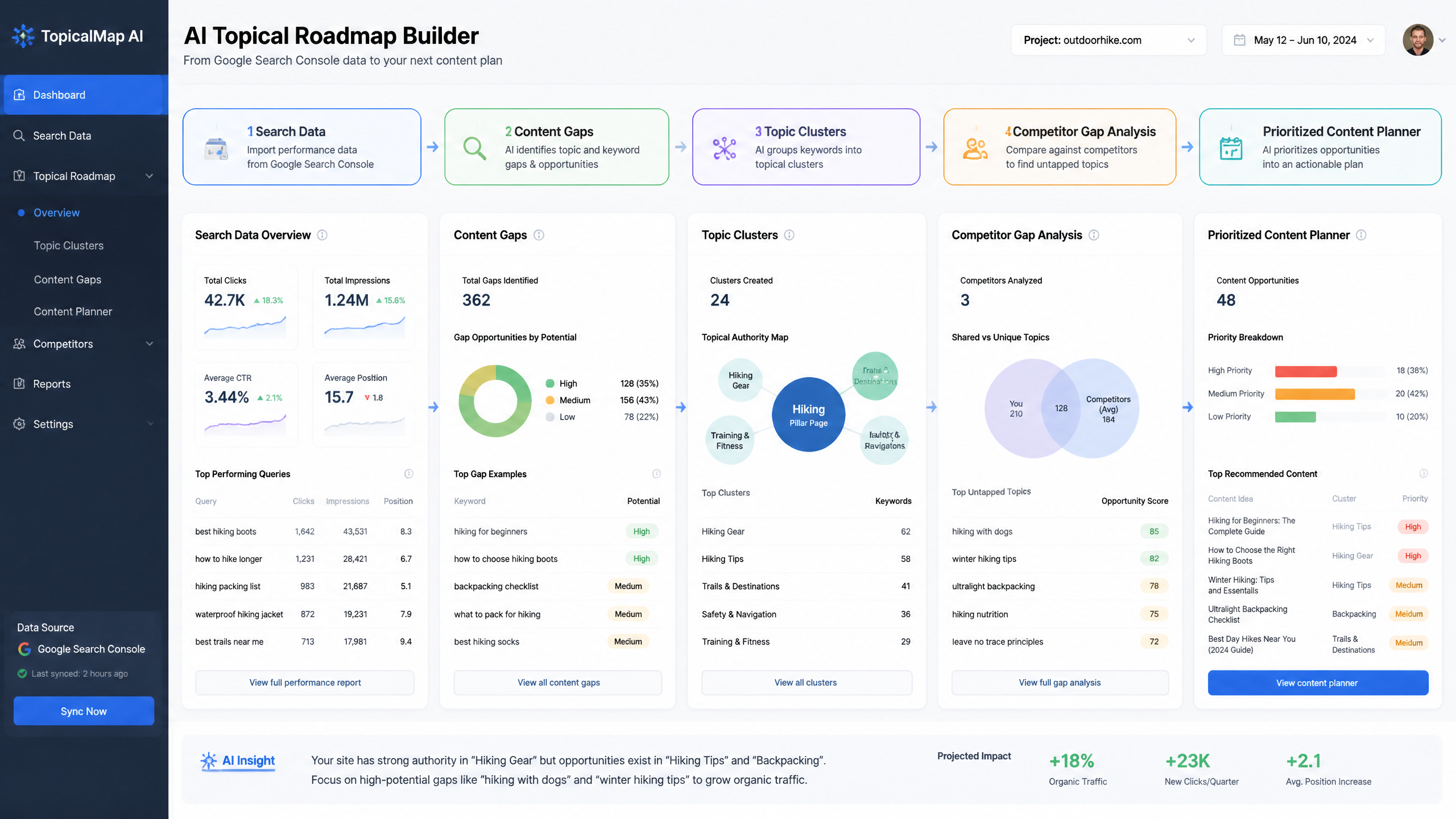
Nuwtonic connects to your Google Search Console and builds a workspace around your actual site performance. From there, it runs 32+ agentic analyses automatically, surfacing top movers, zero-CTR queries, topic clusters, cannibalization issues, ranking gaps, and trust signals.
That changes the map process in a very practical way.
Instead of asking, “What should we write about in this niche?” you can ask better questions:
Where do we already have topical traction?
Which nearby content gaps can we realistically win?
Which underperforming pages need expansion before we create new ones?
Which clusters align with current authority signals?
I like this approach because it reduces wasted motion. It also fits how Google actually evaluates sites over time—you build from demonstrated relevance, not just ambition.
It generates topical maps from existing authority
The Nuwtonic content writer is built on your GSC data and existing topical authority. That’s a critical distinction.
Look, what NOT to do first is ask AI to invent a map from a blank slate when your site already contains ranking signals. That usually leads to detached cluster ideas that ignore what Google has already learned about your domain.
Nuwtonic instead helps you extend the authority you already have. In practice, that means your map is more likely to include:
• Adjacent subtopics with a realistic ranking path
• Support content tied to proven query themes
• Articles that reinforce current pillars
• Opportunities rooted in actual impressions and search behavior
Topical map approach | Primary input | Likely outcome |
|---|---|---|
Generic AI prompt | Broad web knowledge | Fast but generic topic list |
Keyword tool export | Search volume and difficulty | Better query data, weak sequencing |
Nuwtonic topical planning | GSC data plus existing authority | More relevant Topical map with execution context |
It ties Topical map creation to content gaps and competitor gaps
This is where Nuwtonic becomes more than a content idea tool.
If a page or prompt is underperforming, Nuwtonic can run a citation gap analysis and identify:
• Content gaps
• Structural gaps
• E-E-A-T gaps
• Competitor gaps
That matters because a Topical map should not only answer what to create next. It should also answer why current content is losing.
I’ve seen this play out on teams where everyone wanted new content, but the real lift came from tightening page structure and filling missing subtopics on existing URLs. A good Topical map is part editorial plan, part repair plan.
It keeps planning close to execution
One of my recurring frustrations with Topical map workflows is how often planning and execution are disconnected.
A strategist creates clusters in one tool. Writers work from another. Audits happen elsewhere. Then nobody knows whether the plan improved the right KPIs.
Nuwtonic closes that loop better because the topical map can feed directly into the content planner, where articles are generated with contextual assets and scored with content, citation, and E-E-A-T signals.
That does not mean you should automate everything. It means the Topical map is not trapped in a slide deck.
When to trust AI and when to step in manually
What AI should handle well
In my experience, AI is very good at the heavy lifting that drains strategist time.
Task | AI usefulness | Why |
|---|---|---|
Keyword clustering | High | Pattern recognition at scale |
Topic expansion | High | Quickly broadens content clusters |
Gap detection | Medium to high | Strong when grounded in source data |
Competitor pattern spotting | Medium | Useful, but depends on data quality |
Publishing priority | Medium | Needs human business context |
Final angle selection | Low to medium | Messaging nuance still needs humans |
For the Topical map -building stage, I would trust AI most for:
• Organizing related terms
• Surfacing missing subtopics
• Grouping ideas by likely intent
• Suggesting expansion paths from a central entity
• Highlighting patterns across large datasets
What humans still need to decide
This part is non-negotiable.
There is no clear universal standard in the current evidence for exactly which Topical map steps must remain human-led, but in practice I would keep these decisions with people:
Business-fit prioritization
Monetization alignment
Brand positioning and claims
Risk review in technical or regulated niches
Final content angle and editorial judgment
Topical maps should be flexible; I’ve seen too many rigid plans flop because they didn’t adapt to real-time data. AI can help you draft the map, but your team should still reshape the sequence when performance data shifts.
A simple decision rule I use
If the decision depends on pattern recognition, let AI lead.
If the decision depends on brand judgment, legal nuance, commercial priority, or audience psychology, keep a human in the loop.
That sounds obvious, but teams ignore it all the time.
A practical workflow for teams using Nuwtonic
Step 1: Start with performance reality
Begin in Nuwtonic after connecting Google Search Console.
Review:
• Existing topic clusters
• Top movers
• Zero-CTR queries
• Cannibalization signals
• Mobile versus desktop ranking gaps
Why first? Because your Topical map should emerge from observed demand and current visibility, not brainstorming alone.
Step 2: Identify Topical map -worthy gaps
Next, use Nuwtonic’s analysis to separate three types of opportunities:
Opportunity type | What it means | What to do |
|---|---|---|
Existing page expansion | The page ranks or earns impressions but misses subtopics | Update before creating new content |
New support article | A clear adjacent gap around an existing cluster | Add to content Topical map |
Competitor-led opportunity | Rivals cover a relevant topic you do not | Validate fit, then prioritize |
This is where a lot of wasted content production gets cut out.
Step 3: Build clusters around proven authority
Use the content writer and topical map capability to extend what your domain already demonstrates authority for.
That usually means organizing the Topical map into:
Pillar topics tied to your main solution area
Support clusters aligned with informational intent
Fix-first pages where optimization beats net-new publishing
Quick wins from competitor gap findings
A common pattern looks like this: the team thinks they need 30 new articles, but after reviewing actual data, only 10 should be new. Another 8 should be page expansions. The rest should be deprioritized because intent is weak or overlap is too high.
Step 4: Review, refine, and assign KPIs
This is the human-in-the-loop stage.
Before approving the Topical map , check:
• Are there duplicate topics?
• Are any content clusters too broad?
• Does each topic map to a real intent?
• Are we supporting revenue pages or just publishing for traffic?
• Which KPIs define success for this cluster?
Suggested KPI mapping:
Topical map objective | Primary KPI | Secondary KPI |
|---|---|---|
Build authority in a cluster | Ranking spread across related queries | Impressions growth |
Improve underperforming pages | CTR | Average position |
Capture competitor gaps | New ranking keywords | Share of voice |
Support AI search visibility | Citation presence | Prompt-level visibility |
Step 5: Publish and keep the Topical map alive
Topical map should not be static PDFs nobody revisits.
Because Nuwtonic monitors both SEO and AI search visibility, your Topical map can evolve based on what actually changes:
• New query patterns
• Citation gaps
• Content performance changes
• Competitor movement
• Search behavior shifts after algorithm updates
That last piece is underrated. A topical Topical map built once and ignored for six months becomes historical fiction.
FAQ
Can AI accurately identify knowledge gaps in my existing content?
Yes, to a point. The strongest evidence in the provided research comes from a 2024 TopicalMap.ai test showing AI could analyze existing content and identify missing keyword opportunities. But accuracy depends heavily on the source data and niche complexity.
For a practical workflow, I would trust AI more when it is grounded in first-party data. That is why Nuwtonic is better suited for this task than a generic chatbot—it starts from GSC and page-level performance signals.
How quickly can AI generate a topical Topical map ?
Very quickly.
Toolsolved says Topical Map AI can generate a topical map in 60 seconds. Moonlit Platform describes generating a 100-topic cluster plus 10 future clusters in minutes. That speed is real. The catch is that review still takes time, especially if you need to merge duplicates or remove weak-intent ideas.
What inputs produce the best AI Topical map ?
The research points to a few essential inputs:
• Central entity
• Search intent
• Source context
• Existing site data
• Starter ideas or strategic constraints
In my experience, if you skip audience context and business goals, the Topical map gets broader but less useful.
Can AI separate core monetized topics from informational support topics?
Yes, some tools can. Moonlit Platform specifically frames output as core topics and outer topics. That is useful because it mirrors how strong content clusters are usually structured.
Nuwtonic supports this more indirectly but more pragmatically—by grounding ideas in topical authority, competitor gaps, and page performance, it helps you decide which content should support conversion-focused pages versus authority-building content.
What is the biggest risk of relying on AI for topical maps?
The biggest risk is strategic overconfidence.
The Topical map can look complete while still being wrong about:
• Intent
• Priority
• Business fit
• Existing page overlap
• Ranking feasibility
That is why I treat AI output as a first draft and use Nuwtonic’s data-backed analyses to validate what deserves action.
Can AI update a Topical map as search trends change?
Yes, in principle. Miro describes AI planning systems as adaptable as conditions shift. In SEO practice, that only works if the system stays connected to live performance signals.
This is another reason Nuwtonic fits the topical Topical map use case well. It is not just a one-time ideation engine—it continuously monitors visibility and opportunities, which makes roadmap updates far more realistic.
Sources/References
• Toolsolved overview of Topical Map AI: AI topical map workflow
• Moonlit Platform topical map generator app: 100-topic cluster generator
• Product and workflow context from the research brief provided for this article
Final verdict
So, can AI build my topical Topical map ?
Yes—but the Topical map is only as smart as the data, constraints, and validation behind it.
If you use AI as a blank-slate ideation machine, you will probably get a decent topic list and a shaky strategy. If you use AI on top of real search data, actual content gaps, competitor context, and existing authority signals, you get something much closer to a Topical map that can actually rank.
That’s why I see Nuwtonic as a strong fit for this exact problem. It does not try to solve Topical map building with generic prompting alone. It uses Google Search Console data, topic clusters, content gaps, cannibalization analysis, and competitor insights to help you plan around what your site can realistically win next.
If your team is tired of stitching together spreadsheets, keyword tools, and disconnected content briefs, this is the smarter place to start.
My advice: use AI to build the draft, use Nuwtonic to ground it in reality, and use your team to make the final calls that impact revenue.