If you're looking for a Cognizo AI alternative, you're most likely dealing with one of two things: pricing that isn't published anywhere and requires a sales call to even see, or a platform that tracks your AI visibility well but leaves the actual fixing to you.
This guide only covers tools built specifically for AI search optimization — tracking, analyzing, and improving how your brand shows up in ChatGPT, Perplexity, Gemini, Google AI Overviews, Copilot, and other answer engines. General-purpose SEO or content platforms without a dedicated AI-search/AEO layer aren't included here, because they solve a different problem than the one that sends people looking for a Cognizo alternative in the first place.
This guide compares the best Cognizo AI alternatives based on:
AI search (AEO/GEO) visibility tracking depth and model coverage
Whether the platform executes fixes or just reports them
Content creation built specifically for AI citations
Competitive intelligence for AI answers
Pricing transparency
Best-fit use cases
Quick Comparison: Cognizo AI vs Alternatives
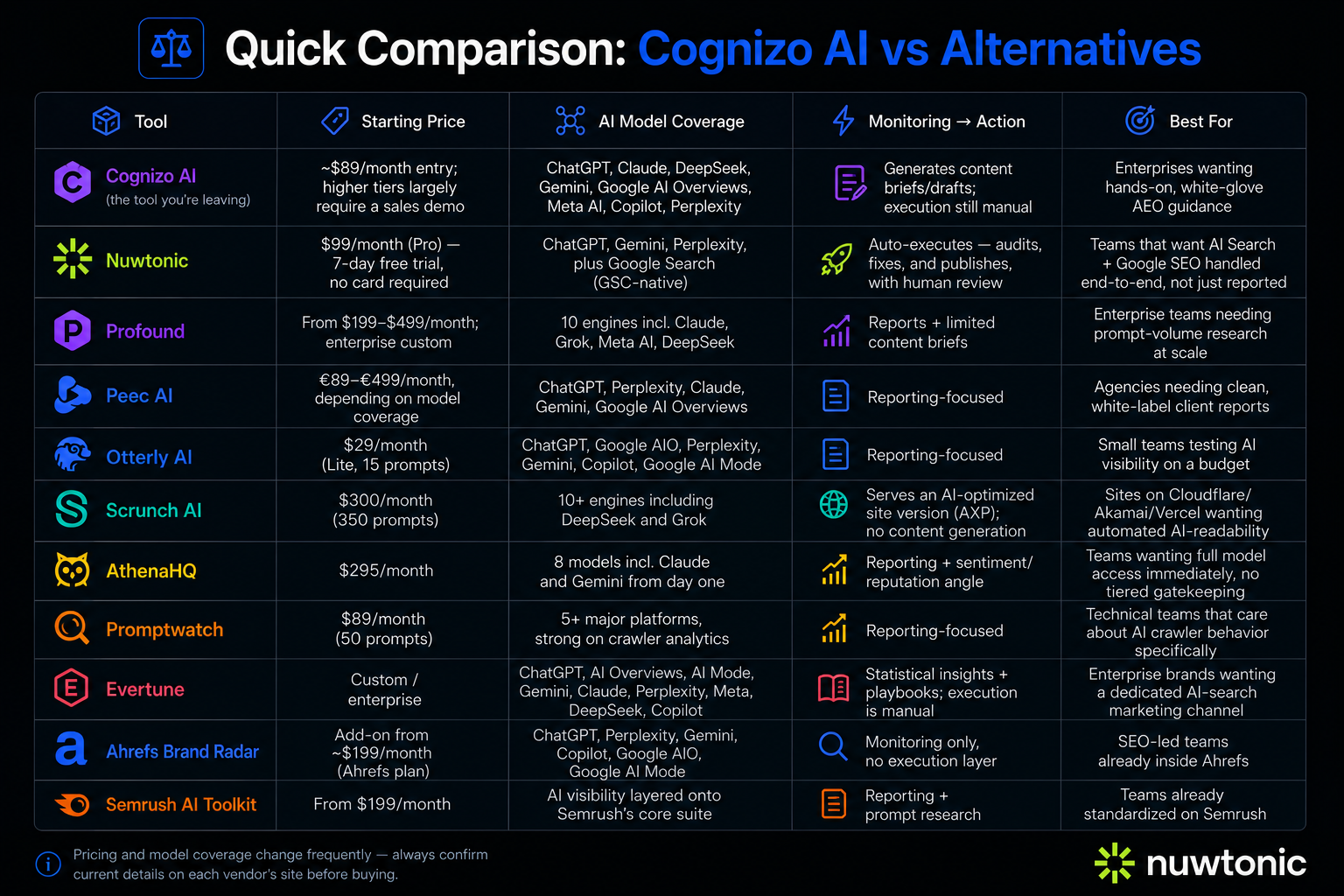
Tool | Starting Price | AI Model Coverage | Monitoring → Action | Best For |
|---|---|---|---|---|
Cognizo AI (the tool you're leaving) | ~$89/month entry; higher tiers largely require a sales demo | ChatGPT, Claude, DeepSeek, Gemini, Google AI Overviews, Meta AI, Copilot, Perplexity | Generates content briefs/drafts; execution still manual | Enterprises wanting hands-on, white-glove AEO guidance |
Nuwtonic | $99/month (Pro) — 7-day free trial, no card required | ChatGPT, Gemini, Perplexity, plus Google Search (GSC-native) | Auto-executes — audits, fixes, and publishes, with human review | Teams that want AI Search + Google SEO handled end-to-end, not just reported |
Profound | From $199–$499/month; enterprise custom | 10 engines incl. Claude, Grok, Meta AI, DeepSeek | Reports + limited content briefs | Enterprise teams needing prompt-volume research at scale |
Peec AI | €89–€499/month, depending on model coverage | ChatGPT, Perplexity, Claude, Gemini, Google AI Overviews | Reporting-focused | Agencies needing clean, white-label client reports |
Otterly AI | $29/month (Lite, 15 prompts) | ChatGPT, Google AIO, Perplexity, Gemini, Copilot, Google AI Mode | Reporting-focused | Small teams testing AI visibility on a budget |
Scrunch AI | $300/month (350 prompts) | 10+ engines including DeepSeek and Grok | Serves an AI-optimized site version (AXP); no content generation | Sites on Cloudflare/Akamai/Vercel wanting automated technical AI-readability |
AthenaHQ | $295/month | 8 models incl. Claude and Gemini from day one | Reporting + sentiment/reputation angle | Teams wanting full model access immediately, no tiered gatekeeping |
Promptwatch | $89/month (50 prompts) | 5+ major platforms, strong on crawler analytics | Reporting-focused | Technical teams that care about AI crawler behavior specifically |
Evertune | Custom / enterprise | ChatGPT, AI Overviews, AI Mode, Gemini, Claude, Perplexity, Meta, DeepSeek, Copilot | Statistical insights + playbooks; execution is manual | Enterprise brands wanting a dedicated AI-search marketing channel |
Ahrefs Brand Radar | Add-on from ~$199/month (Ahrefs plan) | ChatGPT, Perplexity, Gemini, Copilot, Google AIO, Google AI Mode | Monitoring only, no execution layer | SEO-led teams already inside Ahrefs |
Semrush AI Toolkit | From $199/month | AI visibility layered onto Semrush's core suite | Reporting + prompt research | Teams already standardized on Semrush |
Pricing and model coverage change frequently — always confirm current details on each vendor's site before buying.
TL;DR Summary
Which Tool Should You Choose — And Why?
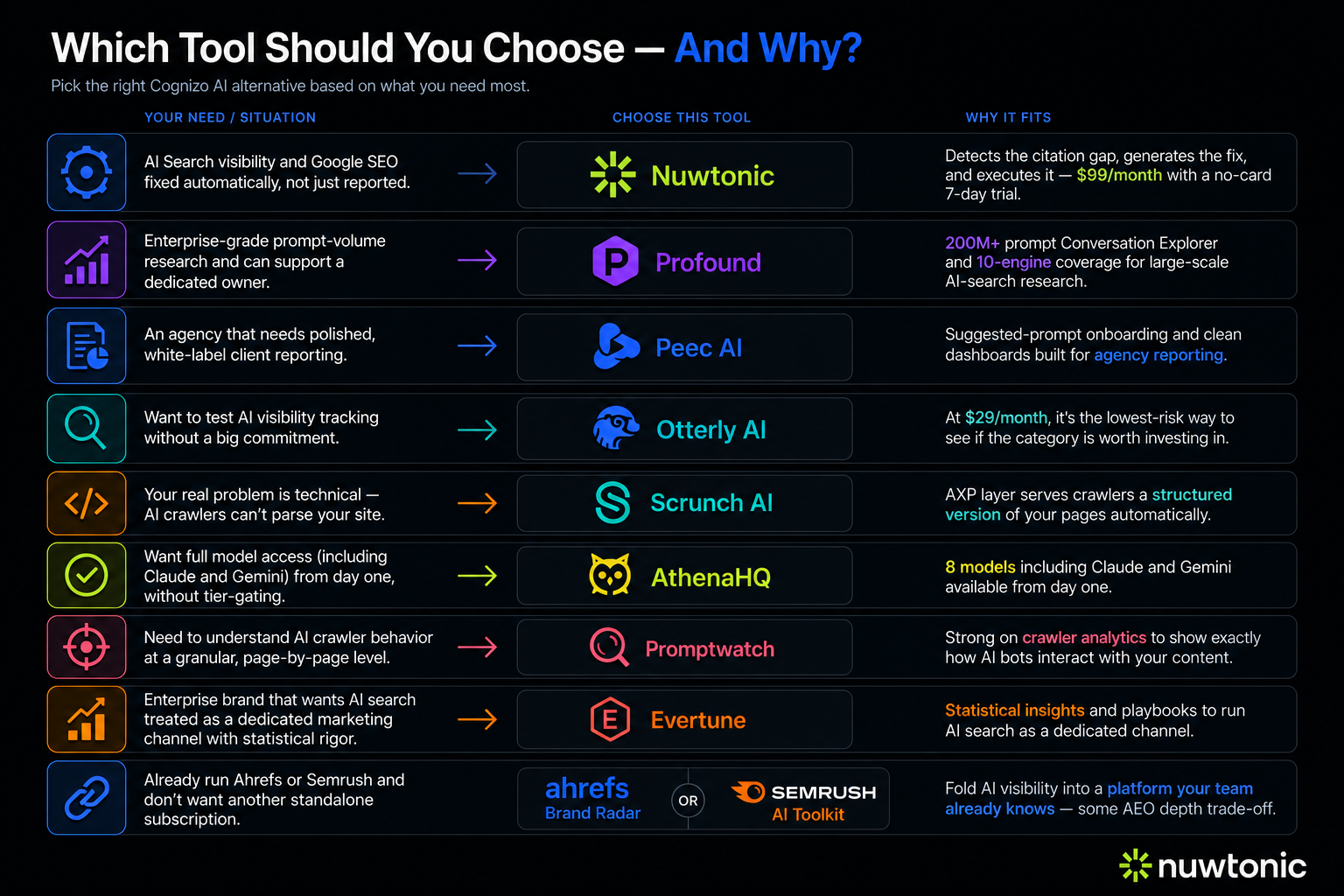
There's no single "best" Cognizo AI alternative — the right pick depends on what's actually missing from your current setup.
You want AI Search visibility and Google SEO fixed automatically, not just reported. → Go with Nuwtonic. It's built to close exactly the gap Cognizo (and most of this list) leaves open: detecting the citation gap, generating the fix, and executing it — with transparent $99/month pricing and a no-card 7-day trial, so you're not stuck booking a demo just to see what it costs.
You need enterprise-grade prompt-volume research and can support a dedicated owner. → Go with Profound. Its 200M+ prompt Conversation Explorer and 10-engine coverage are hard to match for large-scale AI-search research.
You're an agency that needs polished, white-label client reporting. → Go with Peec AI. Its suggested-prompt onboarding and clean dashboards are built for exactly this use case.
You just want to test AI visibility tracking without a big commitment. → Go with Otterly AI. At $29/month it's the lowest-risk way to see whether the category is worth investing in further.
Your real problem is technical — AI crawlers can't parse your site. → Go with Scrunch AI. Its AXP layer serves crawlers a structured version of your pages automatically, which no other tool on this list does.
You want full model access (including Claude and Gemini) from day one, without tier-gating. → Go with AthenaHQ.
You need to understand AI crawler behavior at a granular, page-by-page level. → Go with Promptwatch.
You're an enterprise brand that wants AI search treated as a dedicated marketing channel with statistical rigor. → Go with Evertune.
You already run Ahrefs or Semrush and don't want another standalone subscription. → Go with Ahrefs Brand Radar or Semrush AI Toolkit — both fold AI visibility into a platform your team already knows, at the cost of some AEO-specific depth.
Why People Look for a Cognizo AI Alternative
Cognizo positions itself as being built "from the ground up for GEO" rather than AI-visibility features bolted onto an existing SEO tool — and its feature set backs that up: real-time brand mention tracking across ChatGPT, Claude, DeepSeek, Gemini, Google AI Overviews, Meta AI, Copilot, and Perplexity, competitive benchmarking, citation and source-targeting analysis, automated content workflows for briefs and FAQs, and technical audits covering schema markup and entity recognition. Reviewers consistently praise the hands-on support model, including phone support alongside the usual online channels — a rarity in this category.
That said, a few patterns show up consistently when teams look elsewhere:
Pricing is hard to evaluate up front. Beyond a roughly $89/month entry point referenced by some comparison sites, most of Cognizo's plan details sit behind a demo request rather than a public pricing page — making it hard to compare against competitors without a sales conversation.
Content output still needs a human to finish the job. Cognizo's automated workflows generate briefs, drafts, and FAQs, which speeds up writing — but turning those drafts into published, technically optimized pages (schema, internal links, CMS publishing) is a separate step your team still owns.
Review volume is still building. Compared to category leaders with hundreds of verified reviews, Cognizo's public review footprint on sites like G2 is comparatively thin, which makes it harder to independently verify claims at scale.
It's positioned toward larger teams. The hands-on guidance model and enterprise/agency framing are a good fit if you want a partner-style relationship, but that also means smaller, self-serve teams may find the onboarding heavier than tools built for instant sign-up and immediate use.
That's the gap this list of alternatives addresses.
How We Evaluated Cognizo AI Alternatives
Criteria | Why It Matters |
|---|---|
AI Search Coverage | Tracks visibility across ChatGPT, Gemini, Perplexity, Claude, and other AI platforms — this list only includes tools that do this natively. |
Monitoring → Action | Does the platform just show you the gap, or actually help close it? |
Content Built for Citations | AI-search content needs different structure than a normal blog post — entity density, clear answers, citation-ready formatting. |
Competitive Intelligence | Understand why competitors get cited more often in AI-generated answers. |
Pricing Transparency | Whether a vendor publishes real pricing or requires a sales call to find out. |
[Nuwtonic](https://nuwtonic.com/)
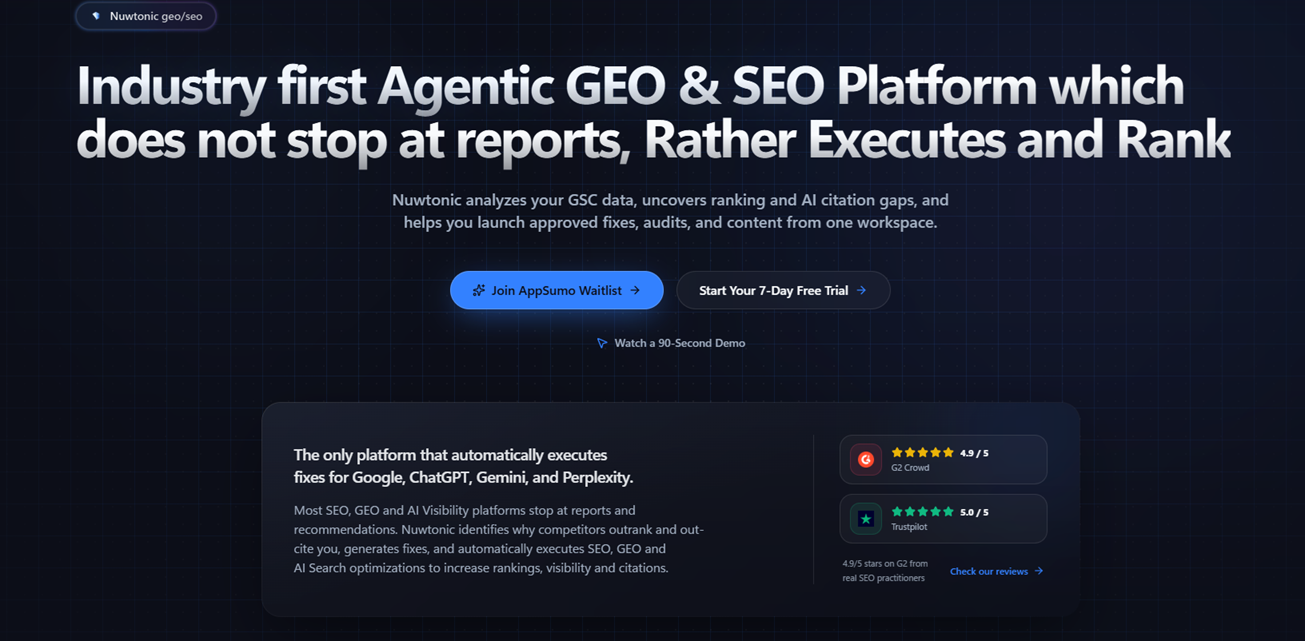
Best for: Teams that want AI Search visibility and Google SEO handled end-to-end — not just reported on.
This is where Nuwtonic's core difference from Cognizo (and most of this list) really shows up: it's built as an agentic platform that doesn't stop at dashboards. It detects the gap, generates the fix, and executes it — schema, meta tags, alt text, on-page structure, and full articles — with every change reviewable before it goes live.
Key strengths
AI Search Visibility & Prompt Tracking — see how often your brand is mentioned and recommended across ChatGPT, Gemini, and Perplexity, and track the exact prompts your audience asks so you can compare how AI models answer for you versus competitors.
GEO Audit & Auto-Fix — runs 120+ AI-visibility checks covering citation references, author trust, and unique details that trigger inclusion in AI answers, then executes structural fixes rather than just listing them.
Trust & Author Repair — automatically adds the expertise and credibility signals whose absence is a common reason AI models skip a brand as a source.
GSC-native root-cause diagnostics — connects directly to Google Search Console so recommendations are grounded in your actual performance data, not third-party estimates, closing the loop between traditional SEO and AI-search visibility in one workspace.
Content built for both rankings and citations — generates entity-rich articles, topical maps, and clusters designed to expand authority and improve AI citation odds, individually or in bulk.
Consolidates the AEO/GEO stack — one Nuwtonic plan is built to replace point tools like AI-visibility trackers, citation-gap tools, and GEO writers separately, instead of stacking several subscriptions.
Why it stands out against Cognizo specifically
Transparent pricing: Nuwtonic Pro starts at $99/month with a 7-day free trial and no credit card required — no demo request needed to see what you're buying.
Execution, not just briefs: where Cognizo's content workflows hand you a draft, Nuwtonic's agents review, apply, and publish the fix (with your approval), closing the "insight to action" gap that shows up repeatedly in AEO tool reviews.
Independently verified reputation: rated 4.9/5 on G2 and 5.0/5 on Trustpilot from practitioner reviews.
Ideal for
SaaS companies and agencies that want AI Search + Google SEO in one workspace
Teams that don't want a sales call just to see pricing
Anyone who has outgrown "tracking-only" AEO tools and wants fixes applied, not just flagged
2\. Profound
p
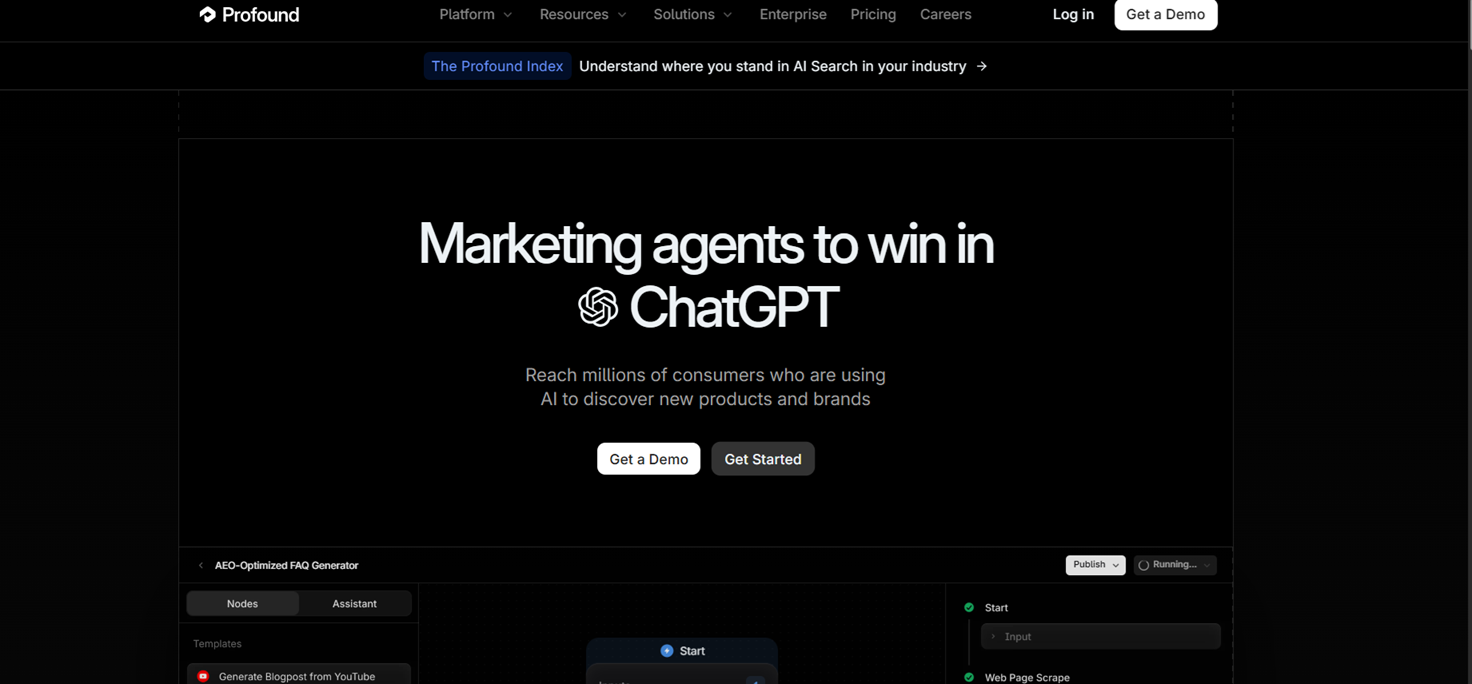
Best for: Enterprise teams that need deep prompt-volume research at scale.
Profound's standout feature is its Conversation Explorer, built on data from 200M+ real user prompts, so you can search a keyword and see actual prompt volume rather than an estimate. It also offers bulk keyword analysis and covers 10 answer engines at its top tier.
Pros
Real prompt-volume data, not modeled estimates
SOC 2 Type II compliance, SSO, dedicated customer success — built for large enterprise procurement
Broadest model coverage of any tool on this list at the Enterprise tier
Limitations
Steep learning curve; typically needs a dedicated owner to manage it
Entry tier is limited on regions, history, and model count relative to its price
3\. Peec AI
Best for: Agencies that need clean, client-ready AI visibility reports.
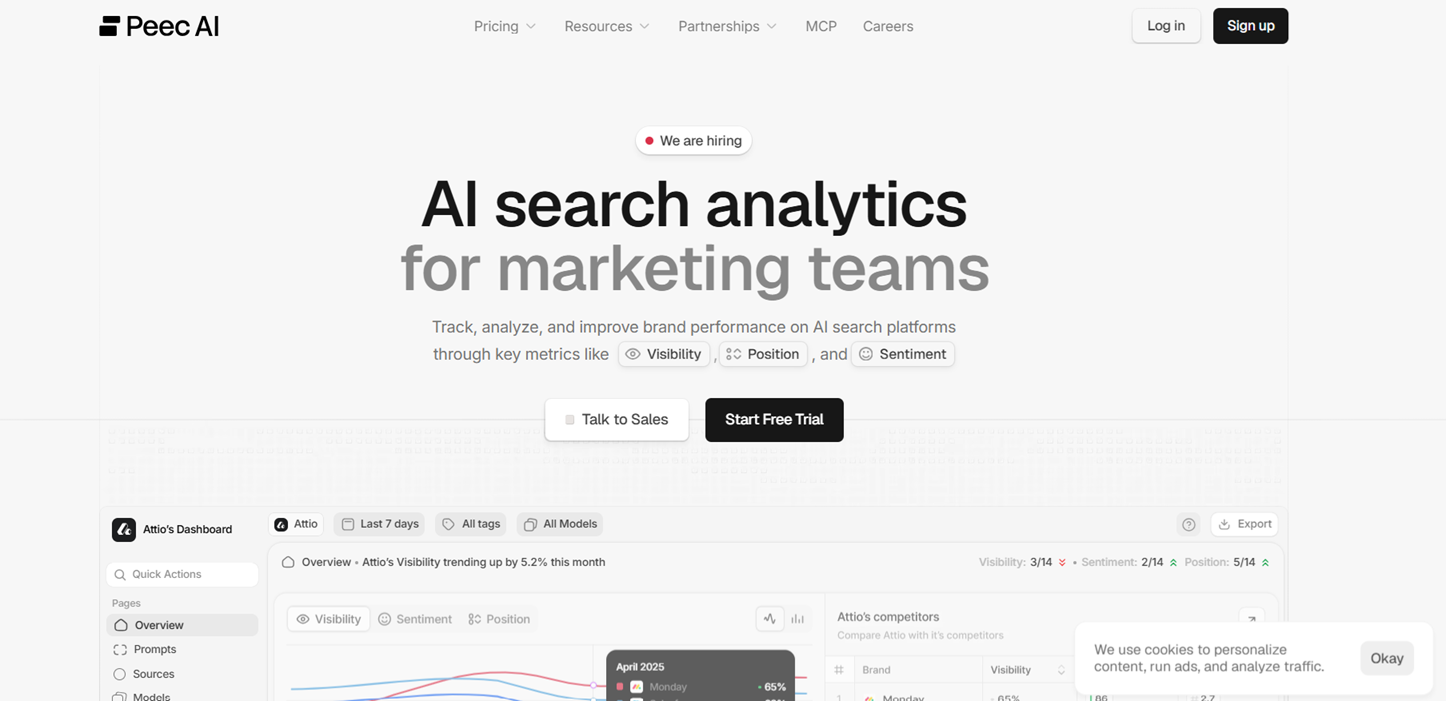
Peec AI's onboarding suggests prompts to track based on your industry and site, and its dashboards separate cited sources from brand-mention visibility — a distinction that makes client reporting clearer.
Pros
Suggested-prompt onboarding removes the guesswork of what to track
White-label reporting well suited to agency use
Clean, uncluttered dashboard
Limitations
Primarily a measurement and reporting tool — turning insights into action still requires separate tools
Full model coverage requires higher-tier plans
4\. Otterly AI
Best for: Small teams validating AI visibility tracking on a tight budget.
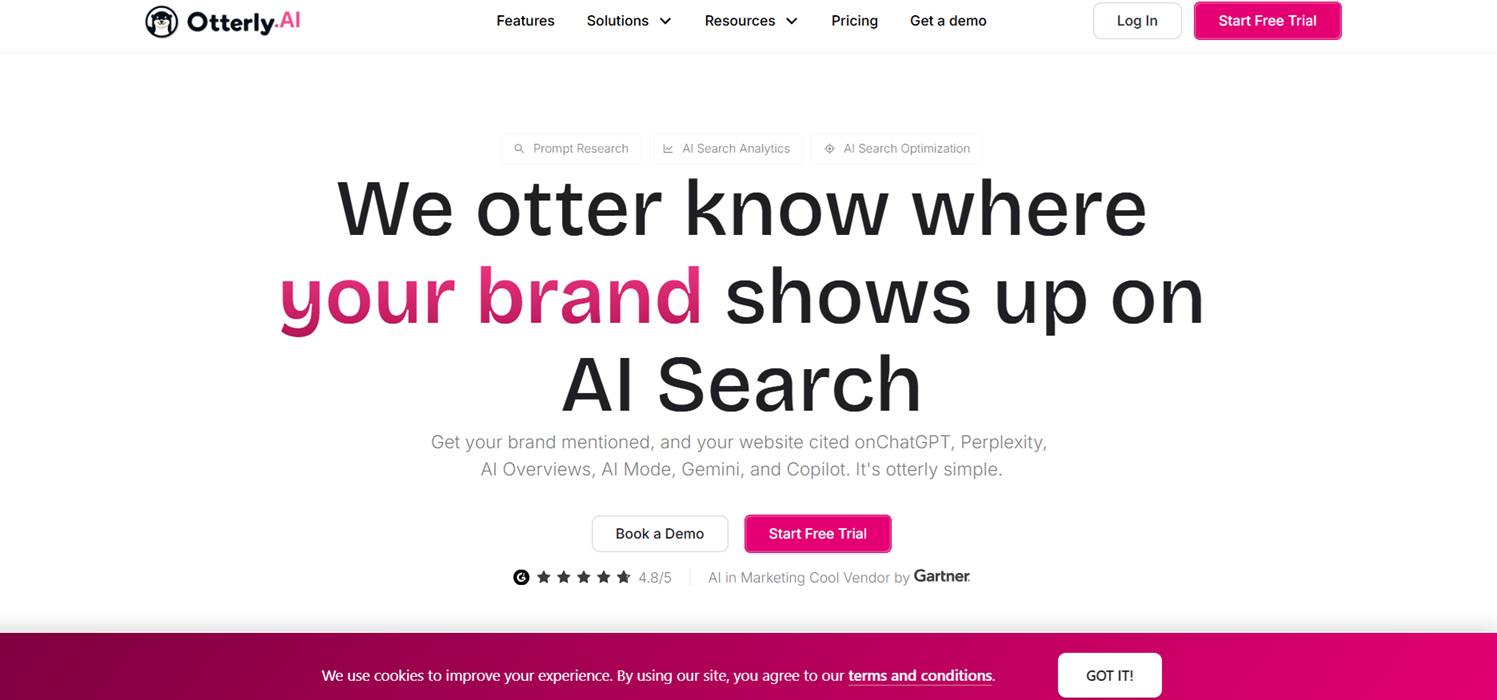
At $29/month, Otterly is the lowest-cost entry point on this list, with a straightforward setup and prompt-discovery flow similar to keyword research.
Pros
Lowest published starting price in the category
Simple, fast onboarding
Clear dashboards for brand mentions, coverage, and domain citations
Limitations
The entry plan's 15 prompts are thin for statistically meaningful tracking
Reporting-focused, with limited automation or execution support
5\. Scrunch AI
Best for: Technical teams that want AI-optimized site delivery, not just tracking.
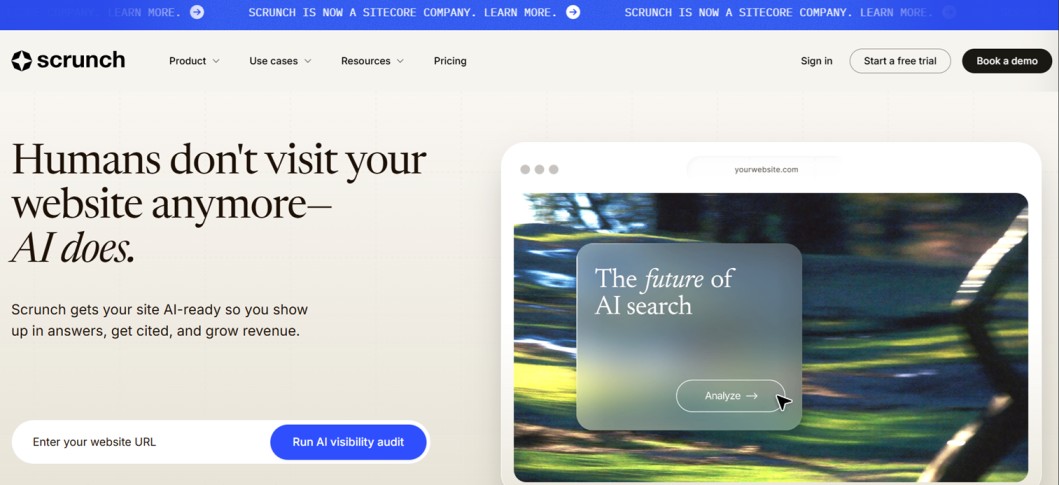
Scrunch's Agent Experience Platform (AXP) is genuinely different: it serves a compressed, structured version of your pages specifically to AI crawlers on supported CDNs (Cloudflare, Akamai, Vercel), rather than only reporting on visibility.
Pros
The only tool on this list serving a parallel AI-optimized site version automatically
Tracks misinformation and misrepresentation about your brand, not just mention counts
Reported average 40% increase in AI-referral traffic among customers
Limitations
$300/month starting price with no free trial
No content-generation layer — the optimization is structural/technical, not editorial
6\. AthenaHQ
Best for: Teams that want full model coverage from day one.
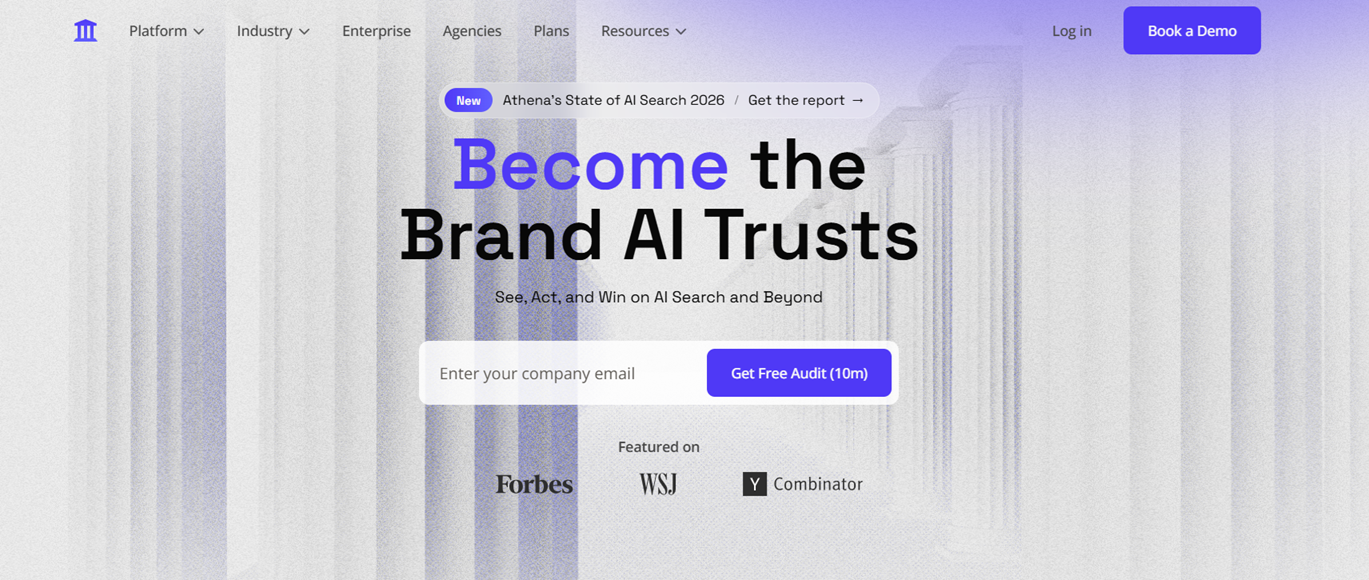
AthenaHQ's plan opens access to 8 AI models — including Claude and Gemini — immediately, rather than gating them behind a higher tier the way some competitors do.
Pros
No tiered model gatekeeping on entry plans
Role-based seat access for small teams
Sentiment and reputation angle layered onto visibility tracking
Limitations
Premium pricing relative to Otterly or Peec
Content/execution tooling is less developed than dedicated writer-first platforms
7\. Promptwatch
Best for: Technical teams focused on AI crawler behavior specifically.
Promptwatch shares real overlap with Cognizo but goes deeper on one specific angle: understanding which pages AI crawlers (OpenAI, Perplexity, and others) actually access, and how often.
Pros
Detailed crawler analytics — timing, frequency, page-level access patterns
Clear visibility scores and citation dashboards
Useful for diagnosing why specific pages aren't being picked up by AI systems
Limitations
- Narrower focus than full-stack platforms — strongest on the technical/crawler side, lighter on content execution
8\. Evertune
Best for: Enterprise brands that want AI search treated as its own marketing channel.
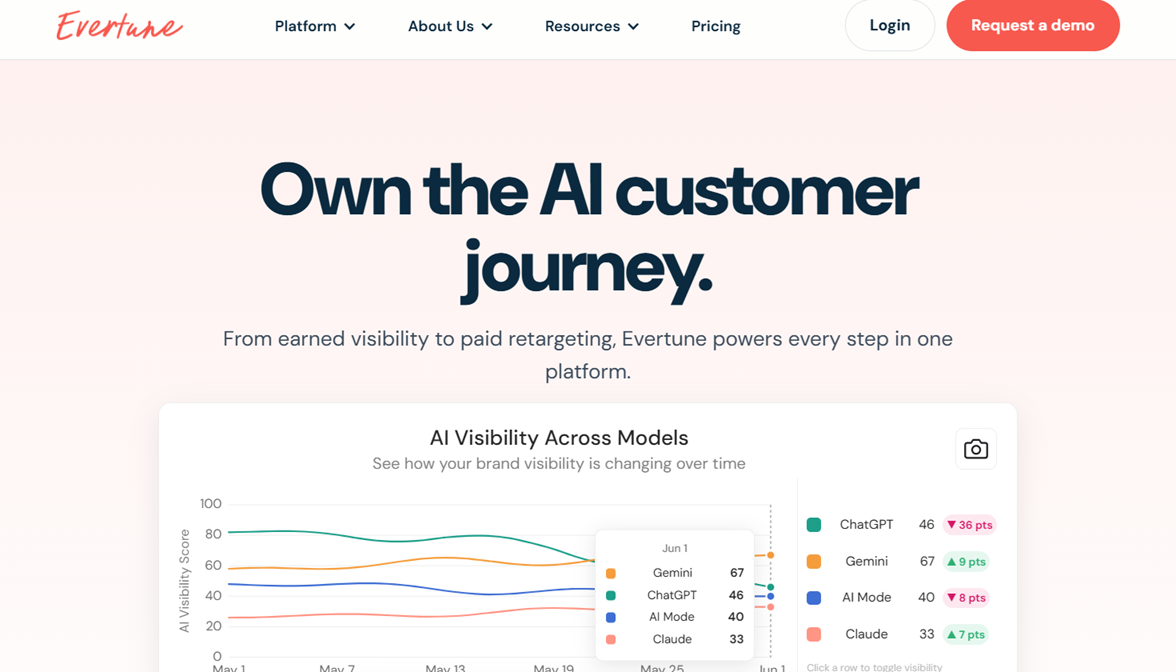
Evertune positions itself as a dedicated GEO platform for enterprise brands, covering ChatGPT, AI Overviews, AI Mode, Gemini, Claude, Perplexity, Meta, DeepSeek, and Copilot, with a statistical-confidence approach to its insights.
Pros
Broad answer-engine coverage
Applied data science approach aimed at statistical reliability, not just raw counts
Positions AI-search visibility as a full marketing discipline, not a side dashboard
Limitations
Enterprise/custom pricing with limited public transparency
Built around insights and playbooks rather than direct execution
9\. Ahrefs Brand Radar
Best for: SEO-led teams already inside the Ahrefs ecosystem.
Brand Radar takes a big-picture view of AI visibility, analyzing brand presence across a large set of real AI answers rather than a small hand-picked prompt list, which is useful for measuring overall share of voice.
Pros
Large-scale analysis surfaces patterns a small prompt list would miss
Backed by Ahrefs' broader search and web data
Good for competitive share-of-voice tracking over time
Limitations
Monitoring and analysis only — no content creation, prompt optimization, or automation layer
Priced as an add-on on top of an existing Ahrefs subscription
10\. Semrush AI Toolkit
Best for: Teams already standardized on Semrush who want AI visibility in the same platform.
Semrush's AI Toolkit layers brand-performance reporting (share of voice vs. sentiment) and prompt research — modeled closely on its existing keyword-research workflow — onto its broader marketing suite.
Pros
Share-of-voice vs. sentiment view shows whether more mentions are actually helping you
AI Search Site Audit flags technical issues blocking AI crawler access
Integrates with existing Semrush backlink, ranking, and traffic data
Limitations
- AI visibility is a feature within a much broader suite, not the core product — less AEO-specific depth than dedicated platforms
Final Thoughts
Cognizo AI is a capable, purpose-built AEO platform, especially for teams that want a hands-on partner relationship. But its opaque pricing and content-briefs-not-published-fixes model mean many teams — especially those that want speed, transparency, and execution without a demo call — are better served by a platform that goes all the way from "here's your gap" to "here's the fix, live on your site." As AI answers become a bigger share of how customers discover brands, the tools worth paying for are the ones that close that loop.