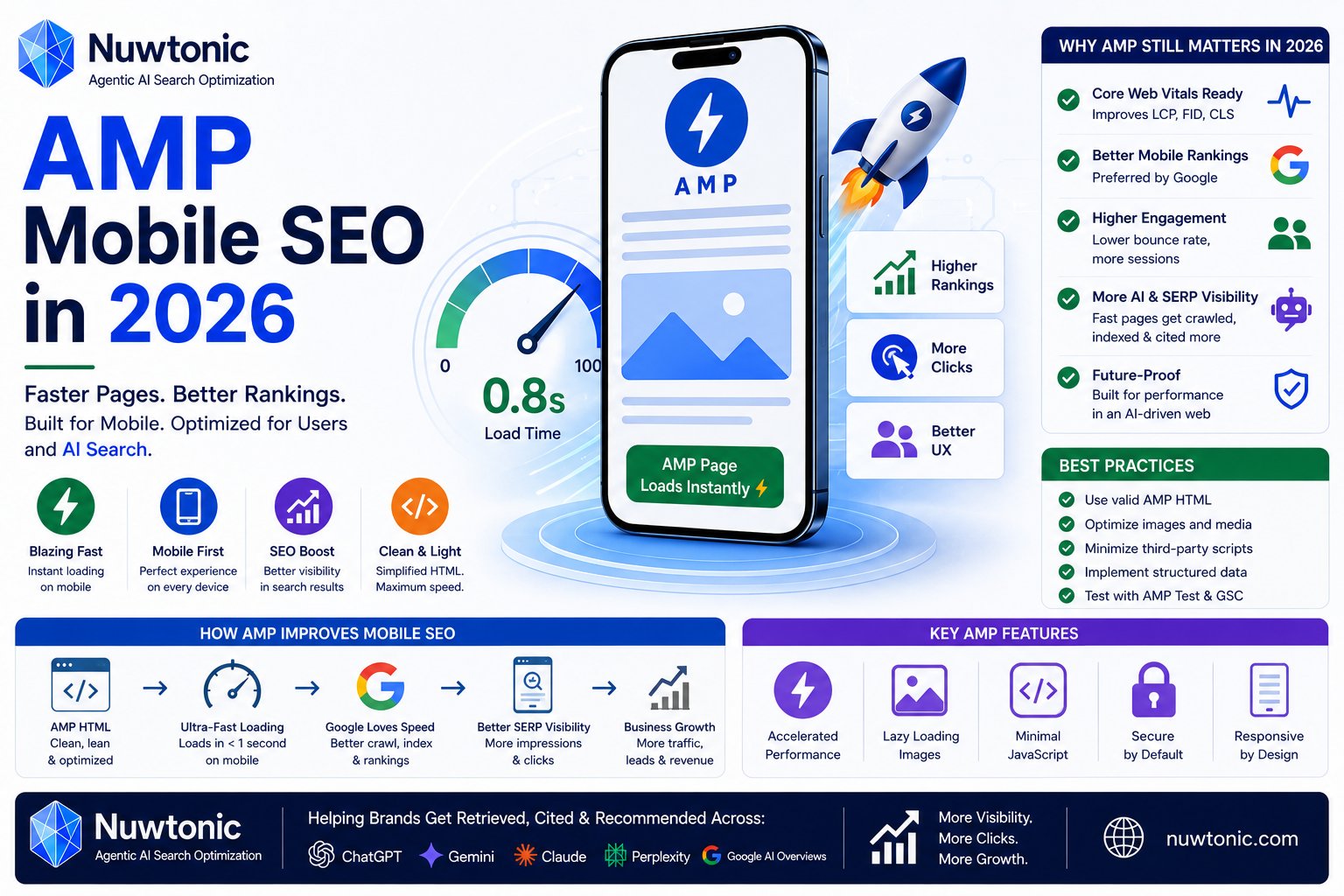
Most AMP advice is stuck in two bad extremes. One camp still treats AMP as a magic mobile SEO shortcut. The other says AMP is dead and should be ignored entirely. Both positions miss what matters in 2026.
AMP mobile SEO is no longer about chasing a special tag for rankings. It's about deciding whether AMP's stripped-down architecture still solves a real performance problem on your site better than a well-built responsive stack can. If your mobile pages are heavy, unstable, ad-clogged, or hard to keep fast across templates, AMP can still be useful. If your team can ship excellent mobile performance on canonical pages without maintaining a second framework, AMP often becomes legacy overhead.
That's the practical frame now. Don't ask, “Should every site use AMP?” Ask, “Does AMP still give this site a net advantage after implementation, parity, analytics, design, and maintenance costs?”
Table of Contents
- The Shifting Role of AMP in Modern Mobile SEO
- What Is AMP A Practical Breakdown for 2026
- AMP Pros and Cons A Data-Driven Analysis
- AMP Core Web Vitals and Mobile-First Indexing
- Implementing or Migrating AMP A Hands-On Checklist
- Auditing Mobile Gaps and Optimizing Performance with Nuwtonic
- FAQ About AMP and Mobile SEO
The Shifting Role of AMP in Modern Mobile SEO
“AMP is dead” is catchy, but it's lazy advice.
What changed is narrower. AMP isn't the default answer for mobile SEO anymore, and it isn't the only route to a fast mobile experience. But the engineering logic behind AMP still matters because Google still rewards fast, stable, usable mobile pages. If you understand why AMP worked, you understand a large part of what strong mobile performance still requires.
AMP began as an open-source HTML framework developed by Google. Its speed came from aggressive constraints: stripped-down JavaScript and CSS, prioritization of essential content, and delivery through a global cache. Early evidence showed AMP pages loaded four times faster and used eight times less data than traditional mobile-optimized pages, according to WordStream's overview of Google AMP. That performance profile matters most on slower networks, where reduced weight can improve session quality and lower abandonment.
Why the old debate misses the real issue
The wrong question is whether AMP is alive or dead.
The right question is whether your mobile stack can consistently deliver the same outcomes without AMP. Some teams can. Some can't. A lean publisher template with disciplined front-end governance may have no reason to keep AMP. A site with bloated ad scripts, multiple third-party widgets, and recurring mobile instability may still benefit from AMP as a constraint system.
Practical rule: Treat AMP as an operational choice, not an ideology. If it enforces the performance discipline your stack keeps losing, it still has value.
The real trade-off in AMP mobile SEO
AMP solves one problem by creating another. It can make speed easier, but maintenance harder.
You're trading flexibility for predictability. AMP reduces room for design freedom, custom interactions, and script-heavy functionality. In return, it creates guardrails that prevent teams from shipping pages that are too heavy for mobile users.
A quick decision view helps:
| Situation | AMP may help | AMP may hurt |
|---|---|---|
| News or article-heavy templates | Strong fit if templates are repetitive and speed-sensitive | Less useful if canonical pages are already very fast |
| Feature-rich ecommerce pages | Sometimes useful for limited content surfaces | Often restrictive for filters, personalization, and custom UX |
| Lean dev team with weak performance governance | Useful as a framework that forces discipline | Costly if the team can't maintain parity across versions |
| Brand-led sites with custom front-end experiences | Rarely ideal | Design and interaction limits usually outweigh gains |
AMP's role shifted. Its principles did not. That's why understanding AMP mobile SEO still matters, even when the answer is “don't use AMP.”
What Is AMP A Practical Breakdown for 2026
AMP is easiest to understand if you stop thinking about it as a ranking tactic and start thinking about it as a performance-constrained publishing system.
A normal custom mobile page is like a bespoke home build. You can add almost anything, but every addition increases complexity, weight, and the chance that something slows down rendering. AMP is closer to a high-performance kit home. You get fewer design freedoms, fewer moving parts, and stricter building rules. In exchange, assembly is faster and performance is more predictable.
Think of AMP like a kit build
That “kit build” model explains why AMP can still appeal to publishers and content teams. It removes a lot of the front-end choices that usually create mobile bloat. That's good when your main goal is getting article pages rendered quickly and consistently.
It's also why AMP frustrates developers. The same restrictions that produce speed also block many common patterns. If your page experience depends on custom JavaScript behaviors, complex app-like interactions, or heavily branded layouts, AMP starts to feel like a cage.
AMP works best when the page's primary job is to deliver content fast. It works worst when the page's primary job is to behave like an application.
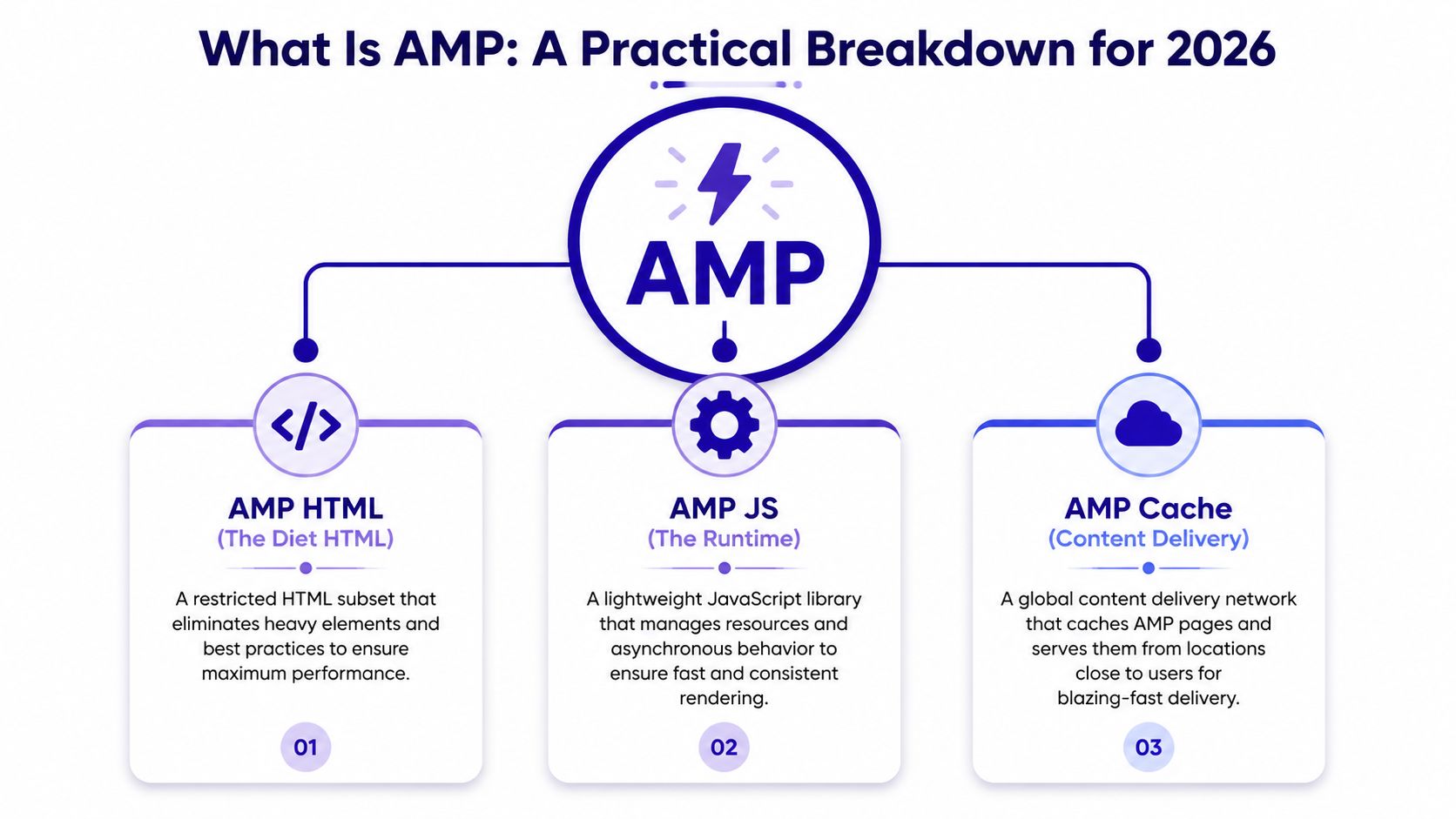
The three moving parts that matter
AMP HTML
This is the restricted markup layer. You don't get full freedom to write any front-end pattern you want. AMP HTML limits what can be used and pushes you toward performance-safe components.
For SEO teams, the practical implication is simple. Templates become more standardized. That often reduces accidental layout weight, but it also means design teams and developers need to accept more rigid implementation rules.
AMP JS
AMP JavaScript is the runtime that controls how AMP pages behave. It limits arbitrary script usage and manages rendering in a way designed to keep the page responsive and predictable.
That restriction is one of AMP's biggest strengths and biggest weaknesses.
- Strength: it prevents many self-inflicted performance problems.
- Weakness: it limits custom features that marketers, product teams, and developers often want.
- Operational reality: when stakeholders keep requesting one-off script additions, AMP stops being a clean fit.
AMP Cache
The cache layer is where AMP's delivery model becomes especially fast. AMP content can be served through a global cache system, which shortens the path between user and page and helps get content in front of the user quickly.
For practitioners, this affects more than speed. It also changes how URLs, delivery, validation, and debugging can feel compared with a standard canonical setup. If your team isn't comfortable tracing cache behavior and version relationships, AMP can create confusion during troubleshooting.
Here's the simplest way to evaluate the architecture:
| AMP component | What it does | What you gain | What you give up |
|---|---|---|---|
| AMP HTML | Restricts markup patterns | Leaner templates | Layout freedom |
| AMP JS | Controls rendering and limits custom scripts | More predictable performance | JavaScript flexibility |
| AMP Cache | Serves pages rapidly through cached delivery | Faster access | More complexity in delivery and debugging |
That's AMP in practice. It's not mysterious. It's just a system that gets speed by limiting what teams are allowed to ship.
AMP Pros and Cons A Data-Driven Analysis
AMP decisions usually break down because each team measures a different cost.
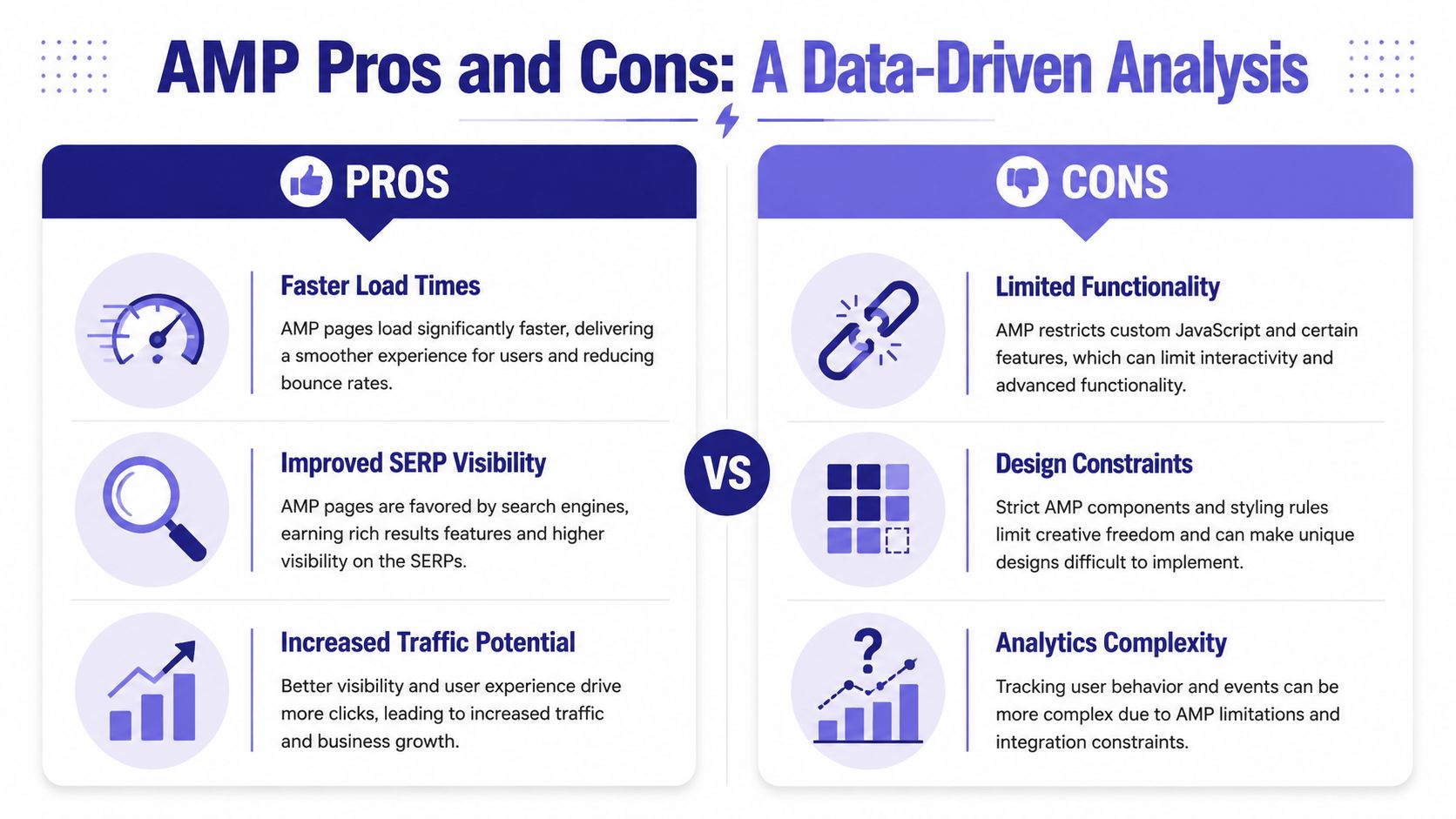
SEO teams often focus on faster delivery and cleaner mobile templates. Developers inherit a second rendering system to maintain. Editorial teams like the speed and consistency on article pages. Product and monetization teams usually push back once AMP limits experiments, ad behavior, or interactive features.
Where AMP still earns its keep
AMP still makes sense for a narrow set of page types. The best fit is high-volume, content-first templates where speed, readability, and crawl consistency matter more than front-end flexibility. Publisher article pages are still the clearest example. Long-form guides, news posts, and opinion content can also benefit if the non-AMP mobile experience is bloated or unstable.
The upside is not that AMP gets special ranking treatment in 2026. It does not. The upside is that AMP enforces the same performance discipline many teams still struggle to build into their standard templates. That can improve user experience metrics and, in some cases, organic performance.
seoClarity's analysis of AMP impact reported meaningful gains in mobile visibility, traffic, and engagement for sites that adopted AMP. I would treat that as directional evidence, not a universal forecast. Results depend heavily on whether AMP is replacing a weak mobile template or duplicating a site that already performs well on Core Web Vitals.
That distinction matters. If your article pages already pass CWV thresholds on real user data, AMP may add very little. If they are still slow because of script bloat, unstable ad slots, or inconsistent rendering, AMP can act as a constraint system that fixes problems your main stack has not solved.
A practical filter helps. If a team needs a fast way to identify whether poor mobile performance is really the root issue, start with a technical SEO audit checklist for mobile and template problems before committing to an AMP rollout.
Where AMP becomes expensive
A main downside is operating overhead.
AMP introduces another template layer, another QA path, and another place where tracking, structured data, internal linking, and ad logic can drift from the canonical version. Even with CMS support, that drift shows up over time. A small mismatch in content blocks, schema, analytics events, or consent handling can turn a clean rollout into a maintenance habit your team never budgeted for.
The cost usually shows up in four places:
- Template parity: canonical and AMP versions diverge as content modules evolve
- Product limitations: interactive tools, calculators, comparison features, and custom JavaScript often become harder to support
- Measurement quality: analytics setups need tighter validation across cached and non-cached experiences
- Revenue trade-offs: ad layouts, header bidding, and experimentation frameworks may require compromises
The sites that manage AMP well usually keep the scope tight. They use it for article inventory, not for every template in the stack.
The trade-off by site type
The decision gets easier when you evaluate AMP by page economics, not by ideology.
| Site type | Likely AMP outcome |
|---|---|
| Publisher with article-heavy inventory | Often favorable if standard mobile templates are still underperforming |
| B2B blog with repeatable editorial pages | Sometimes favorable when development capacity is limited |
| Ecommerce category and product pages | Often unfavorable because filtering, merchandising, and conversion UX need more flexibility |
| SaaS marketing site with interactive funnels | Usually unfavorable unless AMP is restricted to top-of-funnel blog content |
That is the current reality of AMP mobile SEO. AMP itself is legacy technology in many stacks. The principles behind it are not. Teams that no longer need AMP still need the same outcomes it forced by default: lighter pages, fewer scripts, stable layouts, and faster mobile rendering.
AMP Core Web Vitals and Mobile-First Indexing
AMP used to be discussed as if the framework itself were the prize. That isn't how mobile SEO works now.
The prize is strong mobile page experience. AMP can still be one route to that outcome, but it's no longer the privileged route. That distinction matters because many teams are still optimizing for yesterday's SERP mechanics instead of today's mobile quality standards.
AMP used to get special treatment
Google gave AMP a special search presentation in the past. It officially integrated AMP listings into mobile search results on February 24 and reserved a dedicated placement for AMP pages in the Top Stories carousel above other results, as described in Ayokay's analysis of AMP and SEO. That history shaped years of AMP adoption.
But treating that older visibility mechanic as current strategy is a mistake. In modern AMP mobile SEO, the better frame is this: AMP was an early, opinionated answer to the same underlying problem that Core Web Vitals later formalized. Fast loading. Stable rendering. Reduced front-end chaos.
If you're evaluating whether AMP still fits, start with a proper mobile technical review instead of assumptions. A solid SEO audit checklist for technical and content issues helps separate “AMP is helping us” from “AMP is masking deeper template problems.”
What matters now on mobile
Mobile-first indexing raised the bar on consistency. Google evaluates the mobile version as the primary experience, so any mobile weakness is now your main weakness, not a side issue.
AMP can act as a shortcut to cleaner mobile outcomes because its architecture naturally pushes teams toward:
- Lighter page construction
- More stable rendering
- Fewer script-driven delays
- Cleaner content prioritization
That doesn't mean AMP is required. It means the principles AMP enforced are now essential on any stack.
If your non-AMP pages can deliver a fast, stable, content-complete mobile experience, Google has no reason to prefer AMP for its own sake.
Many migrations falter when teams remove AMP because they've heard it's legacy tech, but fail to rebuild the canonical mobile experience to match the speed, stability, or content clarity AMP had been forcing. Rankings don't drop because AMP vanished. They drop because the replacement mobile experience is worse.
A practical way to consider this:
| Goal | AMP path | Non-AMP path |
|---|---|---|
| Faster rendering | Enforced through restricted framework | Achieved through disciplined front-end engineering |
| Stable layout | Easier by design | Requires tighter component governance |
| Mobile content parity | Built into implementation requirements | Requires explicit QA and template checks |
| Search performance | Indirect through better experience | Indirect through better experience |
Google rewards the result. AMP is one method. It isn't the objective.
Implementing or Migrating AMP A Hands-On Checklist
If you keep AMP, implement it with precision. If you remove it, migrate with precision. Most traffic losses happen because teams get casual about parity, relationships, or redirects.
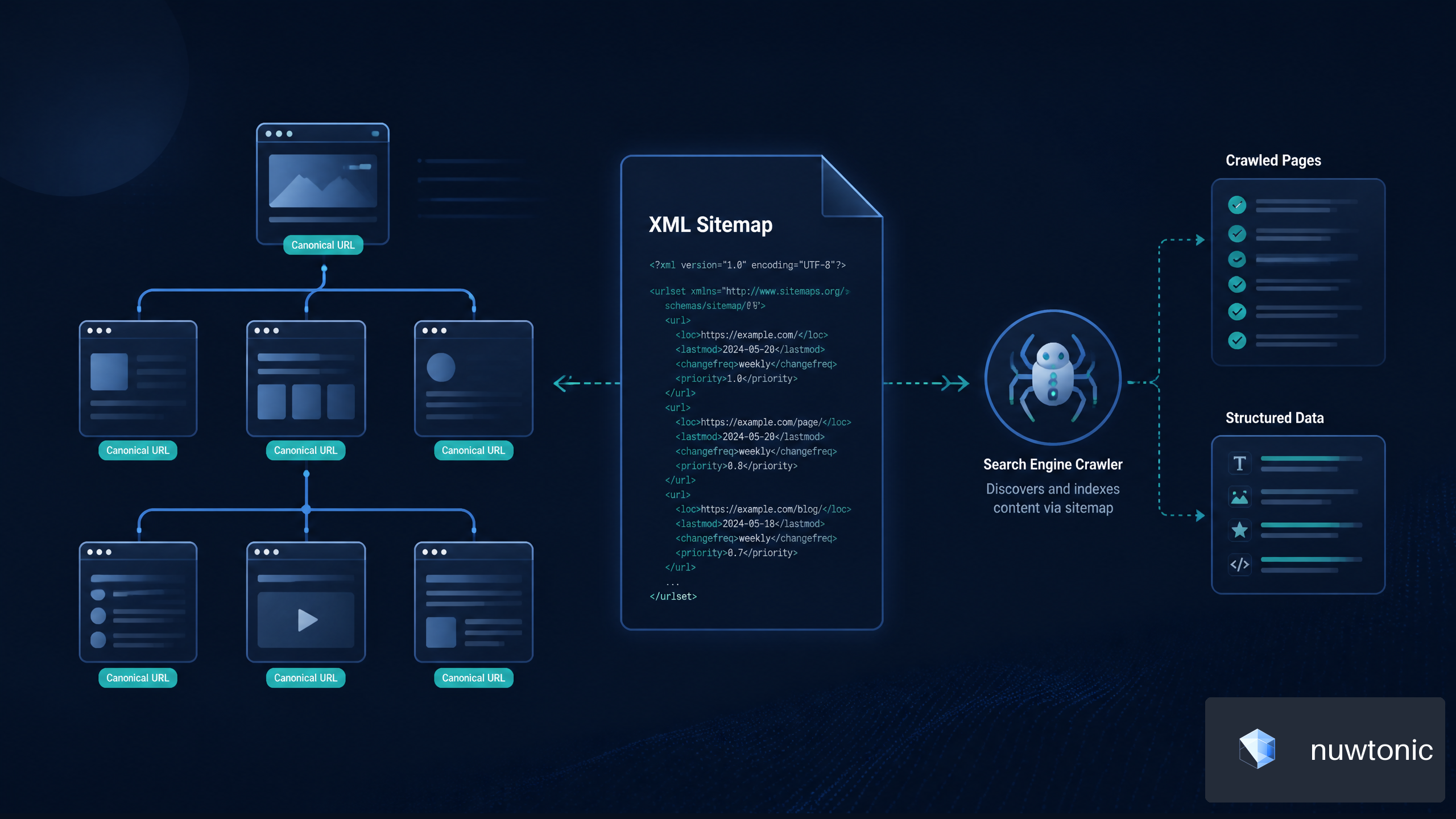
The technical rules are strict. For AMP to help SEO, AMP and canonical versions need on-page parity across metadata, structured data, and content. That includes elements such as H1s, alt text, hreflang tags, and JSON-LD. Canonical pages need a <link rel="amphtml"> reference to the AMP version, AMP pages need a <link rel="canonical"> back to the canonical version, and only canonical URLs should appear in XML sitemaps to avoid indexing conflicts, as outlined in Search Engine Journal's AMP SEO guide.
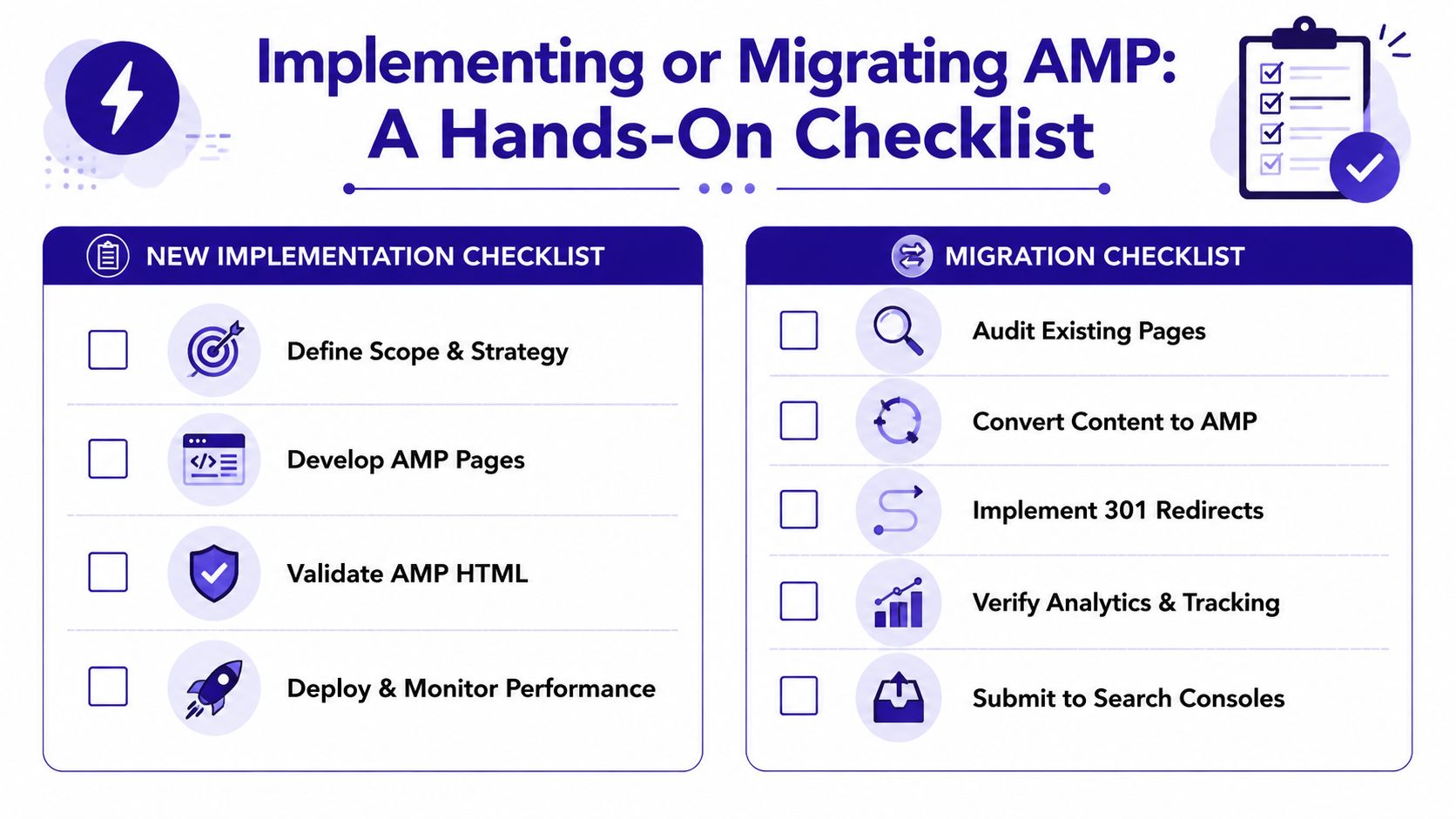
New AMP implementation checklist
Don't start by converting everything. Start by choosing page types where AMP's constraints are acceptable.
Define page scope first
Limit AMP to templates that are content-led and structurally repeatable. Blog posts, articles, and news pages are the usual candidates. Avoid forcing AMP onto page types that depend on custom interactivity.Build parity into the template spec
Make parity a launch requirement, not a cleanup task. The AMP page and canonical page need the same critical content, metadata, alt text, hreflang signals, and schema.Add bidirectional linking correctly
Canonical pages should reference their AMP versions withrel="amphtml". AMP pages should point back withrel="canonical".Keep sitemaps clean
Include canonical URLs only. Don't submit both versions in XML sitemaps.Validate before rollout
Check every template variant, not just one sample URL. A passing homepage example doesn't prove your author pages, category-linked posts, or embedded media templates are valid.Review on-page SEO details
Use a methodical process for titles, headings, alt text, internal links, and schema coverage. This on-page SEO workflow for technical content pages is the right level of rigor for AMP parity checks.
Implementation note: AMP failures usually come from edge-case templates, not from the default article template everyone tested on day one.
Safe migration away from AMP
Removing AMP isn't just deleting /amp/ URLs and hoping Google sorts it out.
Use this order instead:
Inventory every AMP URL
Crawl the site and export all known AMP patterns. Don't rely on memory, plugin settings, or a partial list from one report.Benchmark mobile performance before migration
Record mobile rankings, clicks, sessions, and engagement for the affected templates. Without a baseline, you won't know whether the migration helped or hurt.Upgrade canonical mobile templates first
Improve speed, layout stability, media handling, and script weight on the destination pages before you redirect traffic to them.Map redirects one-to-one
Every retired AMP URL should 301 redirect to the correct canonical equivalent. Don't send all AMP URLs to a generic hub page.Remove conflicting references
After migration, clean uprel="amphtml"references and other legacy AMP signals so search engines don't keep receiving mixed instructions.Submit updated sitemaps
Make sure the XML sitemap reflects only canonical destinations.Monitor for errors and shifts
Check for 404s, redirect loops, dropped impressions, and odd mobile-only declines after launch.
A good migration isn't judged by whether AMP disappeared. It's judged by whether the canonical mobile experience became stronger and cleaner than the AMP version it replaced.
Auditing Mobile Gaps and Optimizing Performance with Nuwtonic
The hard part of mobile SEO usually isn't identifying that mobile performance matters. The hard part is deciding which URLs deserve action first.
That's where a mobile gap workflow becomes useful. Instead of staring at one aggregate sitewide score, you compare desktop and mobile outcomes at the URL level and look for pages where mobile underperforms disproportionately. Those are the pages where AMP may still be helping, where AMP may be masking weak canonical templates, or where neither setup is good enough.

A practical workflow for mobile gap triage
One useful way to work is to connect Google Search Console data to page-level mobile deltas, then sort by impact. The goal isn't to flag every mobile issue. It's to find URLs where the difference between desktop and mobile visibility is large enough to cost traffic.
A platform with Mobile Opportunity Gap analysis can help surface those URLs faster by showing where mobile rank, CTR, or traffic lags behind desktop performance. That matters for AMP decisions because it gives you a priority list instead of a philosophical debate.
For example, if article pages perform well on desktop but consistently lag on mobile, the next questions become operational:
- Is the canonical mobile template too heavy?
- Is the AMP version outperforming it?
- Is parity broken between versions?
- Would consolidating into a stronger non-AMP template close the gap?
What to fix first after you find the gap
Start with the pages closest to revenue, lead generation, or strategic visibility. Then inspect the template mechanics behind them.
A practical review sequence looks like this:
| Priority check | Why it matters |
|---|---|
| Mobile content completeness | Missing mobile elements can reduce relevance and engagement |
| Layout stability | Shifting pages create poor user experience |
| Script and media weight | Heavy assets often explain mobile-specific underperformance |
| Version consistency | AMP and canonical mismatches can create SEO noise |
| Internal linking on mobile templates | Weak discoverability often compounds performance issues |
Find the pages where mobile loses the most value first. Then decide whether AMP is the fix, the crutch, or the thing you should retire.
That's the useful role of tooling in AMP mobile SEO today. Not to argue for AMP by default, but to show where mobile execution is breaking and which URLs deserve immediate attention.
FAQ About AMP and Mobile SEO
Is AMP still a ranking factor in 2026
No. AMP is not a direct ranking factor, and Google no longer requires it for Top Stories. The practical question is simpler. Does AMP help this site produce a faster, more stable mobile experience than the current canonical template?
If the answer is yes, AMP can still support better SEO outcomes through stronger page experience signals and cleaner mobile delivery. If the answer is no, it becomes maintenance overhead.
What are the best alternatives to AMP for strong mobile performance
A well-built responsive site is the default alternative in 2026.
That means lighter templates, tighter JavaScript control, stable layout behavior, optimized images and video, and fewer third-party scripts competing for the main thread. For many teams, that approach is easier to scale because it avoids running parallel AMP and non-AMP systems while still targeting the same performance standards AMP pushed the industry toward.
Can I delete AMP pages without redirects
No.
If AMP URLs have been indexed, linked, or surfaced in analytics history, removing them without redirects creates avoidable crawl waste and user dead ends. Redirect retired AMP URLs to the canonical equivalent, remove outdated AMP references from templates and sitemaps, and validate that canonical tags, internal links, and structured data all point to the surviving version.
When does AMP still make sense
AMP still makes sense for a narrow set of cases. It can work for publishers or content-heavy sites that need strict template control, have limited engineering resources, or still see a real performance gap between AMP pages and their standard mobile pages.
I would keep AMP only when it is measurably better than the non-AMP experience and the team can maintain content parity cleanly. If your responsive pages already pass Core Web Vitals and support your ad, analytics, and UX needs without friction, AMP is usually legacy tech.
Is there evidence that AMP can still improve traffic
Yes, but the gains are situational.
As noted earlier, some publishers have reported stronger traffic or engagement after rolling out AMP at scale. That does not make AMP a default recommendation. In practice, the upside usually comes from speed, template discipline, and reduced page bloat. Those benefits can often be matched, or beaten, by a modern responsive build without the cost of maintaining two versions.
If you want to decide whether AMP is helping, hurting, or no longer necessary, Nuwtonic gives you a practical way to audit mobile gaps, surface underperforming URLs, connect Search Console data to execution priorities, and turn technical findings into reviewable fixes instead of another static report.