TL;DR Summary
Core Concept | Traditional SEO | Generative Engine Optimization (GEO) |
|---|---|---|
Primary Metric | SERP blue-link positions and CTR | Citation Share of Voice and Entity Confidence |
Mechanism | Crawler-based keyword matching | Retrieval-Augmented Generation (RAG) synthesis |
Actionable Priority | Keyword density and backlink volume | Structured data, atomic answers, and entity validation |
Key Takeaway: By 2026, securing AI search visibility for agencies requires a complete transition from keyword ranking to structured authority optimization. If your client's content is not structured for easy extraction by LLMs, it will remain invisible in AI-generated answers.
Table of Contents
Introduction: The Death of the Blue Link and the Rise of GEO
The Mechanics of RAG: How AI Systems Retrieve and Cite
On-Page GEO: Structuring Content for AI Extraction
Off-Page GEO: Establishing the Trust Graph
Traditional SEO vs. AI SEO: The Strategic Shift
Scaling GEO with Nuwtonic: The Agentic Advantage
Frequently Asked Questions (FAQ)
Sources and References
The shift from the Blue Link and the Rise of GEO
Why Blue Links are Becoming a Legacy Metric
Here's the thing: by 2026, the traditional SEO playbook hasn't just aged—it has been completely rewritten. For years, digital marketing agencies measured success by keyword rankings and blue links on the SERP. But today, the game is entirely different. We are no longer just optimizing for human clicks; we are optimizing for AI synthesis.
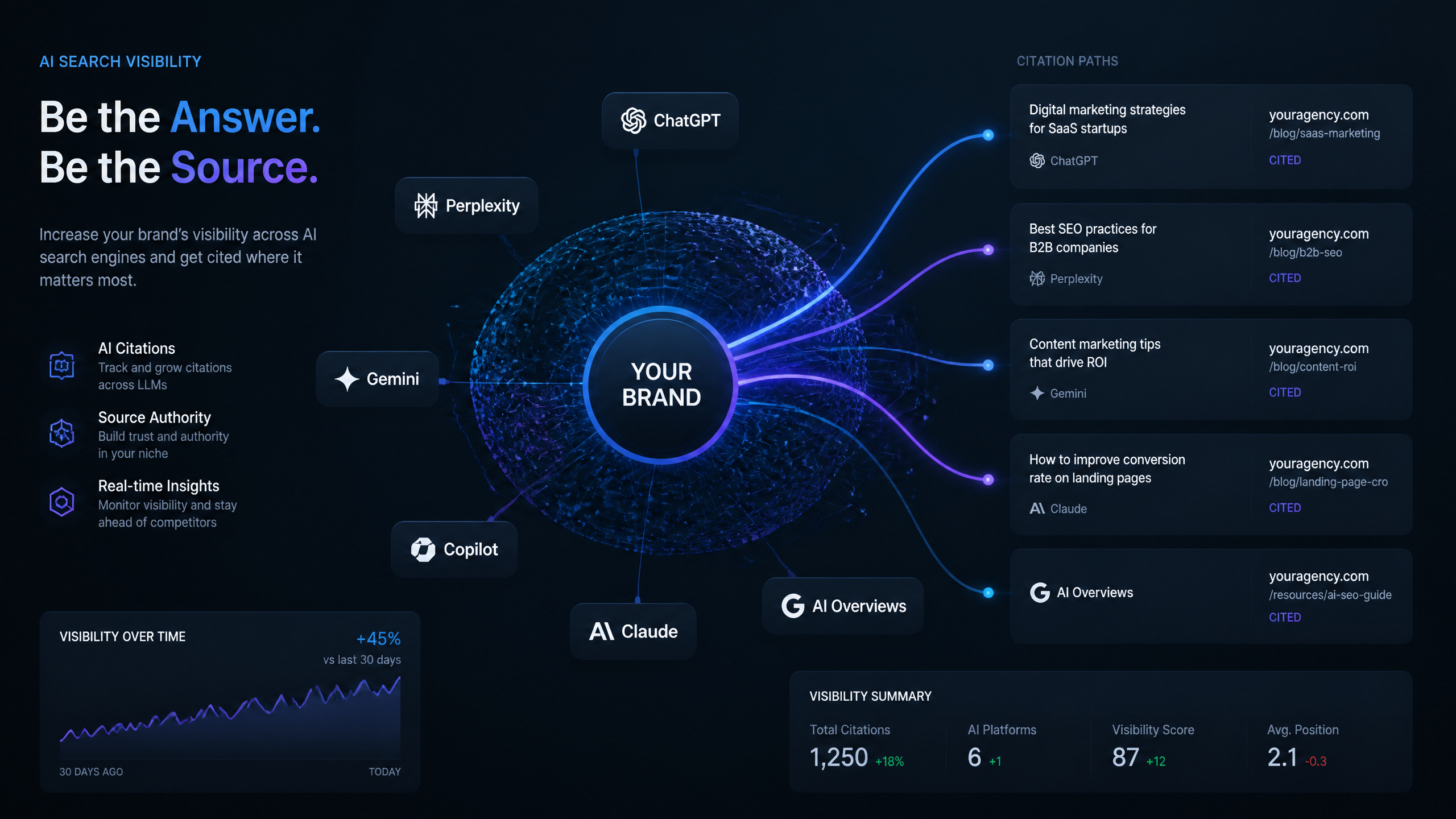
With Google's AI Overviews, Perplexity, and ChatGPT dominating search behavior, the traditional click-through pipeline has collapsed. Users want answers immediately, formulated in clean, conversational prose. If your agency is still promising "Page 1 rankings" without a dedicated strategy for AI search visibility, you are selling a legacy service that is rapidly losing commercial value.
Defining Generative Engine Optimization (GEO)
Generative Engine Optimization (GEO) is the practice of optimizing digital content so that AI-powered search engines can easily retrieve, synthesize, and cite it. Unlike traditional search engines that rely heavily on keyword matching and page authority, generative engines use advanced retrieval systems to parse the web for direct answers.
To capture AI search visibility for agencies, we must understand that these engines act as synthesizers. They do not merely index pages; they construct answers on the fly. Your content must be formatted in a way that allows these engines to extract facts, statistics, and expert opinions seamlessly while maintaining high trust scores.
The Agency Dilemma: Adapt or Become Invisible
Don't just stuff keywords; that's a surefire way to lose visibility. Many agencies fail to realize that AI engines ignore fluff. If your clients' websites are filled with generic marketing copy that lacks clear structure, they will be bypassed entirely by AI crawlers.
This creates a massive operational challenge. How do you audit thousands of client pages for AI compatibility? How do you prove value when traditional organic CTR is shifting toward AI-assisted conversions? Agencies that adapt quickly will secure a massive competitive advantage, while those that cling to 2020-era practices will face client churn as organic traffic declines.
The Mechanics of RAG: How AI Systems Retrieve and Cite
Vector Search and Semantic Closeness
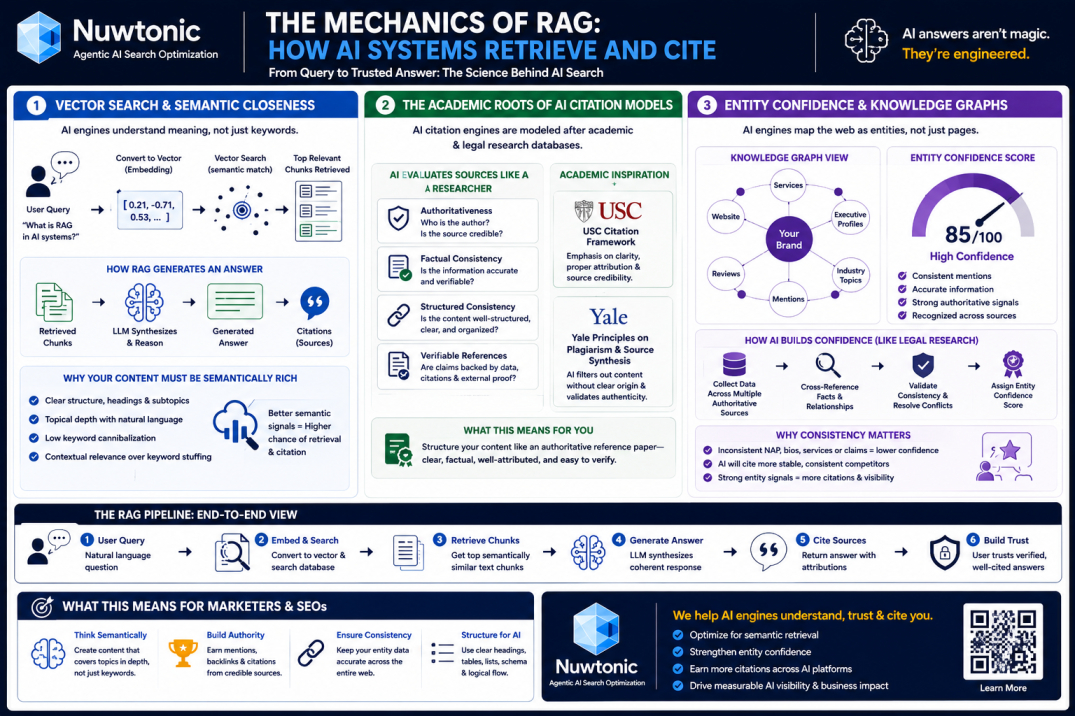
Under the hood, modern AI search engines rely on Retrieval-Augmented Generation (RAG). Instead of matching exact keyword strings, these systems convert search queries and web content into mathematical vectors. This allows the engine to understand the semantic meaning and intent behind a query.
When a user asks a complex question, the AI retrieves the most semantically close "chunks" of text from its database. It then uses an LLM to synthesize these chunks into a coherent answer. If your content lacks semantic richness or contains high keyword cannibalization, the vector search algorithms will struggle to map your pages to the user's intent.
The Academic Roots of AI Citation Models
To build trust, generative engines must cite their sources. Interestingly, these citation algorithms are heavily modeled after academic and legal research databases. AI engines prioritize sources that demonstrate rigorous attribution and structured consistency.
For instance, the way an LLM evaluates a source's credibility mirrors established academic guidelines, such as those outlined in USC's citation framework. The engine looks for clear authoritativeness, factual consistency, and verifiable references. Furthermore, to prevent generating false information, AI algorithms filter out content that lacks clear origin data, applying validation standards similar to Yale's principles on plagiarism and source synthesis. To ensure high AI search visibility for agencies, your clients' content must be structured like an authoritative reference paper—clear, factual, and easily attributable.
Understanding Entity Confidence and Knowledge Graphs
AI engines do not view websites as isolated pages; they view them as nodes within a broader Knowledge Graph. The engine assigns an "Entity Confidence Score" to your client's brand based on how consistently it is mentioned across the web.
This process is highly structured, akin to how professional researchers verify corporate facts using Thomson Reuters' legal research processes. The AI cross-references data points across multiple authoritative databases. If your client's business name, services, and executive profiles are inconsistent across the web, the AI's confidence in that entity drops, and it will choose a more stable competitor to cite in its answers.
On-Page GEO: Structuring Content for AI Extraction
Atomic Content Architecture and the TL;DR Principle
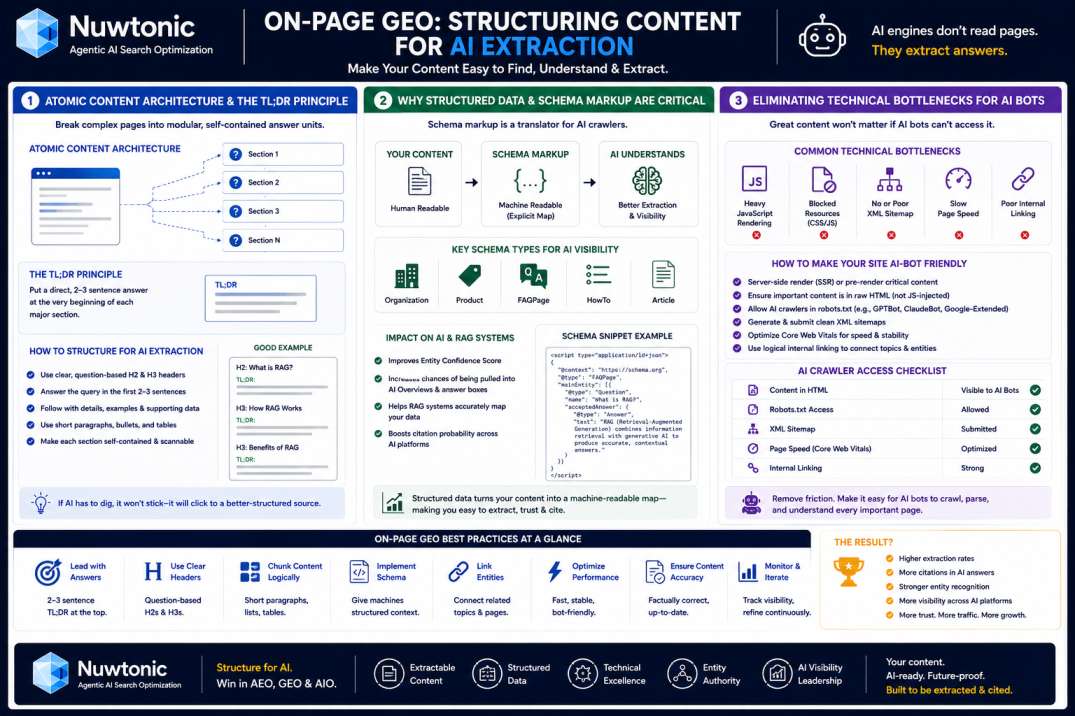
To make your client's content "extractable" for AI engines, you must adopt an Atomic Content Architecture. This means breaking down complex pages into modular, self-contained sections that answer specific questions.
I highly recommend enforcing the "TL;DR Principle" across all high-value pages. Place a direct, 2–3 sentence answer to the primary query at the very beginning of each major section. Use clear, question-based H2 and H3 headers so the AI parser can easily map the user's query to your content block. If the AI has to dig through paragraphs of introductory fluff to find the answer, it will move on to a better-structured site.
Why Structured Data and Schema Markup are Critical
Here's the thing about structured data: I often see agencies underestimating the power of structured data—it's a game changer for AI search visibility.
Schema markup acts as an explicit translator for AI crawlers. By implementing detailed Organization, Product, FAQPage, and HowTo schema, you are giving the machine a machine-readable map of your content. This directly improves your Entity Confidence Score, making it significantly easier for RAG systems to pull your data into AI Overviews and answer boxes.
Eliminating Technical Bottlenecks for AI Bots
Many agencies focus entirely on content and ignore the technical pipelines that AI bots use. If your client's site relies heavily on complex, client-side JavaScript rendering, you are going to run into serious issues.
Let me share an anecdote from my own trial-and-error experiences. A couple of years ago, I was managing a massive site migration for an enterprise B2B client. I misjudged the impact of core web vitals on our crawl budget, thinking the AI parser would easily bypass slow loading times to grab our content. I was wrong. The LLM crawlers timed out on our heavy, unoptimized JavaScript elements, completely wiping out our citation share of voice overnight. That taught me a brutal lesson—if the machine can't render your site instantly, you don't exist. Always ensure your high-value content is available in clean, standard HTML.
Off-Page GEO: Establishing the Trust Graph
Entity Validation Across the Web
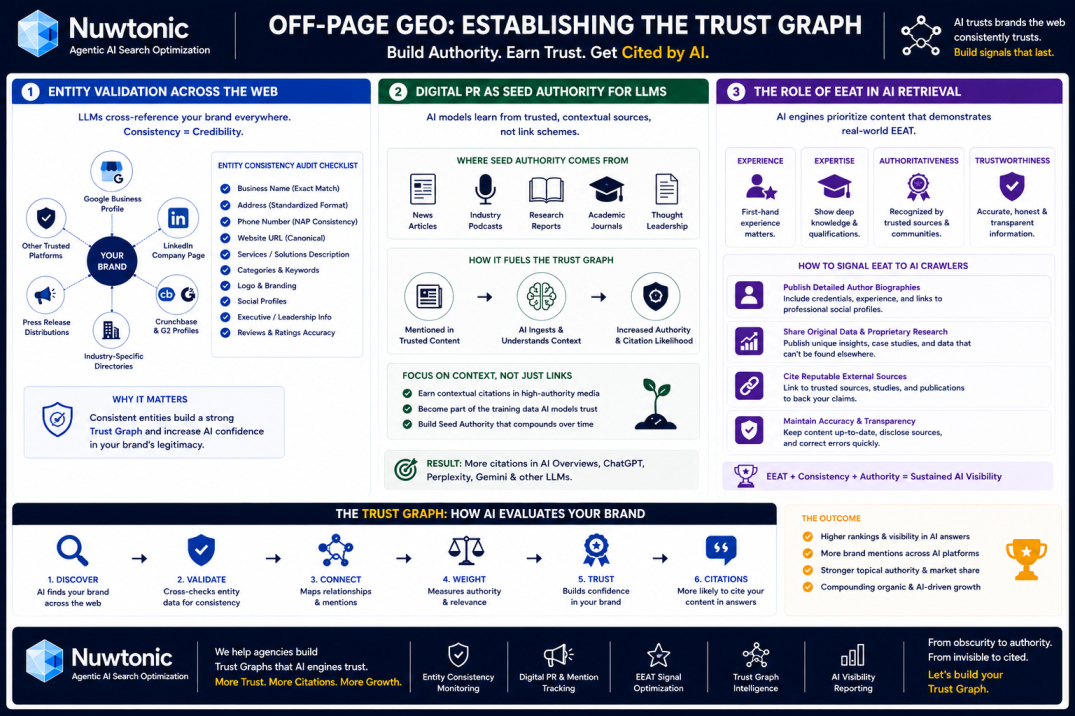
Off-page optimization in 2026 is no longer about spammy backlink acquisition. It is about building a validated entity profile. LLMs cross-reference your brand across multiple trusted sources to determine if you are a legitimate authority.
To build a strong Trust Graph, you must conduct regular Entity Consistency Audits. Ensure that your client's Name, Address, Phone (NAP), and core service descriptions are 100% consistent across all digital assets, including:
• Google Business Profile
• LinkedIn Company Pages
• Crunchbase and G2 profiles
• Industry-specific directories
• Major press release distributions
Digital PR as Seed Authority for LLMs
Stop chasing "do-follow" links just to pass PageRank. Instead, focus on contextual citations in high-authority media. AI models are trained on massive datasets that prioritize reputable news sources, academic journals, and industry-specific publications.
When your client is mentioned in an industry podcast transcript, a major news article, or a verified research report, the AI ingests this as a heavy authority signal. These contextual mentions build "Seed Authority," making the AI far more likely to trust and cite your client's website when answering relevant user queries.
The Role of EEAT in AI Retrieval
To secure sustained visibility, understanding the importance of EEAT for AI SEO is critical. AI engines are programmed to favor sources that demonstrate real-world Experience, Expertise, Authoritativeness, and Trustworthiness.
You can signal EEAT to AI crawlers by:
Publishing detailed author biographies with links to their professional social profiles.
Including original data, proprietary research, and case studies that cannot be found elsewhere.
Linking to reputable external sources to back up your claims, showing that your content is thoroughly researched.
Traditional SEO vs. AI SEO: The Strategic Shift
Core Differences in Execution
Let's look at the differences between traditional SEO and AI SEO side by side to understand how your agency's day-to-day operations must evolve.
Operational Area | Traditional SEO Workflow | AI SEO (GEO) Workflow |
|---|---|---|
Keyword Research | Targeting high-volume, low-difficulty search terms | Mapping semantic entities and conversational long-tail queries |
Content Creation | Writing comprehensive, keyword-optimized articles | Creating structured, atomic answers with clear data tables |
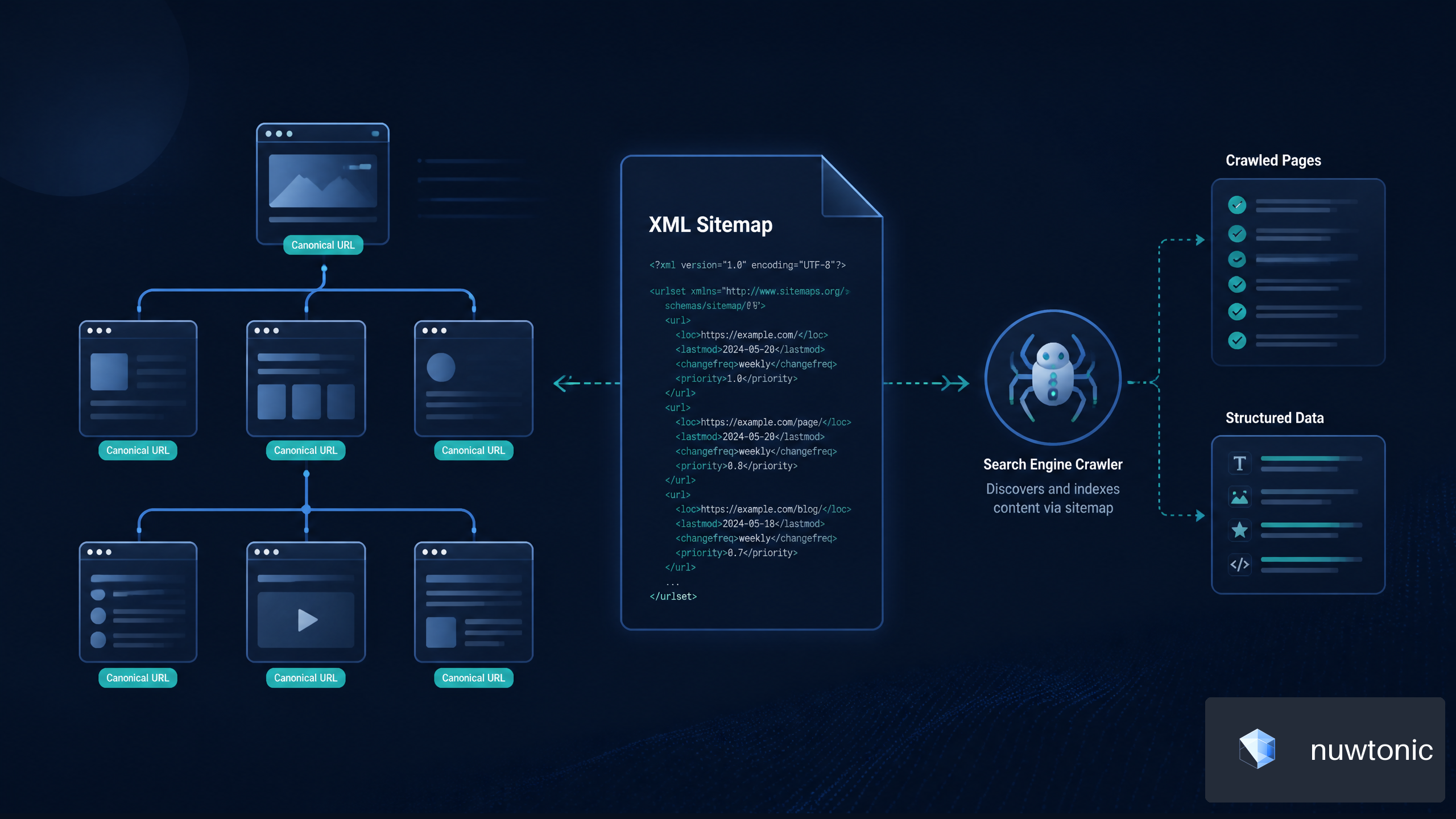
Technical Auditing | Checking indexation, sitemaps, and page speeds | Verifying schema accuracy, API accessibility, and bot rendering |
Link Building | Acquiring high-authority backlinks for PageRank | Securing entity-validating citations in trusted datasets |
Reporting | Tracking SERP rankings, organic traffic, and CTR | Measuring Citation Share of Voice and Entity Confidence |
Transitioning Agency Workflows
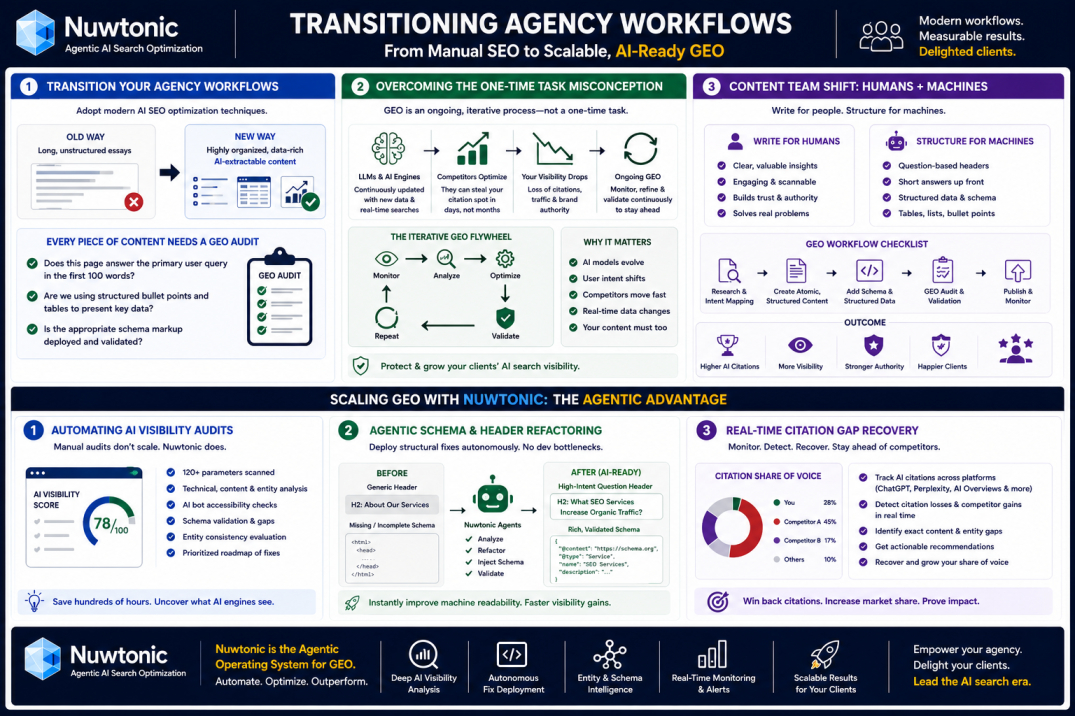
Transitioning your agency's workflow requires adopting modern AI SEO optimization techniques. You must train your content team to write for both humans and machines. This means moving away from long, unstructured essays and toward highly organized, data-rich resources.
Every piece of content your agency produces should undergo a "GEO Audit" before publishing. Ask yourself:
• Does this page answer the primary user query in the first 100 words?
• Are we using structured bullet points and tables to present key data?
• Is the appropriate schema markup deployed and validated?
Overcoming the One-Time Task Misconception
Here's another major issue: the misconception that SEO is a one-time task rather than an ongoing strategy can really hold agencies back. Many clients—and unfortunately, some agencies—believe that once a page is optimized, the job is done.
But in the AI era, LLMs are continuously updated with new training data and real-time web searches. A competitor can easily optimize their structured data and steal your client's citation spot in a matter of days. To protect your clients' AI search visibility, you must treat GEO as an ongoing, iterative process of monitoring, refining, and validating information.
Scaling GEO with Nuwtonic: The Agentic Advantage
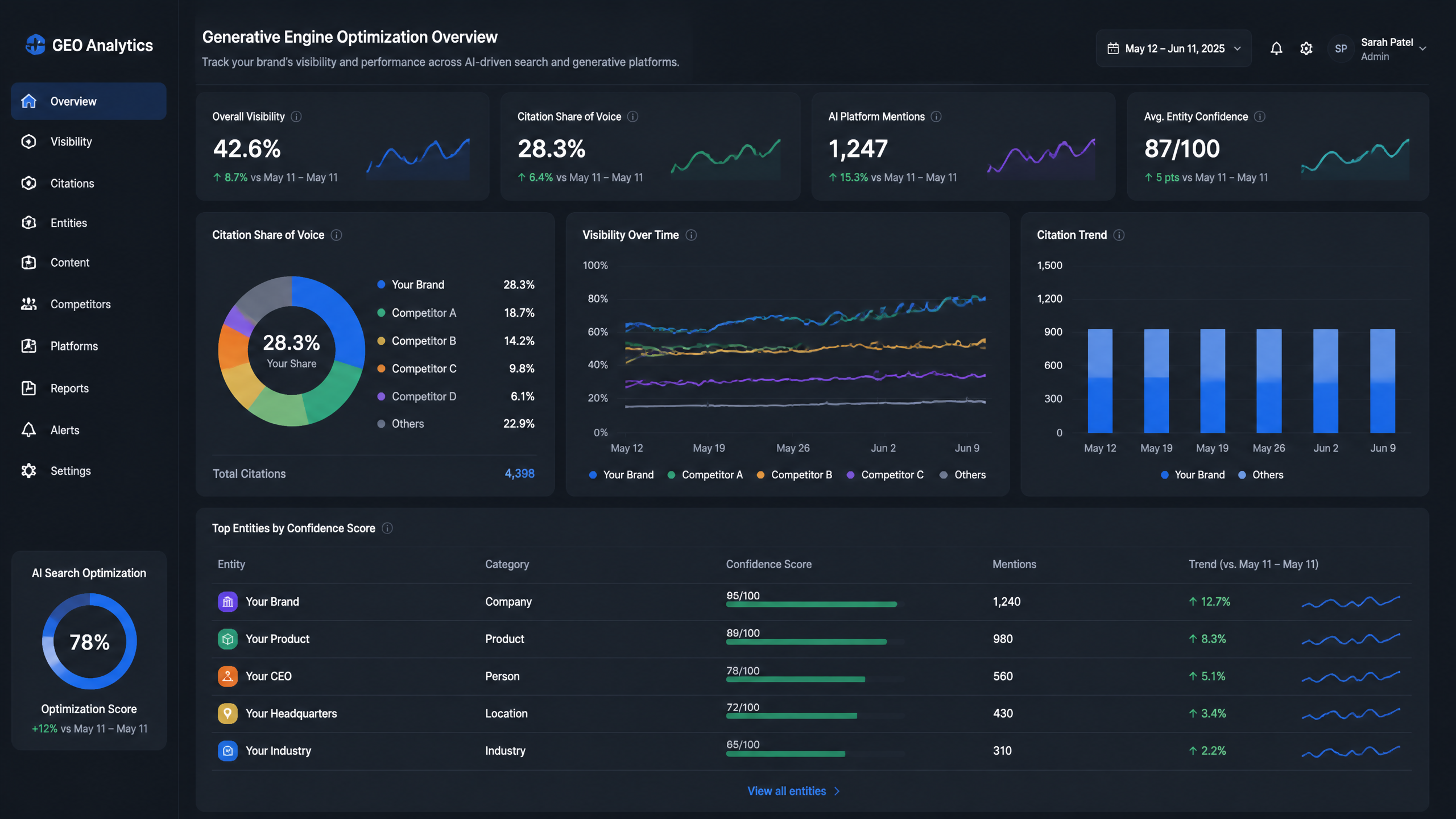
Automating AI Visibility Audits
Let's be honest—manually auditing hundreds of client pages for AI readiness is mathematically impossible for busy agency teams. You simply do not have the hours to manually check every H2, verify every schema markup string, and analyze crawl logs for AI bot blockages.
This is where Nuwtonic becomes an indispensable partner for your agency. Operating as an Agentic Operating System, Nuwtonic automates the deep technical analysis required for GEO. The platform runs comprehensive scans across 120+ parameters to identify exactly why your clients are being ignored by AI engines, giving your team a clear, prioritized roadmap of technical fixes.
Agentic Schema and Header Refactoring
Instead of writing endless development tickets and waiting weeks for client devs to implement them, Nuwtonic allows your agency to deploy structural fixes autonomously.
Our intelligent agents can automatically refactor page headers into high-intent questions and inject precise, validated schema markup site-wide. This ensures your content is instantly formatted for machine readability, dramatically reducing the time it takes to see improvements in AI search visibility.
Real-Time Citation Gap Recovery
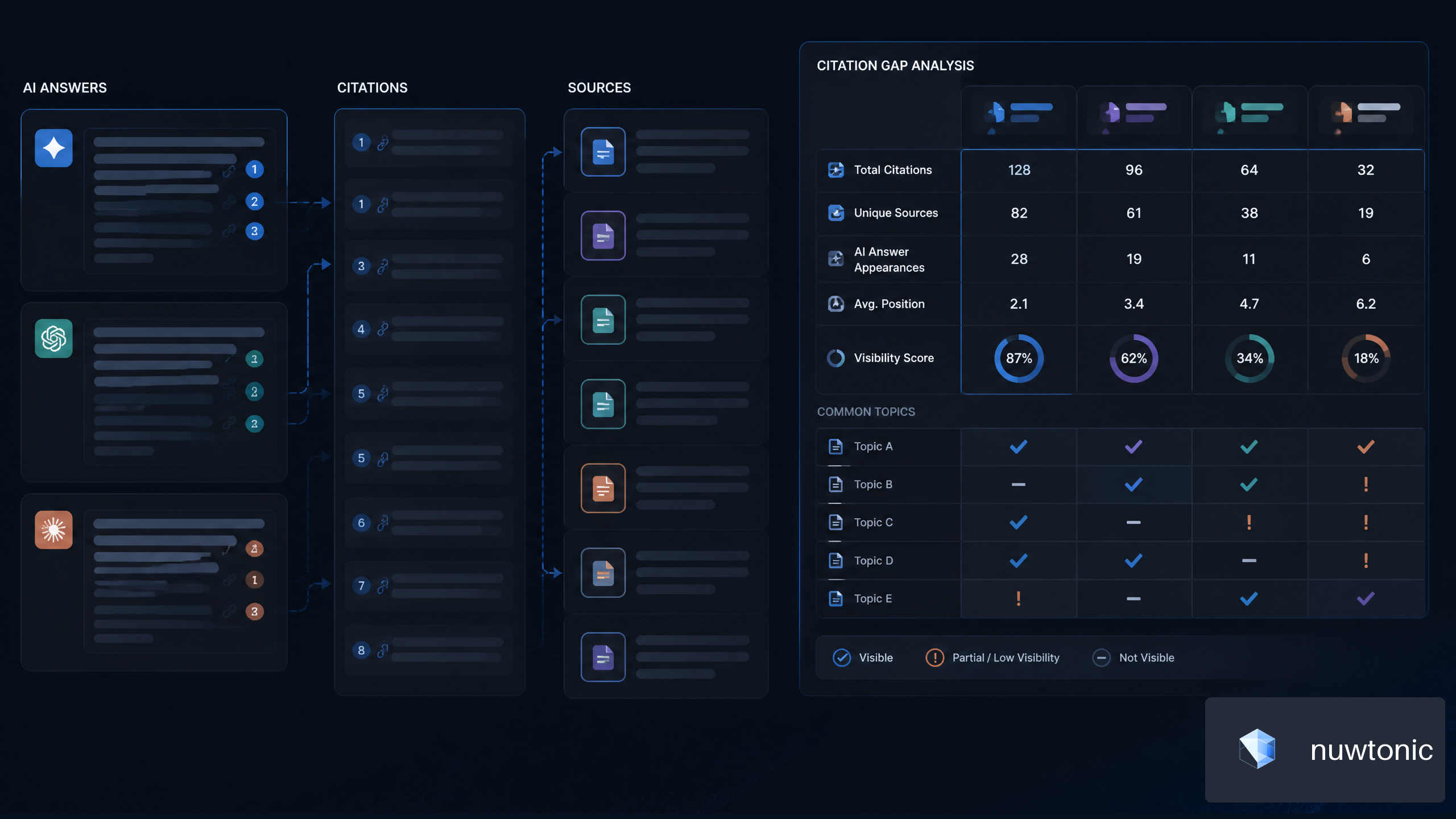
Nuwtonic monitors the AI search landscape in real-time, tracking your clients' Citation Share of Voice against their direct competitors.
When a competitor captures an AI answer box for a high-value query, Nuwtonic immediately alerts your team and identifies the exact content gaps you need to fill. By automating the identification and execution of these optimizations, Nuwtonic empowers your agency to scale its GEO services efficiently, delivering measurable, high-impact results for your clients.
Frequently Asked Questions (FAQ)
How do we measure Citation Share of Voice?
Citation Share of Voice (SoV) measures how frequently your client's brand is cited as a source in AI-generated answers for a specific set of queries. You can track this by running automated API queries across platforms like Google AI Overviews and Perplexity, calculating the percentage of times your client's URL is featured in the citations compared to competitors.
Will optimizing for AI search hurt our traditional organic CTR?
No. In fact, optimizing for GEO often improves traditional SEO performance. By implementing clear schema, structuring your content with clean headers, and improving page speed, you are making your site highly accessible to both traditional search algorithms and generative AI engines.
Can we block AI crawlers without losing visibility?
If you block AI bots (like GPTBot or Google-Extended) via your robots.txt file, those specific models will not be able to crawl your site for real-time RAG synthesis. While this protects your content from being used for LLM training, it will significantly reduce your visibility in live, AI-powered search results. For most clients looking to drive traffic, blocking these bots is counterproductive.
Sources and References
Academic and Industry Frameworks
• USC LibGuides: USC's citation framework
• Yale Poorvu Center: Yale's principles on plagiarism and source synthesis
• Thomson Reuters: Thomson Reuters' legal research processes