Key Takeaways
• Foundation First: Technical SEO is the engine; without it, search engines cannot crawl or index your local landing pages.
• Proximity Rules: Local SEO focuses on geo-targeting and map pack visibility, heavily relying on Google My Business (GMB) and NAP consistency.
• The Multi-Location Trap: Multi-location brands face constant conflicts between technical duplicate-content rules and local geo-keyword requirements.
• Budget Alignment: Technical SEO requires a larger upfront investment, whereas Local SEO is highly cost-effective but demands continuous maintenance.
Table of Contents
Demystifying the Core Battle: Technical SEO vs Local SEO
The Intersecting Gears: Where Technical and Local Meet
When Technical Rules Clash with Local Reality
Strategic Decision Matrix: Where to Spend Your First Dollar
Common Pitfalls and What NOT to Do
Frequently Asked Questions (FAQ)
Sources and References
Demystifying the Core Battle: Technical SEO vs Local SEO
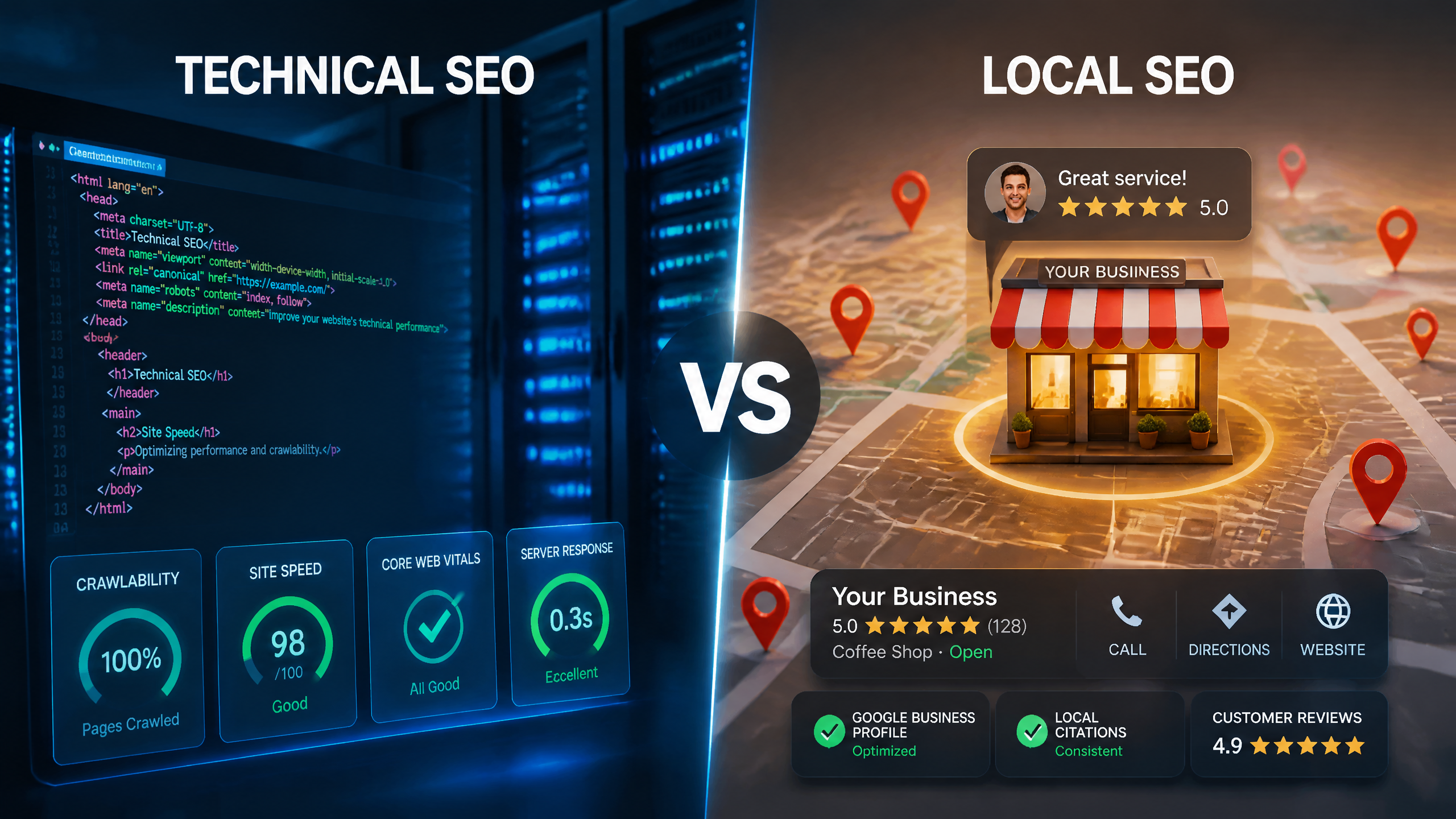
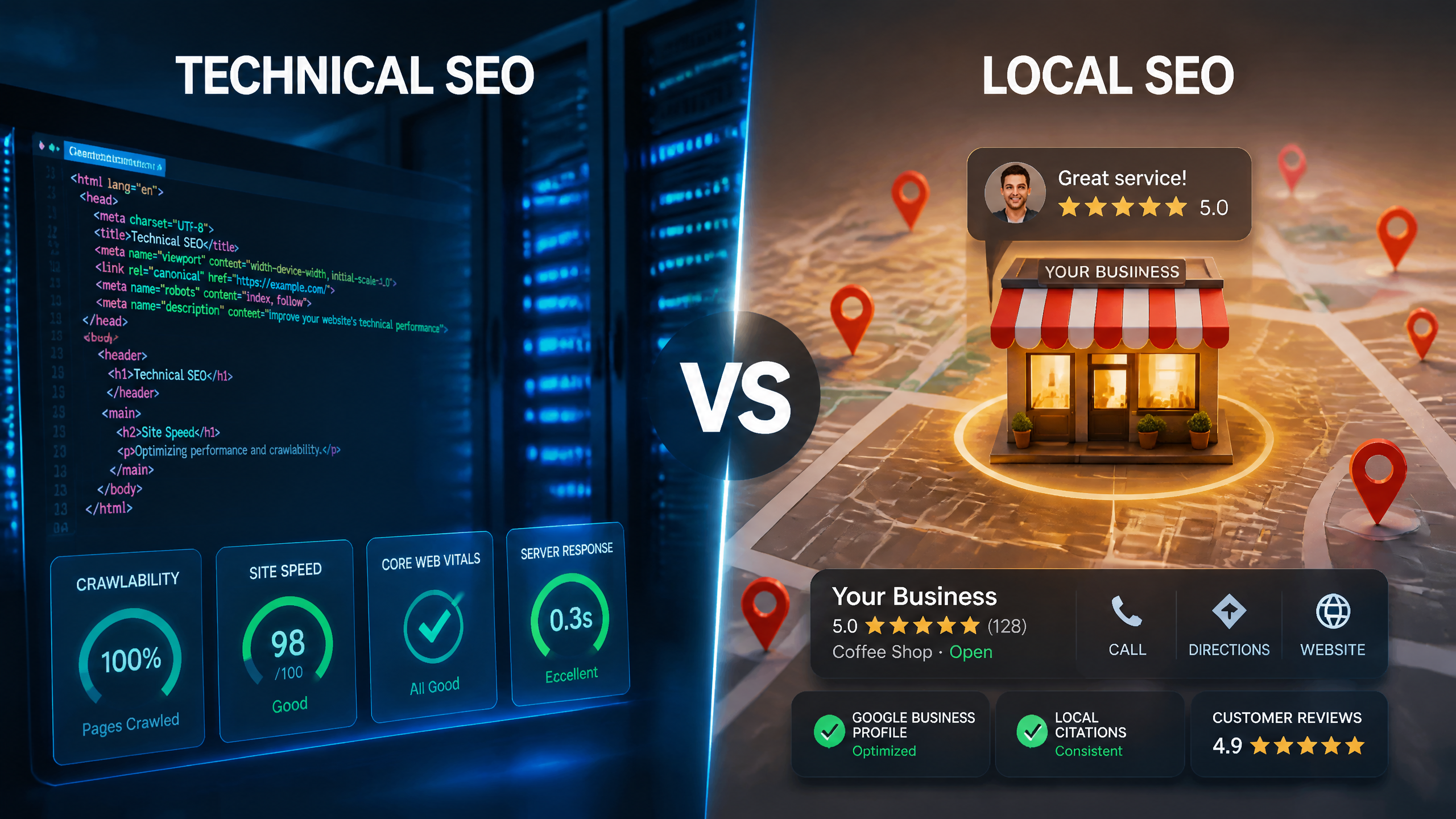
Listen, if you've spent more than five minutes in the digital marketing world, you've probably heard people throw these terms around like they're competing for the same crown. They aren't. They are two entirely different animals pulling the same cart.
What is Technical SEO? (The Engine Room)
Let's look at the plumbing. Technical SEO is the practice of optimizing your website's backend infrastructure so search engines can easily find, crawl, and index your content. As Content Powered points out, technical SEO is a subset of overall SEO that focuses entirely on on-site, non-content elements.
If your site has a crawl budget crisis, broken redirect loops, or an SSL certificate that expired during the Obama administration, Google's bots will abandon ship. According to Webyonder, technical SEO determines whether Google can access and rank your content in the first place. If the crawlers can't get past the front door, the most beautifully written blog post in the world won't save you.
What is Local SEO? (The Storefront Sign)
Now, let's talk about the digital storefront. Local SEO is laser-focused on optimizing your online presence to attract nearby customers who are ready to buy. According to CS Design Studios, local SEO's primary goal is helping businesses attract customers within a specific geographic area.
This is where we talk about the local pack (or map pack)—that coveted three-business block that appears at the very top of Google when you search for "plumber near me." Local SEO relies heavily on signals outside of your actual website, such as your Google My Business (GMB) listing, local citations, and the sheer volume of customer reviews. It's about proximity, relevance, and prominence.
The Core Differences Explained
To make this dead simple, let's look at how these two strategies stack up side-by-side. Don't fall into the trap of thinking one is "better" than the other—they serve completely different masters.
Feature / Parameter | Technical SEO | Local SEO |
|---|---|---|
Primary Focus | Website infrastructure, crawlability, and indexability | Geographic proximity, map pack prominence, and local intent |
Core Asset | Your self-hosted website and server configuration | Google My Business (GMB) profile and local directories |
Primary Audience | Search engine crawlers and global searchers | Nearby local consumers with high purchasing intent |
Key Metrics | Page speed, crawl errors, Core Web Vitals, index rate | Map pack rankings, review volume, NAP consistency, local actions |
Upfront Cost | Typically higher ($2,000 to $10,000+ for audits and fixes) | Lower entry barrier ($500 to $2,000/month for ongoing optimization) |
Website Needed? | Yes, absolutely mandatory | No, technically possible to rank in map packs without one |
The Intersecting Gears: Where Technical and Local Meet
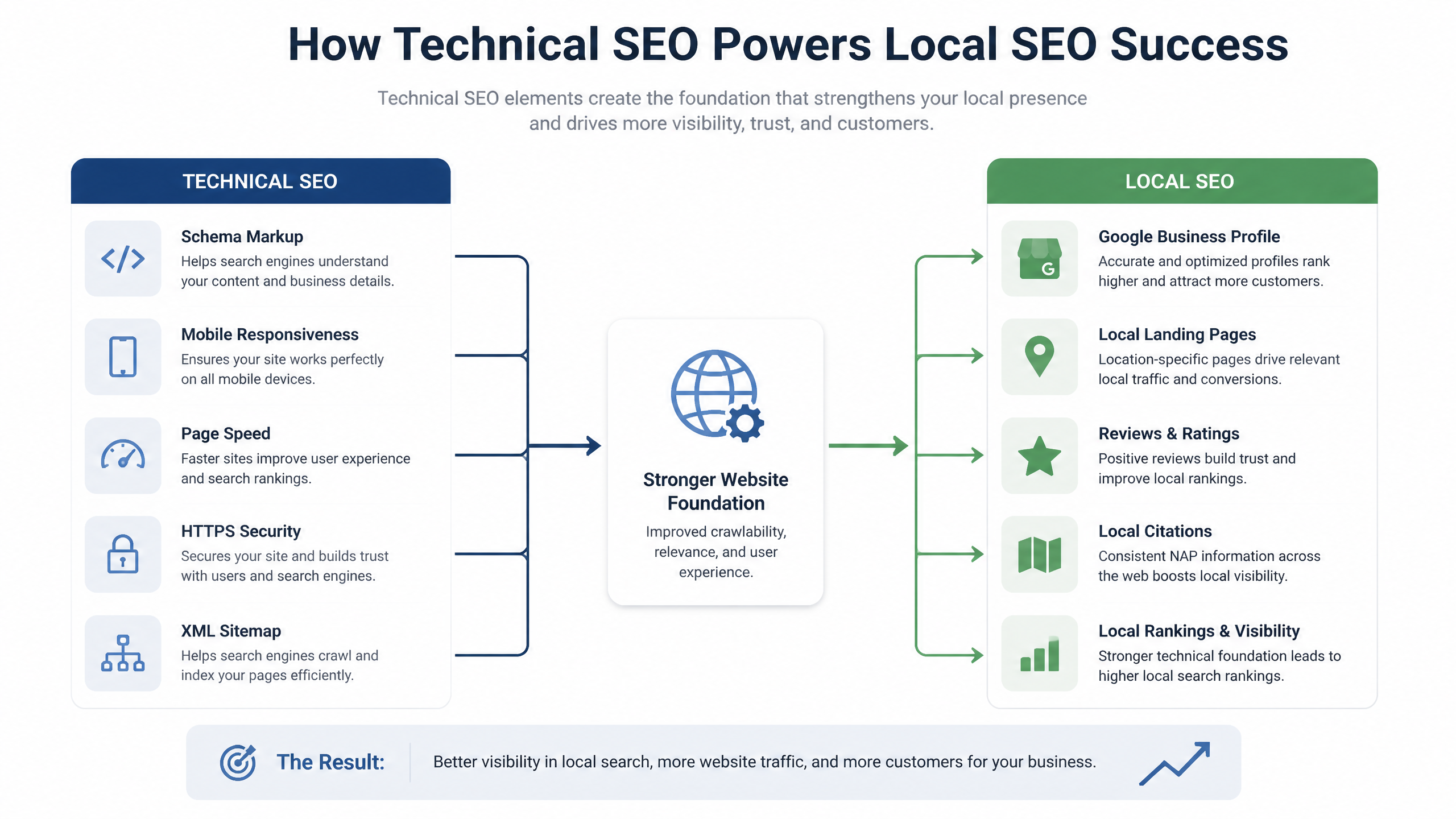
Listen, while it's clean and tidy to separate these two into neat little boxes, the real world is messy. In my eight years of helping small businesses, I've seen that these strategies are deeply intertwined—neglecting one will almost always cripple the other.
Mobile Optimization and Core Web Vitals
Here's a cold hard truth: more than half of all local searches happen on mobile devices while people are literally on the move. According to a study reported by Webyonder, 53% of mobile sites take longer than 3 seconds to load, yet pages loading in under 2 seconds have double the conversion rates.
If your site speed is atrocious, your local mobile searchers will bounce before your beautiful local landing page even loads. This is where technical SEO (optimizing Core Web Vitals and responsive design) directly impacts your local conversion rates. Third Angle highlights that technical elements like mobile-friendly layouts are mandatory for both search accessibility and local user experience.
Schema Markup as a Translation Layer
Think of schema markup as the universal translator between your website and Google's algorithm. By using LocalBusiness structured data—which is a technical SEO implementation—you are telling Google exactly where your physical office is, what your business hours are, and what payment methods you accept.
It bridges the gap. You're taking raw local information (your address and phone number) and packaging it in a clean, technical format that search engines can digest instantly. It's the ultimate handshake between the backend developer and the local marketer.
Local Landing Pages and Crawl Budgets
If you have a business with multiple locations, you need local landing pages. But how does Google find them? Through technical site architecture.
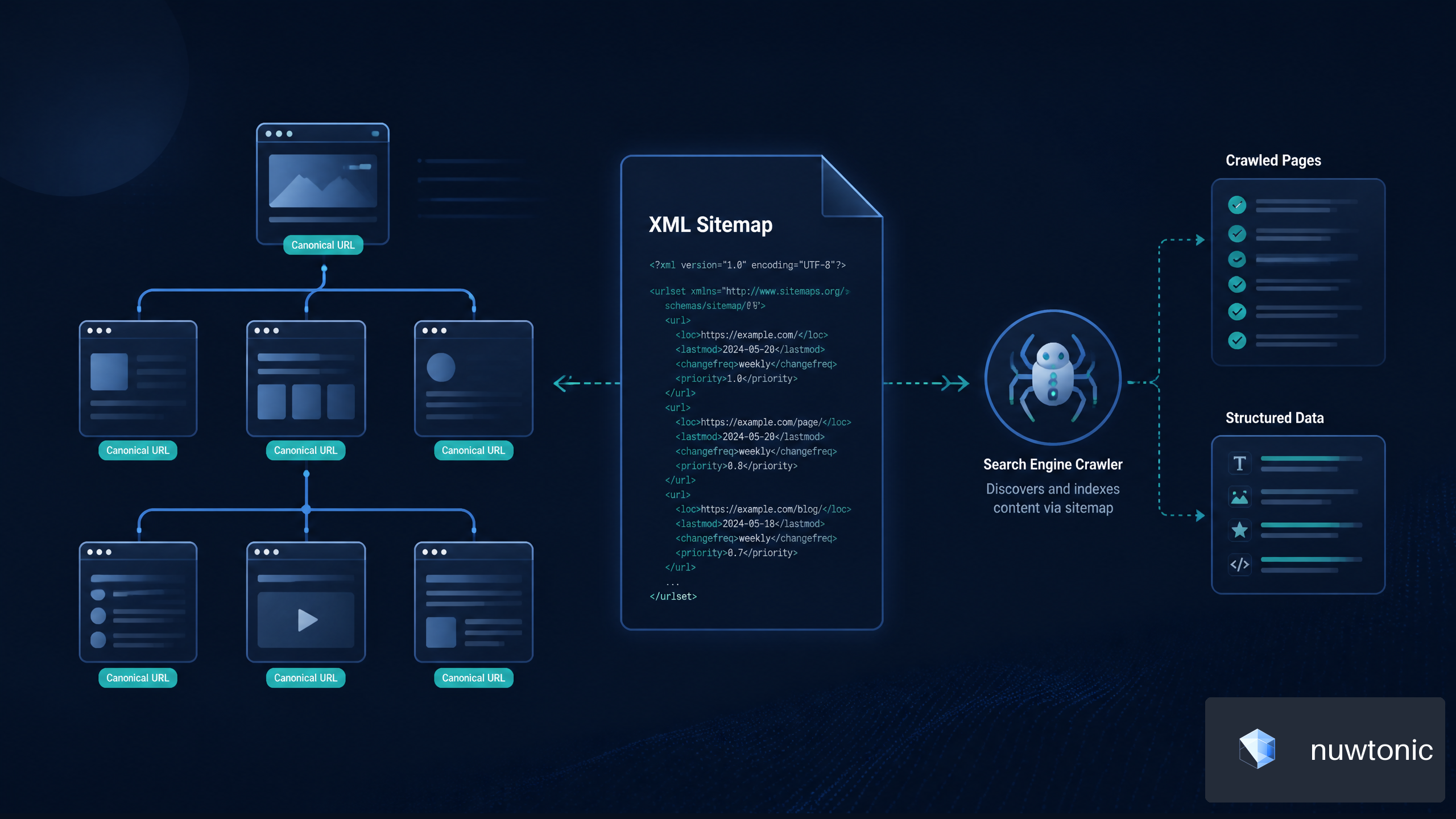
If your XML sitemap is a cluttered mess or your internal linking structure is buried three levels deep, Google's crawlers might never find your local pages. You can write the absolute best geo-targeted content for your Boston location, but if your site's crawl budget is wasted on duplicate parameter URLs, that Boston page is dead in the water.
When Technical Rules Clash with Local Reality
This is where things get spicy. Sometimes, standard technical SEO best practices will run headfirst into local SEO requirements, and you'll have to make a tough choice. Let's look at how these conflicts play out in the trenches.
The Canonical Tag Dilemma
In the technical SEO playbook, duplicate content is a major sin. If you have five different location pages with 80% identical text (because, let's face it, your plumbing services don't change just because you're in a different ZIP code), a technical SEO specialist's first instinct is to slap a canonical tag pointing to the main homepage.
Don't do that. If you canonicalize your location pages to the homepage, Google will ignore those location pages in local search results.
I saw this exact scenario play out with a multi-location dental clinic. They had three locations and had canonicalized all their location pages to the homepage to "clean up" their technical profile. Their map pack visibility completely vanished. Once we removed the canonical tags, kept the technical architecture clean, and rewrote unique geo-specific content for each clinic, their rankings recovered in under two months, and their local pack visibility shot up by 35%.
Multi-Location URL Structure Conflicts
How should you structure your URLs for multiple locations? Technical SEOs love clean, flat directories. Local SEOs need geo-targeting hooks.
If you use parameterized URLs like example.com/services?location=boston, you might make your database happy, but you're making it incredibly hard to build local link juice to a dedicated landing page. The sweet spot is a clean hierarchical structure like example.com/locations/boston. It satisfies the technical requirement for logical site architecture while giving your local campaigns a clean, indexable URL to optimize.
The "No-Website" Local SEO Edge Case
Can you actually rank and get customers without a website? Yes, you can.
I once took on a local Italian bistro whose website had been hacked and completely taken offline. Instead of waiting weeks for the developer to rebuild the site, we doubled down entirely on their GMB profile. We optimized their menus, posted weekly updates, responded to every single review, and ensured their NAP consistency was flawless across third-party local directories.
The result? They ranked in the top three of the local pack for "best pasta near me" within just one month—completely website-free. While I don't recommend this as a long-term strategy (since you don't own Google's platform), it proves that local SEO can deliver immediate wins even when your technical SEO foundation is literally non-existent.
Strategic Decision Matrix: Where to Spend Your First Dollar
Listen, unless you have unlimited venture capital backing, you have to prioritize. You can't fix everything at once. Let's break down exactly how to allocate your budget based on your business model.
The Service Radius Rule of Thumb
Your target geographic area should dictate your strategy. If your business operates within a narrow physical radius, your playbook looks very different from a global SaaS company.
• Under 10 Miles (e.g., Coffee Shops, Dentists, Salons): Put 70% of your budget into Local SEO. Focus on GMB optimization, review acquisition, and local citations. Spend the other 30% on basic technical hygiene (SSL, mobile responsiveness, and basic page speed).
• Over 50 Miles / National (e.g., E-commerce, B2B Software): Put 80% of your budget into Technical SEO. You need flawless crawlability, advanced schema markup, and rapid site speed to compete on a national scale.
• Multi-Location (3+ physical stores): Go with a 50/50 split. You need solid local landing pages (technical) paired with hyper-local GMB management and review generation (local).
Budget Allocation and Time to Results
Let's talk numbers. Webguruz reports that technical SEO typically requires a larger upfront investment because it often involves developer hours to fix deep-seated database or server issues. However, those technical fixes have long-lasting, compounding benefits.
On the flip side, local SEO has a much lower entry cost but requires consistent, ongoing maintenance. If you stop managing your reviews or ignore your GMB profile, your rankings will slide.
Resource Planning: Specialists vs. Generalists
Don't hire a developer to write your local citations, and don't hire a local citation builder to fix your database indexing issues.
If your site is experiencing crawl errors, slow server response times, or rendering issues with JavaScript, you need a technical SEO specialist or an automated tool like Nuwtonic to diagnose and execute the fixes. If your issue is that your business name is spelled three different ways on Yelp, TripAdvisor, and MapQuest, you need a local SEO expert who understands the nuances of NAP consistency.
Common Pitfalls and What NOT to Do
Don't think you can ignore your GMB listing and still rank well just because your site loads in 0.5 seconds. Let's look at the absolute worst mistakes I see business owners make when trying to balance these two disciplines.
Ignoring NAP Consistency for "Smarter" Technical Fixes
I've seen business owners spend thousands of dollars on enterprise-grade speed optimization while their business phone number is wrong on half of their local listings.
Google uses third-party directories to verify that your business actually exists where you say it does. If your Name, Address, and Phone number (NAP) are inconsistent, Google's trust in your business drops, and your local pack rankings will plummet. No amount of technical wizardry will save you from bad data.
Over-Optimizing Keywords and Neglecting Review Signals
According to SEO Mechanic, review signals are one of the most critical local SEO ranking factors. Yet, many businesses spend all their time keyword-stuffing their technical meta tags while ignoring their negative Google reviews.
If you have a 2.5-star rating, Google is not going to put you in the local pack, even if your technical schema markup is flawless. Reviews are the lifeblood of local search.
Treating Technical and Local SEO as Mutually Exclusive
The biggest mistake is building a wall between these two strategies. They are not competitors; they are teammates.
Your local landing pages need to load fast (technical), and your GMB listing needs to link to those optimized landing pages (local). When you integrate both—ensuring your technical foundation supports your local targeting—you create a search presence that is incredibly hard for your competitors to beat.
Frequently Asked Questions (FAQ)
Which should I prioritize first for a new brick-and-mortar store?
If you are a brand-new brick-and-mortar business, prioritize Local SEO first. Set up and optimize your Google My Business profile, build out your foundational citations, and start asking early customers for reviews. This will get you in front of local searchers much faster than waiting for a complex technical SEO campaign to take effect. However, make sure your basic website is mobile-friendly and secure (HTTPS) from day one.
Can I do local SEO without a website?
Yes, you can. You can rank in Google's local pack solely by optimizing your GMB profile, collecting reviews, and maintaining consistent NAP info across local directories like Yelp and Bing Places. However, not having a website limits your ability to rank for broader organic search terms and prevents you from implementing technical SEO strategies like schema markup to capture more search real estate.
What are the top technical SEO mistakes that hurt local rankings?
The top technical mistakes that destroy local performance are:
Slapping canonical tags on your unique local landing pages, which tells Google to ignore them.
Having a slow, non-mobile-friendly website, which causes local mobile searchers to bounce instantly.
Blocking Google's crawlers in your robots.txt file, preventing them from indexing your local pages.
Broken internal links that make it impossible for search engines to find your location-specific content.
How many location-specific pages should I create for multiple stores?
You should create exactly one unique landing page for each physical location. If you have five stores, you need five dedicated local landing pages. Each page must feature unique content, localized keywords, your specific NAP data for that store, and an embedded map. Avoid creating hundreds of thin, low-quality doorway pages for every tiny suburb, as this will trigger technical duplicate-content penalties.
Sources and References
Industry Standards and Analyses
• CS Design Studios: Comparative analysis on the primary goals and mechanisms of technical vs. local SEO [1].
• Third Angle: Technical elements and off-page proximity ranking signals [2].
• SEO Mechanic: Foundational search rankings and the nine critical local ranking factors [3].
• Webguruz: Cost-benefit analysis and timeline expectations for technical and local search campaigns [6].
Search Engine Guidelines
• Webyonder: Core Web Vitals, mobile-friendliness, and site loading speed benchmarks [7].
• Content Powered: Non-content technical optimization and map pack visibility standards [8].
• SEO Fundamentals Lecture: Backend optimization architecture and geo-specific keyword integration guidelines [9].