
Google Ranking Factors are one of the most misunderstood topics in SEO.
Ask ten SEO professionals which ranking factors matter most and you'll likely receive ten different answers. Some will say backlinks are everything. Others focus on content quality, Core Web Vitals, user experience, EEAT, or topical authority.
The confusion exists because Google does not rank websites using a simple checklist of factors.
Modern Google Search relies on multiple ranking systems, machine learning systems, quality evaluation systems, spam detection systems, entity understanding systems, and relevance systems working together.
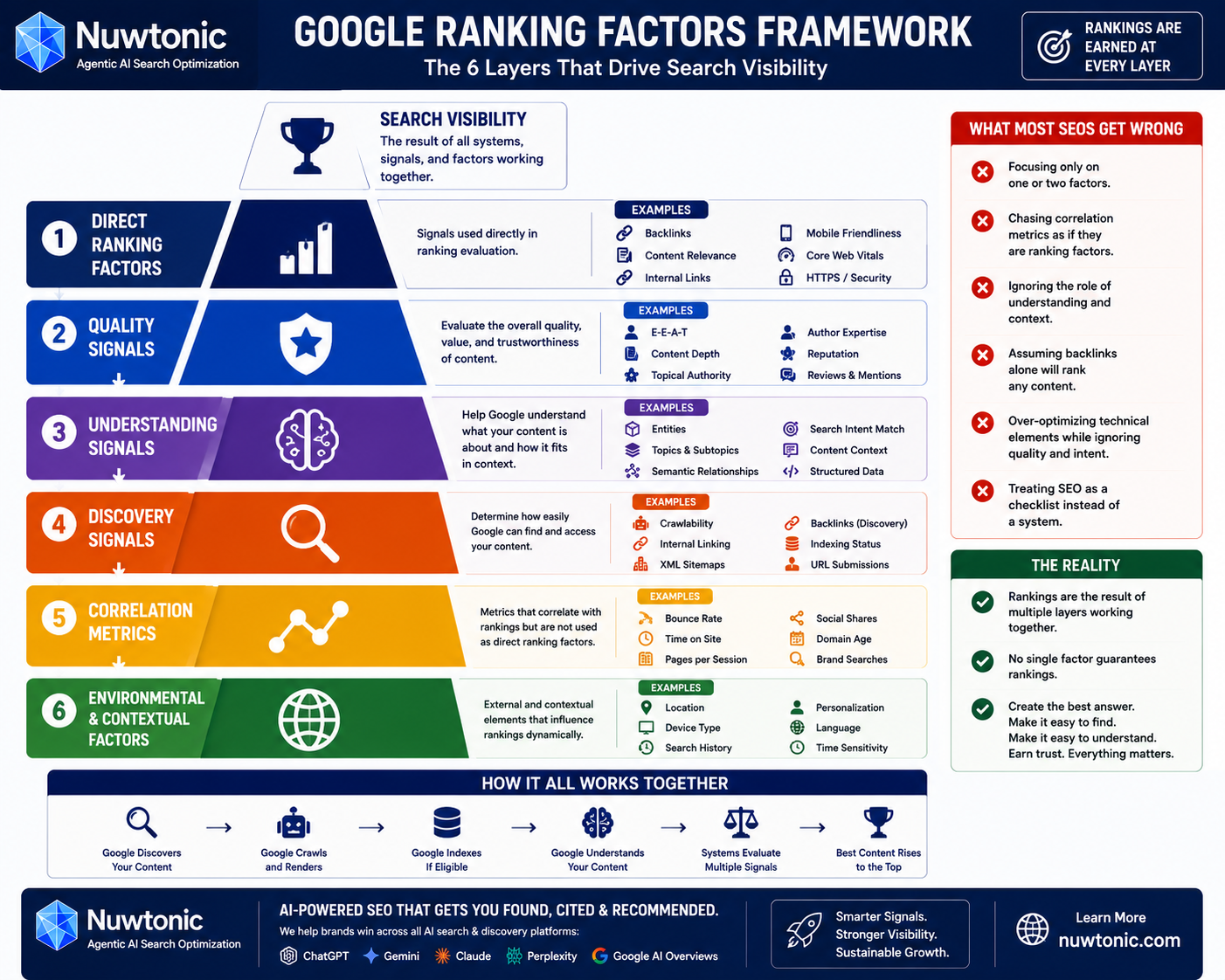
As a result, many SEO discussions incorrectly group together:
Direct ranking factors
Quality signals
Understanding signals
Discovery signals
User experience signals
Correlation metrics
Understanding the difference between these categories is essential for building sustainable organic visibility.
This guide explains how Google rankings actually work, how Google evaluates web pages, and which ranking factors have the greatest influence on modern search visibility.
Key Takeaways
Google Ranking Factors are not a simple checklist.
Modern rankings are influenced by multiple systems that evaluate relevance, authority, trust, quality, user experience, and originality simultaneously.
The most successful websites do not win because they optimize a single ranking factor better than everyone else.
They win because they create the strongest overall combination of:
Relevance
Authority
Trust
Discoverability
User experience
Originality
What Are Google Ranking Factors?
Google Ranking Factors are signals that Google's systems use to evaluate, compare, and order webpages within search results.
These signals help Google determine:
Which pages are relevant to a query
Which pages appear most authoritative
Which pages are most trustworthy
Which pages provide the best user experience
Which pages deserve higher visibility
A ranking factor is not necessarily a single metric.
Some factors are directly measurable.
Others are evaluated through broader systems and patterns.
Examples of commonly discussed ranking factors include:
Backlinks
Page Speed
Core Web Vitals
Mobile Friendliness
HTTPS
Content Freshness
EEAT
Structured Data
However, not every SEO metric is actually a ranking factor.
Understanding this distinction is critical.
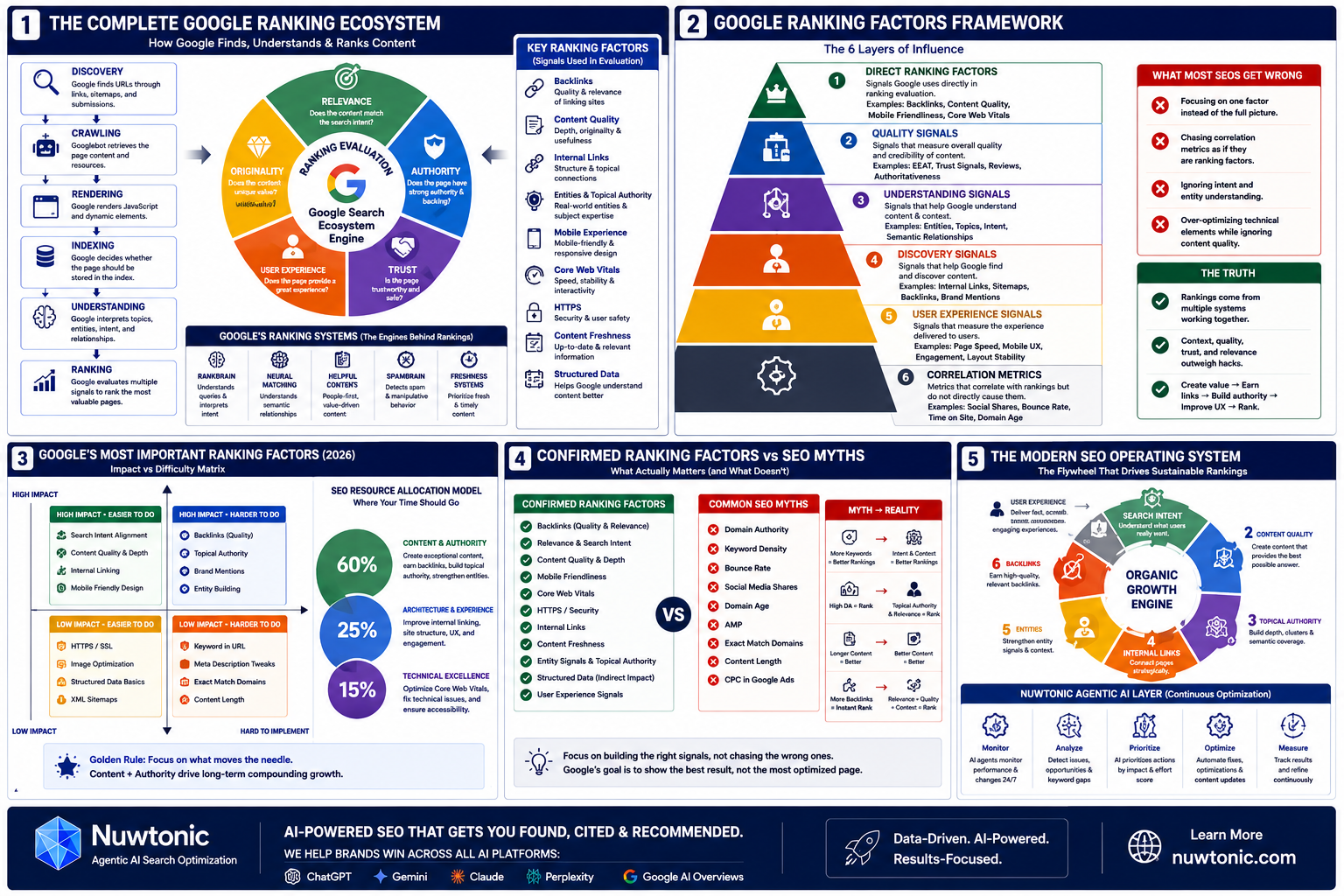
How Does Google's Ranking Algorithm Actually Work?
Google does not use a single ranking algorithm.
Instead, Google uses multiple automated ranking systems that work together to evaluate and rank content.
Before a page can rank, it passes through several stages.
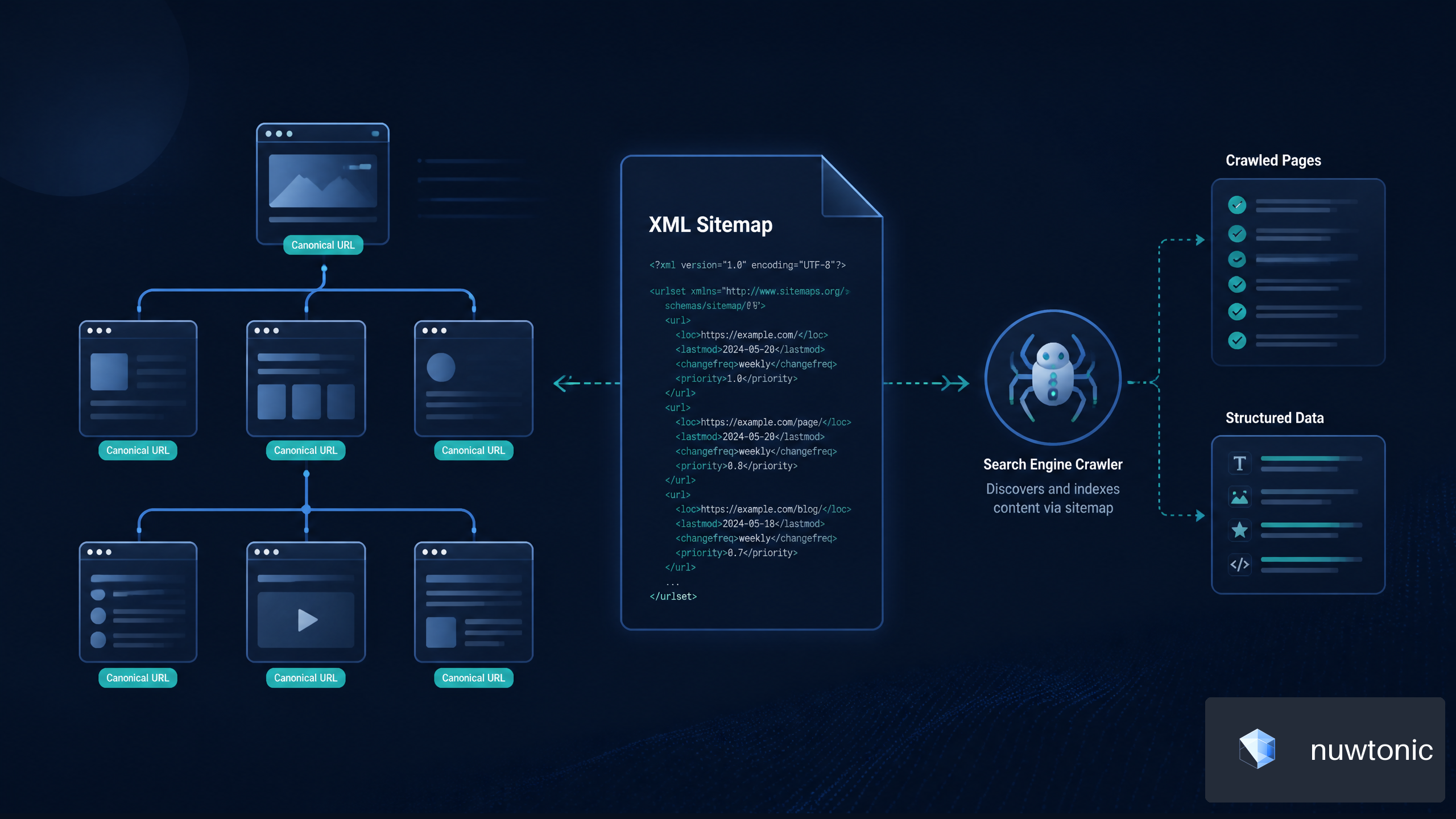
Discovery
Google must first discover a URL.
Discovery occurs through:
Internal links
External backlinks
XML sitemaps
Previously crawled pages
URL submissions
A page that cannot be discovered cannot rank.
Crawling
Once discovered, Googlebot retrieves:
HTML
CSS
JavaScript
Images
Metadata
This process allows Google to access page content.
Rendering
Modern websites often rely heavily on JavaScript.
Google renders pages to understand:
Dynamic content
Interactive elements
Navigation
User-visible content
Rendering failures can prevent proper indexing.
Indexing
Google decides whether a page should be included in the search index.
Factors affecting indexing include:
Content quality
Duplicate content
Canonical signals
Crawl accessibility
Not every crawled page becomes indexed.
Understanding
Google attempts to understand:
Topics
Entities
Search intent
Relationships
Context
Modern search relies heavily on semantic understanding rather than exact keyword matching.
Ranking
Only after understanding the content does Google evaluate:
Relevance
Authority
Trust
Freshness
User experience
The highest-quality and most relevant pages receive greater visibility.
What Is the Difference Between Google's Ranking Systems and Ranking Factors?
One of the biggest SEO misconceptions is treating ranking systems and ranking factors as the same thing.
They are not.
What Is a Ranking Factor?
A ranking factor is an individual signal used during ranking evaluation.
Examples include:
Backlinks
HTTPS
Mobile Friendliness
Core Web Vitals
Freshness
Think of ranking factors as inputs.
What Is a Ranking System?
A ranking system is a larger framework that evaluates many signals simultaneously.
Examples include:
RankBrain
Helpful Content System
SpamBrain
Neural Matching
Freshness Systems
Think of ranking systems as decision-making engines.
Why Does This Distinction Matter?
Many SEO debates become confusing because people discuss systems and factors interchangeably.
For example:
"Helpful Content" is not a ranking factor.
It is a ranking system.
Backlinks are a ranking factor.
Understanding this distinction helps avoid many common SEO myths.
What Ranking Systems Does Google Use?
Google uses multiple ranking systems designed to solve different search problems.
Each system evaluates content from a different perspective.
What Is RankBrain?
RankBrain is a machine learning system that helps Google understand ambiguous and unfamiliar searches.
It improves Google's ability to connect search queries with relevant content.
RankBrain focuses primarily on query interpretation rather than link analysis.
What Is Neural Matching?
Neural Matching helps Google understand relationships between concepts.
Instead of matching exact keywords, Neural Matching helps identify semantically related content.
This allows Google to rank pages that answer a question even when the exact query phrase does not appear.
What Is the Helpful Content System?
The Helpful Content System evaluates whether content appears genuinely useful to users.
The system is designed to reward:
People-first content
Original insights
Helpful information
Expertise
The system attempts to reduce visibility for content created primarily to manipulate rankings.
What Is SpamBrain?
SpamBrain is Google's AI-powered spam detection system.
It identifies:
Link spam
Hacked content
Manipulative SEO tactics
Scaled spam content
SpamBrain continuously evolves to identify new spam techniques.
What Are Google's Freshness Systems?
Freshness systems determine when newer information deserves higher visibility.
Freshness becomes important for:
News
Product launches
Technology updates
Trending topics
Not every search query requires freshness.
What Types of Ranking Factors Does Google Use in 2026 ?
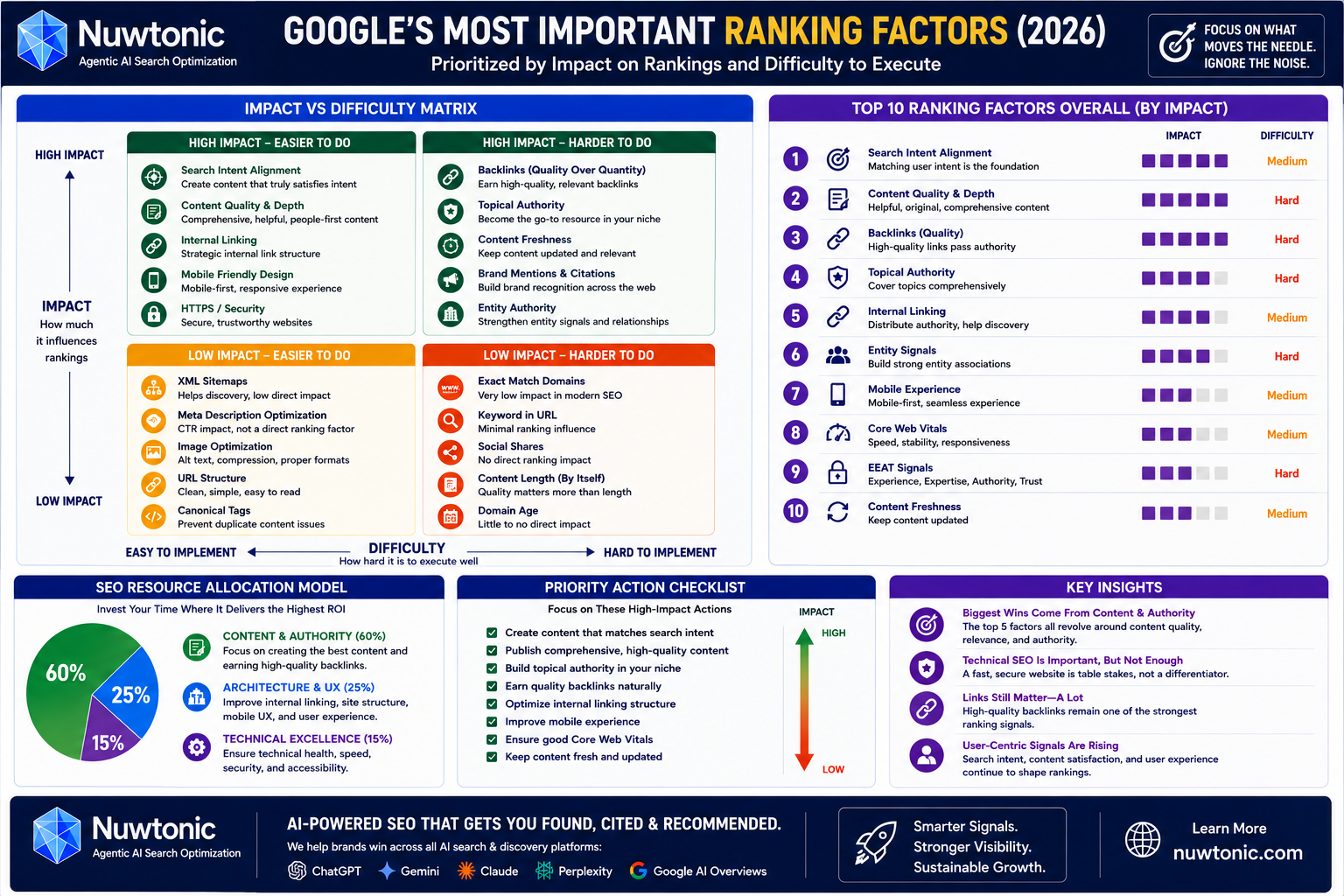
Not all ranking factors serve the same purpose.
A useful way to understand modern SEO is to classify signals according to their function.
Direct Ranking Signals
Direct ranking signals influence rankings directly.
Examples include:
Backlinks
Core Web Vitals
Mobile Friendliness
HTTPS
Freshness
These signals can directly impact search visibility.
Quality Evaluation Signals
Quality signals help Google evaluate trustworthiness and expertise.
Examples include:
EEAT
Author reputation
Brand authority
Citation quality
These signals influence quality assessment systems.
Understanding Signals
Understanding signals help Google interpret content.
Examples include:
Structured data
Title tags
Headings
Entity markup
Google cannot rank content effectively if it cannot understand it.
Discovery Signals
Discovery signals help Google find and process content.
Examples include:
Internal links
XML sitemaps
Hreflang
Site architecture
These signals influence discoverability.
Correlation Signals
Correlation signals frequently appear on successful websites but are not direct ranking factors.
Examples include:
Social shares
Bounce rate
Time on page
Scroll depth
These metrics often correlate with rankings without causing rankings.
Which Google Ranking Factors Matter Most?
Not all ranking factors carry equal weight.
Some consistently influence rankings more than others.
Relevance
Relevance is the foundation of search.
If a page does not answer the user's query, no amount of optimization can compensate.
Google prioritizes pages that best satisfy search intent.
Authority
Authority helps Google determine whether a source deserves trust.
Authority signals include:
Backlinks
Mentions
Citations
Brand recognition
Trust
Trust influences whether Google feels comfortable recommending a page.
Trust signals include:
HTTPS
Accurate information
Author transparency
Reputation signals
User Experience
Google increasingly evaluates:
Mobile usability
Page speed
Core Web Vitals
Accessibility
Poor user experiences reduce search satisfaction.
Originality
As AI-generated content becomes more common, originality becomes increasingly important.
Pages that provide:
Unique insights
Original research
First-hand experience
Novel information
have a greater opportunity to stand out.
Why Do SEO Studies Often Disagree About Ranking Factors?
SEO studies frequently reach different conclusions because they confuse correlation with causation.
What Is Correlation?
Correlation means two things frequently appear together.
Example:
Top-ranking pages often have more social shares.
What Is Causation?
Causation means one factor directly influences another.
Example:
Backlinks directly influence rankings.
Why Does This Matter?
Many ranking-factor studies observe patterns but cannot determine causes.
For example:
Top-ranking pages often have:
More comments
More social shares
Higher engagement
However, those metrics may be consequences of ranking rather than causes of ranking.
Understanding this distinction prevents wasted SEO effort.
How Should Businesses Prioritize Ranking Factors?
Most businesses should focus on the factors that consistently create the largest impact.
Highest Priority
Focus first on:
Search intent alignment
Content quality
Backlinks
Topical authority
Internal linking
These factors typically produce the largest ranking improvements.
Medium Priority
Next, optimize:
Core Web Vitals
Mobile usability
Structured data
EEAT signals
These factors improve competitiveness.
Lower Priority
Finally, refine:
URL structures
Minor technical improvements
Metadata refinements
These improvements can help but rarely compensate for weak content or authority.
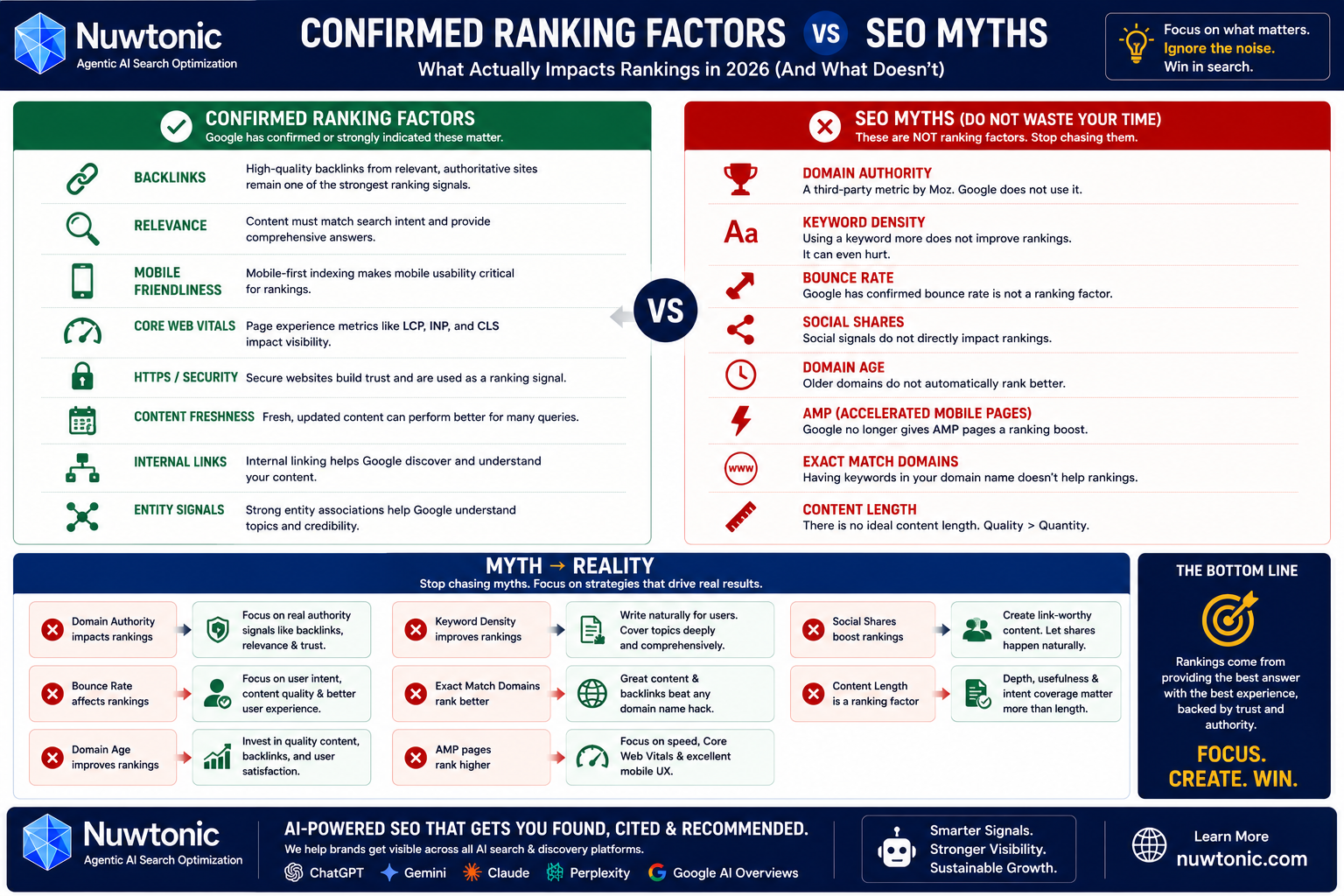
What Ranking Factors Has Google Officially Confirmed?
Google rarely publishes an exact list of ranking factors.
However, through official documentation, public statements, Search Central guidance, court documents, patents, and years of communication from Google representatives, several ranking factors have been either directly confirmed or strongly validated.
Understanding these confirmed ranking factors is important because they represent the signals most likely to influence rankings regardless of industry, niche, or website size.
While no individual factor guarantees rankings, these signals consistently appear within Google's ranking systems and should form the foundation of any SEO strategy.
Are Backlinks Still a Google Ranking Factor?
Short Answer
Yes.
Backlinks remain one of Google's most important ranking factors.
Despite countless claims that links are becoming less important, backlinks continue to serve as one of Google's primary authority and trust signals.
Google's original PageRank algorithm was built around links, and while modern ranking systems have become significantly more sophisticated, link-based authority remains deeply embedded in Google's search infrastructure.
Why Does Google Use Backlinks?
Search engines need a way to evaluate trust.
Backlinks function as recommendations between websites.
When one website links to another, Google treats that link as a signal that the destination page may contain valuable information.
However, modern Google evaluates much more than link quantity.
Today's link analysis considers:
Relevance
Context
Authority
Placement
Trustworthiness
Link neighborhood
Spam likelihood
A single highly relevant editorial backlink can often provide more ranking value than hundreds of low-quality links.
What Makes a High-Quality Backlink?
Not all backlinks are equal.
Factors influencing backlink value include:
Topical Relevance
Links from websites operating in the same industry generally provide stronger signals.
Contextual Placement
Links embedded naturally within content often carry more value than footer or sidebar links.
Authority
Links from trusted and authoritative sources typically pass more ranking value.
Editorial Nature
Links voluntarily placed by editors are generally stronger than self-created links.
Are Backlinks Becoming Less Important?
Google has added hundreds of additional ranking signals over the years.
However, backlinks remain one of the most reliable methods Google uses to evaluate authority.
What has changed is Google's ability to ignore manipulative links.
Modern link building focuses on:
Authority
Relevance
Editorial trust
rather than raw volume.
Is Page Speed a Google Ranking Factor?
Short Answer
Yes.
Google has officially confirmed page speed as a ranking factor.
However, page speed is often misunderstood.
Many SEO professionals treat page speed as a major ranking driver when, in reality, it is generally a secondary signal compared to relevance, content quality, and authority.
Why Does Google Use Page Speed?
Google's objective is to provide users with useful information quickly.
Slow websites create friction.
Faster websites generally provide better user experiences.
Because of this, Google includes performance signals within its ranking systems.
How Important Is Page Speed?
Page speed typically functions as a differentiator among otherwise similar pages.
Consider two pages:
Similar content quality
Similar authority
Similar relevance
The faster page may receive a ranking advantage.
However:
A highly relevant page can often outrank a faster page if it better satisfies search intent.
Which Performance Metrics Matter Most?
Google increasingly focuses on user-centric performance metrics rather than simple loading times.
These metrics include:
Largest Contentful Paint (LCP)
Interaction to Next Paint (INP)
Cumulative Layout Shift (CLS)
These metrics form the foundation of Core Web Vitals.
Are Core Web Vitals a Google Ranking Factor?
Short Answer
Yes.
Core Web Vitals are confirmed ranking signals.
However, they are often overestimated.
Many websites spend months optimizing Core Web Vitals while ignoring far more influential factors such as content quality and authority.
What Are Core Web Vitals?
Core Web Vitals measure real-world user experience.
Google currently evaluates:
Largest Contentful Paint (LCP)
Measures loading performance.
Target:
Under 2.5 seconds.
Interaction to Next Paint (INP)
Measures responsiveness.
Target:
Under 200 milliseconds.
Cumulative Layout Shift (CLS)
Measures visual stability.
Target:
Under 0.1.
How Much Do Core Web Vitals Affect Rankings?
Core Web Vitals matter most when:
Competing pages have similar quality
Content relevance is comparable
Authority signals are similar
In most situations:
Content quality and authority outweigh Core Web Vitals.
Is Mobile Friendliness a Google Ranking Factor?
Short Answer
Yes.
Mobile friendliness is a confirmed ranking factor.
Google now primarily uses mobile-first indexing.
This means Google evaluates the mobile version of a page before the desktop version.
Why Is Mobile SEO Important?
More than half of web traffic originates from mobile devices.
Google prioritizes experiences that work well on mobile screens.
Common mobile issues include:
Small text
Poor navigation
Intrusive popups
Horizontal scrolling
Slow performance
What Does Google Evaluate?
Mobile usability signals include:
Responsive design
Readable typography
Touch-friendly navigation
Mobile page speed
Viewport configuration
Is Mobile-First Indexing a Ranking Factor?
Not directly.
Mobile-first indexing changes how Google evaluates content.
The mobile version becomes the primary version Google uses for indexing and ranking.
Is HTTPS a Google Ranking Factor?
Short Answer
Yes.
HTTPS is a confirmed ranking signal.
Google announced HTTPS as a ranking factor years ago and continues to encourage secure browsing.
Why Does HTTPS Matter?
HTTPS protects:
User privacy
Authentication
Data integrity
Google wants searchers to visit secure websites.
How Powerful Is HTTPS?
HTTPS is generally considered a lightweight ranking signal.
In most cases:
Content quality
Relevance
Authority
have a much larger influence on rankings.
However:
A website without HTTPS may create trust concerns for both users and search engines.
Is Content Freshness a Google Ranking Factor?
Short Answer
Yes.
But only when freshness matters.
Google uses freshness systems to identify situations where users expect recent information.
What Is Query Deserves Freshness?
Google refers to certain searches as freshness-sensitive.
Examples include:
Breaking news
Product launches
Elections
Technology updates
Market data
In these situations, newer content may receive ranking advantages.
When Freshness Doesn't Matter
Many topics remain stable over time.
Examples include:
Mathematics
Physics principles
Historical events
Basic tutorials
For these topics:
Authority and quality often matter more than publication date.
How Does Google Measure Freshness?
Freshness signals may include:
Publication dates
Update dates
New content additions
New backlinks
Recent engagement
Freshness is significantly more complex than simply updating a timestamp.
What Are the Most Important Confirmed Ranking Factors?
While Google uses hundreds of signals, a small group consistently influences rankings more than most others.
High Impact Ranking Factors
The strongest confirmed factors typically include:
Relevance
Backlinks
Content quality
Search intent satisfaction
Mobile friendliness
Page experience
Freshness (when applicable)
Medium Impact Ranking Factors
These factors often provide competitive advantages:
Core Web Vitals
HTTPS
Structured site architecture
Internal linking
Entity signals
Supporting Ranking Factors
These factors improve overall quality but rarely drive rankings independently:
Structured data
Accessibility
URL structure
Metadata improvements
What Ranking Factors Has Google Not Directly Confirmed?
Many SEO discussions focus on factors that Google has never officially classified as direct ranking signals.
Some of these factors influence rankings indirectly.
Others help Google understand content.
Some improve crawlability.
Others simply correlate with high-performing websites.
Understanding the difference is essential because many businesses waste significant resources optimizing metrics that have little direct impact on search visibility.
The factors in this section are often misunderstood, oversimplified, or incorrectly labeled as ranking factors.
Is EEAT a Google Ranking Factor?
Short Answer
No.
EEAT is not a direct ranking factor.
Google does not assign an "EEAT Score" to webpages.
There is no measurable EEAT metric inside Google Search Console.
However, dismissing EEAT as irrelevant would be a major mistake.
EEAT influences how Google's quality systems evaluate content.
What Does EEAT Stand For?
EEAT stands for:
Experience
Expertise
Authoritativeness
Trustworthiness
Trust is considered the most important component.
Without trust, expertise and authority become significantly less valuable.
Why Does Google Use EEAT?
Google's challenge is determining:
Which information is accurate
Which sources deserve trust
Which authors possess expertise
EEAT helps Google's systems evaluate credibility.
This becomes particularly important for:
Medical content
Financial content
Legal content
Health advice
Safety-related information
These categories are often referred to as YMYL (Your Money or Your Life) topics.
What Signals May Influence EEAT?
Google likely evaluates a combination of signals including:
Author Signals
Author bios
Professional credentials
Industry recognition
Brand Signals
Mentions
Citations
Reviews
Media coverage
Trust Signals
Transparent contact information
Editorial policies
Accurate sourcing
Experience Signals
First-hand examples
Original testing
Case studies
Demonstrated expertise
Why EEAT Matters More in 2026
As AI-generated content becomes more common, Google's systems increasingly reward evidence of real-world experience.
Content created by someone who has actually performed a task often contains details that generic AI-generated content cannot replicate.
This is one reason why first-hand experience is becoming increasingly valuable.
Is Structured Data a Google Ranking Factor?
Short Answer
No.
Structured Data is not a direct ranking factor.
Google has repeatedly stated that implementing schema markup does not automatically improve rankings.
However, structured data remains one of the most valuable understanding signals available.
What Is Structured Data?
Structured data provides machine-readable information about content.
It helps Google understand:
Entities
Relationships
Content types
Authors
Products
Organizations
Events
Why Does Structured Data Matter?
Google cannot fully rely on natural language interpretation alone.
Schema provides additional context.
For example:
Without schema:
Google must infer whether a page describes a product.
With schema:
The product relationship becomes explicit.
Can Structured Data Improve Search Visibility?
Indirectly, yes.
Structured data may enable:
Rich snippets
Review stars
Product information
FAQ displays
Event information
These enhanced SERP features can improve:
Click-through rates
Visibility
User engagement
Which Schema Types Are Most Useful?
Common schema implementations include:
Article
Organization
Product
FAQ
Review
Person
Local Business
Structured data helps Google understand content more effectively but should not be viewed as a shortcut to rankings.
Is Hreflang a Ranking Factor?
Short Answer
No.
Hreflang is not a ranking factor.
However, it is one of the most important international SEO signals.
What Is Hreflang?
Hreflang helps Google determine:
Language targeting
Regional targeting
For example:
A company may have:
US English version
UK English version
German version
Spanish version
Hreflang helps Google serve the correct version to the correct audience.
Why Is Hreflang Important?
Without hreflang:
Google may display:
Wrong language versions
Wrong regional pages
Duplicate content variations
Hreflang improves discoverability and targeting.
Does Hreflang Improve Rankings?
Not directly.
Instead, hreflang helps ensure the correct page competes within the correct regional search results.
Are External Links a Google Ranking Factor?
Short Answer
Not directly.
Google has never confirmed outbound links as a direct ranking factor.
However, external links can improve content quality and credibility.
Why Do High-Quality Articles Link Out?
External links often serve as:
Citations
References
Evidence
Supporting documentation
Authoritative sources frequently reference other authoritative sources.
Can External Links Improve Content Quality?
Potentially.
External citations can:
Improve trust
Support claims
Provide evidence
Strengthen research
This may indirectly contribute to overall content quality.
Can Linking to Wikipedia Improve Rankings?
No.
There is no evidence that linking to a specific website automatically improves rankings.
The value comes from providing useful references rather than linking for SEO purposes.
Is Accessibility a Google Ranking Factor?
Short Answer
Not directly.
Accessibility is not currently a confirmed ranking factor.
However, accessibility improvements often overlap with user experience improvements.
What Is Website Accessibility?
Accessibility focuses on ensuring content can be used by:
Screen readers
Keyboard navigation users
Visually impaired users
Hearing-impaired users
Why Accessibility Matters
Accessible websites often provide:
Better navigation
Better structure
Better usability
These improvements benefit all users, not only those requiring accessibility support.
Can Accessibility Affect SEO?
Indirectly, yes.
Accessible content tends to be:
Easier to understand
Better structured
Easier to crawl
These benefits may support broader SEO goals.
Do Comments Affect Rankings?
Short Answer
Not directly.
Comments themselves are not a ranking factor.
However, comments can expand content and provide additional value.
How Comments Can Help SEO
High-quality comments may:
Add topical depth
Introduce new entities
Answer additional questions
Expand semantic coverage
This additional information may improve overall content quality.
When Comments Become Harmful
Poorly moderated comments may introduce:
Spam
Low-quality content
Irrelevant discussions
These issues can negatively impact user experience.
Is Website Uptime a Ranking Factor?
Short Answer
Not directly.
Short outages rarely impact rankings.
However, repeated downtime can create visibility problems.
Why Uptime Matters
Search engines must access pages to:
Crawl
Render
Index
Frequent downtime can interrupt these processes.
What Happens During Extended Downtime?
Prolonged outages may result in:
Reduced crawling
Indexing issues
Temporary ranking losses
Reliable hosting remains important even if uptime itself is not a direct ranking signal.
Is Internal Linking a Google Ranking Factor?
Short Answer
Yes, indirectly and structurally.
Internal linking is one of the most underrated SEO factors.
Why Internal Links Matter
Internal links help Google:
Discover pages
Understand relationships
Transfer authority
Establish hierarchy
Without internal links, important content may become difficult to discover.
How Internal Links Influence Rankings
Internal links distribute PageRank throughout a website.
Strong internal linking structures help:
Important pages receive authority
Search engines understand topical relationships
Users navigate efficiently
Many enterprise websites achieve significant ranking improvements through internal linking alone.
Are Entity Signals a Ranking Factor?
Short Answer
Increasingly, yes.
Modern Google Search relies heavily on entities.
What Is an Entity?
An entity is a uniquely identifiable thing.
Examples include:
People
Brands
Companies
Products
Locations
Google's Knowledge Graph is built around entities and relationships.
Why Do Entities Matter?
Entities help Google understand:
Context
Relationships
Authority
For example:
Google understands that:
Apple is a company
Tim Cook is a person
iPhone is a product
even if these exact relationships are not explicitly stated on a page.
How Entity Signals Influence Rankings
Entity-rich content often demonstrates:
Better topical coverage
Better contextual understanding
Stronger authority signals
Entity optimization is becoming increasingly important for both traditional search and AI search systems.
Which Indirect Ranking Factors Matter Most?
Several indirect signals consistently influence visibility despite not being direct ranking factors.
The most impactful include:
High Impact
EEAT
Internal Linking
Entity Coverage
Structured Data
Brand Authority
Medium Impact
Accessibility
External Citations
Comments
Site Architecture
Lower Impact
Minor technical refinements
Cosmetic improvements
Low-value schema implementations
Which Popular Google Ranking Factors Are Actually Myths?
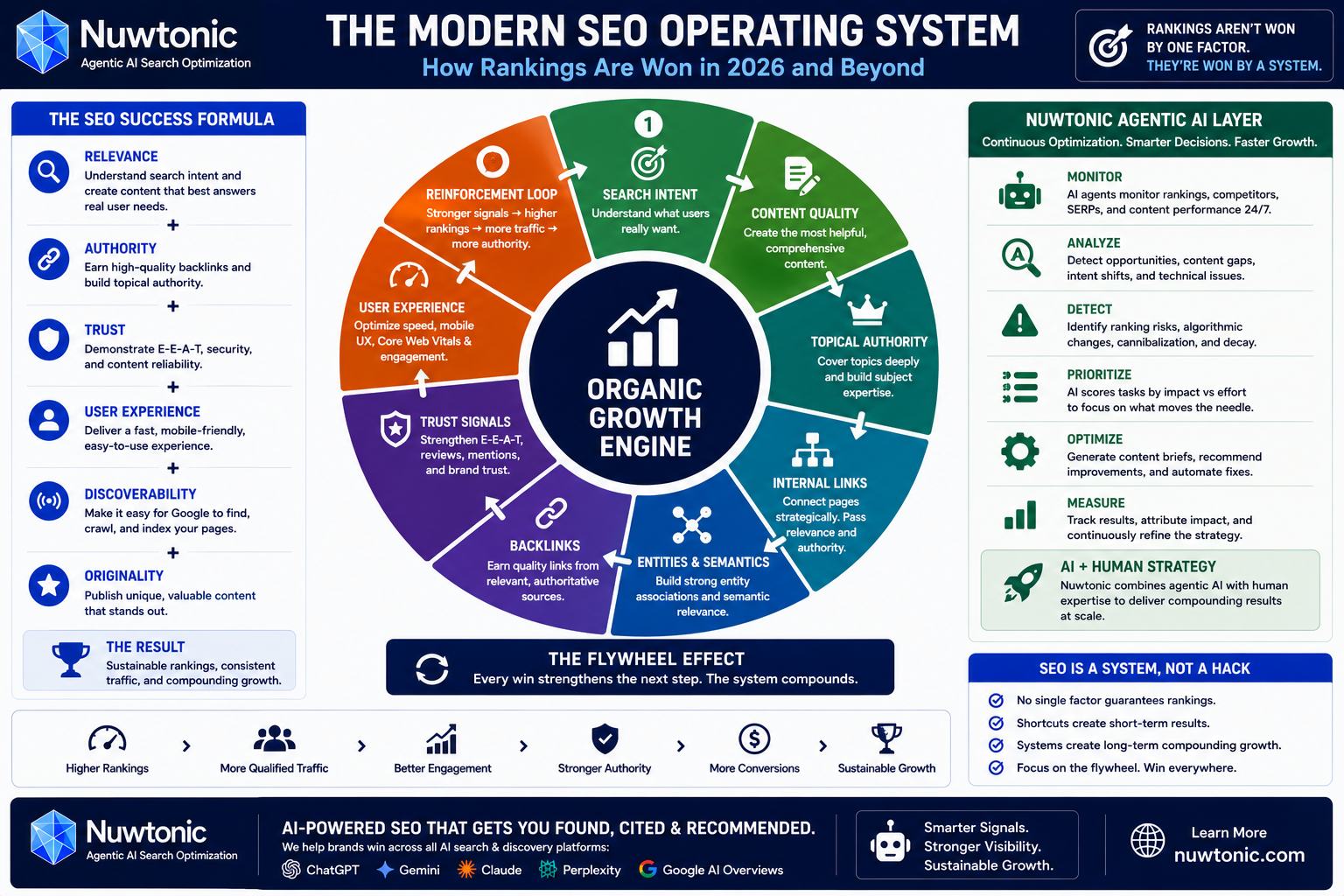
Some SEO topics refuse to die.
Every year, marketers, bloggers, and SEO tools repeat the same claims:
Social shares improve rankings.
Bounce rate affects rankings.
Longer content always ranks better.
Domain Authority is a ranking factor.
Keywords must appear a certain number of times.
Some of these ideas contain a grain of truth.
Others are simply outdated.
The problem is that many website owners spend time optimizing things that Google either does not use or considers far less important than content quality, authority, and relevance.
Let's separate facts from myths.
Are Social Signals a Google Ranking Factor?
Short Answer
No.
Google does not use Facebook likes, LinkedIn shares, retweets, or social media followers as direct ranking factors.
Simply getting more shares on social media will not automatically increase rankings.
Why Do People Think Social Signals Affect Rankings?
Because highly ranked content often receives more social shares.
For example:
A great article may receive:
Thousands of visitors
Hundreds of backlinks
Thousands of social shares
People often assume the shares caused the rankings.
In reality:
The quality of the content caused both.
Can Social Media Help SEO?
Indirectly, yes.
Social media can:
Increase content visibility
Generate brand awareness
Attract backlinks
Create more website visits
These benefits can indirectly support SEO.
Final Verdict
Social shares do not directly improve rankings.
However, they can help content reach more people, which may eventually lead to links and mentions.
Is Bounce Rate a Google Ranking Factor?
Short Answer
No.
Google has repeatedly stated that Google Analytics bounce rate is not a direct ranking factor.
What Is Bounce Rate?
Bounce rate measures how many visitors leave a page without taking another action.
For example:
A visitor searches:
"What is the capital of France?"
The visitor lands on a page.
Reads "Paris."
Leaves.
That visitor bounced.
But the page successfully answered the question.
Why Bounce Rate Can Be Misleading
A high bounce rate does not always indicate a bad page.
Many pages are designed to answer questions quickly.
Examples include:
Definitions
Calculators
Weather reports
Quick answers
In these situations, bouncing is completely normal.
Final Verdict
Bounce rate is not a ranking factor.
Focus on satisfying users rather than reducing bounce rate.
Is Dwell Time a Google Ranking Factor?
Short Answer
Google has never officially confirmed it.
What Is Dwell Time?
Dwell time refers to how long someone stays on a page before returning to search results.
Does Longer Time Always Mean Better Content?
Not necessarily.
Consider two searches:
Search 1:
"How old is Elon Musk?"
The answer takes seconds to find.
Search 2:
"How do quantum computers work?"
The answer requires much longer reading.
Longer time does not automatically mean higher quality.
Final Verdict
There is no confirmed evidence that dwell time is a direct ranking factor.
Is Time on Page a Google Ranking Factor?
Short Answer
No confirmed evidence exists.
Why Time on Page Can Be Misleading
Some pages solve problems quickly.
Others require detailed reading.
The amount of time spent on a page varies based on the type of content.
A shorter visit does not necessarily indicate poor quality.
Final Verdict
Time on page is not a confirmed ranking factor.
Is Scroll Depth a Google Ranking Factor?
Short Answer
No.
Google has never confirmed scroll depth as a ranking factor.
What Is Scroll Depth?
Scroll depth measures how far users scroll down a page.
Many analytics tools track:
25%
50%
75%
100%
scroll completion.
Why Scroll Depth Doesn't Tell the Whole Story
Some pages answer questions near the top.
Users may not need to scroll further.
A low scroll percentage does not automatically mean a page failed.
Final Verdict
Scroll depth is useful for user experience analysis but not a confirmed ranking factor.
Is Pogo-Sticking a Google Ranking Factor?
Short Answer
Google has never confirmed it.
What Is Pogo-Sticking?
Pogo-sticking happens when a user:
Clicks a search result
Immediately returns to Google
Clicks another result
This often suggests the first page did not satisfy the user's needs.
Why It Is Difficult to Measure
Many factors can cause a user to return:
Wrong intent
Slow page load
Poor content
Accidental click
Google has never confirmed a simple pogo-sticking signal.
Final Verdict
Pogo-sticking may indicate user dissatisfaction, but it is not a confirmed ranking factor.
Is Content Length a Google Ranking Factor?
Short Answer
No.
Google does not rank pages based on word count.
Why Do Long Articles Often Rank Well?
Longer content frequently covers:
More questions
More subtopics
More entities
More user intents
The ranking advantage comes from better coverage, not more words.
Example
A 700-word article that completely answers a question can outperform a 5,000-word article filled with repetition.
Final Verdict
Content quality matters.
Word count alone does not.
Is Keyword Density a Google Ranking Factor?
Short Answer
No.
Keyword density is one of the oldest SEO myths.
What Is Keyword Density?
Keyword density measures how often a keyword appears within content.
Years ago, many SEOs tried to hit specific percentages.
Examples included:
1%
2%
3%
keyword density targets.
Why This Approach No Longer Works
Modern Google understands:
Context
Meaning
Synonyms
Related concepts
Repeating a keyword excessively often makes content worse.
Final Verdict
Write naturally.
Focus on topic coverage rather than keyword percentages.
Are Keywords in URLs a Google Ranking Factor?
Short Answer
They provide only a very small signal.
Example
Better:
example.com/google-ranking-factors
Less useful:
example.com/post123?id=98
A descriptive URL helps users and search engines understand the page topic.
Final Verdict
Helpful but not powerful.
Do not expect major ranking improvements from URL optimization alone.
Are Keywords in Domain Names a Google Ranking Factor?
Short Answer
Not in any significant way.
Why Exact-Match Domains Worked Years Ago
Historically, domains containing keywords sometimes received advantages.
Today, Google relies much more heavily on content quality and authority.
Final Verdict
Choose a strong brand name rather than chasing keyword-heavy domains.
Is Domain Authority a Google Ranking Factor?
Short Answer
No.
Google does not use Domain Authority.
What Is Domain Authority?
Domain Authority is a score created by third-party SEO tools.
Examples include:
Moz Domain Authority
Ahrefs Domain Rating
Semrush Authority Score
These metrics are estimates.
Google does not use them.
Why Does Domain Authority Correlate with Rankings?
Sites with high Domain Authority often have:
Strong backlink profiles
High trust
Established brands
These factors help rankings.
The score itself does not.
Final Verdict
Domain Authority is useful for competitive analysis but not a Google ranking factor.
Is Domain Age a Google Ranking Factor?
Short Answer
Not in any meaningful way.
Why Older Websites Often Rank Better
Older websites often have:
More content
More backlinks
More trust
More history
These factors help rankings.
Age alone does not.
Final Verdict
A new website can outrank an older website if it provides better content and stronger authority.
Is AMP a Google Ranking Factor?
Short Answer
No.
AMP is no longer a ranking factor.
What Is AMP?
AMP stands for Accelerated Mobile Pages.
Google introduced AMP to create faster mobile experiences.
Why AMP Lost Importance
Modern web technologies now allow websites to achieve excellent performance without AMP.
Google now focuses on:
User experience
Core Web Vitals
Page performance
rather than AMP itself.
Final Verdict
AMP is optional.
Most websites no longer need it.
What Should You Focus on Instead of SEO Myths?
Rather than chasing unconfirmed ranking factors, focus on the areas Google consistently rewards.
High Priority Areas
Search intent
Content quality
Original information
Backlinks
Internal linking
Topical authority
User experience
Medium Priority Areas
Core Web Vitals
Mobile optimization
Structured data
EEAT signals
Lower Priority Areas
Keyword density tweaks
Minor URL adjustments
Social share counts
Domain Authority scores
Sources and References
• Google Search Central: Google's automated ranking systems guide
• Semrush: Google ranking factors analysis
• Softtrix: Google ranking factors guide
• HubSpot: Google algorithm infographic