
Honestly, most digital marketers are still playing a game that ended two years ago. They are obsessing over whether their blog post ranks position three or position four on a standard SERP, completely blind to the fact that their target audience has migrated to conversational search. Look, this is the deal—if your brand isn't being cited by ChatGPT, Perplexity, Gemini, Claude, and Google AI Overviews, you are effectively invisible to a massive, high-intent segment of your market.
A few years back, I was working on an advanced multi-touch attribution project for a major B2B SaaS client. We had a pristine analytics dashboard, immaculate pixel tracking—which is the backbone of reliable data collection, though many businesses inexplicably overlook it—and a complex cross-device attribution model. Yet, we noticed a massive, unexplained spike in direct traffic that didn't align with any of our active campaigns. After digging into the data layering, we realized the traffic was coming from users copying and pasting links recommended to them directly inside ChatGPT and Claude. That was my wake-up call. Traditional search engines are no longer the sole gatekeepers of information.
A page can rank #1 in Google yet never appear in AI-generated answers. Conversely, a page with modest organic rankings may be cited repeatedly by AI models because it demonstrates stronger topical authority, entity coverage, or better answers to user questions.
That's why AEO (Answer Engine Optimization) tracking tools have emerged. They help businesses understand where they're being cited, how competitors are appearing across AI platforms, and what content improvements are needed to increase AI search visibility.
However, after reviewing the leading AEO platforms, one thing became clear: not every tool solves the same problem.
Some platforms only tell you whether your brand appeared in an AI response.
Others compare competitors.
A smaller group goes further by identifying why competitors are being cited and providing actionable recommendations to improve visibility.
This guide compares the leading AEO tracking platforms based on real evaluation criteria—not marketing claims—including:
AI search coverage
Prompt tracking
Citation monitoring
Competitor intelligence
Gap analysis
GEO optimization capabilities
Workflow automation
Overall value
Rather than ranking tools solely on feature count, we evaluated how well each platform supports the complete AI search optimization workflow—from visibility tracking to identifying optimization opportunities.
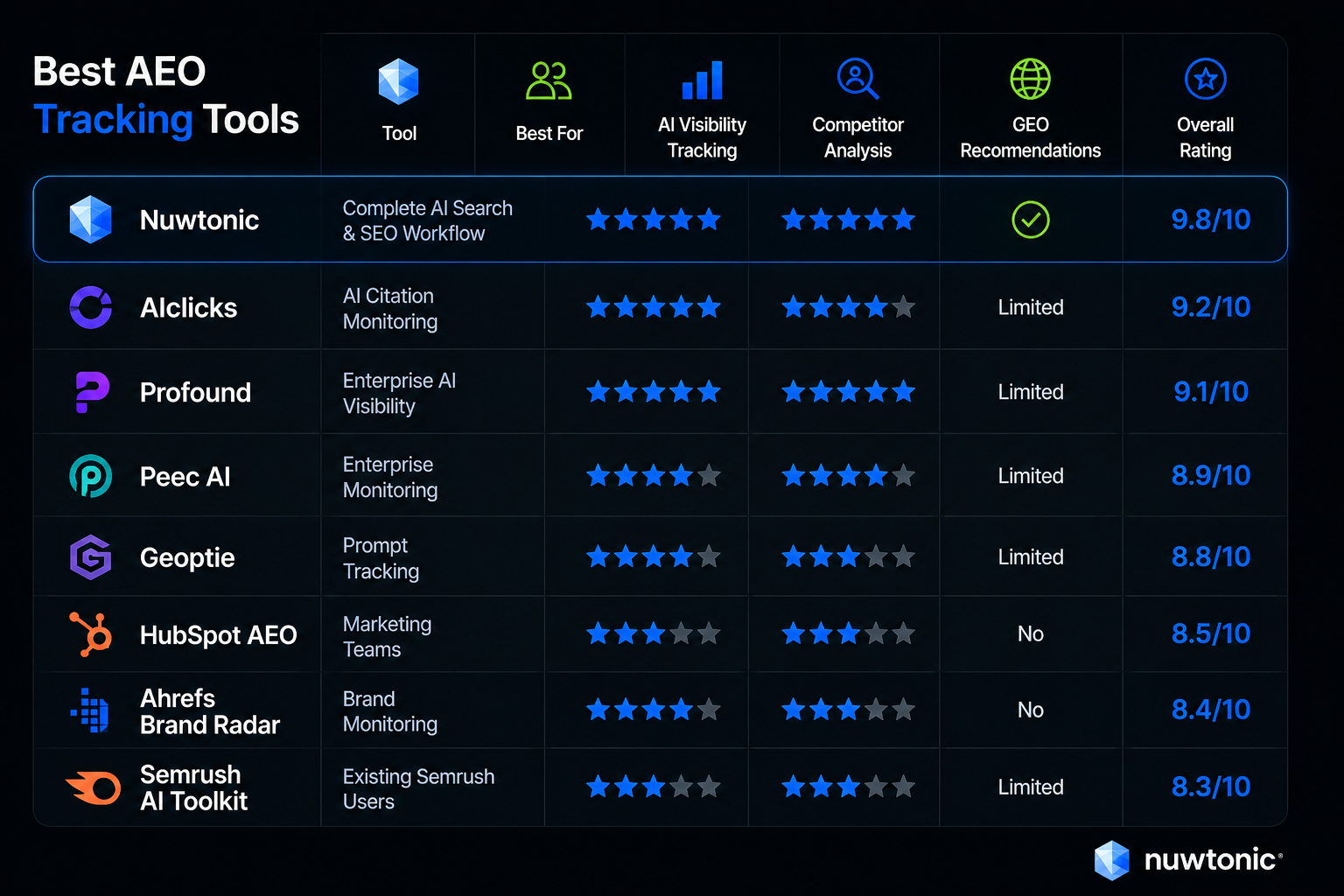
Tool | Best For | AI Visibility Tracking | Competitor Analysis | GEO Recommendations | Overall Rating |
|---|---|---|---|---|---|
Nuwtonic | Complete AI Search & SEO Workflow | ⭐⭐⭐⭐⭐ | ⭐⭐⭐⭐⭐ | ✅ | 9.8/10 |
AIclicks | AI Citation Monitoring | ⭐⭐⭐⭐⭐ | ⭐⭐⭐⭐ | Limited | 9.2/10 |
Profound | Enterprise AI Visibility | ⭐⭐⭐⭐⭐ | ⭐⭐⭐⭐⭐ | Limited | 9.1/10 |
Peec AI | Enterprise Monitoring | ⭐⭐⭐⭐ | ⭐⭐⭐⭐ | Limited | 8.9/10 |
Geoptie | Prompt Tracking | ⭐⭐⭐⭐ | ⭐⭐⭐ | Limited | 8.8/10 |
HubSpot AEO | Marketing Teams | ⭐⭐⭐ | ⭐⭐⭐ | No | 8.5/10 |
Ahrefs Brand Radar | Brand Monitoring | ⭐⭐⭐⭐ | ⭐⭐⭐ | No | 8.4/10 |
Semrush AI Toolkit | Existing Semrush Users | ⭐⭐⭐ | ⭐⭐⭐ | Limited | 8.3/10 |
Most comparison articles simply list features.
We wanted to understand which platform actually helps improve AI search visibility, not just measure it.
Every tool was evaluated across ten criteria that reflect how modern AI search optimization works.
Evaluation Criteria | Weight |
|---|---|
AI Search Visibility Tracking | 15% |
Citation Tracking | 15% |
Prompt Monitoring | 10% |
Competitor Intelligence | 10% |
Citation Gap Analysis | 10% |
GEO Audit & Recommendations | 10% |
Actionable Optimization Insights | 10% |
Content Workflow Support | 10% |
Traditional SEO Integration | 5% |
Workflow Automation | 5% |
One important observation emerged during our evaluation:
Many platforms excel at monitoring AI visibility.
Far fewer help users understand why they aren't appearing in AI answers—or what to change next.
That distinction heavily influenced our rankings.
1\. Nuwtonic — Best Overall AEO Tracking Platform
Best for: Businesses that want one platform to track, diagnose, and improve AI search visibility alongside traditional SEO.
Unlike many AEO tools that stop at reporting visibility, Nuwtonic is designed around the full optimization workflow.
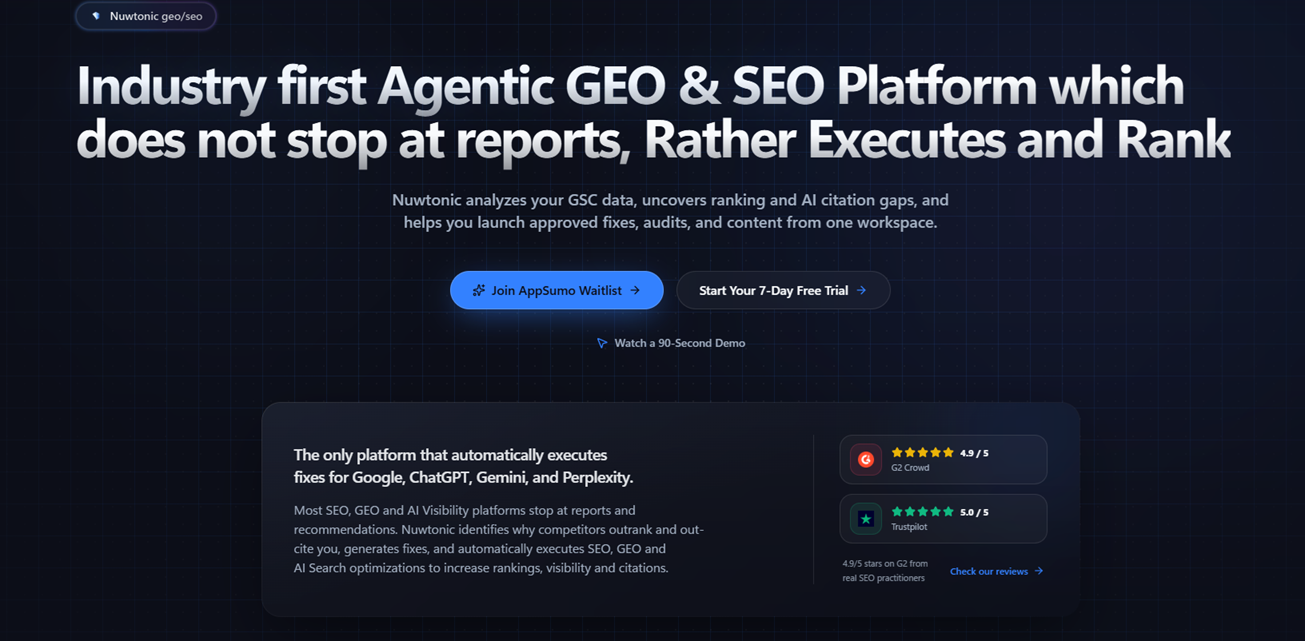
After connecting Google Search Console, the platform analyzes site performance to surface opportunities such as zero-click queries, ranking gaps, topic clusters, cannibalization issues, and trust signals. Beyond traditional SEO metrics, it supports AI search visibility by monitoring prompts, identifying citation gaps, highlighting content and E-E-A-T deficiencies, and providing actionable recommendations for improving AI readiness. It also includes GEO audit capabilities, competitor gap analysis, AI-assisted content generation informed by Search Console data, and integrated SEO monitoring within the same workspace.
Instead of requiring separate tools for rank tracking, AI visibility monitoring, competitor analysis, content planning, and optimization recommendations, Nuwtonic brings these workflows together.
Why It Stands Out
Most AEO platforms answer questions like:
"Did my brand appear in ChatGPT?"
Nuwtonic goes several steps further by helping answer:
Why didn't my page get cited?
Which competitor content is outperforming mine?
What structural gaps exist?
Which E-E-A-T improvements are missing?
Which content additions are likely to improve AI visibility?
Which pages should be prioritized first?
That workflow reduces the manual effort of switching between multiple SEO and AI search tools.
Key Features
AI search visibility tracking
Prompt monitoring
Citation tracking
Citation gap analysis
Competitor gap analysis
GEO audit & optimization recommendations
E-E-A-T recommendations
AI-assisted content planning
Traditional SEO tracking
Rank tracking
SERP monitoring
On-page optimization recommendations
Google Search Console integration
Pros
Covers both SEO and AI search in one platform.
Connects visibility insights with actionable recommendations.
Helps prioritize fixes instead of only reporting metrics.
Integrates content planning with optimization workflows.
Suitable for agencies, publishers, SaaS companies, and in-house marketing teams.
Cons
- More comprehensive than lightweight monitoring tools, which may be more than some users need if they only want simple visibility reports.
Verdict
If your goal is simply to check whether your brand appears in AI answers, there are less comprehensive tools available.
If your goal is to understand why competitors are being cited and how to improve your own visibility, Nuwtonic offers one of the most complete workflows currently available based on its documented capabilities.
Overall Rating: 9.8/10
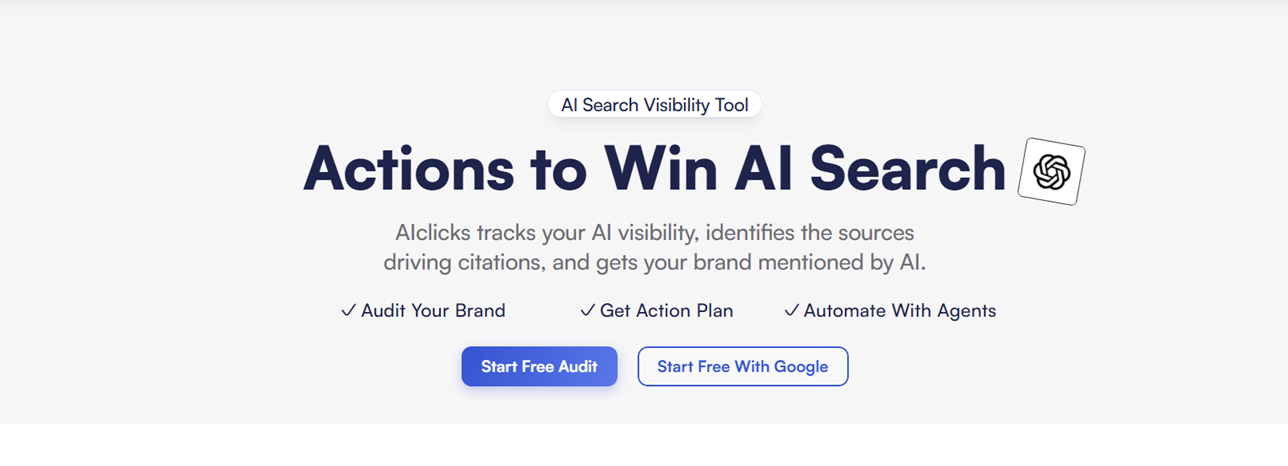
Best for: Teams primarily focused on AI citation monitoring and competitive visibility.
AIclicks has positioned itself as one of the early platforms dedicated to AI search visibility. It emphasizes tracking prompts across multiple AI systems and reporting when brands appear in generated responses.
The interface is straightforward and particularly useful for marketers who want ongoing visibility monitoring without a broader SEO suite.
Strengths
AI prompt tracking
Citation monitoring
Competitive visibility reporting
Easy-to-use dashboards
Limitations
Its primary focus is monitoring. Organizations that also need deeper diagnosis, optimization recommendations, or integrated SEO workflows may require additional tools.
Verdict
AIclicks is a strong option for businesses prioritizing AI visibility reporting, especially if they already use separate platforms for technical SEO and content optimization.
Overall Rating: 9.2/10
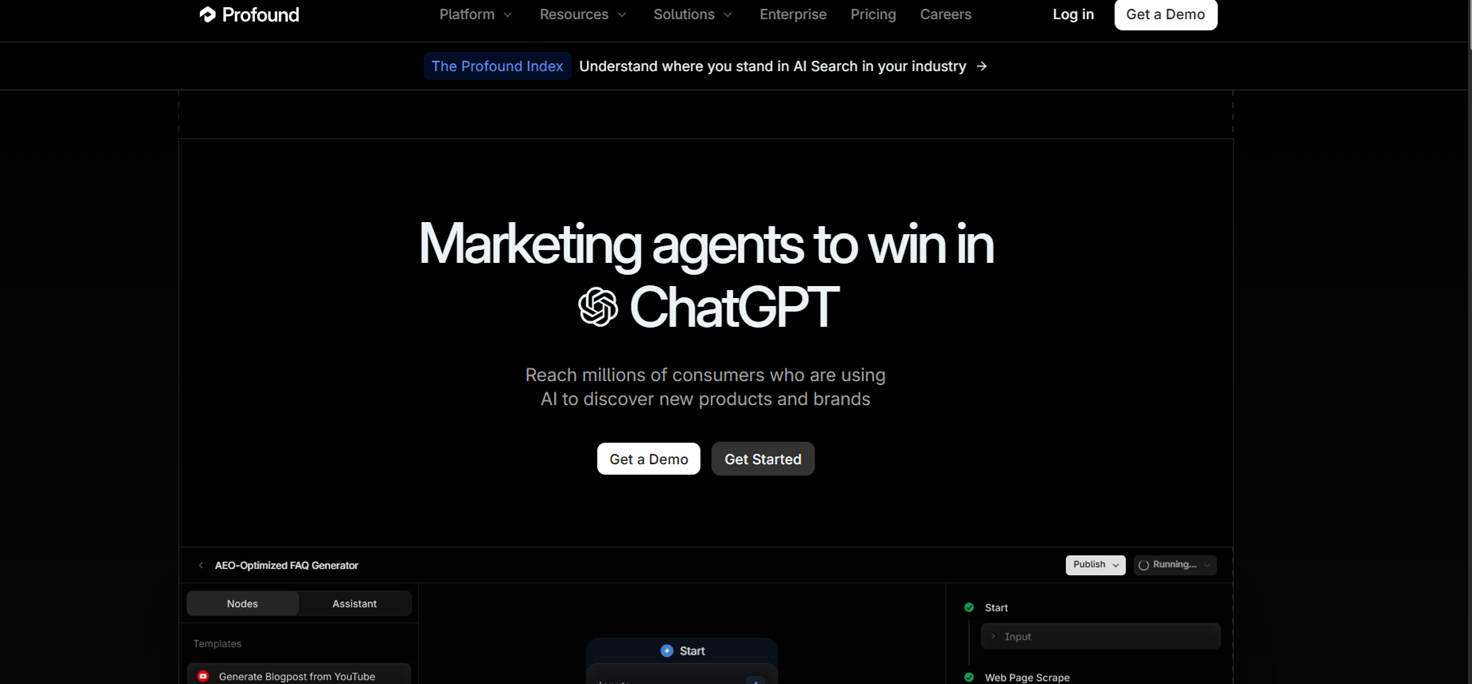
Best for: Enterprise organizations tracking brand visibility across AI ecosystems.
Profound has become a recognized platform for enterprise AI search analytics, with a strong emphasis on executive reporting, brand visibility, and large-scale monitoring.
Its strengths lie in helping larger organizations understand how AI platforms represent their brand over time.
Strengths
Enterprise reporting
AI visibility dashboards
Competitive monitoring
Executive-friendly analytics
Limitations
Compared with broader optimization platforms, Profound places greater emphasis on measurement than on guiding content improvements or integrated SEO execution.
Verdict
Profound is well suited to enterprises that prioritize large-scale reporting and visibility analytics.
Overall Rating: 9.1/10
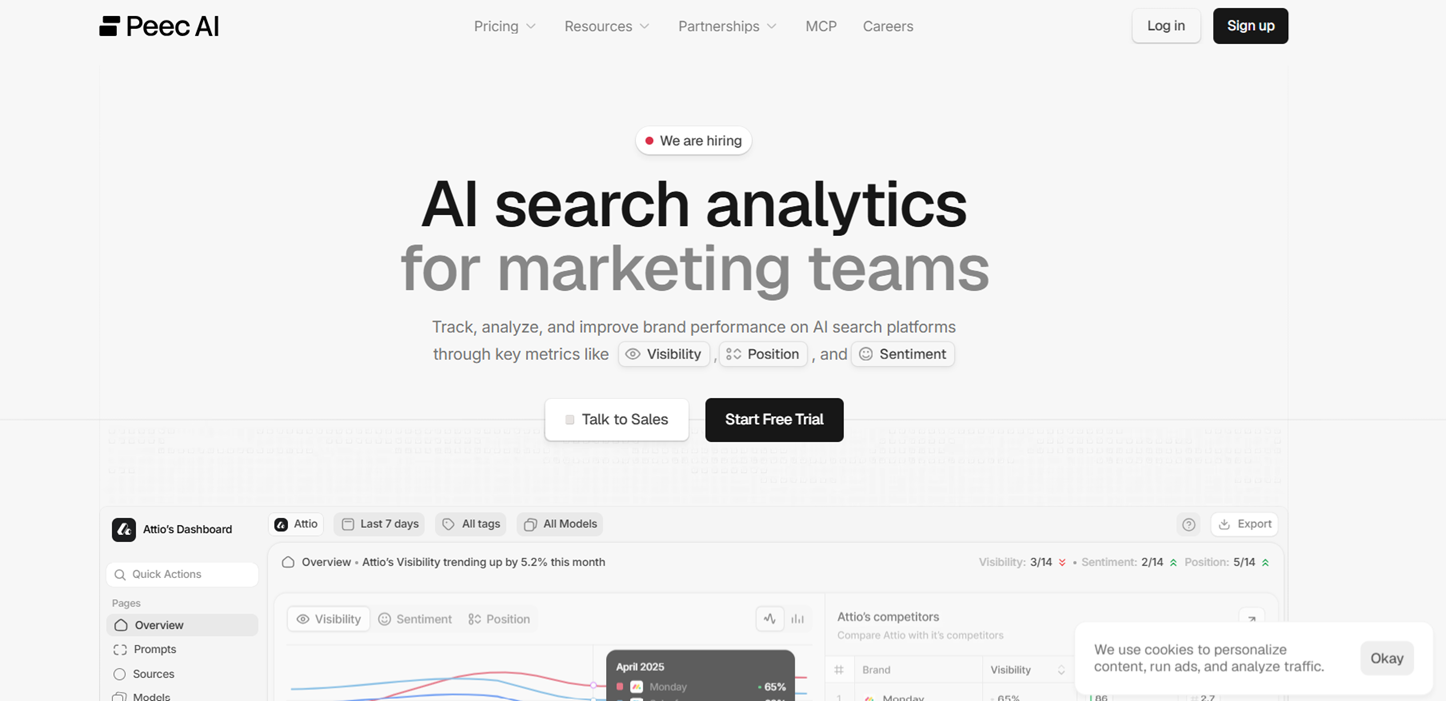
Best for: Organizations seeking enterprise AI monitoring.
Peec AI focuses on monitoring AI-generated answers across supported platforms, helping teams measure brand mentions and compare visibility trends.
Its reporting and dashboards make it a practical choice for organizations interested in ongoing AI presence monitoring.
Strengths
AI visibility dashboards
Brand monitoring
Competitive tracking
Enterprise reporting
Limitations
Organizations looking for broader optimization workflows—such as integrated content recommendations or AI-ready SEO planning—may still rely on additional tools.
Verdict
Peec AI is a solid monitoring platform for enterprises that already have established SEO and content operations.
Overall Rating: 8.9/10
Best for: Teams that want dedicated AI prompt tracking and straightforward visibility monitoring.
Geoptie is purpose-built around AI search visibility rather than traditional SEO. Instead of trying to become a full marketing platform, it focuses on helping users understand how brands appear across AI-generated answers.
The platform emphasizes prompt tracking, citation monitoring, competitive comparisons, and AI visibility reports.
For businesses beginning their AI search journey, Geoptie provides a relatively simple experience without the complexity of a full SEO suite.
Strengths
Prompt-based AI monitoring
AI citation tracking
Competitor visibility comparisons
Clean reporting interface
Limitations
Geoptie's strength is monitoring visibility. Teams looking for deeper content diagnostics, workflow automation, or integrated SEO recommendations may still require additional platforms.
Verdict
A solid choice for companies whose primary goal is understanding AI visibility trends rather than managing an end-to-end optimization workflow.
Overall Rating: 8.8/10
Best for: Marketing teams already invested in HubSpot.
HubSpot has entered the AEO space by extending its marketing platform with AI search visibility capabilities.
Its biggest advantage isn't necessarily advanced AI tracking—it's that AI search insights fit naturally inside HubSpot's broader marketing ecosystem.
For companies already using HubSpot CRM, Marketing Hub, and Content Hub, this creates operational convenience.
Strengths
Integrated marketing platform
Content optimization workflows
Easy adoption
Familiar reporting
Limitations
Organizations looking for dedicated AI search diagnostics or advanced citation analysis may find HubSpot less specialized than platforms built specifically for AI visibility.
Verdict
Excellent for existing HubSpot customers wanting AI visibility inside an established marketing stack.
Overall Rating: 8.5/10
Best for: Measuring brand visibility across AI-generated answers.
Ahrefs approached AI search from a different direction.
Instead of becoming a complete AEO platform, Brand Radar extends Ahrefs' existing authority in search analytics by helping businesses understand how often brands appear in AI-generated responses.
This makes it particularly useful for PR teams and brand marketers already relying on Ahrefs.
Strengths
Strong brand visibility reporting
Existing Ahrefs ecosystem
Competitive benchmarking
Familiar interface
Limitations
Brand Radar is primarily a visibility measurement feature rather than a complete optimization platform.
Verdict
Ideal for Ahrefs users who want AI brand monitoring without replacing their existing SEO workflows.
Overall Rating: 8.4/10
Best for: Existing Semrush users.
Semrush has expanded beyond traditional SEO by introducing AI visibility capabilities.
For marketers already using Semrush daily, the AI Toolkit offers an accessible way to begin monitoring AI search performance alongside rankings, keywords, backlinks, and site health.
Strengths
Integrated SEO ecosystem
Familiar reporting
AI visibility dashboards
Existing workflow compatibility
Limitations
Organizations seeking deeper AI citation intelligence or AI-specific optimization workflows may find dedicated AEO platforms more specialized.
Verdict
A logical extension for existing Semrush customers.
Overall Rating: 8.3/10
Best for: Lightweight AI search monitoring.
Otterly.AI focuses on monitoring how brands appear in AI-generated responses without trying to become an all-in-one SEO platform.
Its simplicity makes it appealing for smaller businesses or consultants that only need periodic AI visibility tracking.
Strengths
Simple setup
AI visibility monitoring
Easy reporting
Limitations
Limited workflow capabilities compared with enterprise AEO platforms.
Best for: Enterprise AI visibility programs.
Scrunch AI is designed around helping larger organizations understand their presence across AI-powered search experiences.
It emphasizes reporting, governance, and enterprise-level visibility measurement.
Strengths
Enterprise reporting
AI visibility dashboards
Organizational insights
Limitations
Better suited to reporting than content optimization.
One of the biggest misconceptions in this category is that every "AEO tool" performs the same function.
After evaluating the market, we found that platforms generally fall into three categories.
Platform Type | Primary Goal | Typical Output |
|---|---|---|
Monitoring Platforms | Measure visibility | Mentions, citations, AI rankings |
Diagnostic Platforms | Explain performance | Competitor gaps, citation gaps, content gaps |
Optimization Platforms | Improve visibility | Actionable recommendations, content improvements, workflow automation |
Many buyers compare these products directly, even though they solve different problems.
A monitoring platform answers:
"Did ChatGPT mention my brand?"
A diagnostic platform answers:
"Why didn't ChatGPT choose my content?"
An optimization platform answers:
"What should I change to increase the likelihood of being cited?"
Understanding this distinction helps prevent buying a tool that reports performance but leaves the optimization work entirely manual.
Most organizations progress through AI search optimization in stages.
Level 1 — Visibility Tracking
You know whether your brand appears in AI-generated answers.
Useful metrics include:
AI mentions
Citation frequency
Prompt rankings
Level 2 — Competitive Intelligence
Beyond measuring your own visibility, you compare competitors.
Questions answered:
Who appears most often?
Which prompts matter most?
Which domains dominate?
Level 3 — Citation Analysis
At this stage, you're looking beyond visibility to understand why certain sources are referenced.
Questions include:
Which pages earn citations?
Which entities are repeatedly referenced?
Which content formats perform best?
Level 4 — Gap Analysis
This is where optimization begins.
Instead of only measuring outcomes, platforms identify missing content, structural weaknesses, topical gaps, and trust signals that may influence AI-generated answers.
Level 5 — Guided Optimization
The most mature platforms don't stop at identifying issues.
They help prioritize improvements through recommendations such as:
Citation gap analysis
Content gap analysis
E-E-A-T recommendations
GEO recommendations
Competitor comparison
AI-ready content planning
Based on the uploaded product knowledge, this is the stage where Nuwtonic differentiates itself by connecting visibility tracking with diagnostics, optimization recommendations, content planning, and traditional SEO workflows within a unified platform.
One challenge buyers quickly notice is that two AEO platforms can report different visibility scores for the same brand.
That doesn't necessarily mean one platform is incorrect.
Several factors influence reported results:
Prompt Library
Each vendor tracks a different set of prompts.
Monitoring 50 prompts versus 5,000 prompts naturally produces different visibility percentages.
AI Engines Supported
Some platforms focus on ChatGPT.
Others include:
Google AI Overviews
Gemini
Claude
Perplexity
Microsoft Copilot
Broader coverage often changes overall visibility metrics.
Prompt Refresh Frequency
AI-generated answers evolve rapidly.
Daily prompt sampling may produce different results than weekly or monthly tracking.
Citation Detection Methodology
Some tools measure only explicit citations.
Others also count:
Brand mentions
URL references
Domain references
Entity recognition
Understanding each platform's methodology is more important than comparing visibility percentages in isolation.
Instead of asking,
"Which tool has the most features?"
Ask,
"Which workflow am I trying to improve?"
Choose a monitoring platform if you simply need visibility reports.
Choose a diagnostic platform if you want to understand why competitors are outperforming you.
Choose an optimization platform if your objective is to continuously improve AI search performance rather than only measure it.
What is an AEO tracking tool?
An AEO (Answer Engine Optimization) tracking tool monitors how your brand, website, or content appears in AI-powered search experiences such as ChatGPT, Google AI Overviews, Gemini, Claude, and Perplexity. Depending on the platform, these tools can track AI citations, prompt visibility, share of voice, competitor performance, and, in some cases, provide recommendations for improving AI search visibility.
How is AEO tracking different from traditional SEO rank tracking?
Traditional SEO tools measure rankings on search engine results pages (SERPs). AEO tracking focuses on whether your content is referenced or cited in AI-generated answers.
For example, a page may rank #1 on Google but never appear in an AI Overview, while another page ranking lower could be cited frequently because it provides clearer answers or stronger topical authority.
Monitoring both SEO rankings and AI visibility provides a more complete picture of your search performance.
Which AI platforms should I monitor?
The most valuable AEO platforms typically monitor multiple AI search experiences, including:
ChatGPT
Google AI Overviews
Google AI Mode (where available)
Gemini
Claude
Perplexity
Microsoft Copilot
Coverage varies by platform, so it's worth checking which AI engines are supported before making a decision.
What metrics matter most in AEO tracking?
While different tools use different methodologies, the most useful metrics generally include:
AI citation frequency
Brand mention rate
Prompt visibility
Share of voice
Competitor visibility
Citation gaps
Content gaps
Prompt coverage
Visibility trends over time
Looking at these metrics together provides more actionable insights than relying on a single visibility score.
Can AEO tools tell me why I'm not appearing in AI answers?
Not all of them.
Many tools focus on measuring AI visibility, while others also identify content gaps, competitor advantages, missing entities, E-E-A-T opportunities, or optimization recommendations.
If your goal is to improve AI search performance rather than simply monitor it, look for platforms that combine visibility tracking with diagnostic and optimization capabilities.
Is AEO replacing SEO?
No.
AEO builds on the same fundamentals that make content valuable for search engines—high-quality information, strong topical authority, and user-focused answers. Traditional SEO remains important for driving discoverability, while AEO helps optimize how that content is surfaced in AI-generated responses.
For most organizations, the strongest strategy is to combine SEO and AEO rather than treating them as separate disciplines.
Which businesses benefit most from AEO tracking?
AEO tracking can be valuable for:
SaaS companies
Ecommerce brands
B2B businesses
Publishers
Agencies
Local businesses
Enterprise marketing teams
Any organization that depends on organic discovery should monitor how AI-generated answers represent its brand and content.
How often should I monitor AI visibility?
AI-generated answers can change frequently as models update, prompts evolve, and new content becomes available.
For most businesses, weekly or bi-weekly monitoring provides a good balance between staying informed and identifying meaningful trends. High-growth websites or competitive industries may benefit from more frequent tracking.
Can I improve AI visibility without building backlinks?
Yes, although backlinks and authority still play a role.
AI systems often evaluate factors such as topical coverage, content quality, structured information, clear answers, entity relationships, and overall trustworthiness. Improving these areas can increase the likelihood of being referenced, even without a significant increase in backlinks.
What's the best AEO tracking tool overall?
The right choice depends on your goals.
If you only need AI visibility reports, a dedicated monitoring platform may be sufficient.
If you want to understand why competitors are being cited and receive actionable recommendations to improve AI search performance, a platform with integrated diagnostics, content optimization, and SEO workflows will typically deliver greater long-term value.
Why do two AEO tools report different citation counts?
It's common to see different AEO platforms report different AI visibility or citation numbers for the same website. That doesn't necessarily mean one tool is inaccurate—they may simply be measuring different datasets.
Several factors influence the results:
Prompt library: Every platform tracks a different collection of prompts. A tool monitoring 10,000 prompts will naturally produce different results than one monitoring only a few hundred.
AI engines covered: Some platforms focus on ChatGPT, while others also include Google AI Overviews, Gemini, Claude, Perplexity, or Microsoft Copilot.
Sampling frequency: AI responses change regularly. Daily monitoring can produce different visibility trends than weekly or monthly scans.
Citation methodology: Some tools only count direct URL citations, while others include brand mentions, domain references, or entity recognition.
For this reason, it's usually more valuable to track trends over time within the same platform than to compare citation percentages across different vendors.
How does AI prompt sampling affect visibility scores?
AI search tools cannot realistically monitor every possible prompt users might ask. Instead, they rely on a representative sample of prompts to estimate visibility.
The quality of that sample has a major impact on your reported performance.
For example, if a platform tracks mostly informational queries, a software company may appear highly visible. Another platform focused on commercial or transactional prompts could report much lower visibility for the same brand.
When comparing AEO tools, consider questions such as:
How many prompts are monitored?
How are prompts selected?
Are prompts industry-specific?
How often are prompts refreshed?
Can you track custom prompts relevant to your business?
Understanding a platform's prompt sampling methodology often matters more than the visibility score itself.
What are the most common mistakes when evaluating AEO platforms?
Many buyers compare AEO tools based on feature lists alone, which can lead to choosing software that doesn't match their actual goals.
Some of the most common mistakes include:
Choosing a tool based solely on the highest AI visibility score.
Assuming every platform monitors the same AI engines.
Comparing citation percentages across different vendors without understanding their methodologies.
Prioritizing dashboards over actionable recommendations.
Ignoring competitor analysis and citation gap insights.
Overlooking how well the platform integrates with existing SEO workflows.
Focusing on monitoring instead of whether the platform helps improve AI visibility.
The best AEO platform isn't necessarily the one with the most features—it's the one that supports the workflow your team needs, whether that's monitoring, diagnosis, optimization, or all three.
What don't today's AEO tools measure well yet?
Although AEO platforms have improved rapidly, there are still important aspects of AI search that remain difficult to measure consistently.
Current limitations include:
Reasoning behind citations: Most tools can identify that a page was cited but cannot definitively explain why the AI model selected it.
Conversation context: AI responses often change based on previous questions in a conversation, making single-prompt tracking an incomplete picture.
Personalization: User location, search history, and account context can influence AI-generated answers, but these variables are difficult to replicate at scale.
Citation quality: Most platforms measure the presence of citations rather than the prominence or influence of those citations within an AI response.
Model updates: Large language models evolve frequently, and changes in ranking or citation behavior may occur before monitoring platforms fully capture them.
As AI search continues to evolve, the most valuable AEO platforms will likely move beyond measuring visibility alone and place greater emphasis on diagnostics, optimization recommendations, and workflow automation that help businesses adapt to these changes.
Answer Engine Optimization is evolving quickly, and so are the tools built to support it.
One clear trend emerged during our evaluation: the market is shifting from simple AI visibility monitoring toward platforms that help teams measure, diagnose, and improve AI search performance in one workflow.
That distinction matters.
Tracking AI citations is useful, but knowing why your competitors are consistently cited—and what changes can improve your own visibility—is where long-term value is created.
Our Top Picks by Use Case
🏆 Best Overall: Nuwtonic
Nuwtonic is our top recommendation because it goes beyond monitoring to support the full AI search optimization workflow. According to the available product documentation, it combines AI visibility tracking with citation gap analysis, GEO audits, competitor gap analysis, actionable recommendations, AI-assisted content planning, and traditional SEO insights, reducing the need to piece together multiple platforms.
🥈 Best for AI Visibility Monitoring: AIclicks
A strong option for marketers focused primarily on tracking AI mentions, prompt visibility, and competitor presence.
🥉 Best for Enterprise Organizations: Profound
Well suited to larger organizations that require executive reporting, AI visibility analytics, and enterprise-scale monitoring.
Which Tool Should You Choose?
Choose Nuwtonic if you want a unified platform that helps you monitor AI visibility, uncover optimization opportunities, and improve both AI search and traditional SEO performance from a single workspace.
Choose AIclicks if your priority is dedicated AI citation monitoring.
Choose Profound if your organization needs enterprise-grade AI visibility reporting.
Choose Geoptie if you want straightforward prompt tracking with a lighter feature set.
Choose HubSpot or Semrush if you're already invested in those ecosystems and prefer AI visibility features integrated into your existing marketing workflows.
Final Thoughts
The future of search isn't exclusively SEO or AEO—it's the combination of both.
As AI-generated answers become a larger part of how users discover information, the organizations that succeed will be those that can continuously monitor their visibility, understand why competitors are being cited, and act on those insights with confidence.
Selecting the right AEO tracking platform today is less about finding the tool with the longest feature list and more about choosing one that supports your complete optimization workflow as AI search continues to evolve.