We are currently witnessing a fundamental shift in how search engines process and rank content. Implementing effective ai seo for wordpress is no longer an optional strategy for digital marketers; it is a mandatory baseline for visibility. As Google integrates generative AI deeper into its core retrieval systems, traditional optimization methods must evolve to meet the demands of AI Overviews, large language models (LLMs), and automated citation engines.
In our analysis at Nuwtonic, we consistently observe that WordPress sites failing to adapt to these new AI crawler protocols experience significant traffic decay. This guide breaks down the exact methodologies, plugin configurations, and compliance standards required to dominate AI-driven search in 2026.
TL;DR Summary
• AI Overviews Require Structure: Generative engines rely heavily on valid Schema.org markup and structured data to extract factual answers.
• Technical Foundations Matter: Sub-2.5 second load times and strict XML sitemap protocols are non-negotiable for AI crawler efficiency.
• E-E-A-T is the Filter: AI-generated content without human expertise and verified author signals faces severe ranking penalties.
• Emerging Standards: Implementing the new llms.txt protocol controls how AI models access and cite your WordPress data.

Table of Contents
- The Evolution of AI SEO on WordPress in 2026
- Essential AI SEO Plugins and Setup Workflows
- Content Generation, E-E-A-T, and Compliance
- Performance Benchmarks and Audit Automation
- Frequently Asked Questions
- Conclusion and Next Steps
The Evolution of AI SEO on WordPress in 2026
How Generative Engines View Your Site
Generative Engine Optimization (GEO) requires a structural pivot in how we build WordPress sites. Google's 2024 data indicated that 15% of queries triggered AI Overviews, a number that has only scaled. Generative engines do not "read" your site like human visitors; they parse entity relationships, structured data, and semantic clusters to formulate direct answers. If your WordPress architecture lacks clear entity definitions, AI models will simply bypass your content in favor of better-structured competitors.
Core Standards: llms.txt and Schema.org
To communicate effectively with AI crawlers, WordPress administrators must adopt new protocols. Just as robots.txt manages traditional spiders, the emerging llms.txt protocol instructs large language models on how to responsibly crawl and cite your intellectual property. Furthermore, according to Schema.org standards, explicitly defining your content with vocabularies like Article, FAQPage, and Product directly feeds the extraction mechanisms of AI search engines.
Traditional vs. AI Optimization Dynamics
We often see SEO professionals applying outdated tactics to modern problems. Understanding the nuances between traditional SEO vs AI SEO clarifies where to allocate your resources. Traditional SEO focused heavily on keyword density and backlink volume. AI SEO prioritizes information gain, entity salience, and logical content formatting that allows an LLM to confidently cite your site as a factual source.
Essential AI SEO Plugins and Setup Workflows
Top Plugin Comparisons for 2026
Choosing the right automation tool dictates the efficiency of your workflow. When evaluating the best AI SEO tools for WordPress, we prioritize platforms that combine technical auditing with AI-driven content enhancements.
| Plugin Name | Primary AI Features | Best Use Case | Schema Automation |
|---|---|---|---|
| AIOSEO | Site analyzer, automated link building | Quick setup wizards and technical audits | High |
| SEOPress | OpenAI integration, metadata generation | Bulk optimization and redirection management | High |
| Yoast SEO | Readability analysis, internal linking | On-page content refinement and E-E-A-T | Medium |
| WP SEO AI | Real-time keyword research | Intent matching and alt-text generation | Low |

Configuring Technical Foundations
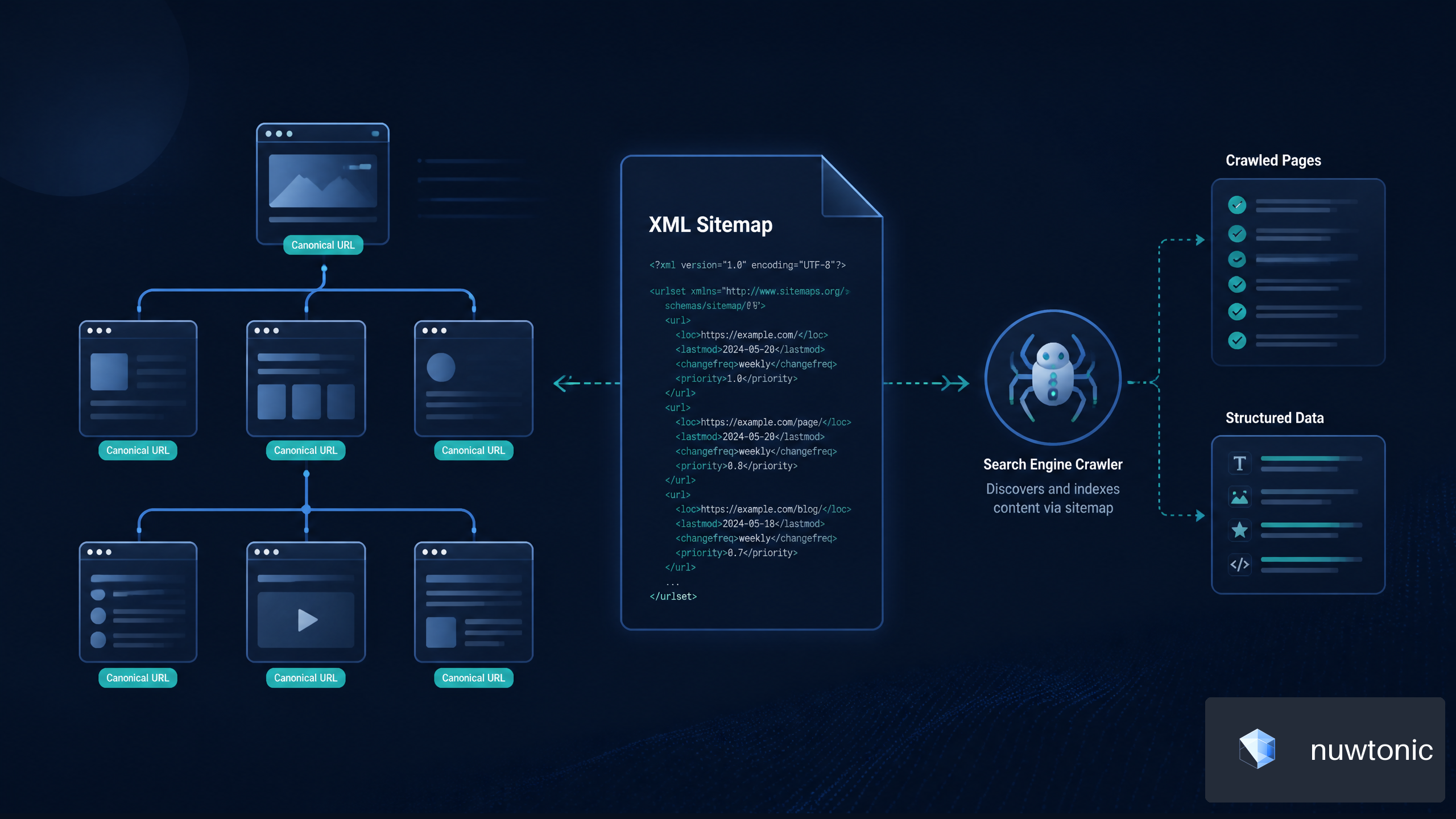
Even the most advanced AI content will fail to rank if technical bottlenecks prevent crawling. We recommend running automated audits to ensure your technical baseline is flawless. Google's Search Central guidelines confirm that XML sitemaps list key URLs to improve crawling efficiency. Ensure your SEO plugin automatically updates these sitemaps the moment you publish new content.
Automating Schema Markup for Rich Snippets
Manual schema implementation is highly prone to syntax errors. Utilizing plugins like AIOSEO or SEOPress allows you to automatically inject JSON-LD structured data into your WordPress headers. For instance, wrapping your Q&A sections in FAQPage schema instantly qualifies your content for expandable rich results, which serve as primary data sources for Google's AI Overviews.
Content Generation, E-E-A-T, and Compliance
Layering Human Expertise Over AI Drafts
While plugins can automate metadata, relying solely on AI for long-form content is a critical vulnerability. Google's algorithms actively demote thin, purely synthetic content. This highlights the importance of EEAT for AI SEO. You must layer human experience—first-hand accounts, unique data analysis, and verified author bios—over any AI-generated draft. For metadata, however, automation is highly effective; OpenAI integration generates SEO metas directly within the WordPress editor, saving hours of manual labor.
US Data Privacy and CCPA Considerations
When integrating AI tools into your WordPress backend, compliance with data privacy regulations like the CCPA is mandatory. Many AI plugins transmit user data or proprietary site data to third-party LLM APIs (like OpenAI or Anthropic).
To maintain compliance, you must:
- Audit the data processing agreements of your chosen SEO plugins.
- Ensure no personally identifiable information (PII) from your WordPress database is passed via API prompts.
- Update your site's privacy policy to disclose the use of AI processing tools.
Mitigating AI Hallucinations and Thin Content Penalties
AI models hallucinate facts. If your WordPress site publishes a hallucinated claim, your Trustworthiness (the 'T' in E-E-A-T) plummets. We recommend establishing a strict editorial review pipeline. Use AI to cluster keywords, generate topical maps, and draft outlines, but require human editors to verify all statistics, citations, and claims before hitting publish.
Performance Benchmarks and Audit Automation
Core Web Vitals and Load Time Targets
AI search engines prioritize user experience. If your WordPress site is sluggish, AI crawlers will abandon the session. According to Google's Core Web Vitals documentation, specific thresholds must be met to avoid ranking suppression.
| Metric | Optimal Target | Poor Performance Threshold | WordPress Fix |
|---|---|---|---|
| Largest Contentful Paint (LCP) | Under 2.5 seconds | Over 4.0 seconds | Optimize images, use caching plugins |
| First Input Delay (FID) | Under 100 milliseconds | Over 300 milliseconds | Defer complex JavaScript |
| Cumulative Layout Shift (CLS) | Under 0.1 | Over 0.25 | Specify image dimensions in CSS |
Tracking AI Overview Citations
Measuring the ROI of AI SEO requires specific analytics configurations. While Google Search Console does not currently have a dedicated "AI Overview" filter, you can monitor impression share spikes on informational queries to infer AI citations. Integrating plugins like MonsterInsights connects your WordPress data to Google Analytics, allowing you to track behavioral metrics from users arriving via generative search.
Automated Crawl Error Resolution
Broken links and redirect loops trap AI crawlers, wasting your crawl budget. Utilizing an automated site analyzer ensures these issues are caught in real-time. Furthermore, WordPress.com support documentation confirms that HTTPS is required for indexing by major search engines and AI tools. Ensure your SSL certificates are active and that your .htaccess file forces HTTPS sitewide.
Frequently Asked Questions
Strategic & Setup Queries
What are the best AI SEO plugins for WordPress in 2026?
Based on current market adoption and feature sets, AIOSEO and SEOPress lead the industry due to their comprehensive setup wizards, automated schema generation, and direct API integrations with major LLMs.
How do I set up AIOSEO or SEOPress for AI-optimized content?
Begin by running their initial setup wizards to configure your site categorization and XML sitemaps. Next, authenticate your OpenAI or preferred API key within the plugin settings to enable automated title and meta description generation directly in the Gutenberg editor.
Content & Quality Queries
What role does E-E-A-T play in AI SEO rankings?
It acts as the primary quality filter. Because AI can generate infinite content, Google relies on Experience, Expertise, Authoritativeness, and Trustworthiness to determine which content deserves visibility. Author bios, original research, and verifiable credentials are required signals.
How does AI content generation affect Google penalties?
Google penalizes content that is generated solely to manipulate search rankings without providing value. AI content that lacks human editing, unique insights, or factual accuracy is highly susceptible to "helpful content" demotions.
Technical & Performance Queries
How to create llms.txt for AI crawlers on my WordPress site?
You can create an llms.txt file in your WordPress root directory (similar to robots.txt) to specify which directories AI models are permitted to crawl and to provide structured summaries of your site's purpose and licensing terms.
Is HTTPS and XML sitemaps enough for AI search visibility?
No. While HTTPS and XML sitemaps are mandatory baseline requirements for indexing, achieving visibility in AI search requires comprehensive structured data (Schema.org), high-performance Core Web Vitals, and dense, entity-rich content.
Conclusion and Next Steps
Summary of Action Items
Adapting your WordPress site for AI-driven search is a methodical process. Start by auditing your current plugin stack to ensure it supports automated schema and API integrations.
Execute these immediate steps:
- Install and configure a top-tier AI SEO plugin (like AIOSEO or SEOPress).
- Implement sitewide
FAQPageandArticleschema markup. - Create an
llms.txtfile in your root directory. - Audit your Core Web Vitals to ensure LCP remains under 2.5 seconds.
Final Thoughts
The integration of AI into Google's ranking systems rewards structure, speed, and verifiable authority. By automating the technical heavy lifting through WordPress plugins and focusing your human efforts on deep, experience-driven content, you position your brand to capture the expanding market of generative search traffic. Stop treating AI as just a writing assistant; leverage it as a comprehensive technical optimization engine.
Sources/References
• Schema.org Documentation on Structured Data Vocabularies
• Google Search Central Core Web Vitals Guidelines
• W3Techs 2025 Web Technology Surveys
• Official WordPress.org Plugin Directory Documentation