The Great Metric Misconception
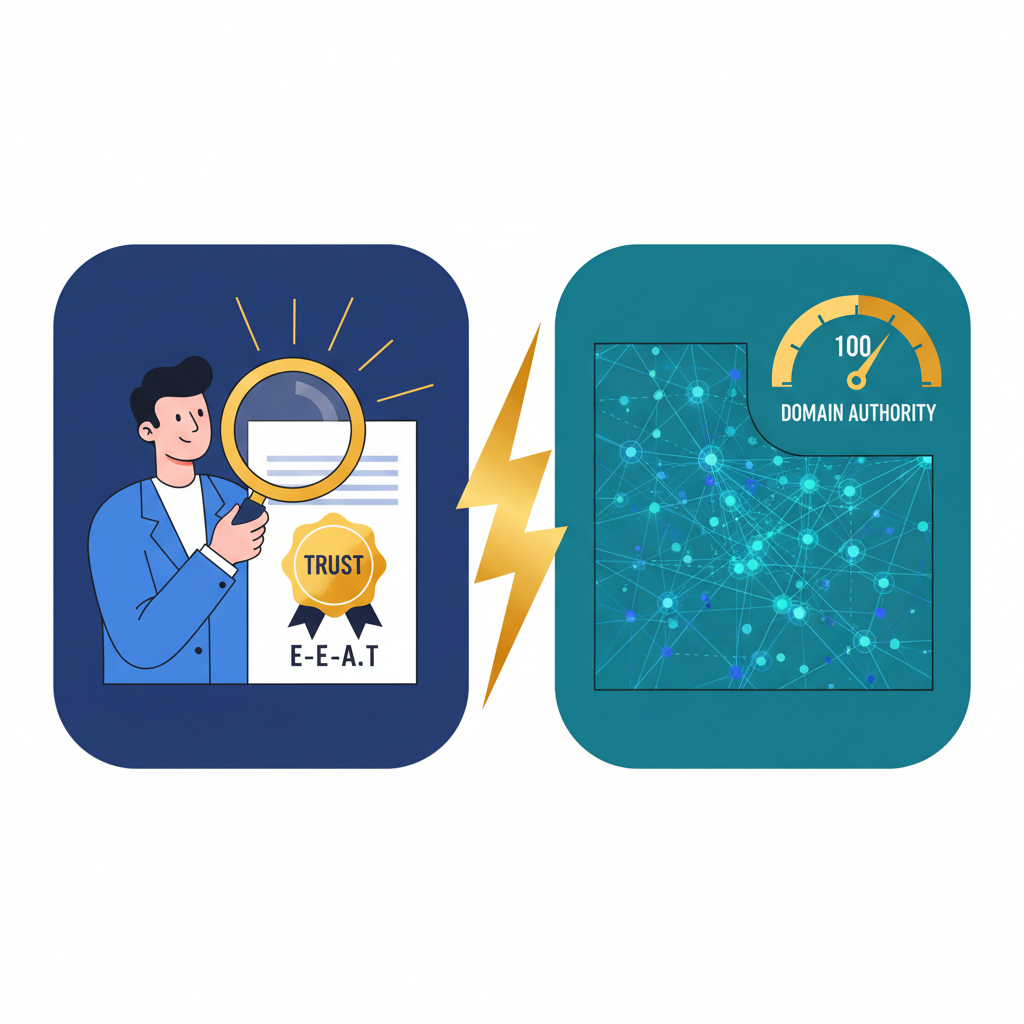
Stop obsessing over a number that Google's algorithm doesn't even see. If you have spent the last decade chasing a higher Domain Authority (DA) score while ignoring the nuances of E-E-A-T, you are optimizing for a third-party ruler, not the search engine itself. In 2026, the battle of eeat vs domain authority is not about which one is "better"—it is about understanding which one actually drives rankings and which one is merely a vanity metric.
I have analyzed thousands of SERPs where low-DA sites outrank industry giants. Why? Because Google's systems, particularly since the integration of "Experience" into E-A-T, prioritize content that demonstrates genuine expertise and trustworthiness over sites that simply have a massive link profile. While DA predicts ranking potential, E-E-A-T secures it.
Defining the Contenders
To navigate this landscape effectively, we must first strip away the jargon and look at the definitions grounded in technical reality.
- E-E-A-T (Experience, Expertise, Authoritativeness, Trustworthiness): This is Google's official framework for assessing content quality. It is not a single ranking score but a complex set of signals used by Quality Raters and algorithmic systems to determine if a page deserves to rank, especially for Your Money or Your Life (YMYL) topics.
- Domain Authority (DA): A proprietary metric developed by Moz. It is a logarithmic score ranging from 1 to 100 that predicts how well a website will rank on search engine result pages (SERPs). It is calculated based on the quantity and quality of backlinks.
E-E-A-T vs Domain Authority: The Technical Breakdown
Let's be clear: Google does not use Domain Authority as a ranking factor. However, the correlation between high DA and high rankings is undeniable because they both value the same thing—high-quality backlinks. But where they diverge is critical for your strategy.
| Feature | E-E-A-T (Google) | Domain Authority (Moz/Third-Party) |
|---|---|---|
| Source | Google Search Quality Rater Guidelines | Moz (and similar tools like Ahrefs DR) |
| Primary Focus | Content Quality, Creator Credibility, Trust | Backlink Profile Strength |
| Ranking Factor? | Indirect (Quality Signals) | No (Predictive Metric) |
| Manipulation Risk | Low (Requires genuine expertise) | High (Susceptible to link schemes) |
| Key Components | First-hand Experience, Citations, Reputation | Root Domains, Link Count, Spam Score |
| Impact Speed | Slow (Builds reputation over time) | Variable (Updates with index refreshes) |
Why E-E-A-T Is the Governance Layer
Think of E-E-A-T as the governance layer of the internet. Google wants to ensure that the person giving medical advice is a doctor, or the person reviewing a chainsaw has actually held one. This is where the "Experience" component becomes vital. A site with a DA of 90 might fail to rank for a specific query if the content lacks the experiential depth that a DA 30 niche expert provides.
For those looking to assess their current standing, running a comprehensive audit is the first step. You can use our EEAT Audit Tool to identify gaps in your trust signals before investing heavily in link building.
The Role of Topical Authority in 2026
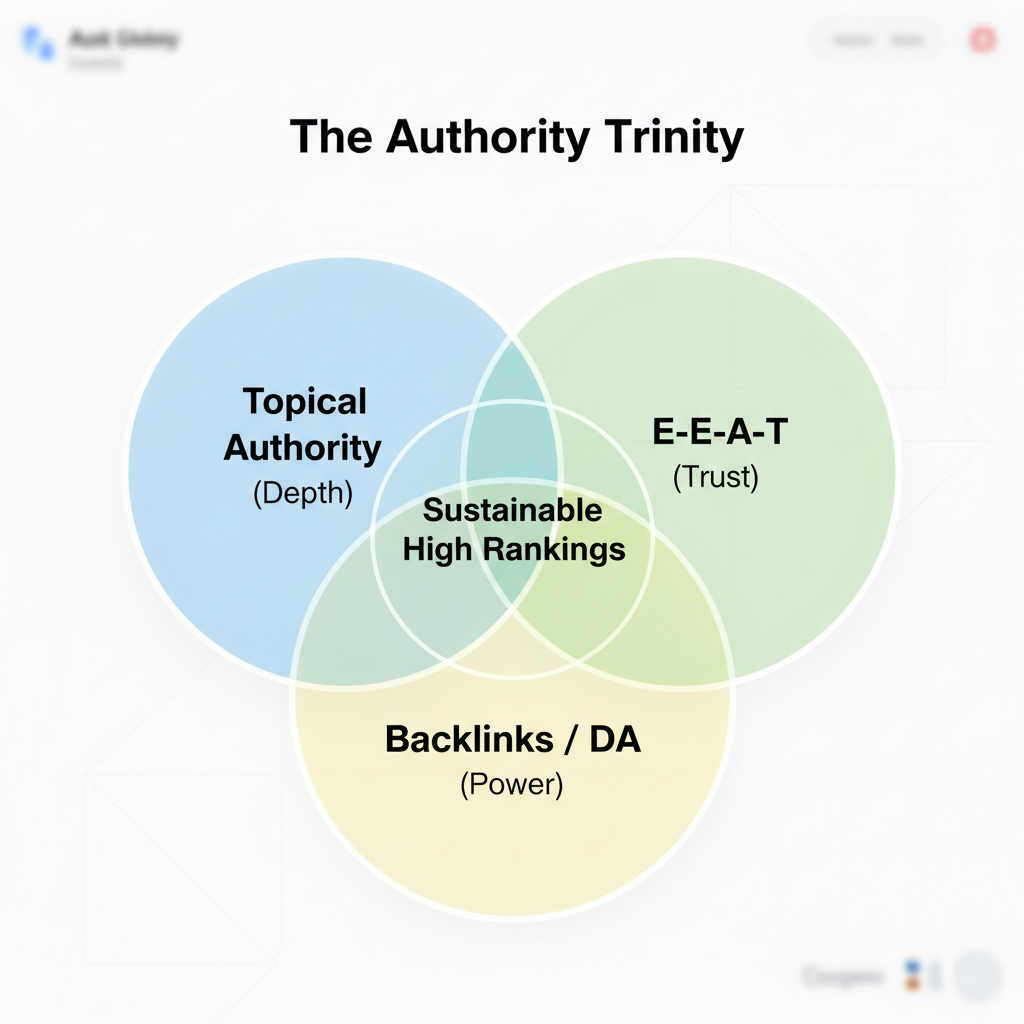
If E-E-A-T is the quality standard and DA is the link metric, Topical Authority is the bridge that connects them. In 2026, semantic relevance often trumps raw link power. Google's understanding of entities—people, places, and concepts—allows it to map a website's expertise across a specific subject area.
How Topical Authority Trumps Generic Power
- Semantic Clustering: Google analyzes the relationship between pages. A site covering every aspect of "commercial roofing" will likely outrank a general news site (with higher DA) for a specific roofing query.
- Entity Co-occurrence: The frequency with which your brand appears alongside relevant industry terms and experts signals authority without needing a direct hyperlink.
- User Intent Satisfaction: High E-E-A-T content answers the user's question thoroughly, reducing bounce rates and pogo-sticking, which are negative signals.
According to recent industry analysis on 2026 topical authority trends, sites that prioritize depth of coverage are seeing faster ranking improvements than those solely focused on acquiring high-DA backlinks.
Building a Hybrid Strategy
You cannot ignore links, but you must prioritize trust. A site with zero links will struggle to rank, regardless of how good the content is. Conversely, a site with a million links and low trust will eventually be devalued by spam updates.
Step 1: Fortify Your Technical Foundation
Before you can demonstrate expertise, your site must be accessible and understandable to crawlers. Technical errors can obscure your E-E-A-T signals. Ensure your schema markup correctly identifies authors and organizations. Utilizing robust Technical SEO Tools allows you to fix crawl errors that might prevent Google from connecting your content to your entity credentials.
Step 2: Optimize for "Experience"
To capture the "E" in E-E-A-T, your content must prove you have been there and done that.
- Use Original Visuals: Do not use stock photos. Use real photos of the product or process.
- First-Person Narrative: Write from a perspective of involvement. "We tested this," not "This can be tested."
- Detailed Case Studies: Share specific data points and outcomes.
Implementing these elements requires granular attention to on-page elements. Our Page SEO Tools can help you analyze individual URLs to ensure they meet the structural requirements for high-quality content.
Step 3: Audit Your Backlinks for Relevance
When building authority, focus on relevance over raw DA numbers. A link from a DA 20 blog in your exact niche is often more valuable for E-E-A-T than a link from a DA 60 general directory. As noted in a study on difference between DA and topical authority, relevance signals help Google place your site in the correct "knowledge bucket."
FAQ: E-E-A-T and Domain Authority
Is Domain Authority a Google ranking factor?
No. Google representatives have explicitly stated that they do not use Moz's Domain Authority metric. They have their own internal metrics (like PageRank) but DA is a third-party estimation.
Can a low DA site outrank a high DA site?
Yes, absolutely. If the low DA site has superior E-E-A-T, better topical authority, and meets the search intent more precisely, it can outrank a high DA competitor. This is common in niche YMYL topics.
How do I improve my E-E-A-T?
- Author Transparency: Clearly identify who wrote the content and their credentials.
- Cite Sources: Link to authoritative primary sources (gov, edu, scientific journals).
- Update Content: Keep information current, especially for finance and health topics.
- Manage Reputation: Monitor off-site reviews and mentions.
Which should I prioritize in 2026?
Prioritize E-E-A-T and Topical Authority. While you need a baseline of backlinks (which DA measures), the trust signal analysis suggests that Google's algorithms are increasingly punitive toward sites that have links but lack genuine expertise.
Conclusion
The debate of eeat vs domain authority resolves into a simple truth: DA is a map, but E-E-A-T is the terrain. You can have a map that says you are important (high DA), but if the terrain (your actual content) is treacherous and unreliable, Google will not send users down your path.
In 2026, the winning strategy is to use DA as a benchmark for your link-building efforts while treating E-E-A-T as the core philosophy of your content production. Build trust first, and the authority—both domain and topical—will follow.