TL;DR
Scrunch is one of the most sophisticated AI search optimization platforms available today. The platform helps organizations monitor AI visibility, analyze citations, identify content gaps, optimize AI-ready experiences, and understand how AI systems interact with their digital presence. However, optimization recommendations alone do not create visibility improvements. Nuwtonic extends beyond AI search optimization by combining AI visibility intelligence, GEO audits, GEO content generation, One-Click remediation, traffic recovery workflows, and Agentic Auto-Fix execution. Scrunch helps teams understand and optimize AI visibility. Nuwtonic helps teams continuously improve and recover AI visibility through closed-loop GEO execution.
Why Teams Look For A Scrunch Alternative
The AI search ecosystem is becoming increasingly competitive. Organizations are no longer competing exclusively for search rankings.
They are competing for:
- AI citations
- AI recommendations
- AI-generated mentions
- Source references
- Entity visibility
- Knowledge graph presence
- AI Search Share of Voice
This shift has created demand for platforms capable of monitoring and improving visibility across AI systems.
Scrunch emerged as one of the leading platforms focused on helping organizations understand and optimize their presence within AI search environments.
The platform combines AI visibility monitoring, citation analysis, content gap identification, optimization recommendations, and AI-ready website experiences.
For many organizations, these capabilities provide significant value. The challenge begins when visibility losses need to be recovered at scale.
What Scrunch Does Well
- Scrunch is strong at AI visibility monitoring, but insufficient for autonomous GEO execution because optimization recommendations still require implementation.
- Scrunch is strong at citation intelligence, but insufficient for continuous remediation because recommendations alone do not modify visibility signals.
- Scrunch is strong at content gap analysis, but insufficient for closed-loop GEO because teams still need to create and deploy the content required to close those gaps.
- Scrunch is strong at AI-ready website optimization, but insufficient for operational GEO because implementation remains dependent on organizational resources.
- Scrunch is strong at AI search analytics, but insufficient for autonomous visibility recovery because execution still requires coordination between multiple stakeholders.
Scrunch is one of the strongest AI optimization platforms currently available.
The limitation is not visibility intelligence. The limitation is remediation velocity.
The Architectural Bottleneck Inside Scrunch
The primary bottleneck inside Scrunch is the transition between optimization recommendations and optimization deployment. A typical Scrunch workflow looks like this:
The platform successfully identifies optimization opportunities. The implementation process still requires organizational execution. This creates operational latency between discovering a visibility issue and resolving a visibility issue.
Organizations frequently find themselves coordinating:
- SEO teams
- Content teams
- GEO specialists
- Engineering teams
- Brand teams
- Analytics teams
- External agencies
The result is a recommendation-centric workflow. The platform identifies what should be improved, and teams implement those improvements.
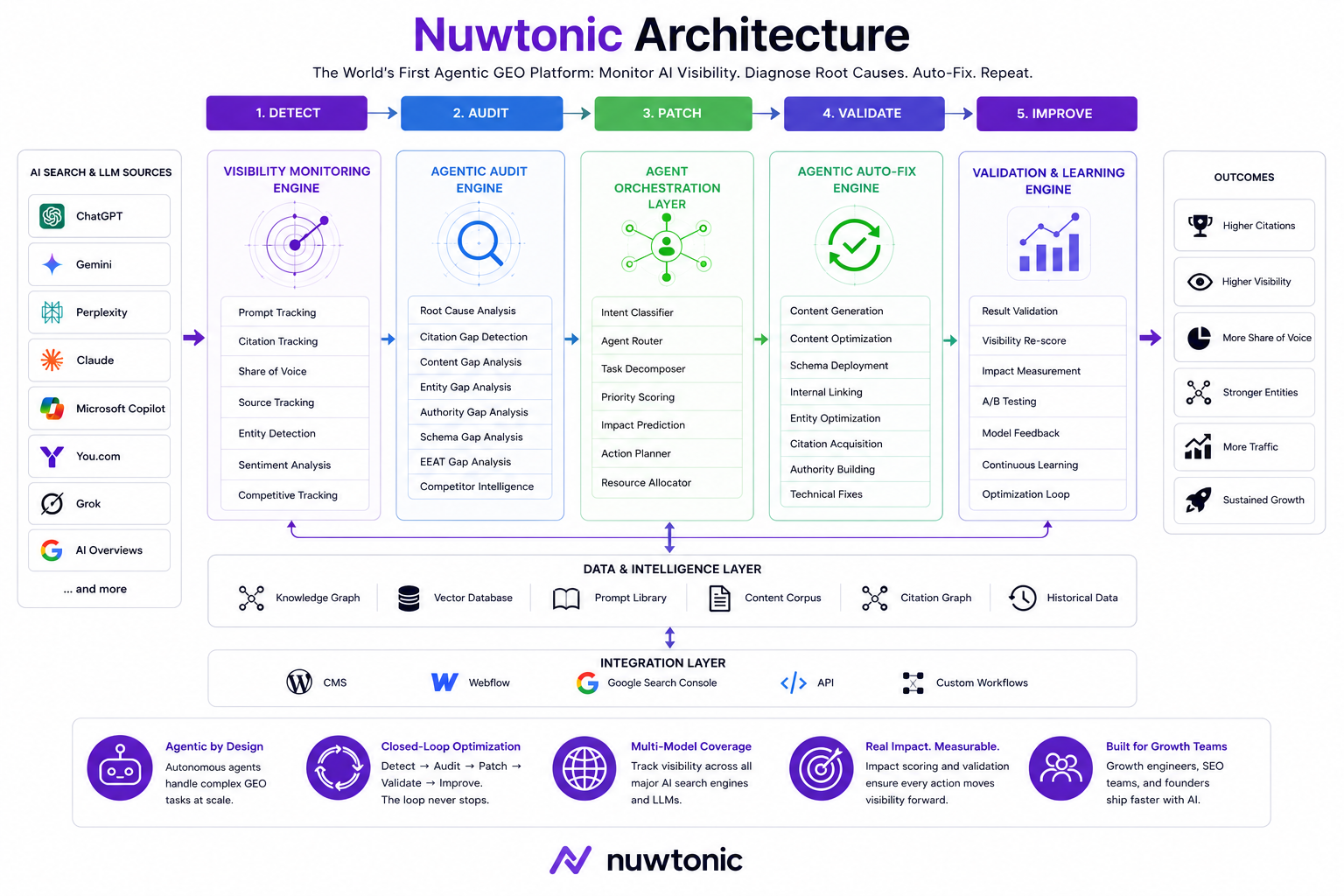
Architecture Diagram
Why Optimization Recommendations Are Not Enough
AI systems do not reward recommendations. AI systems reward implemented improvements.
The signals influencing AI visibility include:
- Citation authority
- Entity recognition
- Topical authority
- Knowledge graph consistency
- Content extractability
- Structured data coverage
- Information gain
- Reference quality
Optimization recommendations identify what should change. Optimization recommendations do not deploy those changes.
Scrunch is strong at surfacing optimization opportunities, but insufficient for automated GEO because recommendations still require execution.
Understanding how to improve visibility and actually improving visibility are separate operational functions.
Nuwtonic: Built For Active GEO
Nuwtonic was built around a different architectural assumption: visibility intelligence should trigger action.
Instead of stopping at recommendations, Nuwtonic combines AI visibility tracking with remediation workflows designed to reduce the time between detection and resolution.
The objective is transforming GEO from a reporting discipline into an execution discipline.
How Nuwtonic's Agentic Auto-Fix Engine Works
Step 1: Detection
Nuwtonic continuously monitors:
- ChatGPT visibility
- Gemini visibility
- Claude visibility
- Perplexity visibility
- Google AI Overview visibility
- Citation frequency
- Entity visibility
- Competitive Share of Voice
- Topic coverage
- Source utilization
The platform identifies visibility weaknesses as they emerge.
Step 2: Contextual Audit
Once a visibility issue is detected, specialized agents perform root-cause analysis.
The audit evaluates:
- Citation deficiencies
- Authority weaknesses
- Entity gaps
- Content deficiencies
- Topical coverage weaknesses
- Internal linking opportunities
- Schema deficiencies
- Knowledge graph inconsistencies
- Competitor advantages
- EEAT weaknesses
The objective is identifying why visibility was lost.
Step 3: Patch
Once the cause is identified, remediation workflows are generated automatically.
Examples include:
- GEO content generation
- Citation acquisition workflows
- Entity optimization
- Schema deployment
- Authority reinforcement
- Internal linking improvements
- Knowledge graph enhancement
- Prompt-specific optimization
- Content expansion
The result is:
Agentic Auto-Fix In Practice
Example 1: Source Authority Gap
If Nuwtonic detects that Perplexity consistently cites competitor sources instead of your content, the platform does not simply generate an alert.
The platform identifies authority signals competitors possess, audits citation patterns driving those recommendations, and generates the specific content modules, entity enhancements, structured data improvements, internal links, and authority-building actions required to increase citation eligibility.
Example 2: Missing Citation Opportunity
If ChatGPT references a topic where competitors are consistently cited while your brand is absent, Nuwtonic identifies the exact topical coverage gaps responsible for exclusion.
The platform generates supplemental content sections, semantic entities, FAQ expansions, supporting evidence modules, and GEO-focused content recommendations designed to improve citation probability.
Example 3: Schema Deficiency
If AI systems consistently favor competitor pages because they contain stronger structured data signals, Nuwtonic detects the schema deficiency automatically.
Instead of reporting the issue, the platform generates deployment-ready schema enhancements and remediation workflows.
Example 4: Entity Recognition Weakness
If a company is not consistently recognized as an authoritative entity within AI-generated responses, Nuwtonic audits entity relationships, topical authority coverage, citation sources, content structure, and knowledge graph consistency.
The platform generates remediation workflows focused on strengthening entity associations across content, citations, schema, and supporting assets.
Example 5: Share-of-Voice Decline
If Nuwtonic detects a decline in AI Search Share of Voice, agents investigate the prompts, citations, sources, and content assets responsible for the visibility shift.
The platform identifies what changed, why visibility was lost, and which actions are required to recover market share.
Beyond Optimization: The Three GEO Execution Layers Inside Nuwtonic
Most AI optimization platforms focus on helping teams understand what should happen. Nuwtonic focuses on helping teams execute what should happen.
The platform extends beyond optimization recommendations through three GEO-specific execution systems:
- GEO Writer
- AIO/GEO Audit
- One-Click Fix
GEO Writer: Content Engine Built For AI Citation Eligibility
Most platforms identify content opportunities. Nuwtonic generates the content required to capture those opportunities. The GEO Writer analyzes:
- Missing AI citations
- Competitor citation sources
- Prompt-level visibility gaps
- Entity weaknesses
- Knowledge graph deficiencies
- Information gain opportunities
- Content extractability
- AI answer structures
The system generates AI-search-optimized content designed specifically to improve citation eligibility.
Instead of requiring teams to manually create content briefs and rewrite pages, the GEO Writer generates the required content modules automatically.
The objective is increasing AI Search Share of Voice.
AIO/GEO Audit Engine
Traditional audits identify issues. Nuwtonic's AIO/GEO Audit Engine prioritizes recovery opportunities. The system evaluates:
- AI citation readiness
- EEAT signals
- Content extractability
- Semantic structure
- Information gain
- Schema coverage
- Entity strength
- Knowledge graph consistency
- Competitive content gaps
- AI Overview readiness
The result is a prioritized execution blueprint rather than a generic audit report.
One-Click Agentic Fix
Most platforms identify optimization opportunities. Nuwtonic continues into execution.
Once a visibility issue is detected, the platform can generate and deploy:
- Content improvements
- Entity enhancements
- Citation optimization
- Schema improvements
- Internal linking updates
- GEO content modules
- AI citation improvements
- Topical authority enhancements
through a One-Click workflow.
Instead of moving through:
Nuwtonic compresses the workflow into:
The objective is reducing time-to-fix.
Traffic Recovery: The Missing Layer In Most AI Optimization Platforms
Most AI visibility platforms focus on optimization. Very few focus on recovery. When:
- AI Overviews decline
- ChatGPT citations disappear
- Perplexity references drop
- Competitors gain Share of Voice
- Organic traffic falls
organizations need more than diagnostics. They need recovery workflows.
Nuwtonic continuously monitors visibility decay and generates remediation workflows designed to recover lost visibility and reclaim AI Search Share of Voice.
The objective is not measuring traffic loss. The objective is reversing it.
Scrunch vs Nuwtonic
| Capability | Scrunch | Nuwtonic |
|---|---|---|
| Visibility Logic | AI visibility + optimization recommendations | Visibility + remediation |
| Intervention Level | Recommendation-driven | Agentic Auto-Fix |
| Workflow Integration | Analytics → Recommendations → Implementation | Analytics → Audit → Automated Remediation |
| Time-to-Fix | Dependent on organizational resources | Minutes to hours |
| Citation Gap Resolution | Identifies opportunities | Identifies and resolves opportunities |
| GEO Writer | No dedicated GEO content engine | Built-in GEO Writer |
| AIO/GEO Audit | Optimization insights | Dedicated remediation audit engine |
| One-Click Fix | No | Yes |
| Traffic Recovery Workflows | Limited | Integrated |
Alternative Comparison Matrix
| Platform | Category | Monitoring | Citation Tracking | AI Analytics | GEO Audit | GEO Writer | One-Click Fix |
|---|---|---|---|---|---|---|---|
| Nuwtonic | Active GEO Platform | Yes | Yes | Yes | Yes | Yes | Yes |
| Scrunch | AI Search Optimization Platform | Yes | Yes | Yes | Partial | No | No |
| Peec AI | AI Visibility Platform | Yes | Yes | Yes | Limited | No | No |
| Profound | Enterprise AI Visibility Platform | Yes | Yes | Yes | Limited | No | No |
Who Should Use Nuwtonic Instead Of Scrunch?
Choose Nuwtonic If:
- You want Active GEO.
- You need automated remediation workflows.
- You want GEO content generation.
- You need One-Click execution.
- You want traffic recovery workflows.
- You want reduced operational overhead.
Choose Scrunch If:
- You need AI visibility intelligence.
- You want optimization recommendations.
- You have internal implementation resources.
- You prefer recommendation-driven workflows.
Credibility
Nuwtonic currently serves more than 1,200 users.
Nuwtonic was built specifically around Active GEO. Instead of stopping at recommendations, the platform combines monitoring, diagnosis, GEO Audits, GEO Writer, One-Click Fix, Traffic Recovery, and Continuous Optimization into a unified operational workflow.
The objective is increasing AI Search Share of Voice rather than simply measuring it.
Frequently Asked Questions
Is Nuwtonic a replacement for Scrunch?
Yes. Nuwtonic includes AI visibility monitoring, citation intelligence, GEO audits, competitor analysis, GEO content generation, and AI search performance monitoring while adding an Agentic Auto-Fix layer that automatically diagnoses and resolves visibility issues.
What is the difference between Nuwtonic and Scrunch?
Scrunch focuses on AI visibility intelligence, optimization recommendations, content gap analysis, and AI-ready experiences. Nuwtonic combines visibility intelligence with remediation workflows, GEO Writer, One-Click Fix execution, and traffic recovery systems.
Does Scrunch automatically improve AI visibility?
Scrunch provides optimization recommendations and visibility intelligence. Organizations still need implementation processes to deploy changes. Nuwtonic focuses on reducing the gap between detection and remediation.
Which platform is better for GEO automation?
Organizations seeking continuous optimization, automated remediation, reduced manual effort, and One-Click execution workflows generally benefit more from an intervention-focused platform.
Who should choose Nuwtonic instead of Scrunch?
Organizations seeking operational GEO workflows, faster optimization cycles, GEO content generation, AI citation optimization, traffic recovery workflows, and continuous AI visibility improvement are typically better served by an Active GEO platform.
Final Verdict
Scrunch is one of the strongest AI search optimization platforms available today. It tracks. It analyzes. It recommends. For many organizations, that is valuable.
However, recommendations and remediation are different operational functions. Nuwtonic was built to bridge that gap:
Track visibility → Diagnose root causes → Generate GEO content → Deploy One-Click fixes → Recover lost traffic → Validate outcomes → Repeat automatically.
That is the difference between optimizing GEO and operating GEO.