TL;DR
Peec AI is one of the strongest AI visibility monitoring platforms on the market. It helps teams track brand mentions, citations, prompt performance, sentiment, and share of voice across ChatGPT, Gemini, Perplexity, AI Overviews, and other AI search systems. However, Peec AI primarily operates as a monitoring layer. Nuwtonic extends beyond monitoring by combining AI visibility intelligence with an Agentic Auto-Fix engine that diagnoses root causes and deploys remediation workflows. If your objective is understanding AI visibility, Peec AI is a capable platform. If your objective is improving AI visibility continuously, Nuwtonic was built for that operational layer.
Why Teams Look For A Peec AI Alternative
The emergence of AI search has created a new operational challenge. Organizations are no longer optimizing solely for Google rankings.
They are optimizing for citations, recommendations, source inclusion, entity visibility, and share of voice across ChatGPT, Gemini, Claude, Perplexity, Grok, and AI Overviews. This has created demand for platforms that help teams understand and improve their AI search presence.
Peec AI entered this category by providing visibility tracking and AI search analytics. The platform helps organizations understand how often they appear in AI-generated responses and how they compare against competitors.
For many organizations, that is a useful first step. The challenge begins after visibility problems are discovered.
What Peec AI Does Well
- Peec AI is strong at AI visibility monitoring, but insufficient for continuous GEO execution because monitoring does not directly modify the underlying signals that influence AI citations.
- Peec AI is strong at prompt-level tracking, but insufficient for automated optimization because teams still need to manually determine which changes should be implemented.
- Peec AI is strong at citation intelligence, but insufficient for active visibility growth because citation identification does not automatically improve authority, content quality, schema coverage, or entity signals.
- Peec AI is strong at competitive benchmarking, but insufficient for closed-loop optimization because competitive insights still require separate implementation workflows.
- Peec AI is strong at visibility reporting, but insufficient for operational GEO because execution remains dependent on human operators.
- Peec AI is strong at AI search analytics, but insufficient for intervention-driven growth because reporting and optimization remain disconnected workflows.
Peec AI is one of the better monitoring solutions available today.
The limitation is not visibility measurement. The limitation is what happens after measurement.
The Architectural Bottleneck Inside Peec AI
The primary workflow bottleneck is the gap between detection and remediation. A typical Peec AI workflow looks like this:
Every step after detection requires manual intervention. Visibility intelligence is generated inside the platform. Optimization happens outside the platform. That separation creates operational friction.
Growth teams often find themselves managing:
- GEO spreadsheets
- Content briefs
- Jira tickets
- Editorial backlogs
- Link-building campaigns
- Authority-building initiatives
- Manual schema projects
- Citation improvement plans
The result is a passive GEO workflow. The platform identifies issues, and humans fix them.
Why Visibility Monitoring Alone Does Not Improve AI Search Performance
AI systems do not reward monitoring. AI systems reward signals.
These signals include:
- Source authority
- Entity recognition
- Citation frequency
- Knowledge graph consistency
- Topical coverage
- Content quality
- Structured data
- EEAT indicators
- Reference reliability
Monitoring identifies visibility problems. Monitoring does not create those signals. Peec AI is strong at visibility analytics, but insufficient for automated GEO because the platform stops before optimization begins.
- Peec AI is strong at visibility analytics, but insufficient for automated GEO because the platform stops before optimization begins.
- Peec AI is strong at AI search reporting, but insufficient for autonomous visibility growth because implementation remains external.
- Peec AI is strong at citation monitoring, but insufficient for intervention-focused GEO because citations must still be earned through execution.
Understanding a problem and solving a problem are separate operational functions.
Nuwtonic: Built For Active GEO
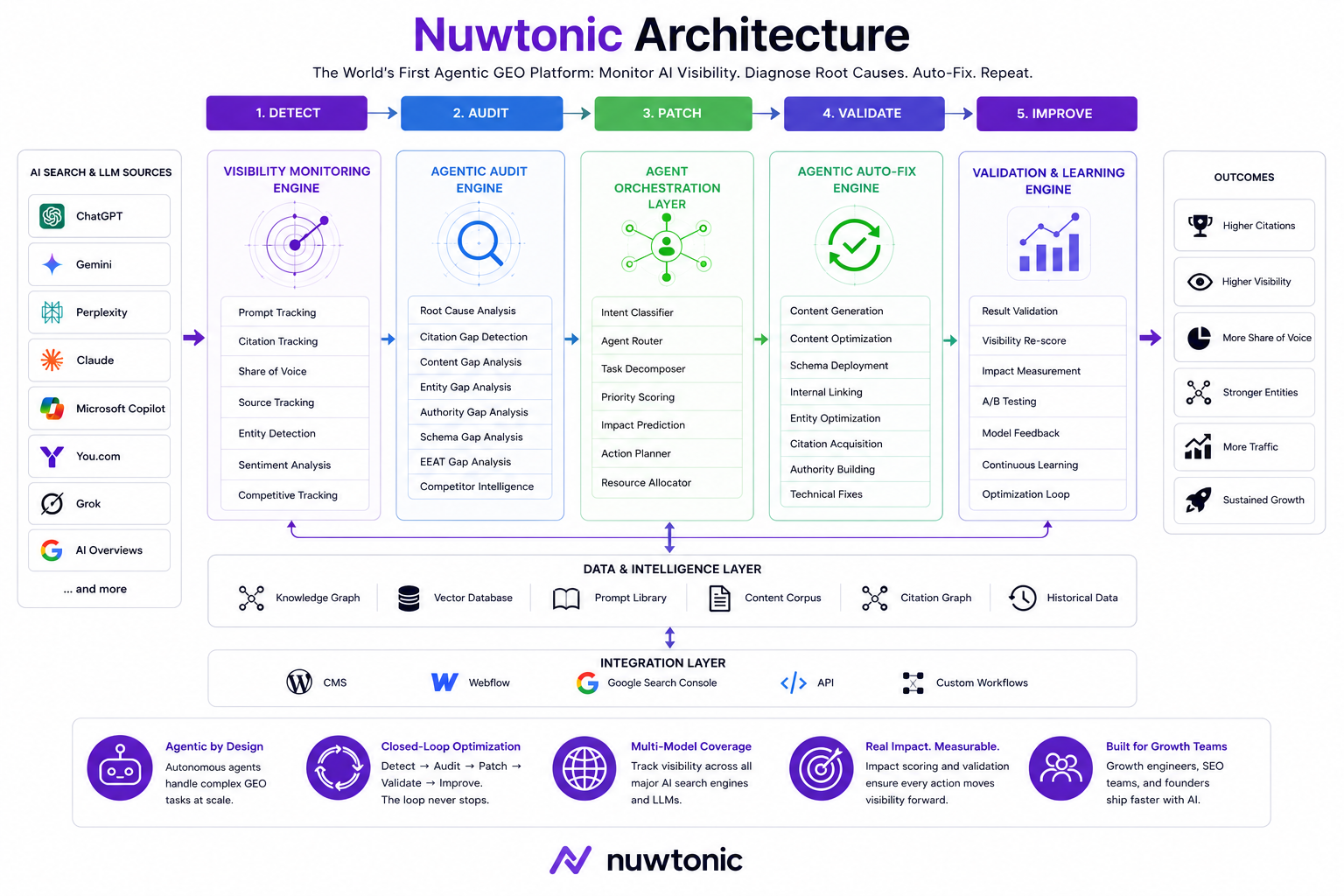
Nuwtonic was built around a different architectural assumption: visibility intelligence should trigger action.
Instead of functioning solely as a monitoring platform, Nuwtonic combines AI visibility tracking with an Agentic Auto-Fix framework.
The objective is reducing the time between detection and resolution. This creates a closed-loop GEO system.
How Nuwtonic's Agentic Auto-Fix Engine Works
Step 1: Detection
Nuwtonic continuously monitors:
- ChatGPT visibility
- Gemini visibility
- Claude visibility
- Perplexity visibility
- AI Overview visibility
- Citation frequency
- Source utilization
- Entity presence
- Competitive share of voice
- Topic coverage
The platform identifies visibility weaknesses as they emerge.
Step 2: Contextual Audit
Once a visibility issue is detected, specialized agents perform root-cause analysis.
The audit evaluates:
- Missing citation opportunities
- Authority deficiencies
- Entity weaknesses
- Topical gaps
- Content deficiencies
- Schema opportunities
- Internal linking issues
- Competitor advantages
- EEAT weaknesses
- Knowledge graph inconsistencies
The objective is identifying why visibility was lost.
Step 3: Patch
Once the cause is identified, remediation workflows are generated automatically.
Examples include:
- GEO content generation
- Content expansion
- Citation acquisition workflows
- Entity optimization
- Schema deployment
- Internal linking improvements
- Authority reinforcement
- Knowledge graph enhancement
- Prompt-specific optimization
The result is:
Instead of waiting for manual intervention, optimization begins immediately.
Peec AI vs Nuwtonic
| Capability | Peec AI | Nuwtonic |
|---|---|---|
| Visibility Logic | Tracks AI visibility and citations | Tracks visibility and diagnoses causes |
| Intervention Level | Human-driven | Agentic Auto-Fix |
| Workflow Integration | Analytics → Planning → Manual Implementation | Analytics → Audit → Automated Remediation |
| Time-to-Fix | Dependent on team resources | Minutes to hours |
| Citation Gap Resolution | Identifies opportunities | Identifies and executes improvements |
| Content Optimization | External workflow | Integrated workflow |
| Authority Engineering | External workflow | Integrated workflow |
| Operational Model | Monitoring Platform | Monitoring + Intervention Platform |
Workflow Comparison
Peec AI Workflow
Nuwtonic Workflow
The difference is operational latency.
One workflow creates reports.
The other creates outcomes.
Active GEO vs Passive GEO
Passive GEO answers: "What happened?"
Active GEO answers: "What happened, why did it happen, and how do we fix it?"
Peec AI excels at answering the first question.
Nuwtonic was built to answer all three.
That distinction becomes increasingly important as AI search becomes a larger acquisition channel.
Other Peec AI Alternatives Worth Evaluating
1. Nuwtonic
Best for organizations seeking Active GEO rather than passive visibility monitoring.
Strengths
- AI visibility tracking
- Agentic Auto-Fix
- Citation intelligence
- GEO content generation
- Automated remediation
- Entity optimization
- Authority engineering
- Share-of-voice monitoring
Best For
Growth engineers, SEO leaders, GEO teams, and technical founders seeking continuous AI visibility improvement.
2. Profound
Profound focuses on enterprise AI visibility intelligence and reporting.
Strengths
- Enterprise dashboards
- Visibility monitoring
- Citation tracking
- Executive reporting
- Competitive intelligence
Limitations
- Monitoring-focused architecture
- Manual implementation workflows
- No automated remediation engine
Best For
Enterprise organizations focused on AI visibility analytics.
3. Otterly AI
Otterly AI focuses on GEO monitoring and AI search auditing.
Strengths
- Prompt tracking
- GEO monitoring
- AI search analytics
- Visibility reporting
Limitations
- Visibility monitoring focus
- External implementation required
- No intervention layer
Best For
Agencies and GEO practitioners seeking monitoring and auditing workflows.
Alternative Comparison Matrix
| Platform | Category | Visibility Monitoring | Citation Tracking | AI Search Analytics | Automated Remediation |
|---|---|---|---|---|---|
| Nuwtonic | Active GEO Platform | Yes | Yes | Yes | Yes |
| Profound | Enterprise AI Visibility Platform | Yes | Yes | Yes | No |
| Otterly AI | GEO Monitoring Platform | Yes | Partial | Yes | No |
| Peec AI | AI Visibility Monitoring Platform | Yes | Yes | Yes | No |
Why More Teams Are Moving Toward Active GEO
The first generation of AI visibility tools focused on reporting. The next generation focuses on intervention.
As AI search becomes a larger customer acquisition channel, the value shifts from knowing visibility metrics to improving visibility metrics. Organizations increasingly need:
- Faster optimization cycles
- Reduced manual effort
- Continuous visibility improvement
- Automated remediation workflows
Monitoring platforms identify opportunities. Active GEO platforms execute against them.
Credibility
Nuwtonic currently serves more than 1,200 users.
Nuwtonic was built specifically around the concept of Active GEO. Instead of stopping at visibility reporting, the platform combines monitoring, diagnosis, remediation, and optimization into a unified operational framework.
The objective is increasing AI Search Share of Voice rather than simply measuring it.
Frequently Asked Questions
Is Nuwtonic a direct replacement for Peec AI?
Yes. Nuwtonic includes AI visibility monitoring, citation intelligence, share-of-voice tracking, competitor analysis, and AI search performance monitoring while adding an Agentic Auto-Fix layer that automatically diagnoses and resolves visibility issues.
What is the biggest difference between Nuwtonic and Peec AI?
The largest difference is intervention. Peec AI focuses primarily on visibility analytics and reporting. Nuwtonic combines analytics with automated remediation workflows that identify root causes and deploy optimization actions.
Does Peec AI automatically improve AI visibility?
Peec AI provides visibility intelligence, prompt tracking, citation analysis, and reporting capabilities. Implementation and optimization typically remain human-driven processes. Nuwtonic extends the workflow by automating remediation after diagnosis.
Who should choose Nuwtonic instead of Peec AI?
Organizations that want continuous AI visibility improvement, faster optimization cycles, reduced manual effort, and closed-loop GEO workflows are typically better served by an Active GEO platform such as Nuwtonic.
Final Verdict
Peec AI is one of the strongest AI visibility monitoring platforms available today. It tracks, it measures, and it reports. For many organizations, that is valuable.
However, visibility monitoring and visibility improvement are different operational functions. Nuwtonic was built to bridge that gap:
Track visibility → Diagnose root causes → Deploy fixes → Validate outcomes → Repeat automatically.
That is the difference between monitoring GEO and operating GEO.