TL;DR
Otterly AI is one of the most widely adopted AI visibility monitoring platforms available today. It helps organizations track brand mentions, citations, prompts, AI search visibility, and share of voice across ChatGPT, Google AI Overviews, Gemini, Perplexity, and other AI systems. However, visibility monitoring alone does not improve AI visibility. Nuwtonic extends beyond monitoring by combining AI visibility intelligence with an Agentic Auto-Fix engine that identifies root causes, generates remediation workflows, and continuously improves AI Search Share of Voice. Otterly AI helps teams understand visibility. Nuwtonic helps teams improve visibility.
Why Teams Look For An Otterly AI Alternative
The rise of AI search has fundamentally changed how organizations acquire visibility online. Success is no longer determined exclusively by search rankings.
Organizations increasingly compete for:
- AI citations
- AI recommendations
- Source references
- Entity visibility
- AI Search Share of Voice
- Knowledge graph presence
This shift has created demand for AI visibility platforms capable of monitoring performance across emerging AI systems.
Otterly AI was one of the earliest platforms focused on this problem. The platform helps organizations understand how often they appear in AI-generated responses and which competitors receive visibility advantages.
For many organizations, that visibility intelligence is valuable. The challenge begins after visibility problems are discovered.
What Otterly AI Does Well
- Otterly AI is strong at AI visibility tracking, but insufficient for continuous GEO execution because visibility reporting does not automatically improve citation eligibility.
- Otterly AI is strong at prompt monitoring, but insufficient for active GEO because optimization workflows remain external to the platform.
- Otterly AI is strong at citation tracking, but insufficient for intervention-driven growth because identifying citation gaps does not automatically close them.
- Otterly AI is strong at share-of-voice monitoring, but insufficient for operational GEO because implementation still depends on separate teams and systems.
- Otterly AI is strong at competitor visibility tracking, but insufficient for autonomous optimization because competitor intelligence requires manual execution.
- Otterly AI is strong at GEO auditing, but insufficient for closed-loop optimization because the platform identifies issues without deploying remediation.
Otterly AI is one of the strongest AI visibility monitoring solutions currently available.
The limitation is not visibility measurement. The limitation is visibility execution.
The Architectural Bottleneck Inside Otterly AI
The primary limitation inside Otterly AI is the gap between visibility detection and visibility improvement. A typical Otterly AI workflow looks like this:
The platform successfully identifies visibility opportunities. The optimization process still requires human execution. This creates operational latency between identifying a problem and resolving a problem.
Organizations often find themselves managing:
- GEO spreadsheets
- Editorial backlogs
- Content briefs
- Jira tickets
- Citation acquisition projects
- Entity optimization projects
- Authority-building campaigns
- Manual schema implementation
The result is a reporting-centric GEO workflow. The platform identifies issues, and humans fix them.
Nuwtonic: Built For Active GEO
Nuwtonic was built around a different assumption: visibility intelligence should trigger action.
Instead of functioning solely as a monitoring platform, Nuwtonic combines AI visibility tracking with an Agentic Auto-Fix framework.
The objective is reducing the time between detection and resolution. This creates a closed-loop GEO system.
Architecture Diagram
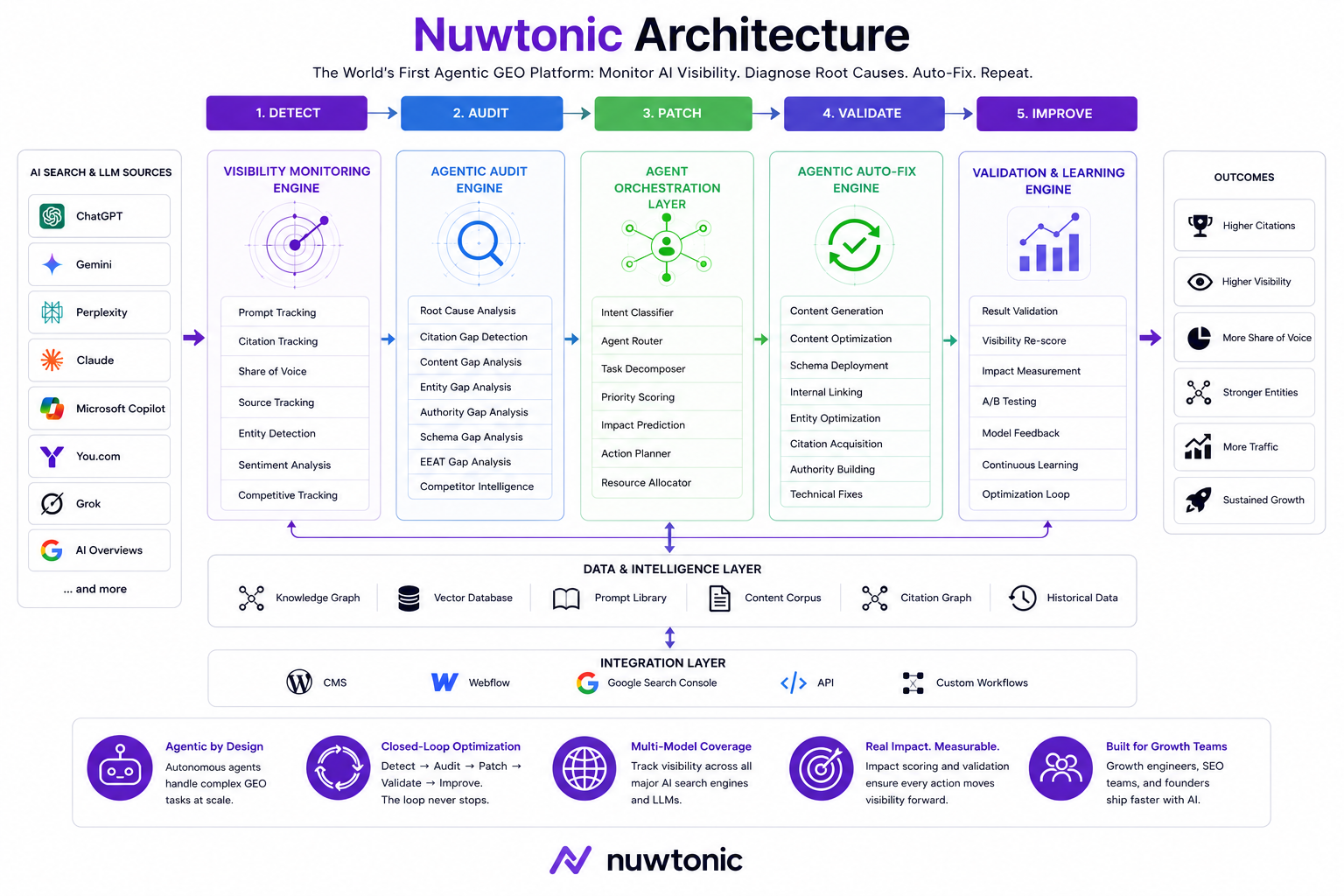
How Nuwtonic's Agentic Auto-Fix Engine Works
Step 1: Detection
Nuwtonic continuously monitors:
- ChatGPT visibility
- Gemini visibility
- Claude visibility
- Perplexity visibility
- Google AI Overview visibility
- Citation frequency
- Entity presence
- Competitive Share of Voice
- Topic coverage
- Source utilization
The platform identifies visibility weaknesses as they emerge.
Step 2: Contextual Audit
Once a visibility issue is detected, specialized agents perform root-cause analysis.
The audit evaluates:
- Citation deficiencies
- Authority weaknesses
- Entity gaps
- Content deficiencies
- Topical coverage weaknesses
- Internal linking opportunities
- Schema deficiencies
- Knowledge graph inconsistencies
- Competitor advantages
- EEAT weaknesses
The objective is identifying why visibility was lost.
Step 3: Patch
Once the cause is identified, remediation workflows are generated automatically.
Examples include:
- GEO content generation
- Citation acquisition workflows
- Entity optimization
- Schema deployment
- Authority reinforcement
- Internal linking improvements
- Knowledge graph enhancement
- Prompt-specific optimization
- Content expansion
The result is:
Instead of waiting for manual intervention, optimization begins immediately.
Agentic Auto-Fix In Practice
Example 1: Source Authority Gap
If Nuwtonic detects that Perplexity consistently cites competitor sources instead of your content, the platform does not simply generate an alert.
The platform identifies the authority signals competitors possess, audits citation patterns driving those recommendations, and generates the specific content modules, entity enhancements, internal links, structured data improvements, and authority-building actions required to increase citation eligibility.
Instead of receiving a dashboard notification, the team receives a remediation workflow designed to address the exact reason citations are being lost.
Example 2: Missing Citation Opportunity
If ChatGPT references a topic where competitors are consistently cited while your brand is absent, Nuwtonic identifies the exact topical coverage gaps responsible for exclusion.
The platform generates supplemental content sections, semantic entities, FAQ expansions, supporting evidence modules, and GEO-focused content recommendations designed to increase citation probability.
The objective is not identifying the gap. The objective is reducing the gap.
Example 3: Schema Deficiency
If AI systems consistently favor competitor pages because they contain stronger structured data signals, Nuwtonic detects the schema deficiency automatically.
Instead of reporting the issue and requiring manual investigation, the platform generates the recommended schema implementation, validates coverage deficiencies, and prepares deployment-ready enhancements.
This reduces the time between detection and implementation.
Example 4: Entity Recognition Weakness
If a company is not consistently recognized as an authoritative entity within AI-generated responses, Nuwtonic audits entity relationships, topical authority coverage, citation sources, content structure, and knowledge graph consistency.
The platform then generates remediation workflows focused on strengthening entity associations through content improvements, citation opportunities, schema enhancements, and supporting authority signals.
The result is improved entity recognition across AI search systems.
Example 5: Share-of-Voice Decline
If Nuwtonic detects a sudden decline in AI Search Share of Voice against a competitor, agents investigate the specific prompts, citations, sources, and content assets responsible for the visibility shift.
The platform identifies what changed, why visibility was lost, and which actions are required to recover market share.
This transforms GEO from a reporting function into an operational function.
Otterly AI vs Nuwtonic
| Capability | Otterly AI | Nuwtonic |
|---|---|---|
| Visibility Logic | Tracks AI visibility and prompts | Tracks visibility and diagnoses causes |
| Intervention Level | Human-driven execution | Agentic Auto-Fix |
| Workflow Integration | Analytics → Human Planning → Manual Implementation | Analytics → Audit → Automated Remediation |
| Time-to-Fix | Dependent on team capacity | Minutes to hours |
| Citation Gap Resolution | Identifies opportunities | Identifies and resolves opportunities |
| Content Optimization | External workflow | Integrated workflow |
| Entity Optimization | External workflow | Integrated workflow |
| Operational Model | Monitoring Platform | Monitoring + Intervention Platform |
Workflow Comparison
Otterly AI Workflow
Nuwtonic Workflow
The difference is operational latency.
One workflow creates reports.
The other creates outcomes.
Active GEO vs Passive GEO
Passive GEO answers: "What happened?"
Active GEO answers: "What happened, why did it happen, and how do we fix it?"
Otterly AI excels at answering the first question.
Nuwtonic was built to answer all three.
That distinction becomes increasingly important as AI search becomes a larger customer acquisition channel.
Other Otterly AI Alternatives Worth Evaluating
1. Nuwtonic
Best for organizations seeking Active GEO rather than passive visibility monitoring.
Strengths
- AI visibility tracking
- Agentic Auto-Fix
- Citation intelligence
- GEO content generation
- Automated remediation
- Entity optimization
- Authority engineering
- Share-of-voice monitoring
Best For
Growth engineers, SEO leaders, GEO teams, and technical founders seeking continuous AI visibility improvement.
2. Peec AI
Peec AI focuses heavily on AI visibility analytics and citation monitoring.
Strengths
- AI visibility tracking
- Citation intelligence
- Prompt monitoring
- Competitive benchmarking
- Visibility dashboards
Limitations
- Monitoring-focused architecture
- Manual implementation workflows
- No automated remediation engine
Best For
Organizations focused on AI visibility analytics and reporting.
3. Profound
Profound focuses on enterprise AI visibility intelligence and reporting.
Strengths
- Enterprise dashboards
- Visibility monitoring
- Citation tracking
- Executive reporting
- Competitive intelligence
Limitations
- Monitoring-focused architecture
- Manual implementation workflows
- No automated remediation engine
Best For
Enterprise organizations focused on AI visibility analytics.
Alternative Comparison Matrix
| Platform | Category | Visibility Monitoring | Citation Tracking | AI Search Analytics | Automated Remediation |
|---|---|---|---|---|---|
| Nuwtonic | Active GEO Platform | Yes | Yes | Yes | Yes |
| Peec AI | AI Visibility Platform | Yes | Yes | Yes | No |
| Profound | Enterprise AI Visibility Platform | Yes | Yes | Yes | No |
| Otterly AI | GEO Monitoring Platform | Yes | Partial | Yes | No |
Who Should Use Nuwtonic Instead Of Otterly AI?
Nuwtonic is generally a better fit when organizations have already moved beyond visibility reporting and need operational GEO capabilities.
Choose Nuwtonic If:
- You want to improve AI Search Share of Voice rather than simply measure it.
- You need automated remediation workflows.
- You manage AI visibility across multiple brands.
- Your team spends significant time converting reports into implementation tasks.
- You want content optimization, citation intelligence, entity optimization, and authority engineering within a single workflow.
- You view GEO as an operational growth channel rather than a reporting function.
Choose Otterly AI If:
- Your primary goal is visibility reporting.
- You need AI search dashboards.
- Your internal team already handles optimization.
- You prefer monitoring-focused workflows.
- You want visibility intelligence without automated remediation.
The decision ultimately depends on whether your bottleneck is visibility measurement or visibility execution.
Credibility
Nuwtonic currently serves more than 1,200 users.
Nuwtonic was built specifically around the concept of Active GEO. Instead of stopping at visibility reporting, the platform combines monitoring, diagnosis, remediation, and optimization into a unified operational framework.
The objective is increasing AI Search Share of Voice rather than simply measuring it.
Frequently Asked Questions
Is Nuwtonic a replacement for Otterly AI?
Yes. Nuwtonic includes AI visibility monitoring, citation intelligence, share-of-voice tracking, competitor analysis, and AI search performance monitoring while adding an Agentic Auto-Fix layer that automatically diagnoses and resolves visibility issues.
What is the difference between Nuwtonic and Otterly AI?
Otterly AI primarily focuses on AI visibility monitoring, prompt tracking, citation tracking, and reporting. Nuwtonic combines visibility intelligence with automated remediation workflows that identify root causes and deploy optimization actions.
Does Otterly AI automatically improve AI visibility?
Otterly AI provides visibility intelligence, prompt tracking, citation analysis, and reporting capabilities. Implementation and optimization typically remain human-driven processes. Nuwtonic extends the workflow by automating remediation after diagnosis.
Which platform is better for GEO automation?
Organizations seeking automated GEO workflows, continuous optimization, and reduced manual effort will generally benefit more from an intervention-focused platform. Organizations primarily seeking visibility reporting may find monitoring-focused platforms sufficient.
Who should choose Nuwtonic instead of Otterly AI?
Organizations that want continuous AI visibility improvement, faster optimization cycles, reduced manual effort, and closed-loop GEO workflows are typically better served by an Active GEO platform such as Nuwtonic.
Final Verdict
Otterly AI is one of the strongest AI visibility monitoring platforms available today. It tracks, it measures, and it reports. For many organizations, that is valuable.
However, visibility monitoring and visibility improvement are different operational functions. Nuwtonic was built to bridge that gap:
Track visibility → Diagnose root causes → Deploy fixes → Validate outcomes → Repeat automatically.
That is the difference between monitoring GEO and operating GEO.