Outil Gratuit de Keyword Clustering
Transformez une liste de mots-clés en clusters clairs et actionnables. Mode gratuit jusqu'à 50 mots-clés, ou mode avancé pour générer 200+ mots-clés thématiques.
Pourquoi le Keyword Clustering est important
Le keyword clustering regroupe les requêtes sémantiquement proches en ensembles éditoriaux. Cela permet de mieux couvrir l'intention, d'éviter la cannibalisation, et de renforcer l'autorité thématique de votre site.
Ce que fait cet outil
L'outil analyse votre liste et crée des groupes de mots-clés exploitables pour vos pages piliers, vos contenus de support, et votre maillage interne. Le mode avancé est conçu pour les stratégies SEO à grande échelle.
Comment utiliser l'outil
Collez un mot-clé par ligne dans le champ de saisie.
Cliquez sur Générer les clusters.
Analysez les groupes pour définir vos pages piliers et satellites.
Passez au mode avancé pour obtenir 200+ mots-clés et exporter en CSV.
Cas d'usage recommandés
Construire une carte thématique avant une campagne contenu.
Segmenter les intentions informationnelles et transactionnelles.
Créer des briefs éditoriaux structurés pour les rédacteurs.
Préparer un planning de publication orienté autorité thématique.
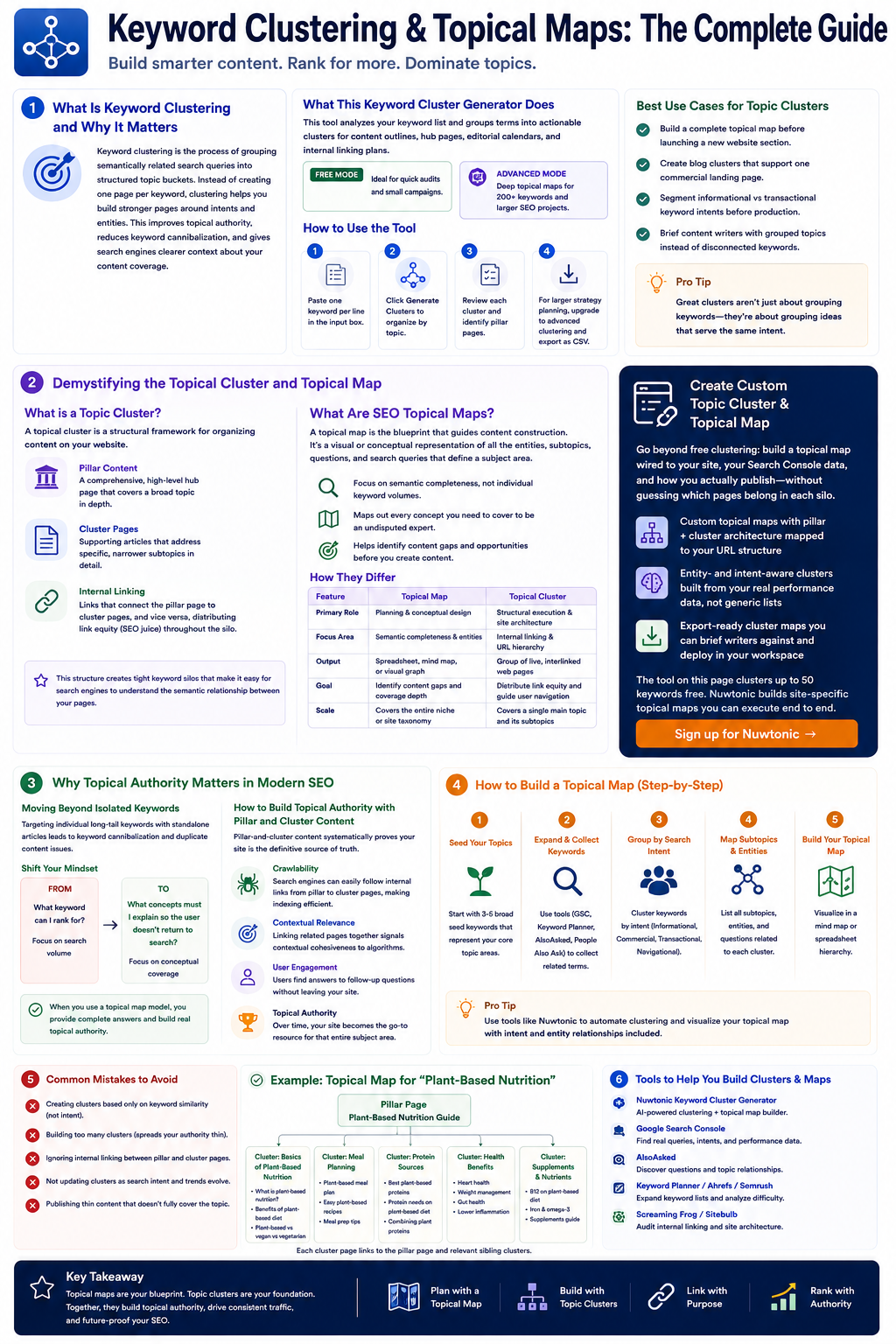
Demystifying the Topical Cluster and Topical Map
Look, let's break this down into plain English. While people often use these terms interchangeably, they refer to two completely different stages of the content planning and execution process. Confusing them is like confusing a blueprint of a house with the actual physical framing.
What is a Topic Cluster?
At its core, a topic cluster (or topical cluster) is a structural framework for organizing content on your website. It consists of three primary components:
- Pillar Content: A comprehensive, high-level hub page that covers a broad topic in depth.
- Cluster Pages: Supporting articles that address specific, narrower subtopics in detail.
- Internal Linking: Hyperlinks that connect the pillar page to the cluster pages, and vice versa, distributing link equity (or as some call it, SEO juice) throughout the silo.
This structure creates tight keyword silos that make it incredibly easy for search engine crawlers to understand the semantic relationship between your pages.
Create Custom Topic Cluster & Topical Map
Go beyond free clustering: build a topical map wired to your site, your Search Console data, and how you actually publish—without guessing which pages belong in each silo.
- Custom topical maps with pillar + cluster architecture mapped to your URL structure
- Entity- and intent-aware clusters built from your real performance data, not generic lists
- Export-ready cluster maps you can brief writers against and deploy in your workspace
The tool on this page clusters up to 50 keywords free. Nuwtonic builds site-specific topical maps you can execute end to end.
Sign up for NuwtonicWhat Are SEO Topical Maps?
If a topical cluster is the physical structure of your content, a topical map is the blueprint that guides its construction. What is a topical map is essentially a visual or conceptual representation of all the entities, subtopics, questions, and search queries that define a specific subject area. Instead of focusing on individual keyword search volumes, a topical map focuses on semantic completeness. It maps out every single concept you need to cover to be considered an undisputed expert on a topic.
How They Differ
To make this concrete, let's compare the two concepts side-by-side:
| Feature | Topical Map | Topical Cluster |
|---|---|---|
| Primary Role | Planning & conceptual design | Structural execution & site architecture |
| Focus Area | Semantic completeness & entities | Internal linking & URL hierarchy |
| Output | A spreadsheet, mind map, or visual graph | A group of live, interlinked web pages |
| Goal | Identify content gaps and coverage depth | Distribute link equity and guide user navigation |
| Scale | Covers the entire niche or site taxonomy | Covers a single main topic and its subtopics |
Why Topical Authority Matters in Modern SEO
Don't just throw random keywords together and expect Google to reward you. The algorithm has evolved. It's no longer about who has the most keywords stuffed into a meta tag; it's about who provides the most comprehensive, authoritative answer to a user's query.
Moving Beyond Isolated Keywords
I've seen too many teams get bogged down in keyword research instead of focusing on creating meaningful connections between topics. In my past projects, we used to target individual long-tail keywords with standalone articles. The result? We ended up with massive keyword cannibalization and duplicate content issues because different pages were competing for the same search intent. When you transition to a topical map model, you shift your focus from search volume to conceptual coverage. You stop asking, "What keyword can I rank for?" and start asking, "What concepts must I explain so the user doesn't have to go back to the search results to find answers?"
How to Build Topical Authority with Pillar and Cluster Content
Building topical authority is about proving to search engines that your site is the definitive source of truth for a specific subject area. When you build a pillar-and-cluster structure, you are systematically demonstrating this depth of knowledge. Let's look at how this works under the hood:
- Crawlability: When search engine spiders land on your pillar page, they follow the internal links to your cluster pages. This clear path makes indexing your site highly efficient.
- Contextual Relevance: By linking related pages together, you signal to algorithms that your content is contextually cohesive.
- User Engagement: Users can easily find answers to follow-up questions without leaving your site, which increases dwell time and reduces bounce rates.
The Role of Search Intent in Semantic SEO
Many marketers overlook the importance of search intent when building topical maps, leading to missed opportunities. Search intent isn't just a filter in your keyword tool; it's the fundamental driver of how your content should be structured. When mapping out your clusters, you must align each page with one of the primary intent types:
- Informational: "What is a topical map?" (Best suited for cluster pages or pillar intros)
- Investigational: "Topical map tools comparison" (Best suited for mid-funnel comparison guides)
- Transactional: "Hire a topical mapping service" (Best suited for landing pages)
If you map a highly transactional keyword to a purely informational blog post, you will struggle to rank—no matter how many internal links you point at it.
Step-by-Step: How to Complete a Topical Map SEO
So, how do we turn this theory into a practical, repeatable workflow? Let's break down the exact steps I use when building out a topical map from scratch.
Step 1: Broad Subject Identification and Entity Mapping
Before you open any keyword research tool, you need to understand the core entities of your niche. An entity is a distinct, well-defined concept or thing that search engines recognize.
For example, if your core topic is "Coffee brewing," your primary entities might include:
- •Brewing methods (Pour over, French press, Espresso)
- •Equipment (Grinders, Scales, Kettles)
- •Ingredients (Coffee beans, Water quality, Roast profiles)
Start by mapping these entities out. This gives you a conceptual skeleton before you even think about search volume.
Step 2: Running a Comprehensive Content Audit and Gap Analysis
Once you have your entity map, it's time to perform a thorough content audit. Look at your existing pages and map them to your new entity structure.
- Do we already have a page that covers this entity?
- Is the content up-to-date and matching the correct search intent?
- Where are the content gaps (entities we haven't written about yet)?
This step prevents you from writing duplicate content and helps you prioritize your content production pipeline.
Step 3: Translating the Map into a Site-Wide Architecture
Now, you need to turn your conceptual map into a physical site structure. This is where you decide your URL taxonomy and category systems. For a scalable, search-engine-friendly structure, I recommend using a Sitewise custom topical map approach. This ensures that your technical SEO, URL structures, and internal linking strategies perfectly mirror your topical map.
An ideal URL structure for a cluster looks like this:
example.com/coffee/ (Pillar Page)
example.com/coffee/french-press/ (Cluster Page)
example.com/coffee/pour-over/ (Cluster Page)
Advanced Implementation: Creating and Clustering Content
How to Create a Topic Cluster
When actually building the cluster, I always advise clients to start with the supporting cluster pages before finalizing the pillar page.
Why? Because it's much easier to write a comprehensive summary (the pillar) when you've already done the deep-dive research on the individual subtopics (the clusters). Here is the sequence I recommend:
- Write the cluster pages: Focus on highly specific, long-tail queries.
- Draft the pillar page: Keep it high-level but comprehensive. It should introduce each subtopic and link out to the dedicated cluster pages for those wanting a deeper dive.
- Implement the internal linking: Ensure every cluster page links back to the pillar page using descriptive anchor text, and ensure the pillar page links to every cluster page.
How Do You SEO Cluster of Similar Keywords?
One of the biggest pitfalls in modern SEO is creating separate pages for keywords that share the exact same search intent. To avoid this, you must learn What is keyword clustering and how to cluster keywords. If two keywords return highly similar search results on Google, they belong on the same page. Do not create one page for "how to make pour over coffee" and another for "pour over coffee instructions." Cluster them together under a single, comprehensive guide.
How to Cluster Long-Tail Keywords for Multiple Countries
If you are operating a multi-regional or international website, keyword clustering becomes slightly more complex. You cannot assume that search intent or topical relationships are identical across different countries. When clustering for multiple regions, follow these guidelines:
- •Analyze local search intent: A term that is informational in the US might have transactional intent in the UK.
- •Keep language-specific clusters isolated: Do not mix internal links between different language versions of your clusters (e.g., don't link a Spanish cluster page to an English pillar page).
- •Use hreflang tags correctly: Ensure search engines understand the relationship between translated versions of your pillars and clusters.
Evaluation, Comparison, and the Future of AI Search
As search engines transition into Answer Engines (think Google Search Generative Experience, Perplexity, and ChatGPT), the way we design and evaluate topical maps must evolve.
How to Compare Two Topic Maps
If you are auditing a competitor or trying to choose between two different content strategies, you need a structured way to compare topical maps. I evaluate maps based on three core dimensions:
- Breadth: How many distinct subtopics or entities does the map cover?
- Depth: How deep does the map go into long-tail variations and niche questions?
- Intent Alignment: Does the map balance informational, investigational, and transactional pages, or is it heavily skewed toward one type?
How to Create a Topical Map for AI Search
AI search engines don't just look at keywords; they look at conceptual relationships and direct answers. To optimize your topical map for AI search, you need to design your content to be highly structured and easily parsed by Large Language Models (LLMs).
- •Use Schema Markup: Implement structured data (like Article, FAQ, or Product schema) to explicitly define the relationships between your entities.
- •Answer Questions Directly: Use clear H3 questions followed immediately by concise, direct answers (ideal for featured snippets and AI summaries).
- •Prioritize First-Party Data: AI engines value unique data, proprietary studies, and expert quotes over rehashed generic content.
Measuring Success and Tracking Cluster Performance
How do you know if your topical cluster is actually working? You can't just look at individual page rankings. You need to track the performance of the cluster as a cohesive unit. Monitor these metrics:
- Aggregate Organic Traffic: Is the total traffic to all pages in the cluster increasing over time?
- Keyword Footprint: Is the cluster ranking for an increasing number of long-tail variations?
- Internal Link CTR: Are users actually clicking through your cluster links to read more of your content?
SERP-Based Keyword Cleanup & Whole-Topic Keyword Research
Sign up to run full keyword research: clean noisy lists with live SERP signals, cluster by intent across an entire topic, and connect research to publishing—without spreadsheets and five separate tools.
- SERP-based keyword cleanup to merge duplicates, drop zero-intent terms, and fix cannibalization
- Whole-topic keyword clustering with primary and secondary roles for every page
- One workflow from research → topical map → outlines so your team ships faster
Free mode gives you a quick cluster sample. Nuwtonic runs end-to-end topic and keyword research at scale.
Sign up for NuwtonicFrequently Asked Questions About Topic Clusters and Topical Maps
Keyword Clustering and Topical SEO Questions Answered
How many keywords can I cluster for free?
Free mode supports clustering for up to 50 keywords from your input list.
What does advanced clustering include?
Advanced mode generates 200+ keywords, deeper long-tail variants, and broad topical groupings for full strategy planning.
Can I download my keyword clusters?
Yes. In advanced mode, you can copy all clusters or download the result as a CSV file.
Why should I cluster keywords before writing content?
Clustering helps you avoid duplicate targeting, align intent properly, and create stronger topic authority in search results.
Does this help with Google AI Overviews?
Yes. Better topical structure and intent coverage improve your content foundation for traditional search and AI summary surfaces.
Essayez nos autres outils SEO et IA gratuits
Nous avons rassemblé certains de nos outils gratuits qui pourraient vous aider dans vos efforts SEO.
Filtrer les outils à afficher
Générateur de Titre Meta Gratuit
Générez des balises de titre à fort CTR optimisées pour Google grâce à l'IA.
AI Overview Keyword Finder
Detectez les keywords qui declenchent les AI Overviews et evaluez les opportunites de citation avec des signaux de volatilite.
Low Competition Keyword Finder
Identifiez les SERP faibles, les opportunites dominees par les forums et les keywords ou une faible autorite peut gagner.
Reddit Keyword Finder
Extrayez les questions recurrentes, les pain points et l'intention d'achat depuis Reddit et les forums.
Question Keyword Tool
Trouvez des keywords de type FAQ et les questions utilisateur les plus courantes.
Buyer Intent Keyword Finder
Filtre specifiquement les keywords commerciaux et transactionnels.
Zero Search Volume Keyword Finder
Detecte des keywords emergents ou caches que les outils de volume classiques ratent.
Vérificateur de Longueur de Titre Gratuit
Vérifiez si vos titres respectent les limites de pixels pour éviter la troncature.
Générateur de Meta Description Gratuit
Créez des descriptions percutantes qui résument votre contenu et boostent les clics.
Vérificateur de Longueur de Meta Description Gratuit
Vérifiez si vos descriptions respectent les limites de pixels.
Prévisualisation SERP Google Gratuit
Simulez l'apparence de votre titre et de votre description dans les résultats Google.
Vérificateur de Balisage Schema Gratuit
Validez vos données structurées pour garantir qu'elles sont lisibles par les moteurs.
Test de Résultats Enrichis Gratuit
Déterminez si votre page est éligible aux résultats enrichis de Google.
Vérificateur de Texte Alt Gratuit
Identifiez les textes alt manquants, vides ou dupliqués sur vos images.
Générateur de Texte Alt Gratuit
Générez instantanément des textes alt descriptifs et conformes pour vos images.
Générateur de Nom de Fichier Image Gratuit
Convertissez du texte brut en noms de fichiers images optimisés pour le SEO.
Outil d'Audit SEO On-Page Gratuit
Lancez un audit on-page pour les pages de services SEO, les workflows de technical SEO audit et les optimisations SEO optimization.
Vérificateur de Balise H1 Gratuit
Identifiez la présence et le contenu des balises H1 sur n'importe quelle page.
Vérificateur de Structure de Titres Gratuit
Auditez vos balises H1-H6 pour garantir une structure logique et SEO-friendly.
Vérificateur d'URL Canonique Gratuit
Identifiez les URL canoniques déclarées et analysez les signaux associés.
Outil d'Audit EEAT Gratuit
Analysez votre contenu pour les signaux d'Expérience, d'Expertise, d'Autorité et de Fiabilité de Google.
Outil d'Audit AIO & GEO Gratuit
Optimisez votre contenu pour les Aperçus IA et l'Expérience Générative de Recherche avec un audit détaillé.
Vérificateur de Liens Cassés Gratuit
Scannez une page pour identifier les liens qui renvoient des erreurs.
Vérificateur de Redirection Gratuit
Analysez le comportement des redirections URL pour identifier les types et destinations.
Derniers articles sur le SEO et l'IA
Parcourir tous les articles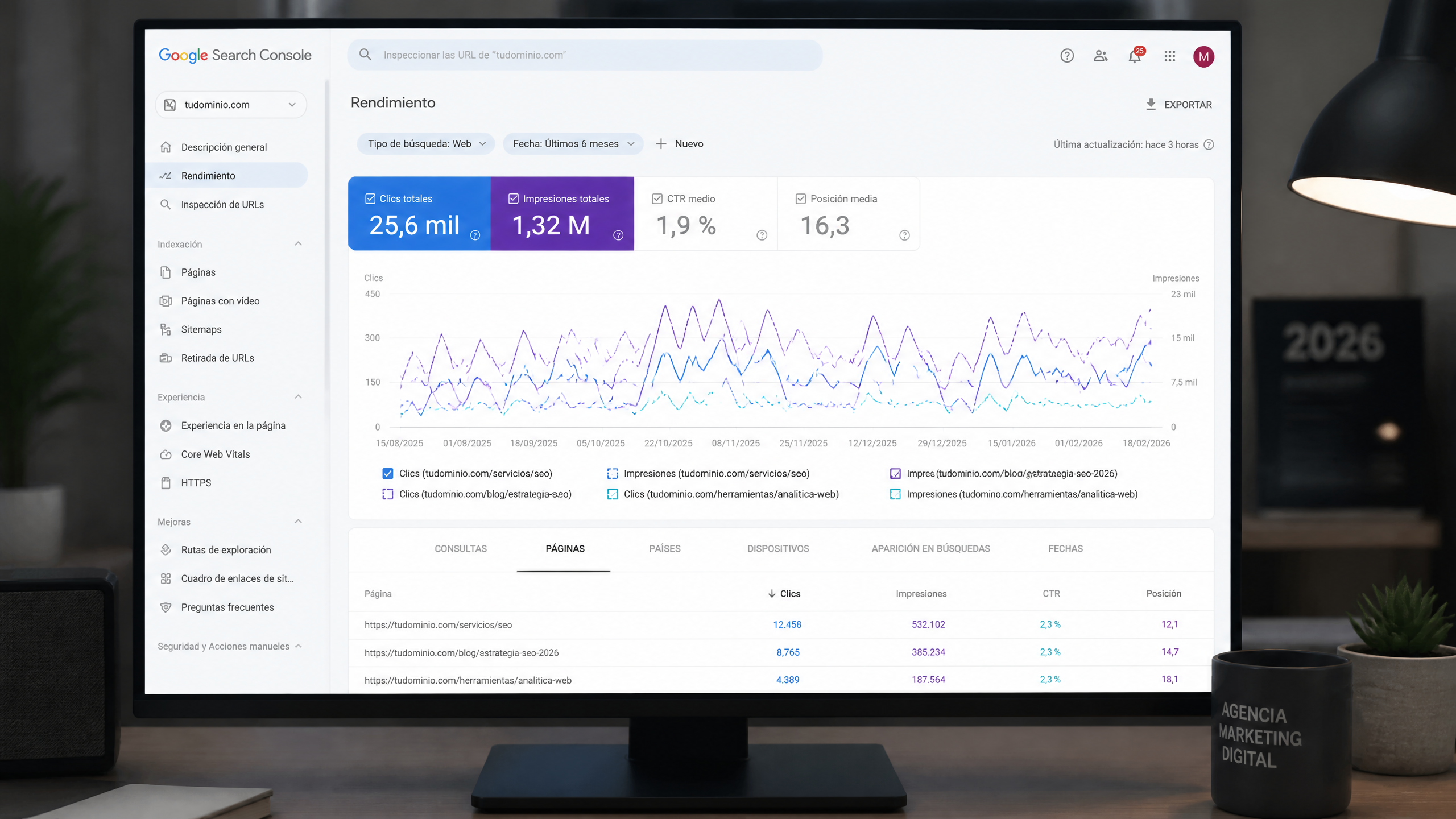
Comment trouver la cannibalisation de mots-clés dans GSC

Pourquoi l'E-E-A-T est le pilier central du SEO à l'ère de l'IA
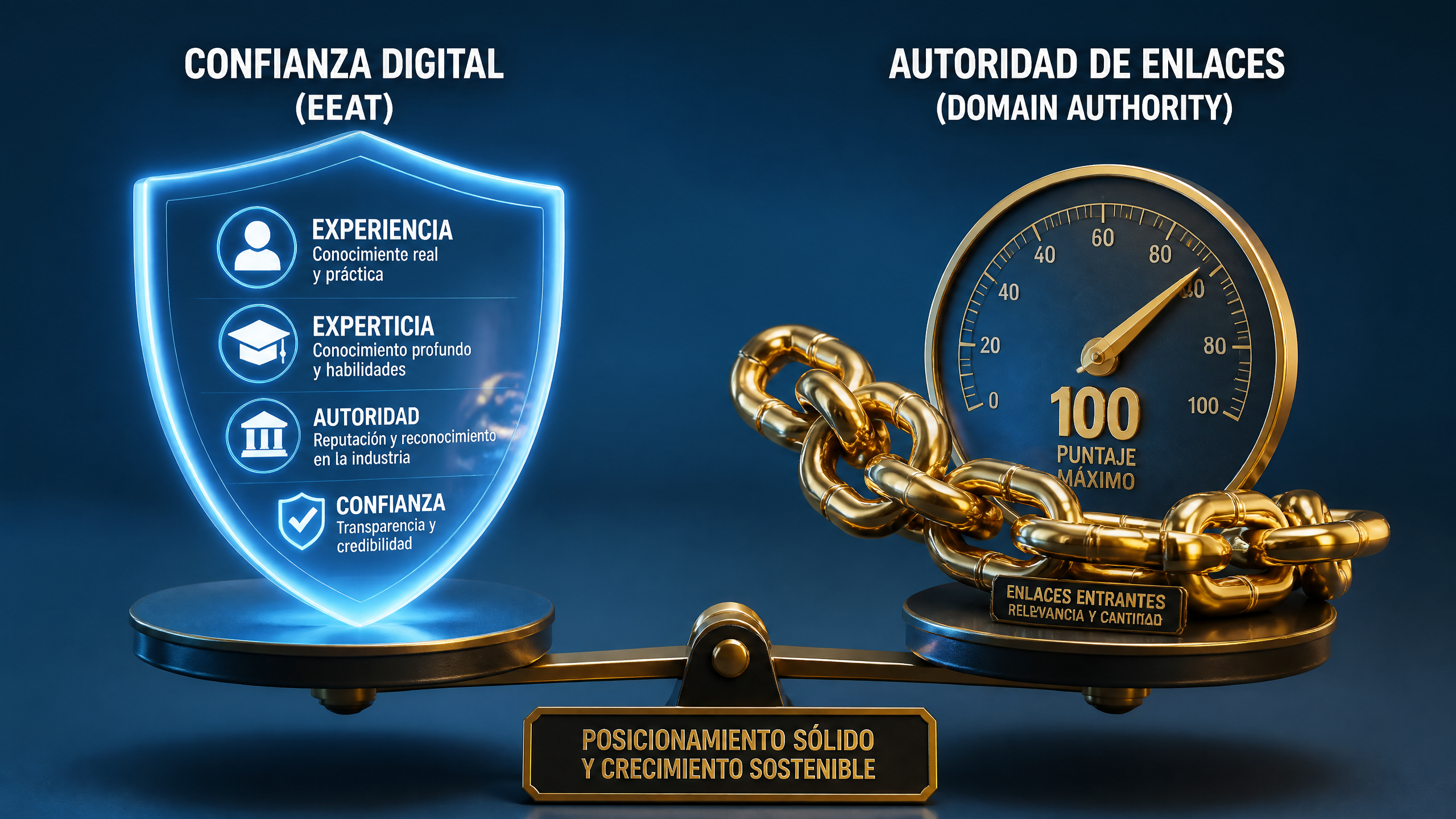
EEAT vs Domain Authority : Le Guide Ultime pour Arbitrer Confiance et Puissance SEO

Best AI SEO Tools : Le Guide Sans Filtre d'un Consultant

Formatting Content for LLM Readability : Le Guide de l'Ingénieur NLP