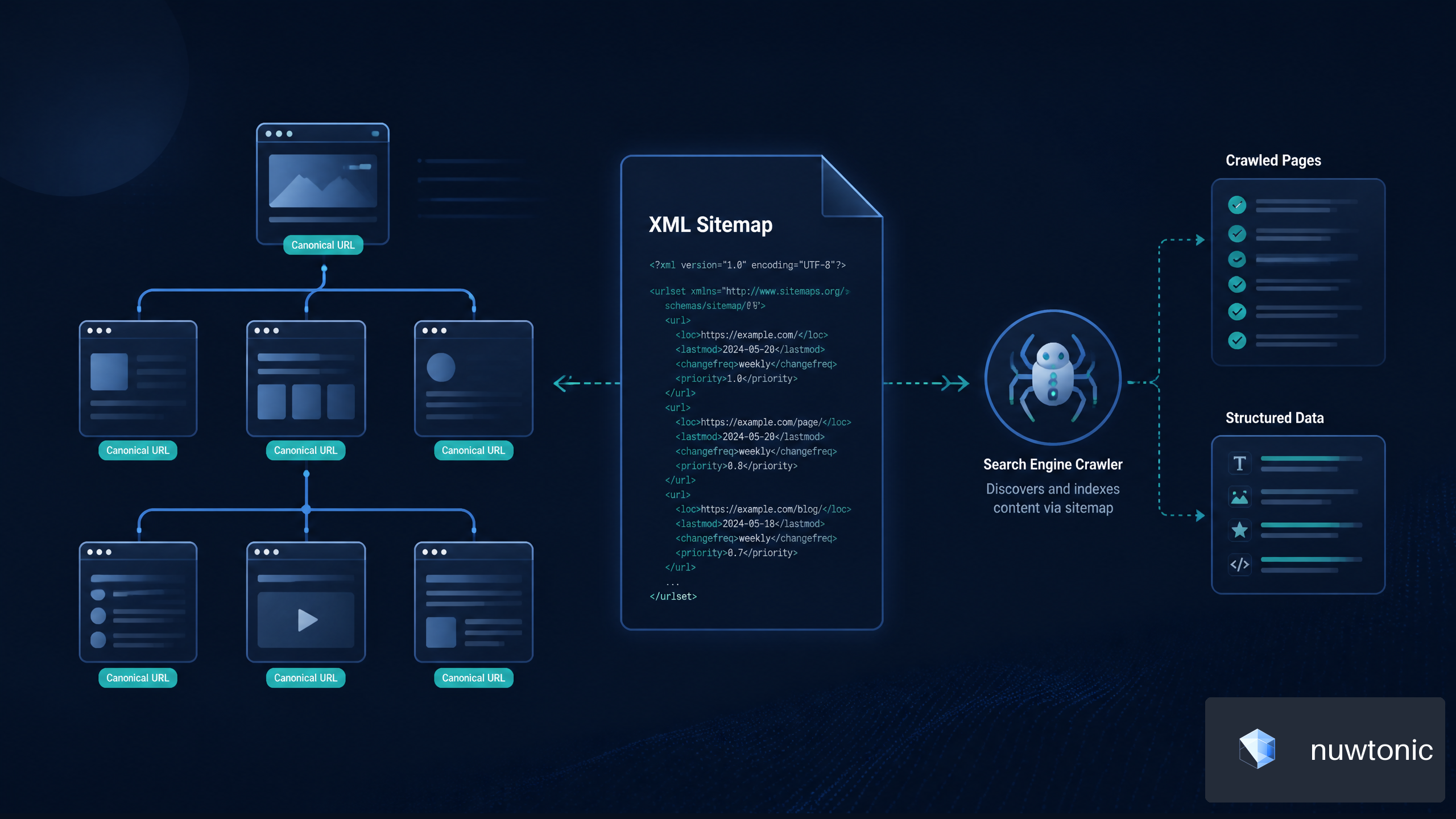
Understanding Keyword Cannibalization in the Google Ecosystem
I have analyzed countless search performance reports over the years, and few issues are as silent yet destructive as keyword cannibalization. Many site owners mistakenly believe that having multiple pages ranking for the same term doubles their chances of capturing traffic. In reality, it often does the opposite.
Defining Keyword Cannibalization Beyond Simple Duplication
Keyword cannibalization occurs when multiple pages on your website target the same keyword and search intent, forcing Google to choose which page to rank. This is distinct from duplicate content, which involves identical text across URLs. Cannibalization is a strategic failure where distinct pages compete for the same SERP real estate.
According to SE Ranking, true keyword cannibalization happens when content on different pages ranks for the same keyword cluster and shares the same search intent. This internal competition confuses search algorithms, often resulting in the wrong page ranking or both pages fluctuating in position.
The Impact on Organic Visibility and Authority
When you split your authority across multiple URLs, you dilute the strength of your domain. Instead of one powerhouse page absorbing all backlinks, click-throughs, and relevance signals, you have two or three mediocre pages struggling to break into the top 10.
Impression Digital notes that this phenomenon dilutes the ranking capacity of affected pages, hindering their ability to reach top positions. From my experience, the symptoms are clear:
Fluctuating Rankings: URLs flip-flop in search results week over week.
Wrong Landing Pages: A blog post ranks for a transactional query instead of your product page.
Diminished CTR: Users are split between two results, lowering the aggregate click-through rate compared to a single, authoritative result.
How to Find Keyword Cannibalization in GSC: The Manual Method
Google Search Console (GSC) is the most accurate source of truth for this audit because it uses actual ranking data, not third-party estimates. Here is the precise workflow I use to diagnose these issues manually.
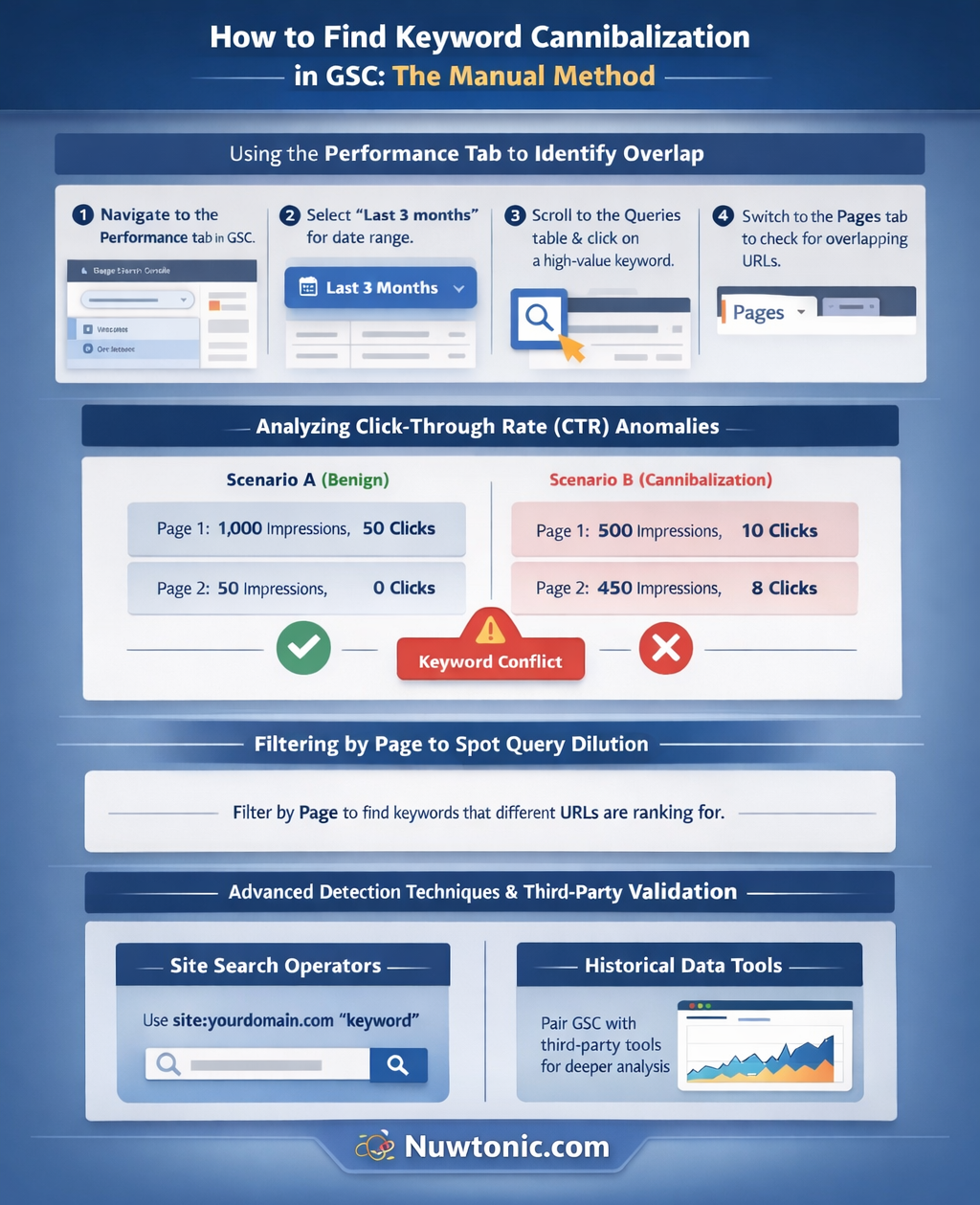
Using the Performance Tab to Identify Overlap
The most reliable way to spot cannibalization is by diving into the Performance report.
Navigate to the Performance tab in GSC.
Ensure distinct date ranges are selected (e.g., Last 3 months) to get a significant data sample.
Scroll down to the Queries table.
Click on a high-value keyword that you suspect is underperforming.
Once the filter is applied to that specific query, switch to the Pages tab.
If you see more than one URL listed with a significant number of impressions for that single query, you have found a potential cannibalization issue. Yoast highlights that Google Search Console's Performance tab is instrumental in revealing these overlapping URLs that receive traffic from identical terms.
Analyzing Click-Through Rate (CTR) Anomalies
Click-through rate is a strong indicator of user confusion. When I analyze the Pages tab for a specific query, I look for a split in clicks.
Scenario A (Benign): Page 1 has 1,000 impressions and 50 clicks. Page 2 has 50 impressions and 0 clicks. This is likely just Google testing a secondary page; it is rarely an urgent problem.
Scenario B (Cannibalization): Page 1 has 500 impressions and 10 clicks. Page 2 has 450 impressions and 8 clicks. Both pages are fighting for visibility, and neither is winning.
Filtering by Page to Spot Query Dilution
Another method involves reversing the process. Instead of filtering by query, filter by Page to see what keywords a specific URL is ranking for. If you find that two different pages are ranking for a nearly identical list of keywords, they are likely cannibalizing each other's potential.
Advanced Detection Techniques and Third-Party Validation
While GSC is excellent, it sometimes lacks the historical context needed for a full audit. I often pair GSC data with other methods to confirm my findings.
Validating GSC Findings with Site Search Operators
Before I even open GSC, I often perform a quick manual check directly in Google. By using the site search operator site:yourdomain.com "keyword", you can immediately see how many pages Google considers relevant for a specific term.
Moz recommends this technique to surface all pages targeting a particular term. If the results show 10 different blog posts for "best running shoes," you know you have a consolidation task ahead of you.
Comparison of Detection Methods
I have compiled a comparison of the different methods available for detecting cannibalization to help you choose the right approach for your scale.
Feature | GSC Manual Check | Site Search Operator | Automated SEO Tools |
|---|---|---|---|
Accuracy | High (Real User Data) | Medium (Index Data) | High (Scraped Data) |
Cost | Free | Free | Paid |
Scale | Low (One query at a time) | Low (Manual entry) | High (Bulk analysis) |
Metric Visibility | Impressions, Clicks, CTR | Indexation only | Rank, Volume, Difficulty |
Best For | Deep diving specific keywords | Quick spot checks | Site-wide audits |
Solving the Cannibalization Puzzle
Once you have identified the culprits, you need a remediation strategy. Not all cannibalization requires the same fix.
Consolidating Content via 301 Redirects
If you have two pages that are 80% similar in content and intent, the best move is almost always consolidation.
Choose the stronger page (better URL structure, more backlinks, higher current traffic).
Merge the unique value from the weaker page into the stronger one.
Implement a 301 redirect from the weaker URL to the stronger URL.
This passes the link equity and history to the single surviving page, often resulting in a rankings boost.
Implementing Canonical Tags for Similar Intent
Sometimes, you need to keep both pages. Perhaps one is a technical documentation page and the other is a marketing landing page. They target the same keyword but serve different audiences. In this case, I use canonical tags to tell Google which version should be prioritized in search results, preventing them from competing directly.
Re-optimizing Content for Distinct Intents
If both pages are valuable and unique, the problem is likely poor keyword targeting. I recommend "de-optimizing" one of the pages.
Action: Change the title tag, headers, and body content of the secondary page to focus on a different long-tail variation or a completely different angle.
Result: The pages stop fighting for the main keyword and start ranking for their own distinct terms.
Automating Detection with Nuwtonic
Manual audits in GSC are effective for small sites, but they become impossible when you manage thousands of URLs. This is where automation becomes essential.
Leveraging Auto SEO Performance Analysis
At Nuwtonic, we developed a system that connects directly to your data to automate this entire discovery process. Our Auto SEO Performance analysis based on GSC ingests your search console data and algorithmically identifies instances where multiple pages are splitting impressions for high-value queries.
Instead of clicking through hundreds of keywords manually, the platform highlights the exact clusters where cannibalization is occurring. This allows you to identify issues immediately and move straight to the solution phase—whether that is redirecting, canonicalizing, or rewriting.
Continuous Monitoring for New Cannibalization Issues
SEO is not static. You publish new content every week, and with every publish, the risk of accidental cannibalization returns. Using Nuwtonic's automated platform ensures that you have a 24/7 watchdog monitoring your SERP performance. If a new blog post starts eating into the traffic of your main product page, you get the insight needed to correct course before it impacts your bottom line.
Common Myths and Edge Cases
In my consulting work, I often have to debunk persistent myths about SEO conflicts.
When Multiple Rankings Are Actually Beneficial
Not all overlap is bad. If you own positions #1 and #2 for a keyword (often seen with indented results), do not fix it! This is "SERP domination," not cannibalization. Action is only required when your pages are suppressing each other (e.g., ranking #15 and #18 instead of #3).
Distinguishing Cannibalization from Keyword Stuffing
Cannibalization is an architectural issue; keyword stuffing is a spam issue. Cannibalization happens when you have too much content about a topic across different URLs. Keyword stuffing happens when you force a keyword into a single page too many times. Fixing one does not fix the other.
Frequently Asked Questions
How do I know if I have keyword cannibalization?
You can identify it by checking the Performance tab in Google Search Console. Filter by a specific query and check the "Pages" tab. If multiple URLs are receiving impressions and clicks for that same query, you likely have cannibalization.
Is keyword cannibalization always bad?
No. If you occupy the top two spots in Google (e.g., position 1 and 2), this is beneficial as it pushes competitors down. Cannibalization is only harmful when it dilutes authority and causes your pages to rank lower than they would individually.
How do I fix keyword cannibalization quickly?
The fastest fix is usually a 301 redirect. Pick the strongest page, merge any unique content from the weaker page onto it, and redirect the weaker URL to the stronger one.
Can canonical tags fix cannibalization?
Yes. A canonical tag tells Google which URL is the "master" version. This allows you to keep both pages accessible to users while ensuring Google only indexes and ranks the preferred version.
Does Google penalize keyword cannibalization?
Google does not have a manual penalty for cannibalization. However, the algorithmic consequence is that your pages may rank lower because your authority is split, which feels like a penalty in terms of traffic loss.